

The K01 does not have a weak specification sheet. It has a very short one, and for a buyer those are different problems. The catalogue page prints five rows for this model and nothing else beside them: Bluetooth V5.3, a 90mAh*2 battery, a charge time of two hours or less, roughly eight hours of rated use, and magnetic charging. Every documented attribute is electrical. Nothing on the page describes the acoustic system, the microphones, the control surface, the housing material, the colourways, the mass, or any ingress rating.
That single fact should reshape the sourcing work rather than end it. A thin file cannot settle a specification dispute, because it contains no statement about the attribute in dispute. What it can do is tell you in advance which rows you will have to obtain from the supplier, in what order, and what the project costs you while each one is outstanding. This page lays out that method: the boundary of each of the five rows, the two claims that must stay off a tender document, the failure modes this particular gap produces, and the written question set that closes it before an order is placed.
K01 limitations: the constraint is evidence, not performance
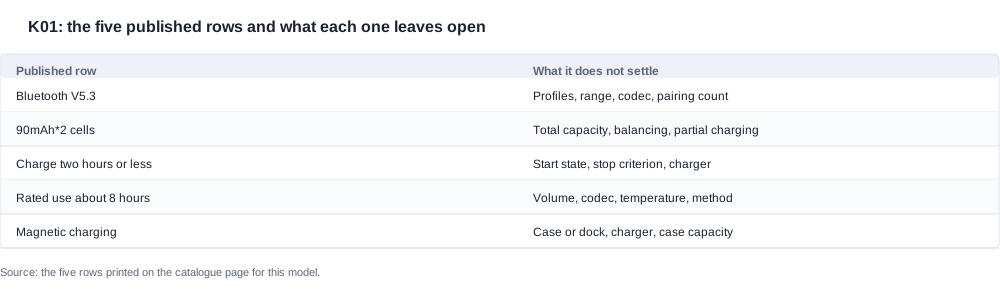
Start from what is actually printed. The page for this model carries a Bluetooth version of V5.3, a battery capacity of 90mAh*2, a charge time of two hours or less, a rated use of approximately eight hours, and magnetic charging as the charging method. There is no feature row of any kind. That is the whole published file.
Read against that, a procurement team has to accept a particular shape of argument: this model can be evidenced on power and charging, and on nothing else. If the business case you are building depends on acoustic performance, on how the device is operated, on water ingress, on physical mass, or on the finishes available for a channel listing, then no sentence you can write from this catalogue will carry it. The honest commercial conclusion is not that the model is weak. It is that the model is under-documented, and that under-documented products cannot be sold on specification comparison — they have to be sold on a quotation, a sample evaluation and a document you own.
The second limitation is harder to spot because it is comparative. The page for the K02 prints the same five rows: the same radio version, the same cell configuration, the same charge ceiling, the same rated use, the same magnetic charging method. On catalogue evidence the two models are indistinguishable. Any shortlist that ranks one above the other on published data is ranking on an assumption, and a buyer who presents that ranking to a supplier has handed the supplier an opening. If the two models are genuinely different, the difference is not in the file — it is in a test report, an acoustic measurement, a sample evaluation, a quotation, or a configuration record that only the supplier holds. That is why the questions in this article are written to be asked separately for each model, and why the answers, not the pages, are the artefact you compare.
So the practical evaluation criteria for a model with this profile are not the usual feature matrix. They are these three:
- Which of my claims are load-bearing for the channel listing, as opposed to load-bearing for the contract, as opposed to decorative?
- For each load-bearing claim, does a document exist that I can attach to a tender response and that the supplier will stand behind?
- If the answer is no, what is the fallback wording, and what does that wording cost me in conversion terms?
The five rows on this model, and how far each one can be pushed
Each of the five published rows is useful, and each one stops at a specific boundary. Getting the boundary wrong is how a buyer ends up defending a promise the catalogue never made.
The radio version is the row most often over-read. The catalogue publishes a Bluetooth version for fourteen of the twenty-eight models it lists, and the eleven camera models publish none. Within the eight audio models, this one and the K02 are V5.3 while the other six are V5.4. But the row says only the version number. There is no profile list, no range figure, no codec row, no pairing-count row and no latency measurement anywhere in the file, so a V5.3 line cannot be turned into a compatibility guarantee for a channel listing. If your brief depends on pairing behaviour with a specific handset fleet, that has to arrive as an answer to a written question, and it belongs in the acceptance test rather than in the marketing copy.
The battery row is published as 90mAh2 — two cells of 90 mAh. The catalogue prints cell value and cell count for every model in this range, and it prints a total for none of them, so a total such as 180 mAh is arithmetic you performed rather than a figure we published. Label it that way if you print it. The row also does not disclose where the cells sit, how they are balanced between them, what the low-battery behaviour is, or whether partial charging is permitted. Structurally, the cell configurations across the audio models group into three shapes: 55mAh2 on the LC-105 pair, the G07 and the YK12; 90mAh*2 on this model and the K02; and a single 100 mAh cell on the D11 and the D12. That grouping is useful for narrowing a shortlist because it is structural, not commercial — we publish no price, no price tier and no unit price for any model, and no cost position can be derived from a cell configuration.
The charge-time row is a ceiling, and ceilings get misquoted more often than any other figure in this catalogue. The catalogue says two hours or less. It does not say under two hours, and the difference is not pedantic: two hours or less permits a charge that takes exactly two hours, while under two hours does not. Only two models anywhere in the catalogue publish an approximate one-hour charge time — the D17 and the ZH12 — and every other model, this one included, carries the two-hour-or-less form. The row also omits the conditions that would make it usable as a schedule: no starting state, no termination criterion, no charger rating, no ambient temperature, no indication of whether a specific cable is required. Ask for those four and you can plan a changeover; without them the number is a marketing line only.
The rated-use row is an approximation with no test conditions attached. Roughly eight hours is printed without volume level, codec, sample rate, notification load or temperature, and the same label appears on models whose cell configurations differ substantially from this one. Within the range, the LC-105 pair also publishes about eight hours on a smaller cell configuration, while the G07 and the YK12 publish about six. The label describes a test condition the catalogue does not print, which means the number is not portable to another product without the condition attached. The only defensible way to use it in a contract is to write the condition into the agreement and let the acceptance test measure the condition rather than the number.
The charging-method row is the one that most often generates a false assumption. Magnetic charging is published. What is not published is everything around it: whether the magnetic target is a charging case, a separate puck or a dock; whether a charger and cable are supplied; the charger's output; whether the accessory differs between destination markets; and any charging-case capacity for this model. Elsewhere in the catalogue, four camera models publish a case capacity while publishing no charging method at all, which shows the two rows are tracked independently and that the absence of a case row here is a genuine gap rather than an implied absence of a case.
Finally, note what the page never contains. There is no colour row — colour rows appear in the catalogue only for the V03 Pro and the V06 — no mass, because the only published mass anywhere is the 158 g of the MT6, which is the whole unit including its battery and camera and excluding its folding case, and that is a different product line. There is no ingress rating, since IP54 appears on the V06 and the S7 only, no camera row, which is correct for an audio model, and no charging-case row. Each of those absences is a question, not a negative finding about the product.
What the catalogue does not publish for this model, and the two claims that must stay off a tender document
Two claims about this model circulate in copy that circulates outside the product catalogue. Both are worth handling precisely, because the difference between stating a claim and sourcing it is the difference between a specification and a marketing assertion.
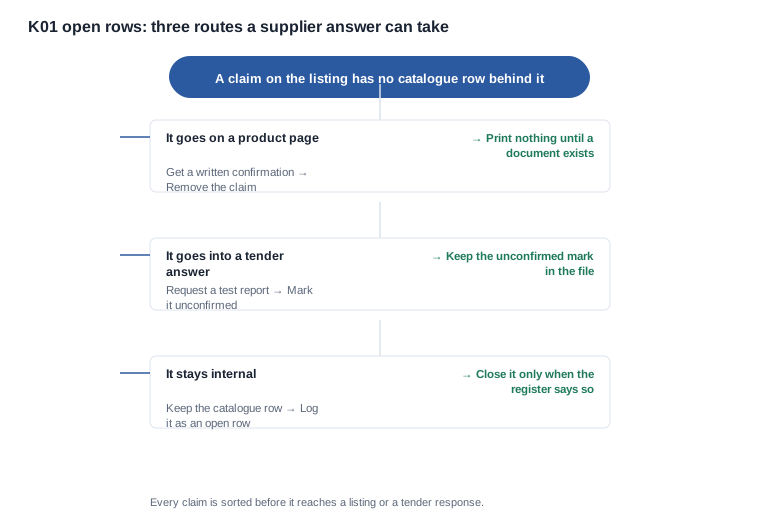
The first is the control surface. The catalogue publishes no touch row for any of the twenty-eight models it lists; the text layer contains no capacitive-touch, touch or gesture specification at all. The only control-surface statement anywhere in the catalogue sits on the AR glasses page, and that one lists an indicator light and button control — buttons, not a capacitive surface, and not on this model either. This model has no feature row at all, so even a button line is not published for it. The practical consequence is that if your channel copy needs to describe how the device is operated, the catalogue cannot be the source of that sentence, and the question "does the temple carry a button, a touch surface or a voice command, and which of these ships on the unit" has to be answered in writing before the copy goes live.
The second is AI-assisted translation. The catalogue contains no translation row for any model. Where our own website copy describes translation as a capability of this model, that wording is a statement from our own website copy rather than a row printed in the product catalogue, and the distinction has consequences: it cannot be quoted as a published specification, it cannot be used as a differentiator against another model, and it should not appear in a tender response, a channel product listing or a quotation unless the supplier confirms in writing what ships, what the service conditions are and what the licence position is. Treat it as an assertion awaiting a document rather than as a row you can print.
The certification position has the same shape and deserves the same care. The catalogue carries a company-level export certification page whose content is images rather than text, and the catalogue text contains no reference to CE, FCC or RoHS anywhere. There is no per-model certification row for any of the twenty-eight models. The ten certificates displayed on that page are patent certificates — eight appearance-design patents and two utility-model patents — so they cannot be read as conformity evidence for a radio product either. For a regulated destination this becomes a document task rather than a specification task: what you need per model and per market is the test report, the declaration of conformity and the list of standards the unit is labelled against, and all three have to arrive in a form you can file. Ask for them explicitly, and treat a general assurance that the range is covered as an answer you cannot file.
Alongside those, the file is silent on microphone and speaker specification, codec and latency, temple materials and mechanism, the mass, the colourways, the ingress rating, and any charging-case capacity. Silence here is not evidence of absence; it is simply the absence of a row, and the honest way to carry it into an evaluation is to name it as an open item with an owner.
Four ways a thin specification file turns into a delivery problem
The failures below are not hypothetical. They are the ordinary consequences of writing copy, contract text or a channel listing from a file that only describes power.
The listing that promises more than the file supports. The most common failure is copy assembled from website marketing rather than from the catalogue, and it surfaces after the product page is live, usually through a channel partner's compliance review rather than through your own quality control. The remedy is procedural rather than editorial: build the listing from the five published rows, and route every other claim through the question set before it is written. A claim that arrives with a supplier document attached is safe to print; a claim that arrives because it sounded right is not.
The runtime number that becomes a contract dispute. A rated-use figure of roughly eight hours, printed without a condition, will eventually be compared against a measured result by someone who assumed a different volume level or a different codec. The remedy is to attach the condition to the number everywhere it appears — in the agreement, in the acceptance test and in the channel description — so that the measurement and the claim describe the same thing. Where you cannot obtain the condition, do not print the figure at all; an absent number is defensible, a mismatched number is not.
The charge time that is read as a promise. The two-hour-or-less ceiling is routinely upgraded in downstream copy to "under two hours" and then treated as a shift-changeover duration. The remedy is to keep the ceiling language exactly as published, to ask for the starting state and the termination criterion, and to keep operational planning out of the marketing claim entirely. This matters more for this model than for most, because it publishes a two-hour-or-less ceiling rather than the approximate one-hour figure that only two models in the catalogue carry.
The magnetic-docking assumption. A buyer who assumes a charging case with a capacity will discover the assumption late, because the accessory line is what determines the unit's real logistics. Ask whether the magnetic target is a case or a standalone dock, get the part number, and price the accessory separately from the unit in the quotation. The catalogue does this in a way that is easy to miss: four camera models publish a case capacity while publishing no charging method at all, so the two fields are independent, and a missing case row here means the information has not been published rather than that the accessory does not exist.
A fifth problem follows from the comparison discussed earlier: if this model and the K02 print identical rows, a shortlist that separates them on published data is a shortlist built on an assumption, and that assumption will surface as a sourcing error. Ask each question for both models and compare the answers.
The written question set that closes the open rows before the order
Send this as one numbered list attached to the request for quotation, and require an answer against each numbered item in writing. "Not published" and "not applicable" are acceptable answers and are worth as much as a number, because they tell you where the file ends. Anything that comes back as "to be confirmed" moves into the pre-production sample checklist and cannot travel into a product listing or a tender response.
- Is the magnetic charging target a charging case, a separate puck or a dock? What is the accessory part number, and is the accessory quoted separately from the unit?
- What charger output and cable are supplied with each unit, and are the supplied mains adapters the same for every destination market?
- How is the roughly eight-hour rated use measured — output level, codec, sample rate, notification load and ambient temperature?
- Does the two-hour-or-less charge figure assume a specific starting state and a specific full-charge termination criterion, and what charger is assumed?
- What is the mass of the unit with cells installed, and is it measured with or without the charging accessory?
- Which colourways are available for this model, and how are they referenced in the packing list and the barcode record?
- Is any ingress rating tested for this model, and if so against which standard and at which level?
- How is the device operated — buttons, a touch surface, voice command, or a combination — and which of these ships on the unit?
- What does the packaging declare: model designation, radio version, electrical rating, and which conformity documents accompany the shipment?
- Which conformity and test documents exist for this model in each destination market, and may they be listed on a channel product page?
- What are the unit price, the accessories price and the bulk-order tiers, and how does the landed cost change by quantity and by destination?
- What are the minimum order quantity per colourway, the production lead time, and the packaging configuration?
- What warranty term and defect replacement threshold will be written into the supply agreement, and what does the quality control checkpoint cover?
- What are the sample order terms, and what access will your engineers have to the production line or to a third-party factory audit?
- If a private label is planned, what tooling is required, what is the NRE, and what is the mould or modification cost?
- What is the margin structure a distributor can hold without breaking the channel price, and what volume commitment supports it?
Sixteen questions is a large list, but the point of a question set is that it is sent once and answered once. The alternative is discovering the same gaps one at a time, at the point where each one becomes urgent, which is the point where a supplier has the most leverage.
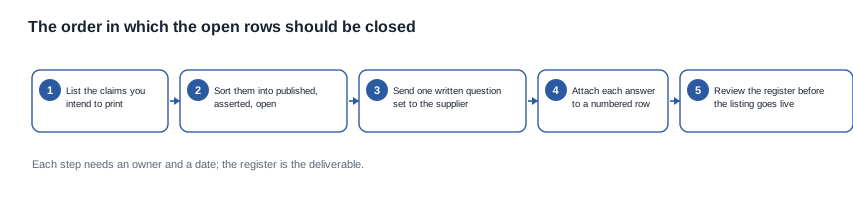
Recording the limitation so it does not return at launch
The output of this work is not a paragraph on a product page. It is a register that travels with the project, and it is the thing that prevents the same limitation from being rediscovered at launch by a different team.
A workable register has three states, and every claim sits in exactly one of them:
| Claim | State | What it takes to move it |
|---|---|---|
| Bluetooth V5.3, 90mAh*2, two hours or less, about eight hours, magnetic charging | Published | Already printable from the catalogue |
| Translation as described in our own website copy | Asserted | A written supplier confirmation, with service and licence conditions attached |
| Control method, colourways, mass, ingress rating, charging-case capacity, conformity documents | Open | A document or a written answer per market |
| Charge time and runtime conditions | Asserted | A test condition written into the agreement and the acceptance test |
Two rules keep the register honest. First, nothing moves from asserted to published without a document that has a document identifier, an issuer and a date — a verbal assurance or a catalogue-style sentence is not a document. Second, the register is reviewed before the listing goes live, not after, and the review is done against the register rather than against memory.
This is the working method behind the k01 smart glasses limitations question: the model's published file is short, the honest response is a document-driven evaluation rather than a feature comparison, and the deliverable for a sourcing team is a register and a quotation, not a paragraph. When you are ready to move from the question set to a commercial proposal, the Bluetooth audio glasses range is where the models and their published rows sit, the K01 buyer review checklist covers what to verify at goods-in, and the guidance on what to check before ordering this model covers the pre-order steps in detail.
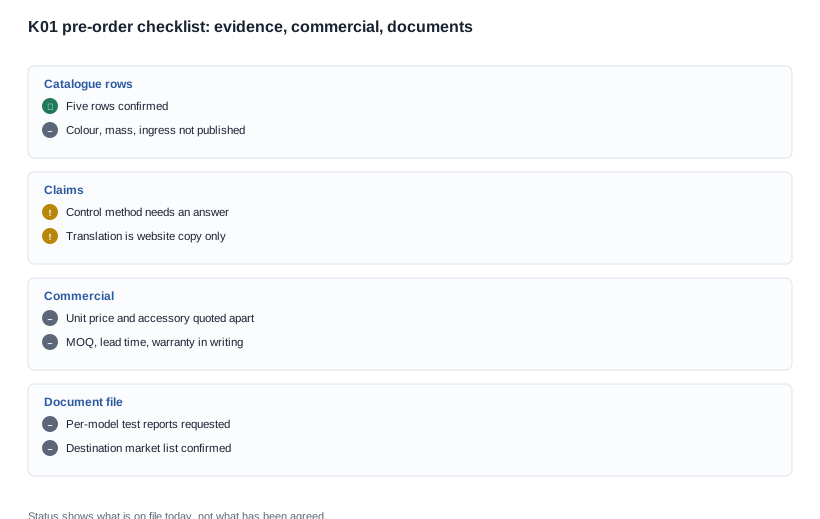
Where CYNRIN stands on the K01's limits. We name the gaps rather than smoothing them over, because a gap you can see in advance is cheaper than one that surfaces at the first shipment. Every limitation listed above is a limitation of the published row, not a fault in the product, and that difference matters: an unpublished row can be closed by a written answer against the model designation, whereas a fault in the hardware cannot be closed by any document. Where a limit would decide your order, we will say so plainly and then tell you what evidence would settle it.


