

The K01 publishes five specification rows and not one feature row, so a buyer review of this model has a narrow and well-defined job: prove that the cartons hold the model that was ordered, prove that the published rows are true of the units delivered, and confirm that the compliance file a destination market expects actually exists. Nothing else in the review can be closed by inspection. This k01 smart glasses buyer review checklist is built for exactly that — six gates, each tied to a row the catalogue actually prints, and a written question for every gap the catalogue leaves open.
The short version. Six gates, in order: model identity, radio version, cell configuration, charge cycle, runtime evidence, documentation pack. Four of them can be closed at goods-in with a carton opener and a stopwatch. Two of them — the charge cycle and the runtime — only mean something if the condition is written down first. The sixth is not about the goods at all; it is the file a regulator, a channel platform or an insurer will eventually ask for. If a supplier cannot answer the documentation gate in writing before you order, the other five gates will not rescue the launch.
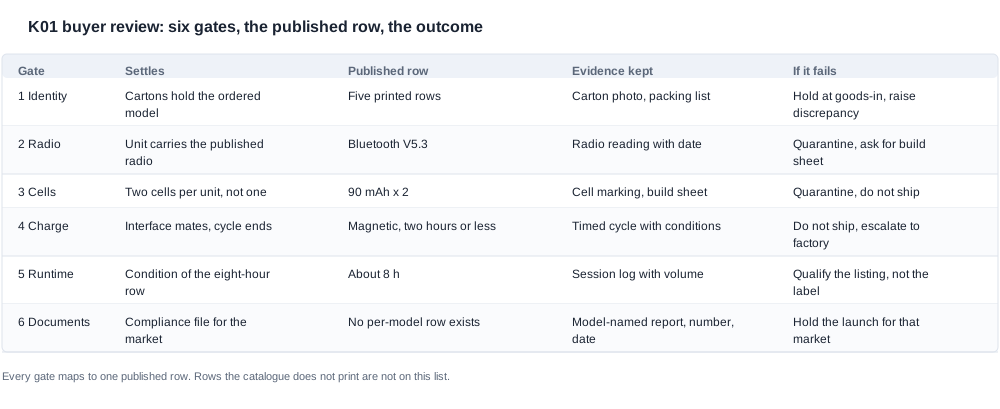
K01 smart glasses buyer review checklist: what the review can and cannot settle
A review checklist is a control document. It has to be usable by two different people — the person who signs the purchase order and the person who signs off the delivery — and it has to survive the handover between them without losing meaning. That is why the checklist below is built from the published rows rather than from a feature wish list, and why every gate carries both an observation and a written outcome.
The desk that owns the purchase
The procurement or sourcing manager is the reader who cares most about two things: whether the documentation supports the claims the channel intends to make, and whether the unknowns are bounded before money moves. For a model whose catalogue page prints five rows, the unknowns are the point. The value of this checklist at the purchasing desk is that it converts "the catalogue is silent about this" into a dated written question with an attachment to the quality agreement. A gap that is recorded becomes a condition; a gap that is remembered becomes an argument later, usually at the worst possible moment, usually with a container already on the water.
The desk that owns the delivery
The quality engineer at goods-in runs a different half of the same document. Their constraint is time: a container is open, a trailer is waiting, and the cost of holding a shipment is charged by the day. Only two of the six gates need supplier documents at this stage — the cell configuration and the radio version can both be corroborated from a build sheet — and the rest are physical observations. Any gate that can only be closed by an email to the factory is, in practice, a gate that will be closed by whatever answer arrives first. The checklist is designed so that four gates never require a phone call.
What the five published rows can settle
The catalogue prints five rows for this model: Bluetooth version V5.3, battery capacity 90 mAh × 2, a charge time of two hours or less, use time of about eight hours, and magnetic charging. Each gate below maps to one of them. That mapping is the reason the checklist is short: it does not ask the reviewer to invent an acceptance standard where the supplier has published none, and it does not let the absence of a published standard pass unnoticed. It also makes the boundary explicit. The five rows settle identity, radio, cells, charge behaviour and runtime behaviour. They say nothing about acoustic output, control method, frame mass, ingress protection, colour range or per-model certification scope. Those six topics are not review gates; they are the questions a competent buyer puts to the supplier in writing, and they belong in the agreement rather than on a clipboard at the dock.

Six review gates and the published row behind each one
Each gate below states the published row it tests, what the reviewer physically does, and the decision that follows. The order matters: cheap observations run before expensive ones, and the gates that can trigger a quarantine run before the gates that can trigger a documentation request.
Gate one: model identity on the carton and in the paperwork
The published rows are attached to a named model, so the first gate is simply that the delivered goods are that model. Photograph the carton label, the packing list and any model marking on the frame itself, and compare them against the model designation in the order. The catalogue's title for this entry carries the AI designation, so the carton should match that designation exactly rather than approximately — an "AI Bluetooth glasses" carton with no model code is not a match, because the range contains eight audio models whose published rows differ from each other. This is the cheapest gate in the checklist and the one that catches the most expensive mistakes, since a mixed delivery of two audio models is indistinguishable at the retail end but obvious at the carton end.
Gate two: the radio row, checked against the actual unit
The catalogue publishes Bluetooth V5.3 for this model, and V5.3 appears on only one other entry in the audio group. That makes the version a useful discriminator: if a sampled unit reports a different version, the buyer is not holding the ordered model. Read the radio version from the unit itself rather than from the carton, since the carton is a print artefact and the unit is the product. Record which unit, which carton range and which date the reading came from. Two things are worth remembering at this gate: the version tells you which Bluetooth specification the radio was built against and nothing about pairing behaviour, and the radio's qualification for a destination market is a separate documentation question that no amount of inspection on the dock can answer.
Gate three: two cells, not one
The published capacity is 90 mAh × 2 — two cells of 90 mAh, not one cell of 180 mAh, and the catalogue publishes the cell value and the cell count rather than a total. The gate exists because the two forms are easy to conflate in a specification sheet and impossible to fix after the packaging is printed. Confirm the count against the supplier's build sheet and against the carton content list, and ask for the cell model identifier so the transport documentation can be matched to the goods actually fitted. The derived total of 180 mAh is useful for internal capacity arithmetic and for an endurance argument, but it must always be labelled as derived wherever it appears, because a bare 180 mAh in a listing will be read as a published figure within a month.
Gate four: the magnetic charge cycle and what ends it
The catalogue publishes magnetic charging and a charge time of two hours or less. Two hours or less is a ceiling, not a measurement: it permits a cycle that takes exactly two hours and forbids a promise of under two hours. The reviewer's job here is to record a cycle with two conditions attached — the state the battery was in when the cycle started, and the point at which the cycle was called complete — because without them the number cannot be reproduced or defended. The magnetic interface is itself worth checking against the physical goods, since a magnetic contact that has to be held in place for two hours is a different customer experience from one that seats and stays seated, and that difference decides what the channel's own instructions to the customer have to say.
Gate five: the eight-hour row and the condition it was measured under
Use time is published as about eight hours, with no starting state, no volume level, no radio state and no test profile attached. The gate therefore cannot confirm or deny the figure; it can only establish the condition under which the buyer's own units behave. Run one timed session per shipment sample with the volume level and the radio state written down, and treat the result as the channel's own figure with its own condition. This is a deliberate separation: the published row stays as the published row, and the buyer's field figure travels beside it, qualified. A listing that quotes the catalogue figure alone is making an unqualified claim; a listing that quotes both is making a claim it can evidence.
Gate six: the documentation pack, per destination market
The catalogue carries no per-model certification row for this model, or for any model in the range, and the catalogue text contains no reference to CE, FCC or RoHS at all. The export certification page in the catalogue is a page of images — ten patent certificates, eight appearance-design and two utility-model — which says nothing about radio or electromagnetic compliance for a given market. So this gate is entirely about documents the supplier must produce: a declaration or test report that names the model, the factory and the market, with the report number and the date attached. A document that names the company but not the model does not close the gate. A document that names the model but not the market leaves the market open.
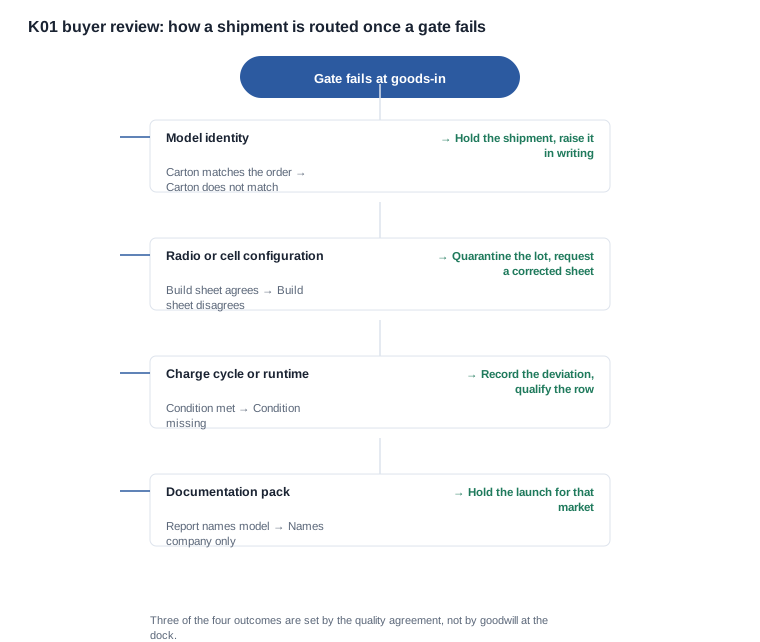

Six gates, the evidence for each, and the record that has to survive
A review that produces a pass or a fail and no record is worth very little, because the moment that matters is not goods-in — it is the first customer complaint, six months later, when somebody asks what was actually checked. The verification method for this model is deliberately unglamorous.
Sampling: the golden unit, then a production sample
Two reference points, not one. The golden unit is the sample that was approved at the sample stage; it is the physical benchmark that the production units are compared against, and it should be retained rather than returned to the supplier. The production sample is drawn from the delivered lot at the frequency the quality agreement specifies. Ask for the sample order to be an explicit purchase-order line rather than a favour, because a sample that is not paid for and scheduled is a sample that arrives late, and a golden unit that does not exist before mass production has started cannot be created afterwards.
The battery document question, and what the standard actually covers
UN38.3 is the transport testing standard for lithium cells and batteries. It covers the cell, not the finished product: it says nothing about the radio, the acoustic design, the firmware or the packaging. Two questions follow from that. First, does the cell test summary match the cell actually fitted, identified by model and by capacity and count against the published configuration? Second, is the transport document current for the batch in hand rather than for an earlier production run? Neither question can be answered from the catalogue, because the catalogue publishes no cell model identifier, no test report number and no certification row — which is precisely why the documentation gate has to sit inside the review rather than after it.
Recording the result so a later dispute is cheap
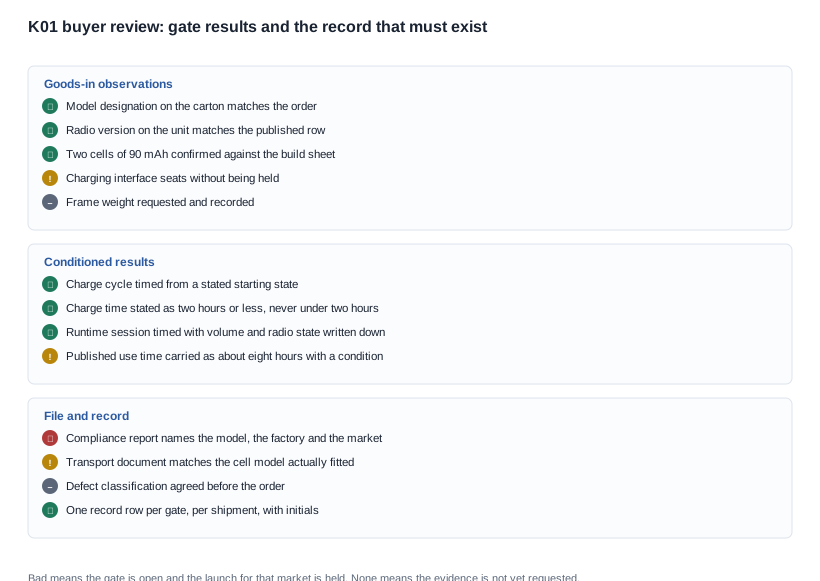
One row per gate per shipment: date, lot or batch identifier, carton range sampled, result, reference to the photograph or document, and the initials of the person who signed it. A gate that fails becomes a hold, and a hold needs an owner and a deadline attached at the moment it is raised, because an unowned hold is not a hold, it is a negotiation waiting to happen. Where the buyer and the supplier disagree about a result, the record is what turns the disagreement into a comparison of two sets of observations rather than two versions of memory.

What to do with a gate that fails
Three outcomes are available, and which ones are available is decided by the quality agreement rather than by goodwill.
- Accept with a recorded deviation. The shipment moves, the deviation is logged, and the same check is repeated on the next lot.
- Rework at the supplier's cost. This requires the procedure to exist beforehand, including who pays the second freight leg and how long the rework window runs before the stock is stranded.
- Reject the lot. The outcome most agreements describe least well, and the one a buyer should never reach for the first time while a trailer is waiting at the gate.
Classify defects before the order, not after: a critical defect — anything touching safety, radio compliance or the cell configuration — is not a matter for negotiation, because the alternative is a shipment that cannot lawfully be sold in the market it is intended for.
Where a K01 review goes wrong, and what each failure costs
The six gates are simple. The failures come from what surrounds them — the inferences people make from a five-row catalogue page when they are writing a listing, a specification sheet or a market entry.
The AI designation read as a feature
The catalogue's title for this model carries the AI designation, and across the range 20 of the 28 entries carry one. The model's own page prints no feature row beyond the five standard ones, so an AI capability claim has no published row behind it. The failure is not a lie so much as a translation error: the label in the product name gets read as a description of what the product does. The cost lands later — refund exposure, platform takedown, and in markets with strict rules on advertising claims, a compliance file to answer. The checklist answers this at gate one, where the carton's designation is compared with the order.
The radio version used as a quality headline
V5.3 is a real published difference, and it is the row a competing listing will pick at, because it is easy to print and it looks like an upgrade in one direction and a downgrade in the other. But a generation number describes the radio component against a specification; it does not measure pairing behaviour, connection stability, codec support or how the unit behaves on a customer's phone. Publishing it as a headline creates a specification sheet that no longer describes the product in the next carton. Gate two keeps the version in the data sheet, where it belongs, and keeps it out of the marketing copy.
The two-hour ceiling restated as a promise
This is the smallest error on the list and the easiest to make by accident, because a ceiling and a promise look alike on a product page. "Two hours or less" permits exactly two hours; "under two hours" does not. Only two models in the whole catalogue publish a charge time of about an hour, and this model is not one of them. A buyer who restates the ceiling as a promise has written a claim that cannot be evidenced from the published row, and that a customer can disprove with a clock.
The eight-hour row used as a working day
About eight hours is the top published use time in the range and it appears on four model groups whose cell configurations differ by 70 mAh per cell. That spread is a clear signal that the ratings were not measured under one shared protocol, so the numbers cannot be compared to each other and cannot be promised as a shift length. The commercial version of the failure is a support line that has been told to expect something the hardware was never measured to deliver.
A certificate that does not name the model
This is the gate that most often gets waved through, because a certificate is a certificate and the factory is known. The catalogue itself cannot supply the missing evidence: it has no per-model certification row, and its export certification page is images of patents rather than compliance reports. A report that names the company and not the model, or names the model and not the market, leaves the buyer holding a file that cannot be shown to a regulator, a channel or an insurer. It also leaves the supplier exposed, which is why a supplier with a real compliance file will normally produce it on request without friction.
The unknown weight and the freight bill that follows
The catalogue publishes a frame weight for exactly one model in the entire range, and that model is a camera model with a folding charging case, not an audio model. For this model the weight is not published at all. A parcel quoted at the wrong weight class produces a surcharge on every shipment, and the error compounds because it recurs on every replenishment. It also affects the return path, where an overweight guess turns a refund into a loss. This gap cannot be closed by inspection either, since it is a specification that was never printed; it has to be requested.
The review record, and the order that follows it
A worked example: a channel shipping into Europe
The scenario is hypothetical and no customer is being described. A channel places a first bulk order of the K01 into two European markets, and it has to be clear about what the catalogue can carry into that launch and what it cannot.
Gate one passes on the carton designation, which matches the ordered model. Gate two raises a deviation: the sampled units report the published radio version, but the supplier's build sheet lists a module revision that the documentation does not explain, so the version row is recorded as confirmed with a question attached for the next production run. Gate three passes, with the cell configuration confirmed against the build sheet and the transport document matched to the cell model by capacity and count. Gate four passes with the condition recorded, because the timed cycle from a stated starting state completed inside the published ceiling and the magnetic contact seated without being held.
Gate five is the interesting one. The timed session produced a shorter working figure than the published rating under the condition the channel used, which is normal when a rating is not qualified. The catalogue row is not withdrawn and not contradicted; the listing simply carries the channel's own figure with its condition, beside the published row. Gate six fails for one market only: the compliance file does not name the model. The consequence is not a shipment rejection. The launch is held for that market, the stock is directed to the other market, and the supplier is asked for a model-named document with a report number and a date.
Five gates closed, one held, one deviation recorded. The inventory was never what stood at risk — the launch date was, and it moved by weeks rather than by seasons. The important part of the example is what did not happen: no unverified feature was published, no ceiling was turned into a promise, and no weight was guessed into a freight calculation.
What we will put in writing, and what we will not
For this model we publish five rows, and the checklist above is built on exactly those five. We will not publish a capacitive control claim for the K01 or for any other model, because the catalogue prints no touch row anywhere in the range; we will not publish an AI translation capability for the K01, because the catalogue prints no translation row either. We will not quote a frame weight for the K01, and we will not infer one from another model. We will not attach CE, FCC or RoHS to this model as facts about the product — those are the buyer's compliance questions, and we answer them with documents rather than with a catalogue page that does not contain them. We will state the charge time as two hours or less and the use time as about eight hours, and we will attach a condition to the use time once one has been agreed with the buyer.
What to send so the review can be mapped to your order
Send the application the frames are intended for, the destination markets, the annual volume, the packaging requirement and the review stage you are at. From that we return the six gates mapped to the published rows, the written questions for the gaps, and the quality-agreement language that turns each of them into a condition rather than a remark. The related reading on what to check before ordering the K01, on the K01 customisation path and on choosing across the audio range covers the adjacent decisions.


