
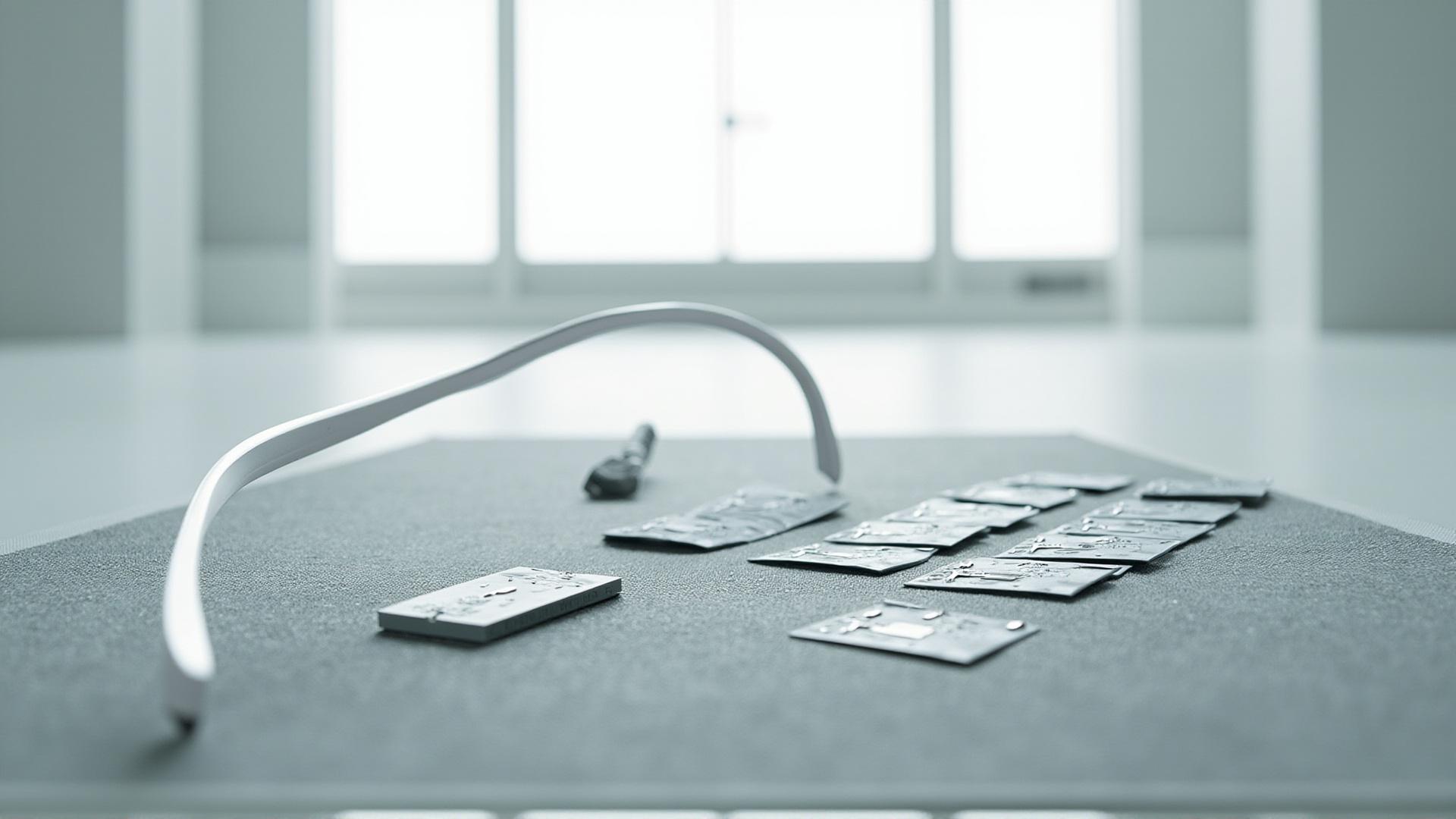
The K01 publishes Bluetooth 5.3, two 90 mAh cells, a charge time of two hours or less, about eight hours of endurance and magnetic charging; the control method is not published for it. It also carries one feature claim that no other model in this range carries: AI translation, flagged in the source material as a company self-description rather than a measured specification. That single claim is both the reason to buy the model and the largest item to resolve before ordering it, because a self-description is not a specification and a feature you cannot characterise is a feature you cannot price, support or defend.
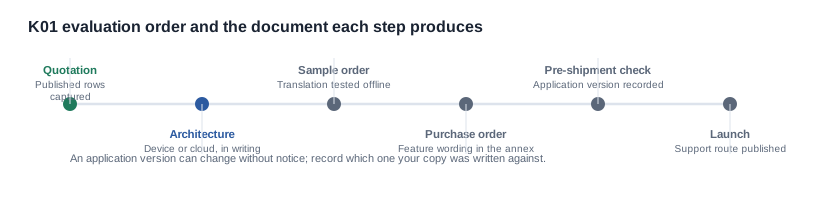
The order below is deliberate. The feature rows come first because they stop the product being sold honestly; the hardware rows come second because they stop the order file being signed; the commercial rows come last because they are the ones a supplier can actually commit to in a quotation. Buyers who work through this in a different order usually discover the translation dependency after the deposit, which is the point at which it is most expensive to change your mind about.
This article is the method for closing that claim and the six undocumented rows around it, and for deciding what your channel may say while they remain open.
K01 AI translation: the claim to resolve before anything else
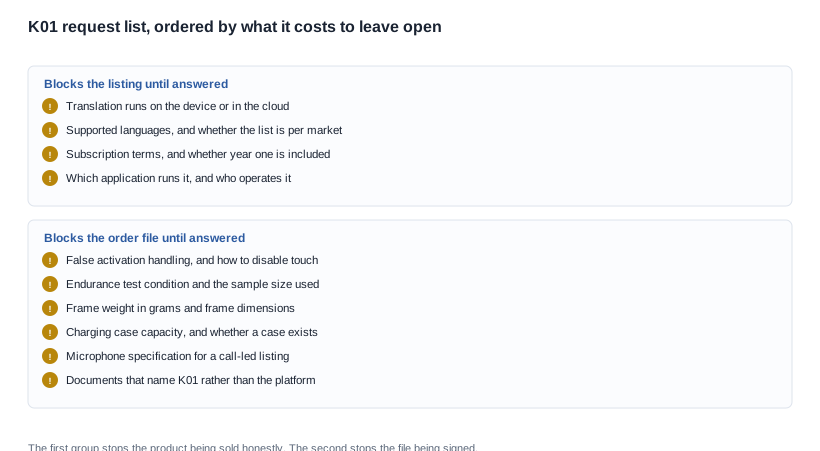
AI translation implies a chain of dependencies, and not one of them is documented for this model. Where does the translation actually run — on the device, or on a server somewhere else? If it runs on a server, what happens when there is no network? Which languages are supported, and is the list the same in every market? Is there a subscription, and is the first year included? Which application does it run in, and who operates it — the factory, your brand, or a third party? Where is any data processed and stored?

None of that is pedantic. Each answer determines something you would otherwise promise by accident. A translation feature with a subscription attached is a recurring cost you carry or pass on, and either way it changes the arithmetic on a product bought at a single unit price. A cloud-only feature is a product that does not work on a mountain, on a plane, or in a market with patchy connectivity — which is a product limitation you will discover from a customer rather than from a test. A data location determines your own compliance position, and it is a question your legal team will ask after the purchase order rather than before it.
What you can safely say today is narrow: the model is published with an AI translation capability attributed to the company. What you cannot say is a language count, an offline capability, a service term, or an accuracy claim. The distinction is easy to hold and easy to lose, because a single adjective in a product title is enough to turn an attributed capability into a performance promise.
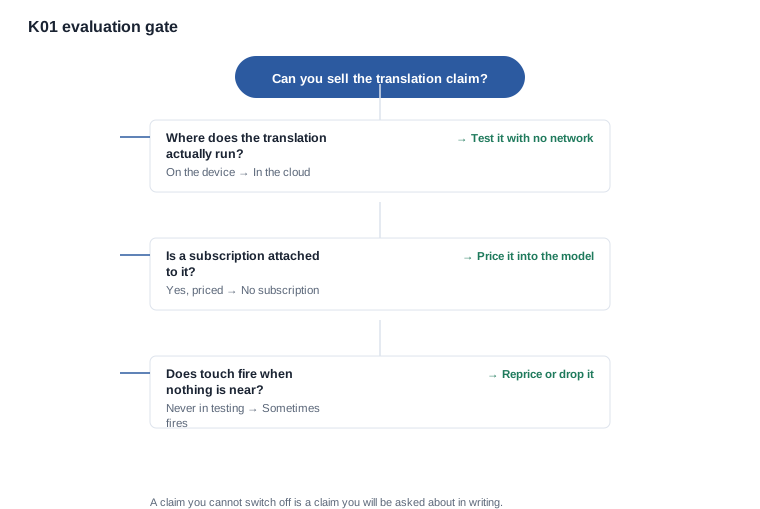
Record the answers in the specification annex of the purchase order, not in a message thread. If the answer is that the feature depends on an application, the annex should name the application, the version you tested, and the operator of the service, because all three can change independently of the hardware and none of them is under your control once the goods have shipped.
Seven published rows and the six that cannot enter a listing
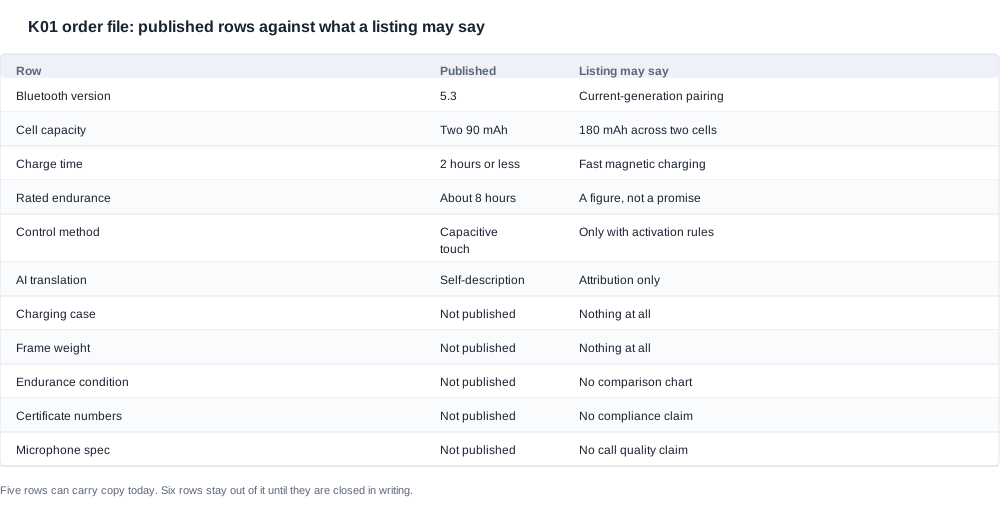
The hardware is well specified. Bluetooth 5.3, two 90 mAh cells totalling 180 mAh across two cells, a charge time of two hours or less, roughly eight hours of endurance and magnetic charging; the control method is not published for it either. That is the most energetically generous published configuration in the audio range, and it is a defensible basis for a functional listing.
Five of those rows can carry copy today. Six rows cannot, and the reason each one fails is different.
Bluetooth 5.3. A compatibility statement, not a differentiator. In this category the version number is rarely what wins an order; do not let a supplier present it as one.
Two 90 mAh cells. A real capacity figure and one of the larger published ones in this range. The cell count is stated as two, which implies a cell per side — an architecture detail worth confirming, because a single-cell design behaves differently when one side fails.
Charge time of two hours or less. Reasonable, and unremarkable. The published figure does not say whether that is from empty, from a flat battery, or under a stated ambient condition, so time it yourself before it appears in a specification table.
Roughly eight hours of endurance. The most useful row and the most slippery. No volume, codec, distance or duty cycle is stated. Treat it as a ceiling rather than an expectation, and do not place it in a comparison chart against models whose figures were measured differently.
Capacitive touch. Published, and the only control method published anywhere in this range. It carries its own conditions, covered in the next section.
Charging case capacity. Not published for this model, in a range where magnetic charging is standard. A case is a second lithium cell in the box, and its capacity decides the parcel weight, the freight class and the transport paperwork — three consequences from one unpublished number.
Frame weight. Not published. For an open-ear frame this is the number that decides whether the product is carried all day, and it is also the number that sets the parcel weight. The weight comparison across the range sets out what happens to a shipping calculation without it.
Three of the six gaps are commercial rather than technical, and they are the ones most often left until after the quotation. Minimum order quantity for this model is not published, nor is the price tier structure, nor the lead time, nor whether either differs by colourway. Ask for all four in the quotation rather than in a catalogue, because a figure in a catalogue cannot be changed and a figure in a quotation can. Ask at the same time whether the lead time clock starts at deposit, at artwork approval or at a confirmed purchase order, because the three readings can differ by weeks and the difference lands directly on your inventory plan.
Microphone specification. Not published. This model will be sold for calls by somebody, and the person who writes that listing will need a pickup figure or they will invent one.
Capacitive touch, and the failure mode nobody specifies
Capacitive touch on an open-ear temple, where a model offers one, is a design decision with a specific failure mode, and the failure mode is not a specification-sheet item — it is a returns item. A capacitive surface that rests against the skin can pick up unintended input. A frame hung on a chair back or set down in a bag can register a touch. Both produce the same customer event: the product appears to start doing something on its own, which reads as a fault and arrives at your channel as a defect report rather than as a question.
The K01 publishes no touch control row, so a channel listing that names capacitive touch as a feature is a claim the supplier has to evidence; ask three things. How is false activation handled — by a lock threshold, a gesture requirement, or nothing at all? Can it be disabled in the application or in firmware, and if so, does disabling it affect any other function? What are the physical controls, so that a customer whose touch is misbehaving has something else to reach for?
The comparison with the K02 is worth noting, because it makes the range awkward in a useful way. The K02 shares the rest of this platform but does not state its control method at all, and the K01 does not publish one either. That means a two-model comparison in your channel will have to handle two models with no documented control, and the honest treatment is to describe what each publishes rather than to normalise them. Buyers who work in this category read a missing control method as a missing test, not as a missing feature.
Bring the returns question into the same exchange, because it is the same row viewed from your side. Ask what the supplier's stated warranty period is, what it covers, and what the defect allowance is on a pre-shipment inspection. A capacitive touch surface that misfires produces a mix of genuine defects and genuine misunderstandings, and without a written allowance you cannot separate them at the inspection stage — you can only argue about them afterwards. Write the allowance and its remedy beside each other in the purchase order, and make sure the remedy names who pays the return freight.
The practical mitigation, if the answer is that false activation occurs: write the mitigation into your own documentation rather than leaving it to the customer to discover. A one-line instruction in your listing and a matching line in your support macro cost nothing and remove most of the returns that come from this row.
Sample protocol: test the feature with the network switched off
A sample order for the K01 has to cover the feature and the hardware, and the feature needs a longer test than the hardware does. Order one unit per colourway plus two spares, keep a signed test sheet, and record the date, lot code and measuring person against every result.
- Translation with no network. Turn off connectivity and try the feature. Record exactly what happens: an error, a fallback, silence, or a result that suggests local processing. This single test answers a question no document will answer reliably.
- Translation in poor conditions. Test in reproduced background noise and note whether the capture degrades before the translation does. That distinction determines whether your listing can mention calls and translation in the same sentence.
- Touch false activation. Rest the temple against skin, set the frame down on a surface, place it in a bag and leave it. Record every activation, with the time elapsed.
- Endurance at the stated condition. Run to depletion at the volume and duty cycle you asked about, and record what you measured rather than what was quoted.
- Charge timing from a stated low point, with the supplied cable and the ambient condition noted.
- Application check. Record the application name, version and operator exactly as they appear, and take a dated screenshot of the settings page that shows them.
- Port, cable and box contents, checked line by line against the quotation.
State the sample order policy in the quotation while you are asking. How many units, at what price, how long before dispatch, and whether the sample cost is credited against the first bulk order. A sample order that is neither credited nor discounted is a real cost on a low-value product, and it is the kind of term that is easy to agree in principle and never revisited. Ask also what happens to the sample units after testing — whether they can be included in the production run, shipped separately, or must be destroyed. Each answer changes the arithmetic, and none of them is obvious from the outside.
The application screenshot is the cheapest insurance in this whole article. Services change, applications are replaced, and language lists get revised without a hardware revision. A dated record of what you tested against lets you answer "which version were you on" in a year, which is a question every channel partner will eventually ask and almost nobody can answer.
What the translation feature actually costs you commercially
A feature claim that cannot be characterised should be treated as a cost centre until it can be. There are four ways it shows up, and they should all be priced before you commit.
Support load. Every AI feature generates a category of questions that nobody anticipated, from customers who expect a specific language pair to work to customers whose network is unreliable. Decide now whether your channel absorbs those questions or routes them to a named party, and write that routing down.
Subscription exposure. If a subscription is attached, it is either a cost you absorb for the life of the product line or a charge you pass on. Both are defensible; discovering which one you have chosen after launch is not. If the answer is that year one is included, ask what happens in year two and write it in the annex.
Listing language. The safest formulation available today is attribution: the model is published with an AI translation capability attributed to the company. Anything more specific — a language count, an offline claim, an accuracy claim — requires a document you do not hold. Buyers who test the feature themselves and find a narrower list will convert that into a review, and the review will be more specific than your listing ever was.
Total cost of ownership. A frame that depends on a service has a continuing cost that a frame that does not, has none. That difference does not show up in a unit-price comparison, which is why it belongs in the negotiation rather than in the arithmetic you do afterwards.
The same discipline applies to the paperwork. A company statement that a product is certified is not a document naming the K01, and the distinction matters more than buyers expect because the certificate schedule is what your customs broker will read at the port of entry. Request the test reports, the certificate references with issuing body and validity, the Bluetooth listing and declaration identifiers, the cell test summary referenced by the battery marking, and the index of the technical file. Then check that your purchase order designation appears on every one of them. This is a short piece of due diligence that removes an entire category of problem at clearance, and it costs one message.
One closing point on the hardware rows, since they are the ones that look finished. The 180 mAh across two cells is genuinely the most generous published configuration in this range, and it is still not a claim about endurance, because endurance is a measurement of a duty cycle rather than a property of a cell. Ask for the condition, get the condition, and only then put the figure next to another model's figure.
Which buyer the K01 serves, and where a different model is wiser
Name the cases. If your channel sells on translation and can support a service-backed feature, the K01 is the only model in this range that gives you that proposition, and the premium is defensible once the architecture question is closed. If your channel sells on hardware specifications and endurance, the K01 is a strong choice on capacity and a weak one on documentation, and a model with a published microphone specification and a stated endurance condition will convert better at the same price. If your market is one where connectivity cannot be assumed — travel, industrial sites, some emerging markets — a cloud-dependent feature is a liability unless you have confirmed local processing, and the honest answer may be a different model entirely.
One practical way to keep this manageable is to run the whole thing as a single written request with a stated deadline, rather than as a series of conversations across a quotation cycle. The reason is not efficiency. It is that a supplier who answers a long structured request in one response has demonstrated something you will need later — that they maintain per-model records and that they are willing to commit to them on paper. A supplier who answers three questions and offers to look into the rest is telling you something different about how a quality claim will be handled eighteen months from now, and that is information worth having before you commit rather than after the first shipment lands.
Buyers should also know what they are not buying. There is no published charging case capacity, no published frame weight and no published microphone figure. If any of those three is central to your proposition, settle it before you commit rather than after the first quarter of channel feedback.
The K01 is the model to choose if translation is the proposition, and translation has to be characterised before it can be sold. We will not publish a language count, an offline capability or a service term for this feature, because the source identifies it as a company self-description rather than a measured specification. We will also not quote a weight, describe a charging case, or present capacitive touch as a benefit without knowing how false activation behaves.
Buyers who want to move faster can ask for the short version first: the translation architecture, the microphone specification, the frame weight and the certificate schedule. Those four answers will settle whether the K01 belongs on your shortlist at all. The remaining rows matter once you have decided to proceed, and none of them changes that decision, which is why asking for them first tends to cost a week without changing the outcome.
Send us the application, the markets and the volume, and we will tell you which of the open rows are already answered and which need a sample or a test house.
Related reading
- The entries published for this model — K01 smart glasses specifications and features
- Choosing across the audio range — which Bluetooth audio glasses model to pick
- The document set to request before you commit — Bluetooth SIG certification checklist
- What an unpublished weight does to freight — weight comparison across the range
Send us the application, the markets and the volume, and we will tell you which of the seven checks are already answered and which need a sample or a test house.


