

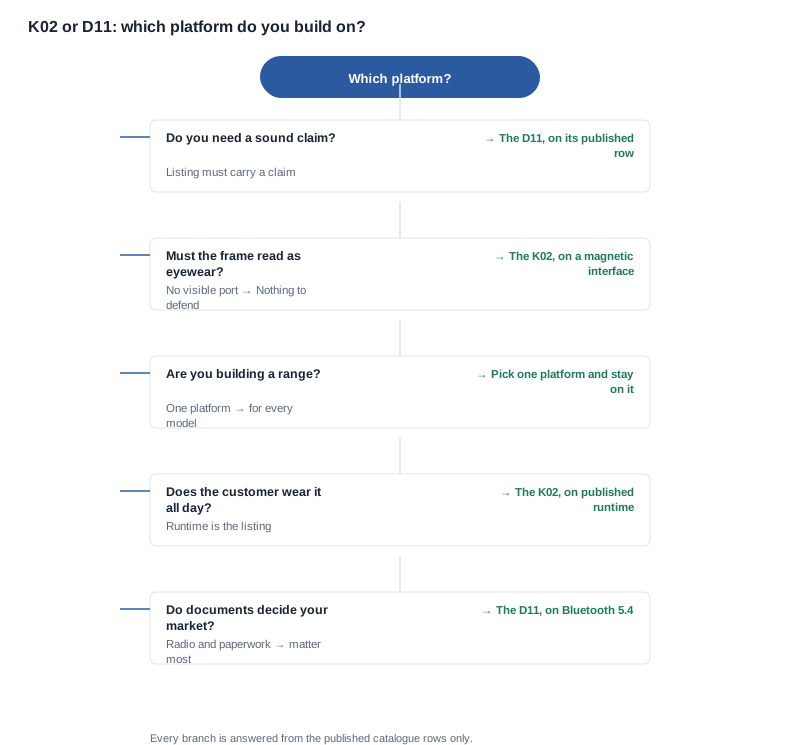
The conclusion first, because it is the part a buyer normally wants before any table: the K02 and the D11 are not two products in one range, they are two platforms, and the choice between them is really a decision about which platform your next models sit on. That is a longer decision than a specification comparison, and it changes which questions are worth asking at all.
The published rows are short. The K02 publishes Bluetooth V5.3, two 90 mAh cells, magnetic charging, about 8 hours of runtime and a charge time of 2 hours or less. The D11 publishes Bluetooth V5.4, a single 100 mAh cell, USB-C charging, about 7 hours of runtime, the same 2 hours or less charge time, and a surround sound claim. Everything else a buyer might want to compare — frame weight, dimensions, lens material, colours, ingress protection, certification status, price, MOQ, lead time — is not published for either model.
So this comparison is written the way a sourcing conversation actually runs: what the catalogue publishes, where the two rows genuinely separate, what the rows cannot tell you, and which questions convert an opinion into a decision. Where the catalogue is silent, we say it is silent and we tell you what to ask for in writing.
What the catalogue publishes for the K02 and the D11
Here is the entire published specification set for both models, reproduced as rows rather than as prose.
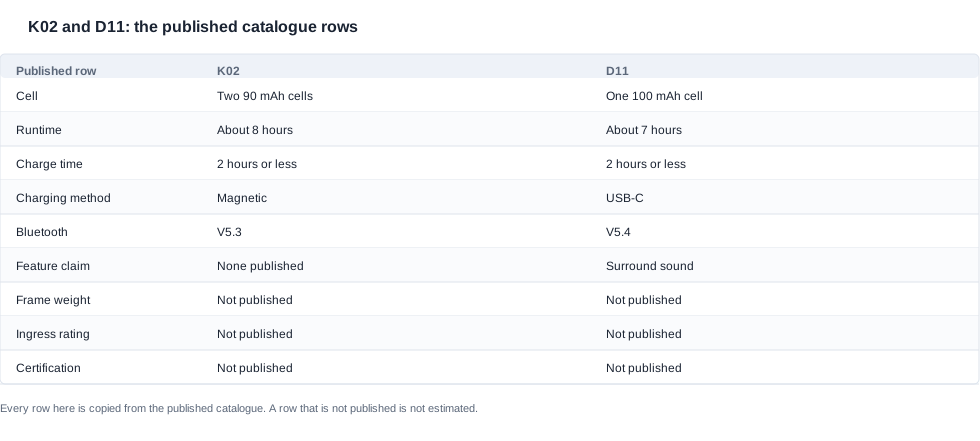
| Published row | K02 | D11 |
|---|---|---|
| Product name | K02 AI Bluetooth Glasses | D11 AI Bluetooth Glasses |
| Cell | 90 mAh × 2 | 100 mAh |
| Published runtime | about 8 hours | about 7 hours |
| Charge time | 2 hours or less | 2 hours or less |
| Charging method | Magnetic | USB-C (Type C) |
| Bluetooth | V5.3 | V5.4 |
| Published feature claim | None published | Surround sound |
Read that set carefully and notice how much of it is absent. There is no frame weight, no temple length, no lens measurement, no lens material, no colour option and no ingress protection rating for the K02 or the D11. In the wider catalogue the only models that publish an ingress protection figure are the V06 and the S7, both of which carry IP54 — no audio model in the range publishes any ingress rating at all, so a question about water resistance has no published answer for either of these frames.
The same is true of weight. The only published frame weight anywhere in the catalogue belongs to the MT6, at 158 g for the eyewear body excluding its folding case, which tells you nothing about the K02 or the D11 and should not be borrowed as an estimate for them.
Certification is the other silence. The catalogue body contains no FCC, CE, RoHS or RED reference for any model, and the export compliance page is an image page with no per-model certification line behind it. That means there is no certificate number, no issuing body, no test report reference and no covered-model schedule available on the page for either the K02 or the D11. A buyer who assumes a certification route because the product is "sold as Bluetooth glasses" is assuming something the catalogue does not state. The compliance question is not answered by the sheet; it is answered by a document you request.
Two more catalogue-level silences matter here. There is no capacitive touch control row anywhere in the library, and there is no translation row either. So the control method for the K02 and the D11 is simply not published, and any AI function you have seen mentioned for either model in a conversation is a conversation, not a catalogue row. The audio range itself covers eight models — the D11 and the K01, the LC-105-2 and the K02, the G07 and the LC-105-1, and the YK12 and the D12 — and the published rows quoted in this article cover seven of them.
One last warning about the names themselves. A model code is not a specification, and the codes in this range are not alphabetical, sequential or grouped by function: the K-prefixed models share a radio revision and a cell configuration, the D-prefixed models share an interface and a single-cell layout, and the LC-prefixed models share a small-cell platform with the G07. A buyer who reads the K02 and the D11 as two points on one scale is reading a scale that the catalogue never published. What the catalogue publishes is a set of rows, and the rows are what this article compares. Where a row is missing, the answer is a request, not an inference from a neighbouring model, a neighbouring brand or a neighbouring generation.
Where the two rows actually differ, and where they do not
Four differences carry the weight, and they are not the four a buyer usually assumes.
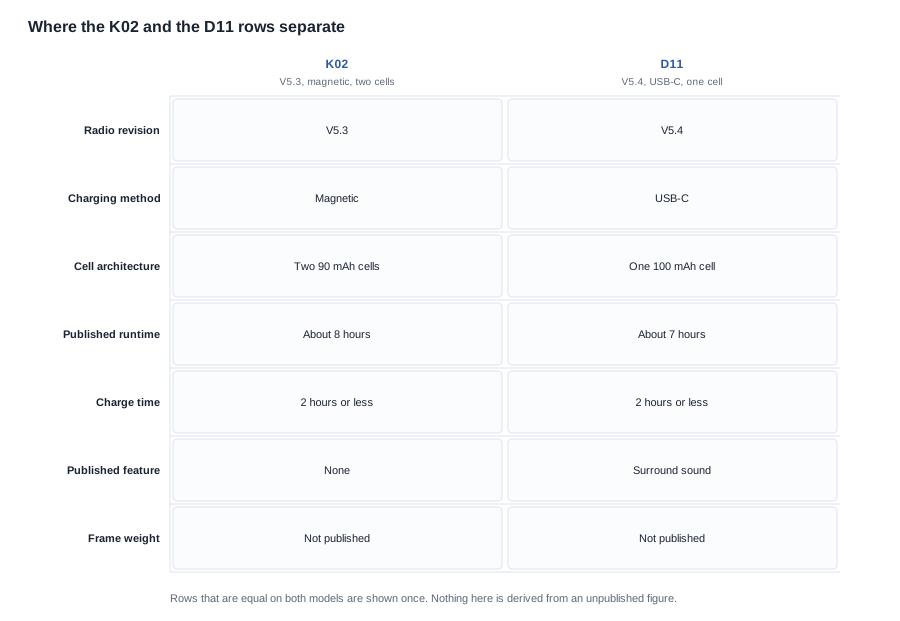
First, the radio revision. The K02 publishes Bluetooth V5.3 and the D11 publishes V5.4. That gap is smaller than it looks in isolation and larger than it looks in a range: the K02 shares its radio revision with exactly one other model, the K01. Every other model in the audio range, the D11 and the LC-105-1, the YK12 and the LC-105-2, and the D12 and the G07, sits on V5.4. A radio revision is fixed at the silicon level, so a platform built on V5.3 is a platform whose successors inherit V5.3 unless the silicon changes. Our Bluetooth connectivity note covers what the revision differences do to pairing stability and power behaviour in practice.
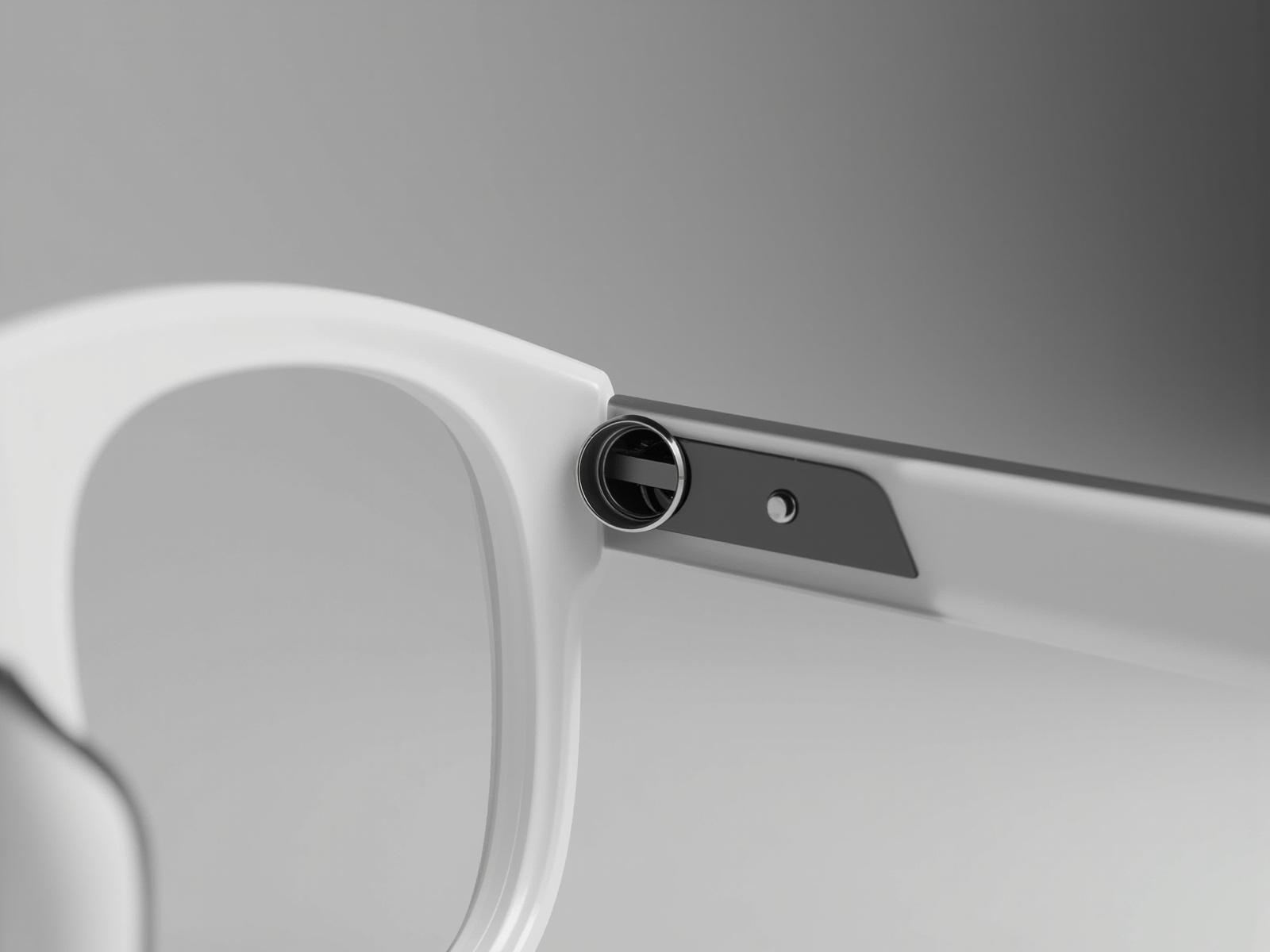
Second, the charging interface. The K02 charges magnetically and the D11 charges over USB-C. This is a visible difference on the product, not a line in a table: a magnetic model has no port in the temple, a USB-C model has one, and the customer owns a dock in the first case and a cable in the second. It decides the accessory line in your store, the cable in the box, the shape of the unboxing, and the parcel. The D11's charging options are covered in more detail in our note on D11 charging options.
Third, the cell architecture. The K02 carries two 90 mAh cells and the D11 carries one 100 mAh cell. That is a different internal layout, a different balance across the frame, a different service procedure and a different failure mode. Whether the cells are field-replaceable, and how a partial failure is handled, is not published for either model, and that is a question worth asking before the platform is chosen rather than after a return arrives.
Fourth, the published runtime. The K02 publishes about 8 hours and the D11 publishes about 7 hours, and this is the row a comparison chart would lead with. It is also the row that does not survive contact with the rest of the range.
Where the two rows do not differ is just as important. The charge time is identical at 2 hours or less for both. Neither publishes an acoustic specification, a driver size, a microphone count, a leakage figure, a pickup distance, a frequency response, a charge indicator behaviour or a charging input voltage. Neither publishes an ingress protection rating. Neither publishes a frame weight, a temple length or a lens dimension.
And the runtime figures are not comparable across the range. The LC-105-1 and the LC-105-2 publish about 8 hours on two 55 mAh cells — 110 mAh of total capacity, more than the D11's single cell and well below the K02's pair. The G07 publishes about 6 hours on the same two 55 mAh cells. Identical cell configuration, a two-hour spread between two models. The published runtime is therefore describing platform tuning, average power draw and test method rather than capacity, and no test condition is published for any model in the range. Our battery life guidance sets out exactly which method questions to put in front of a supplier.
So the honest position on runtime is this: the K02 has more published capacity and a longer published figure, and the difference cannot be treated as a measured gap until somebody explains the method. The same platform split shows up in the K01 against the K02 comparison, where the difference between the two models is a feature on top of a shared radio and cell base — see K01 versus K02.

Choosing between them when the decision is about supply, not specifications
Most comparisons end at the specification table and then jump straight to a recommendation. That jump is where sourcing goes wrong, because the specification table is rarely the binding constraint — the binding constraint is whether you can get the units, document them, and land them at a cost that survives your channel.
We will not present a specification difference the catalogue does not publish, so a buyer choosing between the K02 and the D11 should decide from the supply route and ask for the unpublished rows in writing. That sentence is the position of this article, and everything below it exists to make the supply route concrete.
A supply route for a private label smart glasses programme runs like this: a quotation, then a sample order, then written technical confirmation, then a contract, then a deposit, then production and quality control, then a shipment. Not one of those stages has a published figure in the catalogue — no price, no MOQ, no lead time, no payment terms, no incoterms, no warranty period and no certification schedule — so every number in this comparison has to come from a supplier's own documentation, in writing, attached to a document you can hold.
What to ask in the quotation. Ask for the unit price at your expected volume and ask what is inside it: the hardware, the packaging, the private label print, any tooling amortisation, and any cost attached to producing conformity documents for your destination market. Ask how long the quotation stays valid. Ask what moves the price — a change of cell, a change of radio revision, or a change of packaging all behave differently between a two-cell magnetic platform and a single-cell USB-C platform, and a supplier who cannot say which of those move the price is guessing.
What to ask about MOQ. Ask for the minimum order quantity per model, per colour and per logo, and then ask the question that actually matters: whether the MOQ applies per SKU or per purchase order. A range that carries the K02 and the D11 at once can carry two MOQs, and a mixed-model order is often the one that makes a launch economical.
What to ask about the sample order. This is where the measurement gaps in this article actually close. Ask what a sample costs, whether the sample fee is credited against the bulk order, how many samples you receive, and how long the sample takes. Then measure the sample: weigh the frame, measure the temple and the lens, and run the runtime test yourself under your own conditions. A sample is the only published-object evidence available for the weight, the fit and the endurance rows that the catalogue does not publish, and it is the cheapest risk reduction available before a bulk order.
What to ask about lead time and payment terms. Ask for the sample lead time and the production lead time separately, and ask what the clock starts from — artwork approval, deposit, or a written specification sign-off. Ask for the deposit percentage, the balance trigger, and whether payment terms can be negotiated for a second order. Ask which incoterms the factory works with, and how a shipment is insured and documented, because that determines who carries the risk once the goods leave the factory.
What to ask about tooling and the contract. For a private label build, ask what the tooling cost is, whether it is a one-off charge or amortised into the unit price, and who owns the tooling at the end of the contract. Then put the specification itself into the contract, because a contract that only names a model name protects nothing: the published rows, the approved sample, the packaging specification, the inspection criteria, the agreed delivery date, the conformity documents handed over at shipment, and the remedy for a non-conforming batch all belong in it.
What to ask about warranty, quality control and the factory. Ask for the warranty period, what it covers, the return route and who pays the freight — a single-cell design and a two-cell design fail differently and are replaced differently. Ask what the incoming inspection covers, whether you may inspect before shipment and who pays for it, and what batch records or serial numbers you receive. And ask who holds the technical file for each model, and whether the declaration of conformity is handed over with the shipment or kept in the factory's own file — because a document you cannot produce is not a document you have. And if this is a repeat order rather than a one-off, run due diligence before you scale it: ask whether a factory audit is possible, whether a third-party audit is acceptable, what the supplier's own quality control system looks like, and what the risk is if a sub-supplier changes underneath you. The OEM and ODM options page sets out how our own programme is structured.
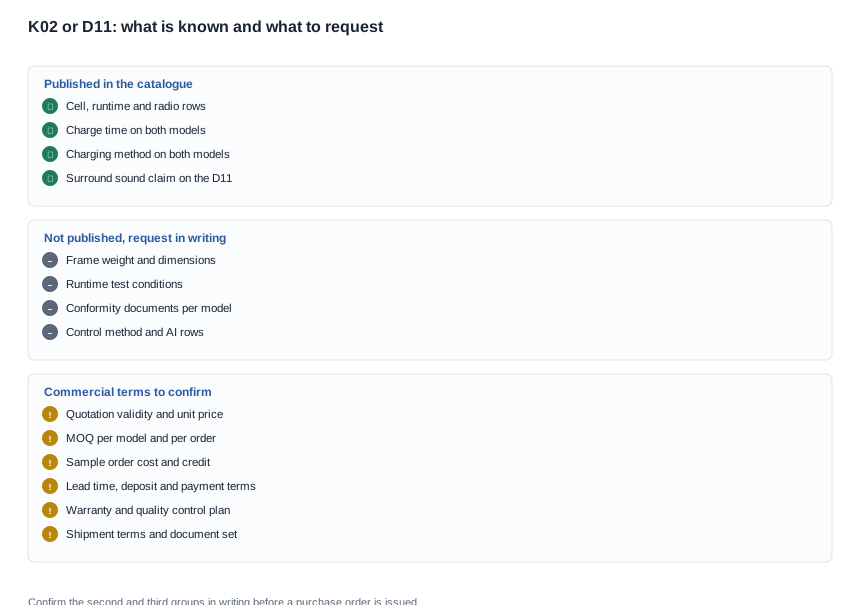
Before you order, the checklist is short and it is all documentary. The questions to ask are not about preferences — they are about which document will hold the answer.
- A written specification for the exact model, listing the rows you are buying against, and signed as the order reference.
- A runtime test condition — volume level, source content, ambient conditions, and whether the figure is continuous audio or mixed use — so the K02's about 8 hours and the D11's about 7 hours become comparable.
- Measured frame data from an approved sample: weight, temple length, lens dimensions, and the balance point.
- A conformity document set for your destination market, with the issuing body, the model coverage and the validity period named — asked as a question, because none of it is published for either model.
- A sample cell and charging check: the cell configuration, whether cells are replaceable, the charge input, and the charge indicator behaviour.
- A commercial pack: quotation validity, MOQ per SKU and per order, deposit, payment terms, incoterms, lead time, and the tooling position.
- A warranty and quality control position: coverage, return route, inspection point, acceptance criteria, and the batch records you receive.
- A shipment plan: packing list, carton marks, documentation set, and the delivery window you will hold the supplier to.
The trade-off between the two platforms, stated in supply terms. If your channel needs a product that carries no claim you have to defend and a port-free frame, the K02 is the lighter platform to run: one accessory line, one charging story, and a specification sheet that publishes nothing you must support. If your range needs the newer radio, a visible USB-C port, and the only published audio feature claim in the range, the D11 is the one that carries the surround sound claim on its row. Both choices carry an unpriced set of obligations — documents, samples, tooling, packaging and spares — and those obligations are usually larger than the specification gap between the two models.
One trade-off deserves its own paragraph, because it is the one buyers negotiate hardest. Lead time and flexibility pull in opposite directions. A narrow platform — one model, one radio revision, one interface — is faster to qualify and easier to schedule, because there is nothing else competing for the same line. A range that mixes the K02 and the D11 carries two qualification paths and two sets of documentation, and every change you make to one of them has to be reflected in the other. If your forecast is uncertain, a single platform is usually worth more than the specification difference, and if your forecast is firm, the second platform costs documentation time rather than unit cost. Either way, that negotiation belongs in the quotation stage, not in the sample stage, because the answer determines whether the sample you order is a proof of specification or a proof of a programme.

Where CYNRIN places the K02 and the D11 in the audio range
The audio range is eight models: the K01 and the D12, the YK12 and the LC-105-2, the D11 and the G07, and the LC-105-1 and the K02. Sort them by the published rows and the range stops being eight products and becomes a small number of platforms.
- One platform: Bluetooth V5.3, two 90 mAh cells, magnetic charging, about 8 hours. The K01 and the K02 sit here. The K01 is the variant of this platform that the catalogue gives a name to; the K02 publishes no feature claim of its own.
- One platform: Bluetooth V5.4, a single 100 mAh cell, USB-C charging, about 7 hours. The D11 and the D12 sit here, and their published rows are identical in cell, runtime, charge time, charging method and radio revision. The D11 is the one that publishes a surround sound claim; the D12 publishes no feature claim of its own. Two models, one platform, and the reason to pick between them is the claim, not the electronics.
- One platform: Bluetooth V5.4, two 55 mAh cells, magnetic charging. The LC-105-1, the LC-105-2 and the G07 sit here — and they are the clearest proof in the catalogue that the published runtime is a platform figure rather than a capacity figure, because the LC-105 pair publishes about 8 hours on those cells while the G07 publishes about 6 hours on the identical cells.
- The YK12 is the eighth model in the audio range. Its row is not among the published rows quoted in this article, so we ask for it in writing rather than infer it from its neighbours — inference from a neighbouring row is how an incorrect specification ends up on a purchase order.
So where do we place the K02 and the D11? We place the K02 as the conservative end of the range: the longest published runtime, the highest published capacity, no feature claim to defend, magnetic charging and no port in the temple. We place the D11 as the forward end: the newer radio revision, USB-C charging, a single-cell architecture that is simpler to describe and simpler to balance, and the only published surround sound claim among the eight. Neither is a better product in the abstract; they are different answers to different channel questions, and the catalogue supports one row of reasoning for each and no more.
How to evaluate the pair, practically. Score the two models against the criteria your own channel actually uses — the accessory line you will carry, the documents you must collect, the spares you will hold, the claim you will print on the box, and the runtime figure your customer will read — and the decision makes itself. Most evaluations come down to a single line: if the listing must carry an audio claim, the D11's published surround sound row is the only one of the two that gives you something to print; if the listing must carry no claim at all, the K02's row gives you nothing to defend and the longest published runtime.
There is a second-order effect to the platform grouping that is worth naming. A range built on one platform produces one set of conformity documents, one inspection criteria list, one packaging specification and one set of spare parts. A range built on two platforms produces two of each, and the second set is discovered late, usually when a customer asks for a document that was never scoped. That is the real cost of the K02 and the D11 appearing together in one catalogue line-up, and it is invisible on the specification sheet and visible in your document register. Whichever way you decide, write the document list before the purchase order, because the document list is the thing that actually goes wrong.
Then run the questions above before you order, in writing, against the supplier, with the sample in hand. That is the whole method: no invented numbers, no borrowed figures from a neighbouring model, and every gap closed by a document or a measurement instead of an assumption.
The full family sits on our Bluetooth audio glasses range page. Send us the channel, the volume, the target market and how many models you plan, and we will tell you which platform we would start on and which rows we can put in writing for you before the sample order.
Related reading
- The charging interface decision in detail — D11 charging options
- The same platform family with a feature on top — K01 against the K02
- What the radio revision changes — Bluetooth connectivity
Send us the channel, the volume and how many models you plan, and we will say which platform we would start on.


