

There is almost nothing to compare, and that is the finding rather than a failure of the comparison. Both models publish the same rows: 90 mAh × 2 cells, a stated endurance of about 8 hours, a charge time of two hours or less, magnetic charging, and Bluetooth V5.3. Neither model publishes a feature line of any kind, and our catalogue records no difference between them.
So this is not a specification comparison between two tiers of a range. It is a comparison between two designations of one published configuration, and the question a buyer actually faces is not which model is better but whether a second designation earns its place in the range at all.
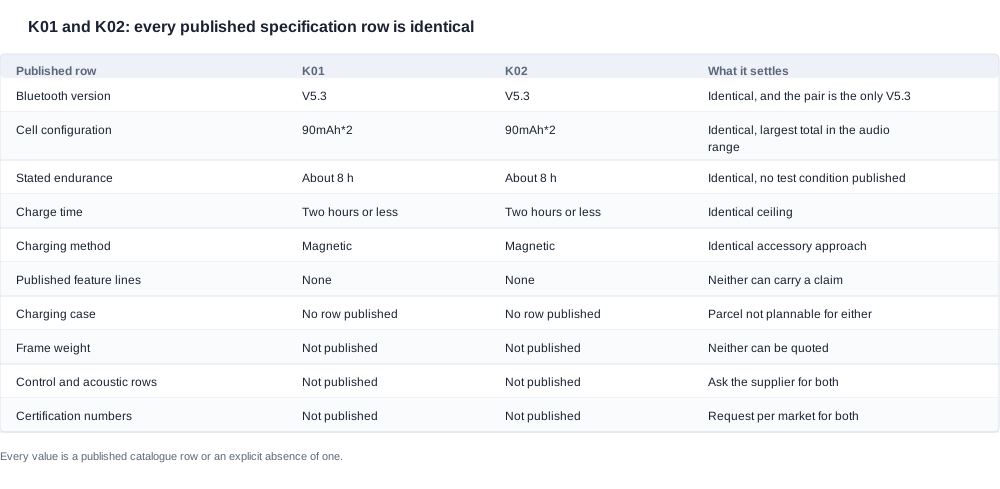
The rows that are identical, and what that means for a range
Every published specification matches
| Published row | K01 | K02 | What it settles |
|---|---|---|---|
| Bluetooth version | V5.3 | V5.3 | Identical — and the pair is the only V5.3 in the catalogue |
| Cell configuration | 90mAh*2 | 90mAh*2 | Identical — the largest total energy published for an audio model |
| Stated endurance | About 8 h | About 8 h | Identical, and not a differentiator between them |
| Charge time | Two hours or less | Two hours or less | Identical ceiling |
| Charging method | Magnetic | Magnetic | Identical accessory approach |
| Published feature lines | None | None | Identical, and neither carries a claim a page can be written around |
| Charging case | No row published | No row published | Neither model's parcel can be planned from the catalogue |
| Frame weight and dimensions | Not published | Not published | Neither can be quoted |
| Control, acoustic and microphone rows | Not published | Not published | Neither can be listed on any of them |
| Certification numbers | Not published | Not published | Neither can be quoted |
Five identical rows and a column of blanks on both sides. Any comparison table that presents these two models with different values in any cell is presenting something our documentation does not contain, and a buyer who signs off on such a table is carrying a claim it cannot evidence.
There is one nuance worth stating because it is easy to misread. The catalogue publishes the cell value and the cell count, so the row reads 90mAh*2. When the two are added for analysis the result has to be marked as a derived figure — "two cells totalling 180 mAh" — because a bare total in a specification block reads as an official number and this one is not.
Why identical rows are a commercial problem, not a technical one
Two models with identical published specifications are not two products. They are one product with two names, and the range logic has to account for that.
The cost of carrying both is not zero. Each designation needs its own artwork, its own carton, its own listing pages, its own instruction material, its own stock line, and its own place in the certificate file if the file names the model. None of those is free, and none of them is visible in a unit price comparison.
The benefit of carrying both is also not zero, but it has to be found somewhere other than the specification sheet. A range needs two price points when a channel serves two segments with different willingness to pay, when a distributor wants a good-better-best ladder, or when a brand needs two shelf positions in a category where the competitor above it is visibly different. Those are real reasons. A bill-of-materials argument is not, because the hardware is identical.
The honest way to run this comparison is as a merchandising decision rather than a product decision. Which two channels does the range serve, what does each of them buy on a different occasion, and what does the second listing say that the first one does not. If those answers are not available, one designation is the more defensible choice, and the Bluetooth audio glasses which model to pick piece covers the range-level version of that question.
The one published fact that tells you what these two are
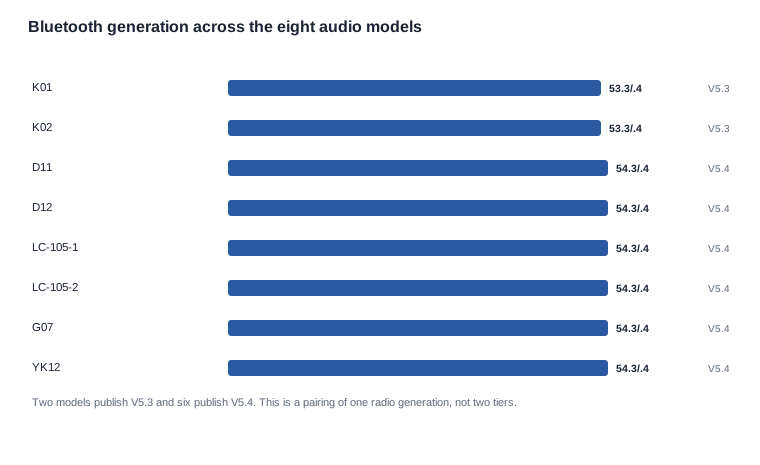
Here is the structural fact that makes sense of why two identical-looking models exist in the catalogue at all: the K01 and the K02 are the only two models publishing Bluetooth V5.3. The other six audio models — the D11, the D12, the LC-105 pair, the G07 and the YK12 — all publish V5.4.
That is worth reading carefully, because it is easy to misread it as a tier distinction. It is not. It is a pairing of one radio generation, which in a catalogue of eight audio models means these two share a platform and the rest of the family sits one generation ahead. A buyer planning a range has to decide how to handle that split, and the honest answer is that it is a platform question rather than a positioning question.
The practical consequences follow from there. A channel whose customers' platforms are known to be V5.4-native has a question to ask about the K01 and the K02. A channel serving mixed platforms has to know what its product does across the versions. And a buyer treating the pair as a premium tier above the V5.4 models would be building a tier on a radio generation rather than on a product difference — which is defensible as a platform decision and indefensible as a specification claim.
There is one further structural detail worth holding on to. The K01 and the K02 publish no feature lines, which places them alongside the D12, the K02's own sibling tier and the LC-105 pair as models whose pages are built from electrical rows only. In this catalogue, a model with a published feature line — a sound descriptor, a temple treatment, a remote shutter — can carry a claim. These two cannot. Any comparison that assigns them a distinctive selling point is inventing one.

What can and cannot be compared between two identical configurations
A matrix of the comparison itself
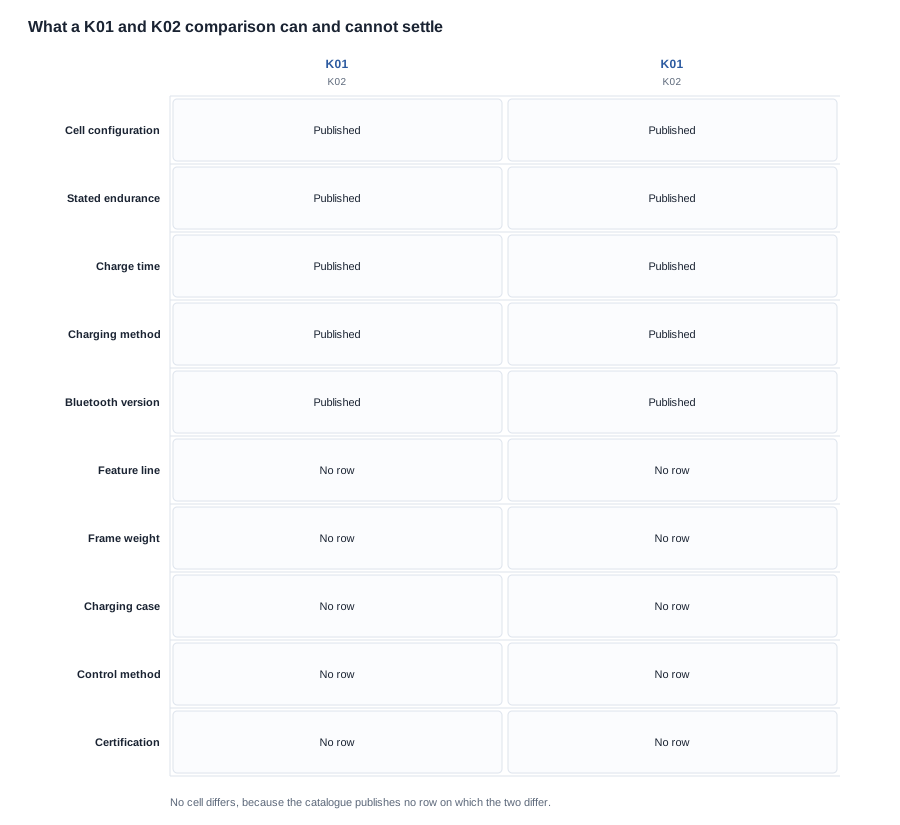
The matrix makes the shape of the problem obvious: where a row exists, it exists twice with the same value, and where a row does not exist, it does not exist for either model. There is no cell in which the two differ, because the catalogue publishes no row on which they differ.
The claims that are available to either model
Both models can carry a claim about their cell configuration, because 90mAh*2 is a published row. It is the largest total energy published for any of the eight audio models, and a buyer can say so without qualification, provided the total is marked as a derived figure where it appears.
Both models can carry the stated endurance of about 8 hours, with the same caveat that applies across the whole audio range: no test condition is published, so the figure cannot be turned into a working day, a duty cycle or a ranking against another model. The eight-hour figure appears on six models in the catalogue across four different cell configurations, which is why it is a family-wide label rather than a measurement of any one frame.
Both models can carry a charge-time ceiling of two hours or less, and both charge magnetically. A magnetic method presumes a mating accessory, but the catalogue does not say what that object is or whether it ships in the box, so the method is the only charging fact either model can publish.
The claims that are available to neither model
Nothing about fit, comfort or weight. No audio model in this catalogue publishes a frame weight, and no model publishes a dimension. The single published frame weight anywhere in the catalogue belongs to the MT6, a camera model, and it cannot be borrowed across platforms.
Nothing about sound. No acoustic figures, no driver size, no frequency response, no microphone count and no pickup distance are published for either model. A listing that describes how these frames sound is describing something the documentation does not contain.
Nothing about how they are controlled. No control-method row is published for any model in the catalogue, so the control surface has to come from the supplier before it can be described.
Nothing about market access. There is no per-model certification row for either model, and the catalogue text contains no reference to CE, FCC or RoHS. The conformity framework a buyer works within for radio equipment is the Radio Equipment Directive (EU) 2014/53/EU, with EMC governed separately under 2014/32/EU — but the framework is the buyer's obligation to satisfy, and the documents demonstrating it have to be requested for each model.
Nothing about the accessory in the box. Magnetic charging is a method, and the catalogue does not publish whether the corresponding object is a case, a pad or a dock, nor its capacity for either model. It would be a mistake to write that one model has a charging case and the other does not: the audio range publishes no charging-case row for any of its models.
The runtime row that cannot rank even a pair
The eight-hour figure is on both models and it is the top published runtime among the eight audio models, and it still cannot be used to separate them — they share it. It also cannot be used to rank them against the models that publish six hours, because the LC-105 pair publishes the same eight hours on a 55 mAh × 2 configuration, roughly three-fifths of the energy these two carry. Identical cells, a two-hour spread.
That is worth pausing on, because it is the single most useful piece of evidence in this whole comparison and it is not about the K01 or the K02 at all. A number that appears on models with completely different hardware is a family label, not a measurement. The six models publishing about eight hours — the K01, the K02, the LC-105 pair, the YKC02 and the ZH12 — do so across four different cell configurations. No test condition is published for any of them.
The practical rule that follows is simple and applies to every listing built on this pair: the eight hours can be quoted as a stated figure with no claim attached, and it cannot be quoted as a working day, a duty cycle, a duration of use, or a ranking. A buyer who wants the second set of claims needs a measured cycle on the application the product is actually sold for, and that measurement has to be taken on the configuration being ordered.
The V5.3 pairing, worked through as a range decision
Because these are the only two V5.3 models in the catalogue, the pair creates a question that no other two audio models create: what happens to the other six.
There are three workable answers, and they lead to different ranges.
Run the pair as the platform and treat the V5.4 models as the successor generation. This is the answer that matches the catalogue structure — the pair shares one radio generation and the rest of the family sits one generation ahead. It requires the buyer to be comfortable describing a product on a radio version, which is a defensible platform claim and a weak consumer claim.
Run one V5.3 model and one V5.4 model as a two-tier range. This gives a genuine step between the tiers, because the step is a published difference. It also gives a buyer something to say on the higher tier that is not simply "more of the same".
Run one model from the pair and stay on the V5.4 generation for the rest of the range. This is the simplest option and the one with the fewest open questions, because the platform question disappears. The cost is giving up a model with the largest published total energy in the audio range.
What does not work is running both V5.3 models as two tiers of a ladder, because the tier step between them has no published row behind it. And what does not work either is describing the V5.4 models as the newer and better option when the catalogue records no difference in capability between them and these two beyond the radio version.
What a buyer should do with the radio version before positioning anything
The V5.3 pairing only matters if somebody has established what it means for the customer. Three things determine that, and all three are outside our documentation.
What platforms the customer actually uses. If the customers are on a known V5.4 platform, then a V5.3 model is a deliberate choice to run an older generation and that choice needs a reason a customer can be given. If the platform mix is mixed, the product has to work across versions and the buyer needs to know it does.
Whether the radio version carries any feature the customer cares about. A generation gap is only meaningful if something functional changed between them. Our documentation does not say what changed between V5.3 and V5.4 for this product, and we will not guess at it.
Whether the customer's own platform policy excludes a version. Some corporate and institutional buyers maintain a supported-hardware list, and a V5.3 product can be excluded by a policy the buyer has never thought to check. This is the fastest route to a purchase order that stalls, which is why it belongs in the first round of questions rather than the market-access stage.

The questions to ask before a second designation is committed
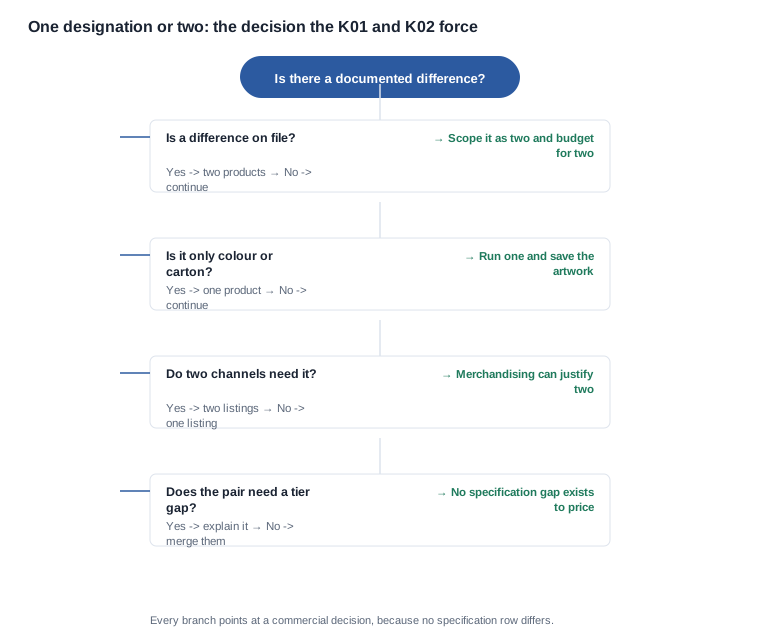
The one question that governs everything else
What, in writing, distinguishes the K01 from the K02? If the answer is a documented difference — a different firmware branch, a different acoustic configuration, a different control method, a different accessory set — then this is two products and the programme should be scoped as two. If the answer is that the difference is a colourway, a carton or a distribution arrangement, then it is one product with two designations, and the correct commercial response is to run one and save the artwork, the carton run and the second stock line.
The form of the answer matters more than the answer itself. A difference in the accessory chain changes the landed cost and the returns process. A difference in the firmware branch changes what has to be re-tested and re-certified. A difference in the acoustic configuration changes what the listing can say. A difference in nothing but the carton changes the packaging budget and nothing else.
Ask the question before the artwork is commissioned. The cost of discovering the answer after two carton runs have been printed is the whole of the saving the question was worth.
The evidence to hold
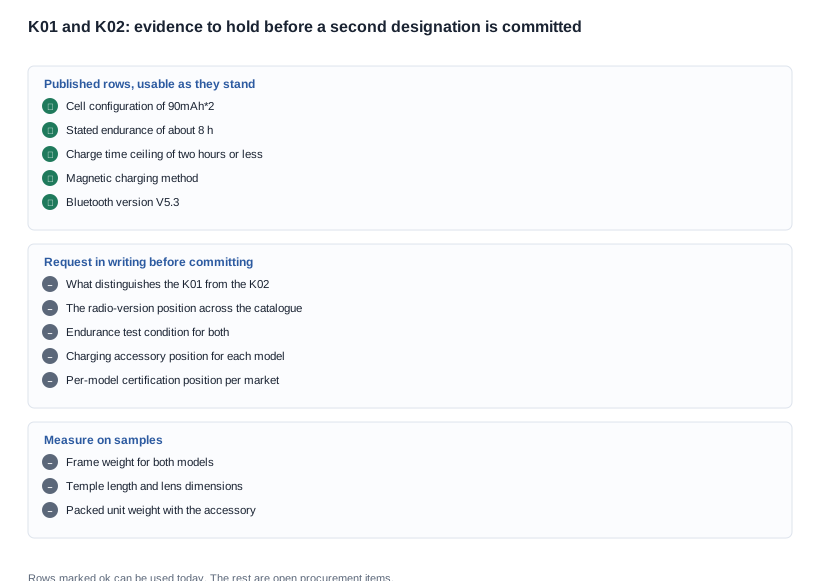
Five items on that list carry real consequences for this particular pair.
The written difference between the two models, or the written confirmation that there is none. Everything downstream depends on this.
The radio-version position across the catalogue. Because these are the only two V5.3 models, a buyer needs to know what the customer's platform actually is before the pair can be positioned against the six V5.4 audio models. If it is not known, that question has to be added to the brief rather than assumed away.
The endurance test condition for both models, asked in identical words. Without it, the eight-hour figure cannot be used to differentiate them from each other — it is the same number — and it cannot be used to differentiate the pair from the LC-105 pair, which publishes the same eight hours on roughly three-fifths of the energy.
The charging accessory position for each. Whether a case, pad or dock exists, its capacity, its interface, its own charge time and its weight, plus whether a spare is available at the buyer's quantity and at what lead time. That last question is a working capital question disguised as an accessory question.
The certification position per model per market. Two designations may need two applications if the file names the model. This has the longest lead time of anything on the list and should be the first request out.
Four failure modes this comparison produces
A difference was assumed to make the comparison work. Symptom: two product pages, two artwork sets and two carton runs for a product with one published configuration, and a range whose tiers are indistinguishable on a shelf. Root cause: a comparison was written without checking whether the rows actually differed. Prevention: get the difference in writing before commissioning anything.
The pair was positioned as a premium tier over the V5.4 models. Symptom: a listing claims a newer or better product where the only published fact is one radio generation, and a customer who checks the versions finds the tier is built on a version number. Root cause: a platform fact was read as a product hierarchy. Prevention: describe the pair as a radio generation, and build any tier on something else.
The 180 mAh total was quoted as a published figure. Symptom: a specification sheet carries a number that appears nowhere in the manufacturer's documentation. Root cause: a derived value was presented without marking it. Prevention: write "two cells totalling 180 mAh", never a bare total.
A weight was borrowed from another model. Symptom: a listing implies a light frame, returns arrive, and the channel corrects its own copy. Root cause: the one published weight in the catalogue was applied to a model it does not describe. Prevention: weigh the samples and quote the measurement, or quote nothing.

What a second designation costs commercially
Since the hardware is identical, no bill-of-materials argument supports a price gap between the two models. That is a direct consequence of the published rows and it is worth stating plainly, because a range with two identical-specification models usually arrives with a price difference attached that nobody can explain.
The gap has to be justified by something outside the specification sheet: the channel structure, the merchandising, the accessory set, the warranty terms or the delivery structure. Any of those is legitimate. The specification sheet is not, because there is nothing on it.
The terms worth working on. Unit price and volume tiers, the accessory set and its own minimum order quantities, packaging specification per designation, delivery splitting, payment nodes tied to inspection, the warranty period with a stated response, and the terms of a pilot order. Where two designations are run, the packaging and listing costs are the ones that differ most, and they are the ones least often negotiated.
Two lines that do not move with volume. Certification cost and its timeline follow the process and the testing body, and sit per product family rather than per order. Tooling is frequently amortised across a first order instead, so ask which of the two is being quoted — the two are often bundled into one line that hides which carries the volume.
What the agreement should carry per designation. The published rows of the configuration ordered, with the cell configuration written as the catalogue writes it; the endurance figure together with its condition once established; the charging method and the in-box accessory set; the packed unit weight confirmed at inspection; the certification position per market; and the warranty period with a stated response.
What must be left out. Any weight or dimension that was not measured; any acoustic or control description; any certification number; any price or price tier attributed to a specification difference that does not exist; and any bare energy total presented as a published figure.
Where a two-designation range quietly costs more than it appears
A buyer running both designations should expect four cost lines to exceed the obvious per-model figures, and each of them is invisible in a unit price comparison.
The artwork and the carton. Two designations means two artwork sets and two print runs, each with its own minimum order quantity. A slow-moving colourway on the second designation can force an order of cartons far beyond what that designation will sell in a year — and the carton minimum, not the frame minimum, is often what actually governs how small a replenishment order can be.
The listing and the support material. Two product pages, two sets of copy, two instruction documents and two support scripts. Where the hardware is identical, most of that copy has to say the same thing twice, which creates a second risk: the two descriptions drift apart, and a customer who has read both notices it.
The certificate file. If the documents naming the model have to be opened per designation, then a second designation carries its own application and its own lead time, and the programme's schedule changes. If the supplier's file covers both, it does not. That answer has to come in writing and early.
The stock line. Two designations split the forecast in two, and each half is less certain than the whole. In a category where the compliance work is front-loaded and the fit data has to be measured, a split forecast is a real risk rather than an administrative detail.
The useful discipline is to total these four before deciding that a second designation is worth it. In many channels the honest total says one designation is the better answer, and that is a better outcome than launching two product pages that cannot tell each other apart.
Where CYNRIN stands on the K01 and K02 comparison
The K01 and the K02 publish identical rows, and the useful output of a comparison between them is a decision about whether a second designation earns its place — not a ranking, because there is nothing to rank on. We will not manufacture a difference to make a two-model range look like a two-tier range, and we will not present a derived energy total as though the catalogue published it.
We will also not fill the gaps with plausible values. Where the documentation is silent — weight, dimensions, acoustics, control method, the accessory in the box, the certification position — we will say it is not published and tell you it has to be obtained, rather than supply a number that becomes a commitment.
What we can tell you is the platform picture, which is the part that actually helps. These two are the catalogue's only V5.3 audio models, they share the largest published total energy in the audio range, and they publish no feature lines at all. The published K01 specification list and the published K02 specification list are the honest baselines for both, and the K02 battery position covers the endurance row in detail.
Six items to settle before a second designation is committed
- What, in writing, distinguishes the K01 from the K02 — and if nothing does, that answer in itself.
- The radio-version position, given that these are the only two V5.3 models in the catalogue.
- The endurance test condition for both, asked in identical words.
- The charging accessory position for each, and whether a spare is available at your quantity.
- The measured frame weight, dimensions and packed unit weight.
- The certification position per model in each destination market.
Related reading
- The published rows for the first designation — K01 smart glasses specifications and features
- The published rows for the second — K02 smart glasses specifications and features
- The endurance row in detail — K02 smart glasses battery life
- The accessory pricing logic — Bluetooth audio glasses charging options
- Choosing across the range — Bluetooth audio glasses which model to pick
Give us the channel, the volume and the target market, and we will tell you whether a second designation earns its place in the range.


