

The published charging row for this model is three numbers and one method: a single 100 mAh cell, Type-C charging, a charge time of two hours or less, and a rated runtime of approximately seven hours. That is enough to plan a retail proposition around, and it is also enough to expose a decision most brands defer until the packaging artwork is already locked — whether the customer receives a cable, and what the product looks like because of it. This page is written for the buyer specifying that decision. It sets out what the published rows already settle, the four commercial forks the interface decision creates, the evidence to collect before the purchase order, and the clauses that should carry into the agreement. It does not contain a price, a minimum order quantity or a lead time, because our catalogue publishes none of them for this model.
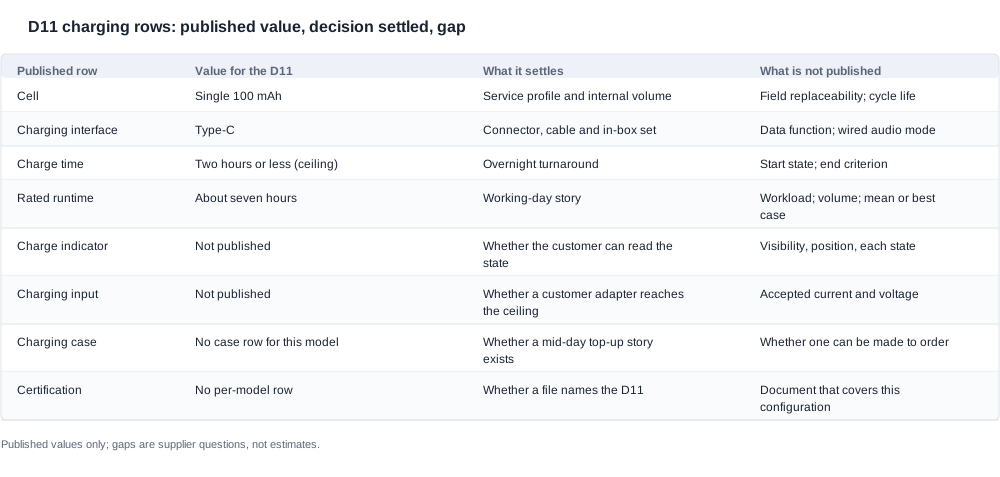
D11 charging options: the published rows and the four decisions they open
What the catalogue actually states for the D11
The charging-related rows published for the D11 are short enough to read at a glance. The charging interface is Type-C. The frame carries a single 100 mAh cell. The charge time is two hours or less. The rated runtime is approximately seven hours. The radio is Bluetooth V5.4. Two feature rows sit alongside the standard rows: a surround-sound line and a long-battery-life line. That is the complete published specification for this model.
Three of those numbers are ceilings or rated figures rather than measurements, and a buyer who treats them as measurements will build a plan that a test will contradict. The two-hour charge time is a published limit. The catalogue states how long the charge may take, not how long it took under a stated start condition with a stated end criterion, so it cannot be converted into the interruption a customer experiences when they top up for ten minutes in a car. The seven-hour runtime is a rated figure with no attached workload, volume level or pairing state. The 100 mAh figure is a cell capacity, and what it produces depends on everything downstream of it. None of the three is a measurement, and none of the three should be quoted in a listing page without that qualification attached.
The four decisions the interface row creates
Type-C on the D11 is a published, settled fact, and that is exactly why it is commercially useful. A stated interface closes the connector question, the cable question and the charger-compliance question in a single step, because every one of them can now be planned against a known standard rather than against an assumption. Four decisions follow from it, and each has a cost attached somewhere in the channel.
The first decision is the in-box accessory set. A Type-C frame needs a USB-C cable to be usable out of the box, and that cable is either supplied, bought separately by the customer, or supplied only in a specific retail bundle. Each of those three answers moves cost between the bill of materials, the support desk and the customer.
The second decision is the visual reading of the product. A USB-C socket in a temple is a hole cut into the frame, sealed against sweat and rain, and subject to wear over time. A magnetic contact has no opening. For a buyer specifying into an apparel or eyewear channel, that difference is a design decision before it is an electrical one; for a buyer specifying into an electronics channel, the visible port reads as reassurance.
The third decision is the failure behaviour at the support desk. A cable either seats correctly and charges, or it visibly does not. A magnetic contact that is misaligned can look seated while charging nothing, and the customer concludes the product is defective. A visible charge indicator is what prevents that ambiguity, and whether the D11 carries one is not published.
The fourth decision is the return path for the all-day story. The catalogue publishes no charging-case row for the D11, and no audio model in our range publishes one, while several camera models do. If the retail proposition depends on a customer topping up mid-day, that story has to be carried by a cable and a wall charger, or the proposition has to change.
Where the D11 sits inside the range
Two of the eight audio models use a Type-C interface: the D11 and the D12. The remaining six — the K01 and the G07, the LC-105-2 and the LC-105-1, and the YK12 and the K02 — publish magnetic charging, and the K01 and the K02 publish Bluetooth V5.3 while the other six publish V5.4. The D11 and the D12 differ from each other by exactly one published row: the D11 carries a surround-sound feature line and the D12 carries no feature row at all.
Across the full twenty-eight model catalogue the interface splits seven against seventeen in favour of magnetic. The seven Type-C models are the V03 Pro, the L2 Utral, the D11, the D12, the D17, the ZH12 and the bone-conduction model; the seventeen magnetic models include the S7 and the MT5, the V06 and the V03, and the LC-105-1 and the A07, the K01 and the A05, the LC-105-2 and the YK12, the K02 and the YKC02, the KY06 and the A06, and the G07, the AR model and the electrochromic model. Four camera models publish no charging method row at all: the CY05 and the MT6, and the L1 Pro and the CY03, all four of which do publish a charging-case capacity. The charge-time split runs the other way from the interface split: twenty-six models publish two hours or less, and only the D17 and the ZH12, both of them sport models, publish approximately one hour.
The single-cell question
One cell changes the charge job in three specific ways, and all three are worth pricing before the purchase order rather than after the first shipment.
One cell means one thing to charge and one thing to fail. A frame that splits capacity across both temples raises a service question our documentation does not answer for any model in the range: what happens when one side fails. With a single cell, the failure is the failure, and the spare-parts question becomes simple even though the answer is not published.
One cell means one service profile. There is one cell to replace, one balance point to manage inside the enclosure and one internal volume to find. Whether the cell is field-replaceable is not published for the D11, and that single unknown decides whether your spare-parts line is a cell or a whole temple assembly, which is a large difference in both the parts list and the return logistics.
One cell means the charge time is not a parallel operation. Two cells can charge in parallel or in sequence; a single cell cannot. It is worth noticing that the two-hours-or-less figure is published for single-cell and paired-cell models alike, so the cell count does not produce a different headline number. Treat the two-hour figure as a family-level ceiling rather than as evidence of a particular charging architecture.

The four commercial forks the port decision creates
The accessory set and its three cost lines
The accessory decision is not a single question but three questions that belong in three different parts of the business, and mixing them up is how the cost appears in the wrong place.
The first cost line is the bill of materials. A USB-C cable is inexpensive per unit and material in aggregate across volume. Whether it is in the box is a cost decision that a procurement manager can make, but it needs to be made explicitly, because an omitted cable is not a saving, it is a support cost deferred to the customer's first week with the product.
The second cost line is the parcel. A cable in the box adds volume and adds weight, and for a product with no published frame weight, the packed weight is one of the numbers the freight quote will turn on. The shipping weight guidance across this range sets out why an unpublished weight becomes a shipping negotiation.
The third cost line is the support and returns path. A missing cable generates contacts from customers who bought a product they cannot use; a defective port generates contacts from customers who dropped the product. The quality check list for this family covers the incoming-inspection discipline that catches the second category before it reaches a customer.
The design consequence, and the channel that cares
A frame with a port and a frame without a port are not the same product with a different component. The port has to be cut into the temple, sealed against sweat and rain, and it degrades with use in a way that a sealed contact does not. The category's history is largely explained by that constraint: models with no visible port have a continuous temple, and models with a port have a break in it.
The commercial consequence is that a Type-C product reads as a connected device, and a portless product reads as eyewear. For a buyer specifying into an apparel channel where the product sits next to a pair of spectacles, that difference is part of the proposition. For a buyer specifying into an electronics channel, it is close to irrelevant, and the port is a reassurance that the product is a real connected device rather than a styled accessory.
The procurement implication is that the interface decision should be taken against the channel, before the shortlist is scored, rather than inherited from whichever model scored highest on the power rows. A shortlist that puts the D11 and the K01 side by side and then weights the interface row afterwards has already made the decision for you.
The indicator question, and why it is not a detail
Whether a customer can tell that the product is charging is a published-row question, and for the D11 the answer is that the row is not published. That is a small gap with a large consequence in a Type-C design, because a Type-C socket can accept a cable in a partial seating that does not charge.
There are three states worth specifying, and each one has a different commercial meaning. A charging state that shows only during charge tells the customer that the cable is seated and the product is drawing power. A full state that persists after the charge ends tells the customer they can stop watching it. A low-battery state tells the customer they have a problem before it becomes a return. The accepted input current and voltage, which determine whether the customer's own wall adapter produces the published charge time, are also not published.
The case question, and the three states the catalogue uses
This is the point where a buyer who works across categories most often makes an error, because "no case" and "case with an unpublished capacity" and "no case row at all" are three different states in our catalogue, and they are not interchangeable.
Five camera models publish a charging-case capacity: Three camera models publish a 1400 mAh case — the CY03 and the CY05, and the L1 Pro — while the L2 Utral is offered with either a 900 mAh or a 1400 mAh case and the MT6 pairs with a folding 1200 mAh one. A further two, the KY06 and the MT5, carry a case whose capacity the catalogue does not give. Four camera models — the V06 and the V03 Pro, and the S7 and the V03 — carry no charging-case row at all, which is an absence rather than a statement, and what each of those four carries in the carton is still to be confirmed. The D11, like all eight audio models, has no charging-case row.
For a buyer, that produces a clear instruction rather than a grey area: if the retail proposition needs a mid-day top-up, the D11 does not currently publish a way to supply one, and the question to ask the supplier is whether a case can be produced for this platform at your volume, at what minimum order quantity, and with what own lithium-cell transport documentation. Those three answers are quotation items, not catalogue facts.
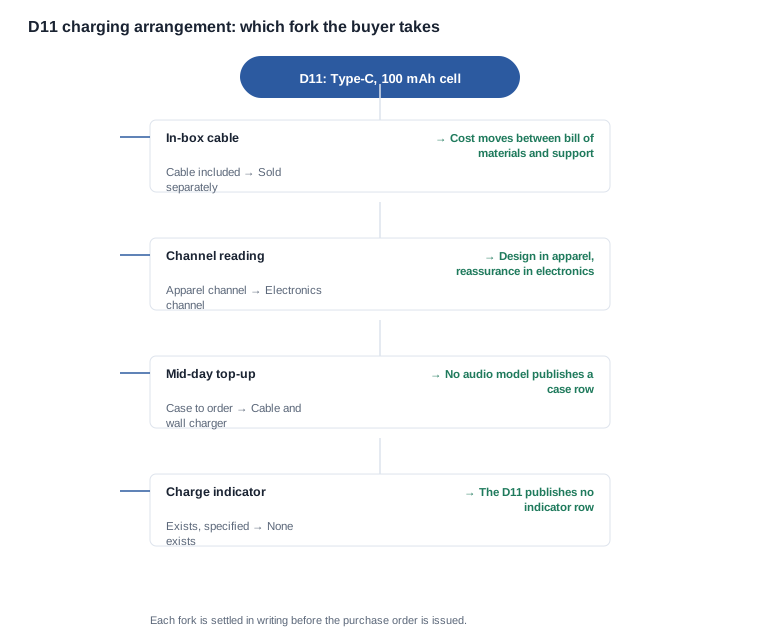
Verifying the charging arrangement before the purchase order
The questions to send, in one message
Three short answers decide the accessory and support model for this platform, and they are cheap to ask and expensive to discover later. Whether the cell is field-replaceable. Whether the Type-C port carries data, and whether it supports a wired audio mode alongside the Bluetooth radio. What the charge indicator shows in each state, and whether one exists at all.
Send them together. A buyer who asks the cell question in one email and the port question three weeks later will receive two answers written by two different people, and will discover the disagreement at incoming inspection rather than in a negotiation. A single message with a single reply date produces one coherent answer that can be written into the specification.
The three documents that close the open rows
Some open rows cannot be closed by a sentence. Three of them need a document, and the request is always the same: the file itself, not a statement that it exists. A file that exists can be read, versioned and attached to the agreement; a statement that a file exists has to be taken on trust and re-requested at every audit.
The first document is the cell specification and, with it, any cycle-life figure. A cycle life number without a test condition — a charge and discharge rate, a temperature, a retention threshold and a cell count — is not usable, because the next shipment may differ from the last one. The published 100 mAh figure is the cell capacity; the number that describes how that cell ages is a separate thing and is not published for any model in the range.
The second document is the charging input specification, covering accepted voltage, accepted current and the adapter the product is expected to be used with. Without it, the published charge-time ceiling has no reference condition, and a customer using a different adapter has no basis for a complaint — or for a satisfied expectation.
The third document is the compliance file that names the D11 under its exact model designation. The relevant radio requirement is governed by the Radio Equipment Directive (framework reference 2014/53/EU), and that requirement binds to one specific configuration; a restricted-substance file for a market is separate work and is often quoted as though it were the same document. Our catalogue publishes no per-model certification row, and the catalogue text contains no reference to CE, FCC or RoHS, so this document has to be requested and inspected rather than assumed. The certification status page for this model explains the difference between a company-level page and a model-level file.
The acceptance rule for an answer
Not every reply closes a row, and the test should be written down before the replies arrive. The rule we suggest is deliberately strict: an answer is accepted when a second buyer could ask the same question, get the same answer and reach the same conclusion.
A figure without a method fails, because the next production lot may differ from the one described. A method without a figure fails, because it cannot be used in a specification or a listing. A statement that a document exists fails, because documents expire, get reissued and get superseded, and a buyer who has attached a statement rather than a file has nothing to audit at the next supplier audit.
Where an answer cannot be obtained, the correct commercial response is to narrow the claim rather than to hold the question open indefinitely. A channel that cannot establish a charge-indicator behaviour can still sell the D11, and it simply keeps the indicator out of the listing copy. A channel that cannot establish field-replaceability can still order the model, and it budgets a whole-unit replacement rather than a cell replacement. The cost of an unanswered question is never zero; it is a narrowed specification, and it is better to narrow it deliberately.

A note on capacity and cell count in the comparison sheets
One methodological point saves a recurring argument in this range. Several models in the audio family publish their cells in the catalogue's own notation — 90 mAh × 2, 55 mAh × 2, 70 mAh × 2 — and that notation is what a comparison table should carry. A table that shows a derived total instead of the published pair reads as though the total were a published specification, and a buyer who quotes that total back at a supplier can be told, correctly, that the catalogue does not publish it.
Derived totals are legitimate inside analysis, provided they are labelled as derived. "Two cells totalling 110 mAh" is a fair analytical sentence. A table cell reading "110 mAh" is not, because a table cell is read as a published value. The battery comparison across this range works through the published rows and the limits of the comparisons they support.
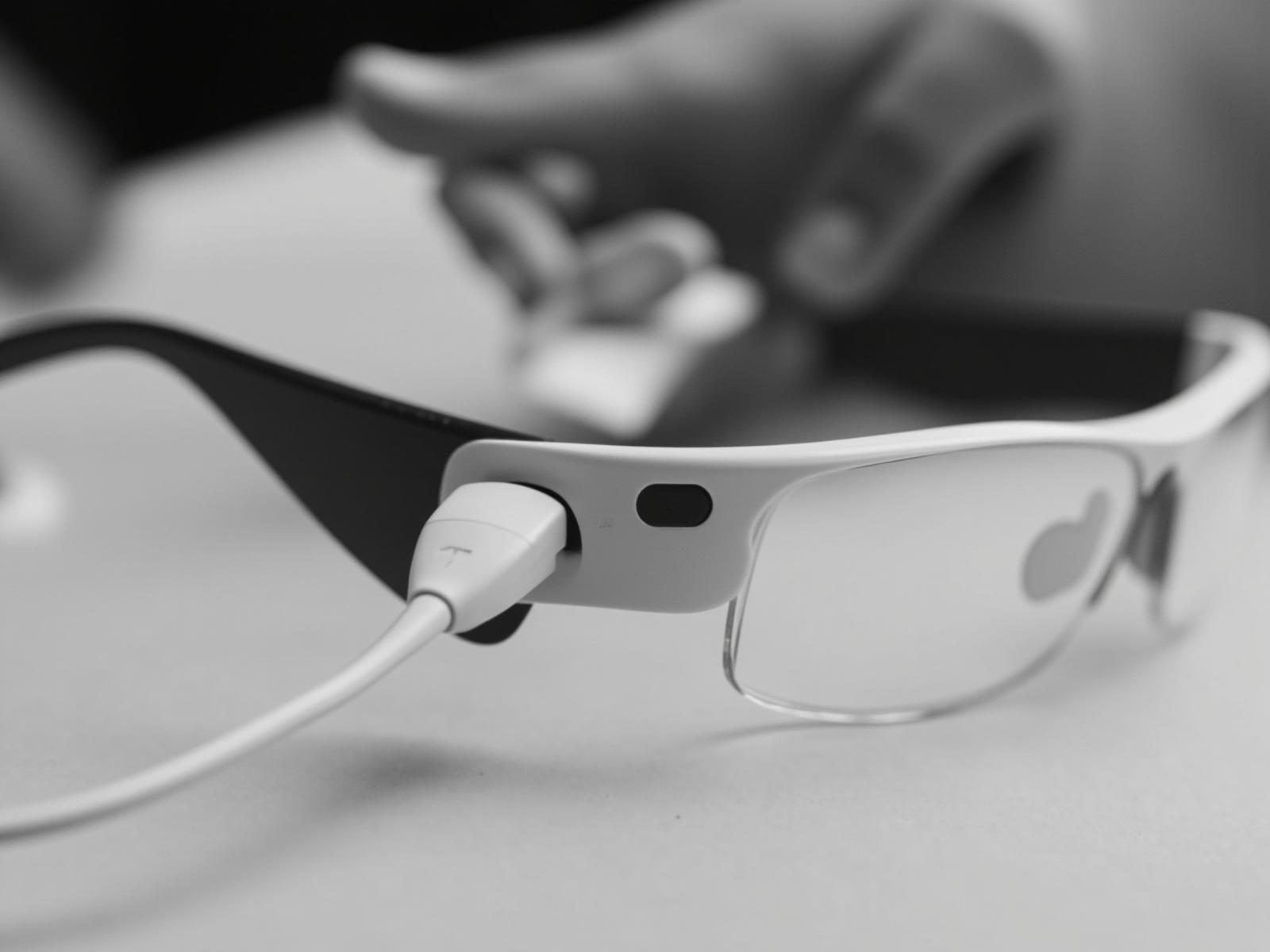
Where charging decisions break down in the channel
Four breakdowns account for most of the trouble buyers report in this category, and all four are visible in advance if the interface question is taken at the right point in the process.
The first is a product chosen on design, with the port noticed afterwards. The symptom is a connected device that reads as a gadget in a channel where it should read as eyewear. The root cause is that the interface was treated as a technical detail rather than a channel decision. The prevention is to settle the interface against the channel before the shortlist is scored, and to treat the four forks above as the scoring criteria rather than as a later configuration step.
The second is the cable omitted from the box. The symptom is a support contact from a large share of customers in their first fortnight, each one avoidable. The root cause is that the accessory was never priced as a bill-of-materials line. The prevention is to decide the in-box set as a cost decision with a named owner, at the same time as the packaging specification, not once the artwork is signed off.
The third is an all-day story promised without a case. The symptom is a listing whose endurance claim exceeds what the hardware can deliver. The root cause is that the audio family was assumed to have the camera family's case position. The prevention is to check the accessory position for the exact platform before the copy is written, and to keep the case question on the supplier request list as a quotation item rather than a expectation.
The fourth is the runtime quoted as a working day. The symptom is a customer in a light-use pattern being disappointed by a figure produced under a heavy one. The root cause is that the test condition was never requested, and the published figure was repeated without its basis. The prevention is to quote the approximately seven-hour figure with the words "rated" attached, and to state in the listing that no test condition is published for it.
A fifth, less frequent, is the charge indicator assumed into existence. The symptom is a customer who cannot tell whether the product is charging and a support contact that describes the product as faulty. The root cause is that the row was never asked for, because nobody thought of it as a published row. The prevention is to put it in the purchase order as a line with a response deadline, exactly like the cell and the port questions.

Writing the charging clauses into the purchase agreement
The terms that move
Several commercial terms belong in the negotiation on this model rather than after it. Unit price and volume tiers, with the quantity break structure written down. The in-box accessory set and the minimum order quantity for each accessory line, including the cable if it is supplied. Packaging specification, including the master carton quantity and the packed dimensions that the freight quote will be built on. Delivery splitting and the schedule against which the deposit and balance payments fall. Payment nodes tied to inspection rather than to elapsed time. The warranty period with a stated response time rather than a stated duration alone. The spare-parts price for a failed cell, if field-replaceability is confirmed, and the route for a failed temple assembly if it is not.
These are the terms where the charging decision shows up in cash. Every one of them is a term the supplier can price differently tomorrow, and every one of them becomes harder to reopen once the purchase order is issued.
The terms that are quoted as fixed
Two cost lines are usually quoted as non-negotiable, and it is worth knowing which ones they are before a negotiation starts. Certification cost and test lead time follow the process and the testing body rather than the volume, so they behave as a fixed line. Tooling is frequently amortised across the first order, and it is frequently bundled with certification into a single line that hides which is which; ask which of the two is being quoted, because the answer determines how the line behaves when the quantity changes.
The clauses that belong in the specification
The clauses that follow from the charging decision, and that should be attached to the agreement as an annex rather than left in a conversation, are: the published rows for the configuration ordered, quoted from this catalogue so that both sides are working from the same numbers; the rated runtime with its stated basis, or an explicit statement that no test condition is published; the charging input specification; the charge-indicator behaviour, including the case where none exists; the port's data and audio behaviour; the cell's field-replaceability and the failure-handling route; the accessory set with its minimum order quantities; and the warranty period with a stated response time.
What should be left out
Some things should not appear in the agreement at all, and the temptation to include them is strong because they make the document look more complete. A charging input figure filled in from a typical value rather than from the supplier. An indicator behaviour described because it sounds sensible. An acoustic number borrowed from another model. A working-day claim derived from the approximately seven-hour rating without its condition. Each of these would make the document look more authoritative while making it less auditable, and an auditor who checks one of them will reasonably begin checking the rest.
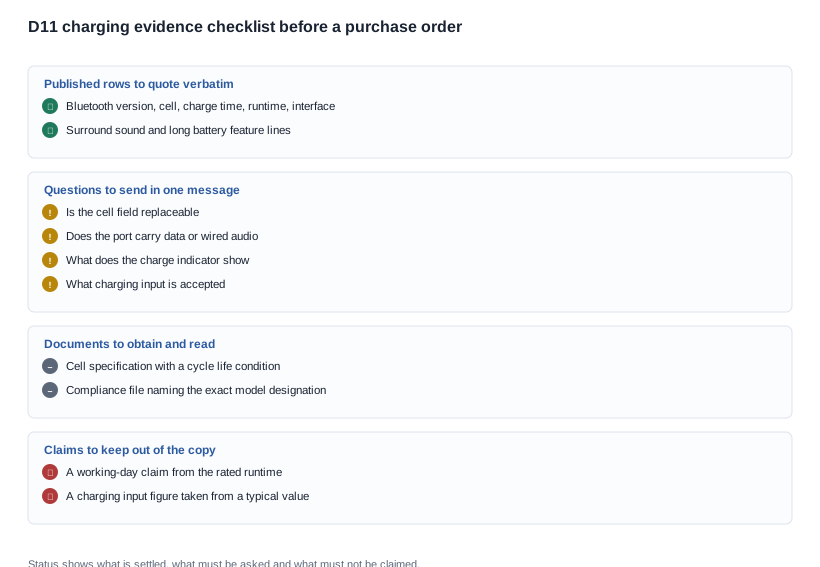
What the catalogue will and will not state about charging
We publish the electrical rows and the feature rows for every model in the catalogue, and we publish nothing else. For the D11 that means Bluetooth V5.4, a single 100 mAh cell, a charge time of two hours or less, an approximately seven-hour rated runtime, Type-C charging, a surround-sound feature line and a long-battery-life feature line. We do not publish a price, a minimum order quantity, a delivery schedule, a warranty term, a production capacity figure, a frame weight, a charging input, an indicator behaviour, a cell cycle life or a per-model certification row, and we will not substitute a typical value for any of them.
That boundary is a limitation we accept rather than a stance we defend. A catalogue that published every number would read better on a web page and be less useful in a negotiation, because the buyer would still have to verify the numbers that drive the cost. The buying guide for this range sets out the same principle at category level, and the pre-ordering checks for this model collect the same evidence in sequence.
Send us the channel, the volume, the target market and the accessory decision you are considering, and we will come back with the configurations that exist, the rows that are published for them, and the rows that are currently questions rather than specifications. We will also say which questions we cannot answer ourselves, so that your supplier request list starts from the real gaps rather than from a generic checklist. The range is on our Bluetooth audio glasses page, the power rows against a paired-cell model are in D11 against the LC-105-2, and the charging arrangements across the range are covered on the charging options page. That is the whole of the D11 smart glasses charging options question: the published rows tell you what the charging arrangement is, the written answers tell you what it costs, and the two together are what a buyer can commit against.
Related reading
- The power rows against a paired-cell model — D11 against the LC-105-2
- What to check before ordering this model — D11 pre-ordering checks
- How charging is handled across the range — charging options
Tell us the channel, the volume and the target market, and we will come back with what is available.


