

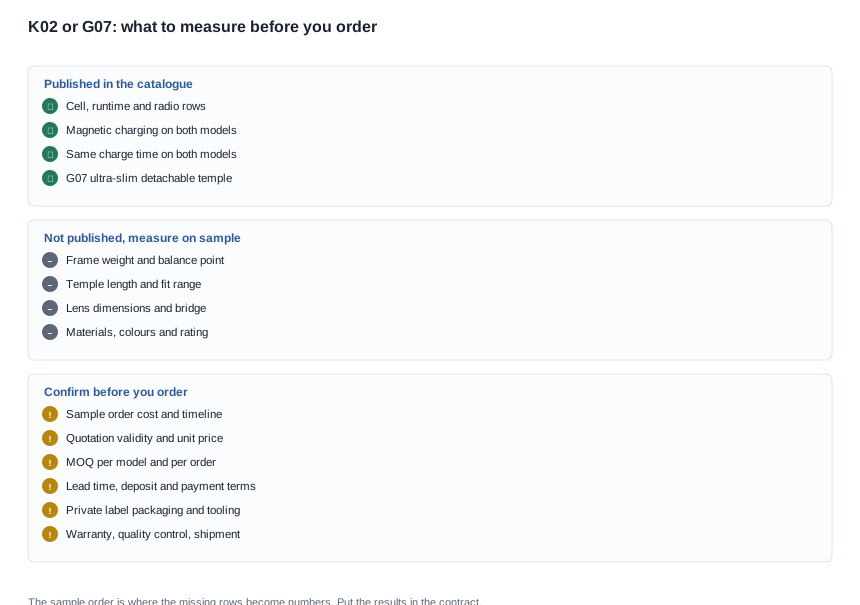
A form factor comparison normally means measurements: weight, temple length, lens size, bridge width, materials, colours. For the K02 and the G07, none of those measurements exist in the catalogue. Not for the K02, not for the G07, and not as a range figure that could be used as a proxy. The only published design statement for either model is the G07's ultra-slim, detachable temple, and the K02 publishes no temple statement at all.
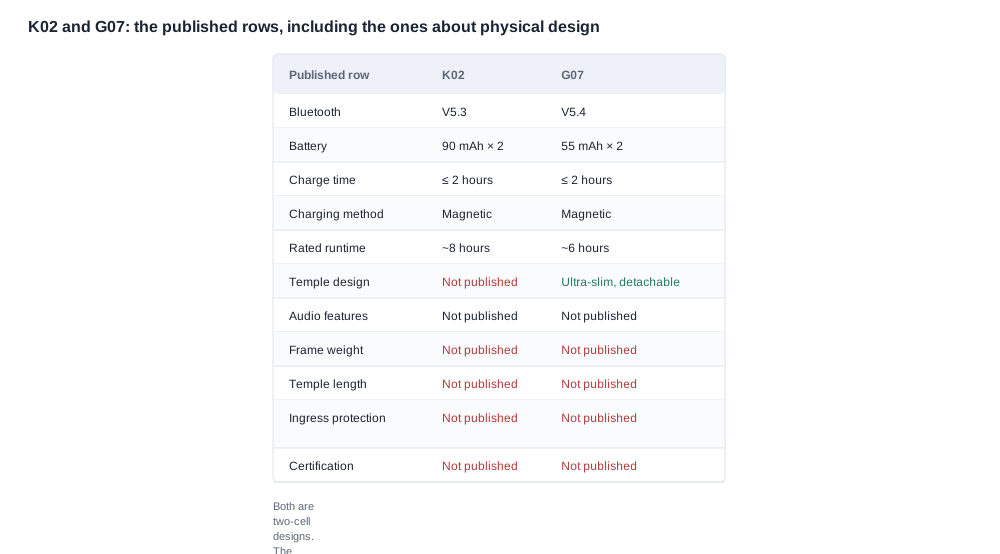
That is not a dead end, it is the finding. The comparison that can be made honestly has two halves: the rows the catalogue does publish, which describe two different hardware platforms, and the rows it does not publish, which describe fit and cannot be closed with a table. A buyer comparing the K02 and the G07 on shape should be treating a sample order as the measurement instrument, and this article is written to tell you exactly what to measure, what to ask for, and what the published rows already tell you about which platform you would be buying.
K02 and G07: what the catalogue publishes
Here are the complete published rows for both models.
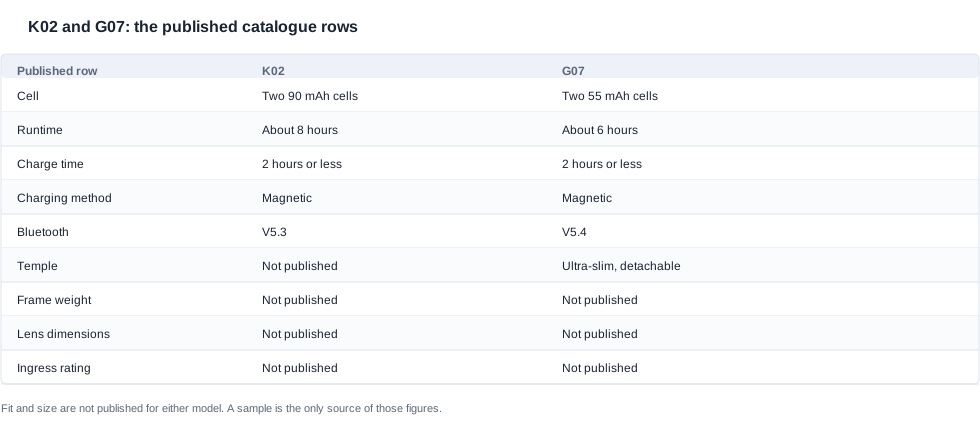
| Published row | K02 | G07 |
|---|---|---|
| Product name | K02 AI Bluetooth Glasses | G07 AI Bluetooth Audio Glasses |
| Cell | 90 mAh × 2 | 55 mAh × 2 |
| Published runtime | about 8 hours | about 6 hours |
| Charge time | 2 hours or less | 2 hours or less |
| Charging method | Magnetic | Magnetic |
| Bluetooth | V5.3 | V5.4 |
| Design statement | None published | Ultra-slim, detachable temple |
| Frame weight | Not published | Not published |
| Lens dimensions and material | Not published | Not published |
| Ingress protection | Not published | Not published |
Start from the bottom of that table and work upwards. Frame weight, lens dimensions, lens material, colour options and ingress protection are not published for either model. In the wider catalogue the only models that publish an ingress protection figure are the V06 and the S7, both of which carry IP54, and no audio model in the range publishes an ingress rating at all — so neither the K02 nor the G07 can be described as water resistant from the published data. On weight, the only published frame weight anywhere in the catalogue belongs to the MT6, at 158 g for the eyewear body excluding its folding case, and a number belonging to a different model with a different architecture is not an estimate for either of these two.
Two further catalogue-level silences close off the usual shortcuts. There is no capacitive touch control row anywhere in the library and no translation row either, so no AI function and no control method can be attributed to either the K02 or the G07. And the catalogue body contains no FCC, CE, RoHS or RED reference for any model — the export compliance page is an image page with no per-model certification line — so there is no certificate number, no issuing body and no validity period available for either frame. Commercial terms are silent as well: no price, no MOQ, no lead time, no sample policy, no warranty period and no capacity figure are published for either model.
So what the catalogue actually supports is this. The K02 publishes Bluetooth V5.3, two 90 mAh cells, magnetic charging, a charge time of 2 hours or less and about 8 hours of runtime. The G07 publishes Bluetooth V5.4, two 55 mAh cells, magnetic charging, the same charge time of 2 hours or less, about 6 hours of runtime, and a design statement describing an ultra-slim, detachable temple. Everything else is either a measurement you take or a document you request.
The temple statement is worth unpacking on its own, because two short words carry two separate decisions. "Ultra-slim" is a proportion claim: it describes how narrow the temple profile is, which affects how the frame reads on a face and how much of it touches the side of the head over a long day. "Detachable" is a mechanical and a commercial claim: the temple comes off, which changes assembly, packaging, replacement and retail sizing. Neither word tells you whether the temple is user-replaceable or factory-only, and those are entirely different products commercially — one is a service-cost reduction and a sizing story, the other is a warranty claim and a return. "Detachable" on a catalogue line does not distinguish them, and the distinction is worth an email before it is worth a purchase order.
And the K02 publishes nothing comparable. It is not published as slim, standard, detachable or fixed. Its silence is not evidence of a fixed temple and it is not evidence of a slim one — it is simply silence, and the honest way to handle it is to measure the sample and write the result into your specification.
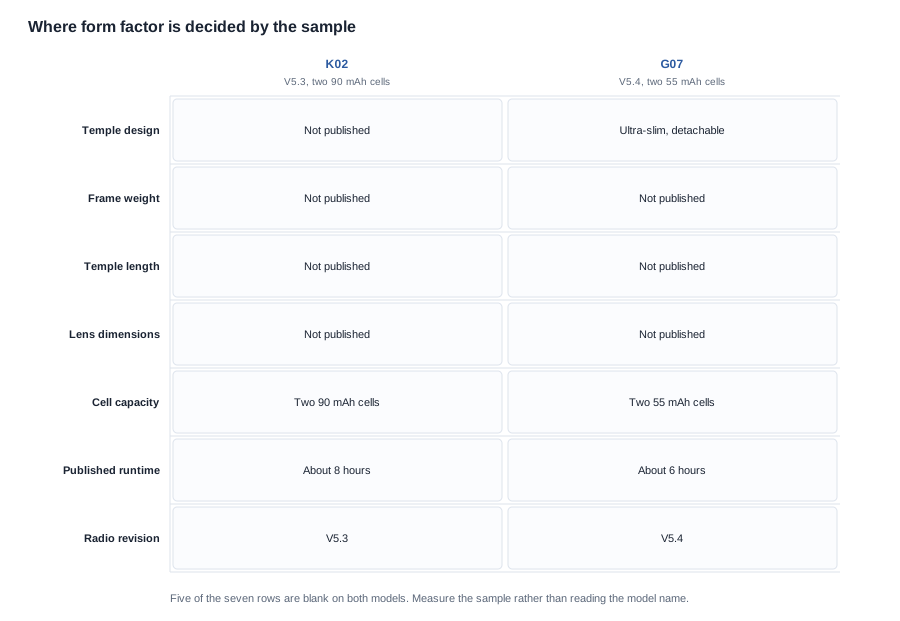
Where form factor is decided by the sample and not the sheet
A frame is a physical object and physical objects answer physical questions. The reason form factor comparisons fail in buying conversations is that the measurement is usually skipped and the model name is read as if it carried a design. So here is the measurement list, complete, for both models.
- Frame weight, measured on the same scale and reported with the packaging removed, because a comparison between two numbers taken with different conventions is not a comparison.
- Temple length and the adjustment range, plus the temple profile width at the hinge and behind the ear — the numbers that decide whether a face shape fits.
- Lens dimensions and bridge width, and whether the frame ships with lenses fitted or with clear demonstration lenses, which changes both the optical impression and the packaging.
- The balance point, which is not the same as the weight: a heavier frame that sits well can wear better than a lighter frame that slides forward, and only a worn sample tells you which one you have.
- Nose pad and bridge contact, because pressure marks after a full day are a return reason and they are not visible in any photograph.
- Hinge and temple flex, and whether the G07's detachable temple is released by a screw, a latch or a magnetic catch — which decides whether a distributor can size a frame at retail.
- Materials and colour options, none of which is published for either model, and all of which affect both the tooling cost for a private label build and the customer-facing claim.
- Ingress behaviour, tested by the buyer if the use case involves water, because the catalogue publishes no rating to rely on.
The runtime row belongs in this section too, because it decides an all-day wear question. The K02 publishes about 8 hours and the G07 about 6 hours, and a buyer comparing an eight-hour frame with a six-hour frame is really comparing how long each one survives a working day. But the range publishes about 8 hours on the LC-105-1 and the LC-105-2, both of which carry two 55 mAh cells, while the G07 carries those same two 55 mAh cells and publishes about 6 hours. Identical cell configuration, a two-hour spread, and no test condition published for any model in the range. The published runtime is a platform figure rather than a capacity figure, so the number you print on a listing is the number you should measure on your own sample under your own conditions. Our battery life note sets out the method questions to put to a supplier.
The platform split matters here as well, because it changes what the sample is testing. The K02 shares its radio revision and its cell configuration with the K01, and the G07 shares its 55 mAh cell configuration with the LC-105-1 and the LC-105-2. You are not comparing two variants of one product; you are comparing two platforms, each of which arrives with its own tuning, its own accessory set and its own set of service parts. A detachable temple also changes the assembly steps in your warehouse and the number of parts in the box, which is a private label and packaging question before it is a fit question.
A sample programme is an order of operations, not a single order. Buy both frames in the same week so that they sit in the same room, in the same box type, with the same accessories. Weigh them on one scale and record the date, because a factory that has just revised a moulding will not tell you that the sample you received differs from the next batch. Wear each one for a full working day and note the pressure points. Test the temple release with the tools a customer would have, not with a technician's screwdriver — if the G07's detachable temple needs a tool to come off, then it is a factory-replacement design and your retailer cannot size it at the counter, which changes the whole retail sizing argument. Charge both from the magnetic dock under the same conditions and time them, because a published charge time of 2 hours or less is an upper bound and not a working figure. And keep the paperwork with the frames: the measurement sheet, the photographs and the supplier's written answers travel into the purchase order, and without them you will be measuring the next batch from memory.

Comparing two frames when the published rows are narrow
Narrow published data does not make a decision impossible, it changes the shape of the decision. The comparison moves from a feature table to a sample programme, and from a feature list to a document set. Six documents do most of the work.
The quotation is the first one, because it is the only document that carries a price, and no price is published for either model. Ask for the unit price at your volume, ask what is inside it — hardware, packaging, private label print, any tooling amortisation, any cost attached to producing conformity documents for your destination market — and ask how long it stays valid. Ask which incoterms the factory offers, because incoterms decide who carries the risk and who arranges the shipment paperwork. Ask for the MOQ per model, per colour and per logo, and then ask the question that actually determines whether a two-model range is economical: does the MOQ apply per SKU or per purchase order?
The sample order is the second document and the most valuable one in the whole process, because it is the only instrument that can answer the fit questions. Ask what a sample costs, whether the sample fee is credited against the bulk order, how many samples you receive and how long they take. Then use them as instruments rather than as showpieces: weigh them, measure them, wear both for a full working day, and record the numbers on a single sheet so the comparison is like for like. A sample that is not measured is a sample that has cost you money and told you nothing.
The written specification is the third. Put the published rows into it, and put your measurements into it, and identify which line came from where. A contract that only names a model name protects nothing, and a specification that says "similar to the sample" protects less. Where the catalogue is silent, the specification should say that the figure was measured on the approved sample, with the sample serial and the date.
The contract is the fourth, and the terms worth negotiating into it are specific: the approved sample as the quality reference, the packaging specification, the inspection criteria, the delivery date, the conformity documents handed over at shipment, the remedy for a non-conforming batch, and the treatment of the tooling you paid for. Know which of these you can negotiate and which are simply fixed by the platform. Tooling ownership is the clause most often missed. If the private label version carries a moulded logo, a moulded temple or a custom colour, ask who owns that tooling at the end of the contract and whether it moves with the supplier.
The warranty and the quality control plan are the fifth. Ask for the warranty period, what it covers, the return route, who pays the freight, and what happens to a unit with one failed cell in a two-cell design — the K02's architecture differs from the G07's, and the service procedure differs with it. Ask what the incoming inspection covers, whether you may inspect before shipment and who pays for that inspection, and what batch records or serial numbers arrive with the goods.
The shipment and compliance pack is the sixth. Certification for either model is not published, so the question is not whether the product has a certificate but which document the supplier can issue, for which model, covering which destination market, with what issuing body and what validity period. Ask for the declaration of conformity, ask whether the technical file sits with the factory or with you, and ask what happens to it if the model is reworked. For a repeat programme, run due diligence properly: whether a factory audit is possible, whether a third-party audit is acceptable, what the supplier's own quality control system looks like, and what the risk is if a sub-supplier changes underneath you.
One caution about a single sample. A sample is evidence of one unit, and the risk you are managing is that the unit you measured is not the unit that arrives in your bulk order. Frame tooling changes, cell suppliers change and assembly steps get re-timed, and none of that is visible on the catalogue page. The defence is procedural rather than technical: ask the supplier to confirm that the sample is production-representative, ask what has changed since the sample was built, ask for a production unit to be measured against the same sheet before shipment, and write the tolerances you will accept into the contract. A frame that arrives half a millimetre heavier and a millimetre longer is still a frame, but it is a different frame, and only a written tolerance protects the shelf.
The trade-off to name out loud. The G07 gives you a published design story — ultra-slim, detachable — that a retailer can put on a shelf, size at the counter and replace in service. The K02 gives you the larger published capacity, the longer published runtime and a specification sheet that publishes nothing you must defend. What the G07 costs you is a platform with smaller cells, a shorter published runtime and a detachable temple that adds parts to your assembly and packaging. Both are defensible; they simply answer different channels.
Before you order, the checklist is short. The questions to ask are not about taste — they are about which document will hold the answer, and which one you will have to measure yourself.
- Sample measurements — weight, temple length, temple profile width, lens dimensions, bridge width, balance point — taken on both models with the same method.
- A worn-day note from each sample: comfort, pressure marks, temple flex, and whether the detachable temple on the G07 is released by a user or only at the factory.
- A runtime test under conditions you can describe, so the published about 8 hours and about 6 hours become numbers you can defend.
- A written temple statement for both models, including whether the K02's temple is detachable and whether the G07's is user-replaceable.
- A commercial pack — quotation validity, unit price, MOQ per SKU and per order, lead time, deposit, payment terms, incoterms, tooling and the warranty position.
- A document list — declaration, technical file, conformity documents for your destination market, inspection criteria and the batch records you will receive.
- A fit statement in your own product page, so the end customer sees a measured figure rather than a borrowed one.
Where CYNRIN places the K02 and the G07 in the audio range
The audio range covers eight models: the D12 and the K01, the G07 and the K02, the YK12 and the LC-105-2, and the D11 and the LC-105-1. Sorted by the published rows, they fall into a small number of platform families, and each family has one characteristic that decides where it is bought.
- The K01 and the K02 share Bluetooth V5.3, two 90 mAh cells, magnetic charging, a charge time of 2 hours or less and about 8 hours of runtime. This is the larger-cell magnetic platform of the range, and the K02 publishes no design statement, so it is bought on its published rows and on what a sample measures.
- The D11 and the D12 share Bluetooth V5.4, a single 100 mAh cell, USB-C charging and about 7 hours. This is the USB-C route through the range, and it is the route a buyer takes when a visible port, a cable in the box and a single-cell architecture matter more than a port-free frame. The D11 is the one of the two that publishes a surround sound claim.
- The LC-105-1, the LC-105-2 and the G07 share Bluetooth V5.4, two 55 mAh cells and magnetic charging. This is the small-cell magnetic platform, and the G07 is the member of it that carries a published design statement. The LC-105 pair publishes about 8 hours on those cells while the G07 publishes about 6 hours on the identical cells, which is the cleanest proof in the catalogue that the runtime row belongs to the platform rather than to the battery.
- The YK12 is the eighth model in the range. Its row is not among the published rows quoted here, so we ask for it in writing rather than reading it across from its neighbours, because a specification inferred from a neighbouring model is a specification that ends up on somebody's purchase order.
So where do we place the K02 and the G07? We place the G07 as the design-led end of the small-cell magnetic platform: the only model in the audio range whose catalogue line carries a physical design statement, aimed at a channel that sells the frame first and the electronics second. We place the K02 as the specification-led end of the larger-cell magnetic platform: the longest published runtime in the range, no published claim to defend, and no published design story to tell. Neither is better in the abstract, and the honest summary is that the G07 answers a merchandising question while the K02 answers a specification question.
How to evaluate the pair, practically. Decide first whether your channel is selling the frame or selling the runtime, because that single question usually collapses the comparison. Then set your criteria — wear comfort, the figure you will print, the claim you can make, the number of parts in the box, the documents you must collect — and score both models against the sample rather than against the sheet. Whatever the outcome, the specification you sign should contain measured numbers and named documents, not adjectives lifted from a catalogue line. The commercial argument for the G07 route is set out in our note on G07 value for money, and the rows where this platform stops short are set out in G07 limitations.
Both models sit in the family shown on our Bluetooth audio glasses range page, and both can be built as a private label programme — our OEM and ODM options page sets out how that structure works. Send us the channel, the volume, the target market and the fit criteria that matter to you, and we will tell you what we can confirm in writing, what we can measure on a sample, and which of the two platforms we would put in front of your customers first.
Related reading
- The rows that stop short on this platform — G07 limitations
- The commercial case for the design-led route — G07 value for money
- Building a private-label version of either frame — OEM and ODM options
Tell us the channel, the volume and the fit criteria that matter, and we will come back with what is available and what is not.


