

This page has a title it cannot fully honour, and the honest way to handle that is to say so at the top rather than to disguise it. We publish no unit price, no order minimum, no production lead time, no warranty period and no defect allowance for the G07, or for any other model in the range. Nobody can produce a value figure from our documentation, and any article that claims to is quoting a number it does not have.
What can be produced from the documentation is the part that actually decides the cost of this model inside a channel: the cost elements that exist, which of them the published rows make larger or smaller, which of them are still open, and which questions close them. The G07's published set is Bluetooth V5.4, a cell configuration of two 55 mAh units, a charge ceiling of two hours or less, a rated use of about six hours, magnetic charging, and two design entries — an ultra-slim build and a detachable temple. Seven rows, and almost every cost question in a private-label programme runs through one of them or through something the catalogue does not publish.
So this is a cost map rather than a verdict, and the criteria it applies are the ones a buyer can check line by line. Nothing here quotes a price, a price tier or an order minimum, nothing here ranks this model against another, and nothing here states what this model returns to a channel. The buyer's own volume, market and numbers settle that, and they are not ours to publish.
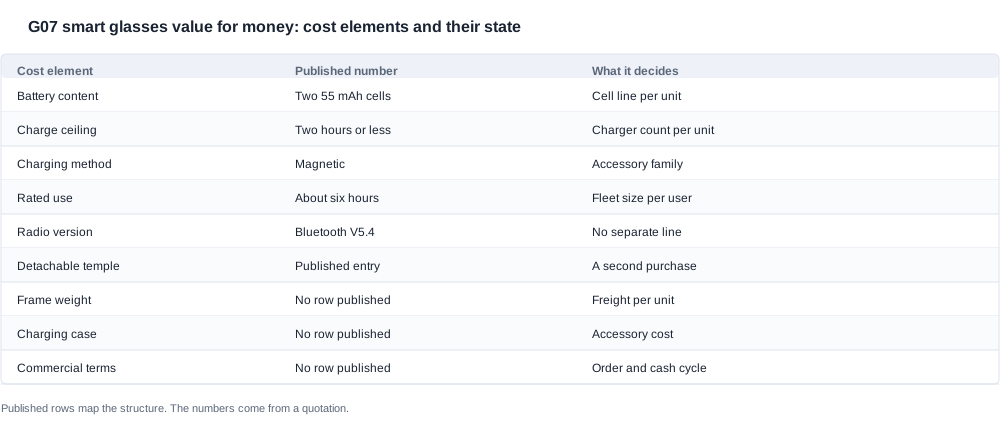
G07 smart glasses value for money: what the published rows actually cost
Costing a hardware product is an exercise in enumerating what the buyer pays for, and the published rows for a model tell a buyer which line items exist before any price is discussed. For the G07 they cover power, charging, accessory and service.
The cost elements the published rows bear on
Six elements follow directly from the published rows. The cell row — two 55 mAh cells — fixes the battery content in every unit, and therefore the cell line in any bill of materials. The charging row fixes the accessory family: a magnetic charger, which is a specific object rather than a generic cable, and which may or may not be counted per unit depending on how the channel is set up.
The charge ceiling bounds the charging infrastructure a channel has to hold. A two-hour ceiling has to be read as a ceiling rather than a duration, because a fleet sized on a number that is only an upper bound will be under-provisioned at the worst moment. The rated use of about six hours affects fleet size directly: for a given coverage requirement, the number of units a channel needs per deployed user depends on how long a unit works between charges, and this model's published figure is at the lower end of the range it belongs to.
The detachable temple adds a second item to the parts plan, with its own supply route, its own minimum and its own lead time. The radio version carries a marginal effect: a current radio version means the radio is not a differentiator that has to be paid for twice.
What each published row decides about cost
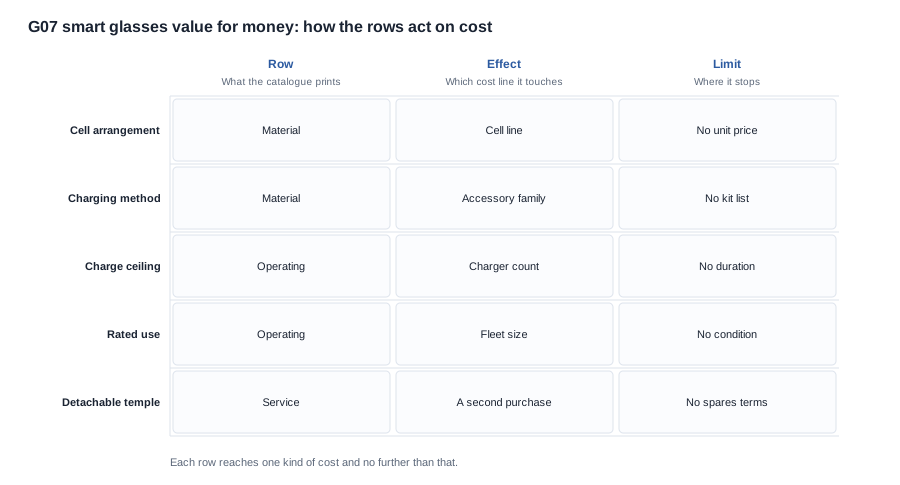
Read as cost drivers rather than as features, the rows divide into three kinds. The cell row and the charging method are direct material facts — they tell a buyer what is inside the unit and what has to accompany it. The rated use and the charge ceiling are operating facts — they tell a buyer how many units and how many chargers a deployment needs. The detachable temple is a service fact — it tells a buyer that a second part exists which will be ordered, stocked and eventually replaced.
That last kind is the one most often missed in a cost model, because it is the only one that produces a second purchase. A fixed-temple product has one purchase event; a model with a detachable part has two, and the second one carries a catalogue of its own — a minimum quantity, a price per unit and a defect rate.
The elements the published rows leave open
Everything else in the cost model is open, and the openings are specific. No frame weight is published for this model, so the freight line per unit cannot be computed from a published figure. No charging-case row is published, so the question of whether a case exists — and what it would cost if it did — has to be asked. No box-contents list is published, so the accessory cost per unit cannot be assumed. No acoustic figures are published, so the acoustic-related failure and return exposure cannot be estimated. And no commercial term of any kind is published, so the ordering decision, the cash cycle and the service exposure all have to come from a quotation.
A worked cost line: the charger
One cost line can be worked through from the published rows, and it is useful to do because the arithmetic is short and the assumptions stay visible.
A channel deploying a fleet has to hold chargers, and how many depends on two published facts and one that is not published. The published facts are the charge ceiling of two hours or less and the magnetic method. The unpublished fact is the rated use of about six hours, because a fleet sized on a rating with no stated condition is sized on a number whose real-world spread is unknown. The charger count therefore follows from the ratio of working time to charging time, and both halves of that ratio carry a caveat that has to be written next to the result rather than forgotten inside it.
The cost line itself then has three items: the charger, which is a specific magnetic object rather than a cable; the shipping weight of that charger, which adds to the freight line on every unit shipped; and the packing space it occupies, which affects the carton design. Only the third of those is under a buyer's control without a supplier conversation.
The purpose of the exercise is not the number, which is the buyer's own. It is that the calculation shows which lines the published rows can settle and which lines are waiting on a supplier answer, and that is the same distinction a cost model needs everywhere else.
The commercial terms that decide the order and are not published
Six commercial terms sit between the published rows and a landed cost. They are the terms a channel negotiates, and they are the terms most often left out of a comparison.
The six terms that decide the order
The unit price, together with whether it varies by configuration or by volume band. The order minimum, stated separately for the product and for the accessories, because a minimum that applies to the pair is a different constraint from a minimum that applies to each. The production lead time, and whether it is quoted for a first order or for a repeat. The warranty period and what it actually covers. The defect allowance, and the process that follows a defect. And the payment and shipment terms, which determine how much working capital a channel commits and when the cost lands.
None of the six is published for this model, and none is published for any model in the range. They are the terms a request for quotation exists to obtain.
Why a quotation has to state them
A quotation that leaves a term out has not saved the buyer anything; it has moved the risk from the price onto the reader. An unstated warranty period is an unknown service cost. An unstated lead time is an unknown working-capital cost. An unstated order minimum is an unknown quantity of capital committed to stock that may not sell.
The practical discipline is to require each line to be present rather than to infer it from the total. It is also the discipline that makes two quotations comparable, because a comparison between a quotation that states the accessory set and one that does not is a comparison between different products presented as the same one. Knowing how to compare them is the rest of the work, and the red flags are easy to name.
What a quotation that omits them actually means
Three readings are possible when a term is missing, and the channel has to pick one deliberately rather than by accident. The term may be a standard default, in which case the buyer should still have it written down because defaults differ between suppliers. It may be negotiable, in which case its absence is an opening. Or it may be something the supplier does not offer for this model, in which case its absence is a finding about the model rather than about the quotation.
Distinguishing between those three is a question to ask, and asking it costs nothing. Assuming the first reading when the third is true is how a cost model ends up carrying a service exposure that was never priced.
What a cost model must not contain
Four things are the usual content of an unsupportable cost model, and each of them matters for this model specifically.
The first is a single all-in figure with no line structure. It cannot be compared against a second quotation, it cannot be renegotiated on one element, and it hides which assumption is carrying the result. The second is a unit price that silently includes the accessories while a second quotation excludes them. The third is a derived battery total presented as a published capacity, which turns an arithmetic convenience into a specification claim. The fourth is a runtime promise — a guaranteed number of hours rather than a rated figure — which converts a catalogue rating into an obligation the documentation has never carried.
Each of the four produces a document that looks complete and cannot be defended. The remedy is structural rather than editorial: build the model in lines, quote each line from a source, mark the lines that are still open, and let the total be the last line of the file rather than the first.

Where the published rows help a channel and where they get in the way
The published rows are genuinely useful to a cost model, and they are also the source of two structural problems. Both sides should be stated, because a cost model built only from the favourable side will be wrong in a predictable direction.
Three ways the published rows reduce cost
The first is charging infrastructure. Because the charge ceiling is published, a channel can size its charger count against a documented bound instead of against an assumption, and can plan the rotation of a fleet from a single figure. The second is accessory standardisation. Magnetic charging is shared by six of the eight audio models, so a channel that already runs magnetic products in that group can consolidate on one accessory family and one packaging routine. The third is service exposure, and it comes from the detachable temple: a temple that separates from the frame can be replaced on site, so a channel may be able to treat a damaged unit as a parts event rather than a return event, provided the spare-parts route exists and is priced.
Three ways the published rows add cost
The first is fleet size. For a coverage requirement measured in working hours, a model publishing about six hours of rated use needs more units per deployed user than one publishing roughly eight. The second is the second purchase event, because a detachable part creates a second line in the parts plan with its own minimum and its own lead time. The third is the unresolved carton: because no box-contents line is published, an accessory that the buyer assumed was included may turn out to be a separate orderable item, and an assumption like that is a cost line that appears late.
Where the model sits against the requirement it serves
The cost question is not a property of the model in isolation. It is a property of the model against a requirement: a coverage requirement, a service model, a channel's existing accessory stock, a destination market's document requirements. The published rows tell a buyer which of those requirements the model can enter at all, and this model's seven rows open a fairly narrow set of them — a magnetic-charging channel, a service channel that can use a detachable temple, and an audio channel that does not need a published acoustic figure.
What the rows cannot do is settle the requirement itself, and a cost model that ignores that boundary produces a number with no purchase behind it.


The questions that produce a costed answer for G07 smart glasses
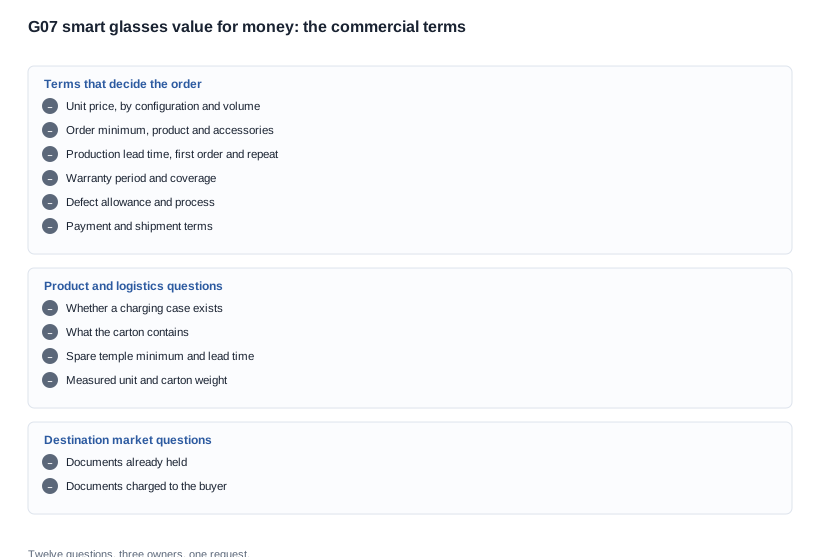
Twelve questions, sent together, turn this model from a row set into a costed position, and they are the questions to ask before any comparison is drawn. They are listed in the order a buyer normally needs them.
The twelve questions
The commercial group: the unit price and whether it varies by configuration or by volume band; the order minimum for the product and, separately, for the accessories; the production lead time for a first order and for a repeat; the warranty period and what it covers; the defect allowance and the process that follows a defect; and the payment and shipment terms.
The product group: whether a charging case exists for the G07 and at what configuration; what physically ships in the carton, so the accessory cost per unit is known; and whether the detachable temple can be ordered as a spare, at what minimum and at what lead time.
The shipping and destination group: the measured weight of one unit and the packed weight of one carton, which the catalogue does not publish; and whether the documents the destination market requires are already held, or whether they are a charge against the buyer.
Grouping them by owner
Each question belongs to a different owner, and that is what makes a single request practical. Commercial terms go to the person who negotiates and signs. Product questions go to the supplier's technical contact. The weight question goes to the quality team, because it is closed by weighing a unit rather than by asking. The document question goes to the compliance owner, and the certification position for this model covers what to ask for and how to read what arrives.
Getting two quotations onto one basis
Two quotations can only be compared when they state the same lines: the same configuration, the same accessory set, the same packaging, the same payment terms, the same warranty scope, the same freight basis, the same document scope and the same validity period. Eight lines, and a quotation missing any one of them is not a different price for the same thing — it is a different thing.
The rule that follows from that should be stated once: an absent line is a question, not a saving. A quotation that looks lower but omits the accessory set, the document scope or the warranty is not a lower cost, it is an undefined one, and undefined costs are the ones that appear in a return statement rather than in an invoice.
What a buyer should ask before writing G07 into a price position
Setting a price position for this model in a channel is a commercial decision, and it is made from the buyer's own numbers. What our documentation can do is make sure the numbers are complete.
The three checks before a price position is set
First, the cost basis has to be complete: every line in the twelve-question list above carries a figure taken from a document rather than from a summary. Second, the scope has to be stated: which configuration, which quantity, which destination market, which document scope, which shipment basis. Third, the risk has to be written: the warranty period, the defect allowance, the validity period of the quotation, and what happens when a term changes.
A fourth check applies to this model specifically, and it is where a total cost review most often misses a line. The published rows make a service proposition possible — a detachable temple that a channel can replace on site — and that proposition should be priced before it is used. An unbudgeted service model is a cost that arrives with the first damaged unit rather than with the quotation.
What our documentation supports
What we publish for the G07 is seven rows and the questions that close the gaps around them: the published specification rows, the battery life analysis, the charging programme and the limitations of this model. Together they let a buyer build a cost model whose structure is right, even though none of its numbers comes from us.
The G07 price position, and why no cost comparison is published
No unit price, price range, price tier or order minimum is published for the G07, and the same silence applies across the whole range, so we do not publish a cost comparison between models. We do not state which requirement this model should be bought for, and we do not publish what a channel should conclude from the rows it can read. That boundary is not a marketing position; it is the same one we apply across the audio range and state in the buying guide for the range, and it exists because a number we cannot substantiate is a liability for whoever repeats it.
The result is that G07 smart glasses carry a cost structure that a buyer can map from published rows and close with twelve questions, and a price position that the buyer sets from the resulting figures. We do not publish that position, and we do not publish any model against it.
For the cost side
- The endurance row and fleet size — what the rating drives
- Silences, facts and open items — who closes what
- The published rows — the cost structure
- The accessory programme — what ships and what is ordered separately
- Document position — the destination-market question
- The buying guide for the range — the wider context


