

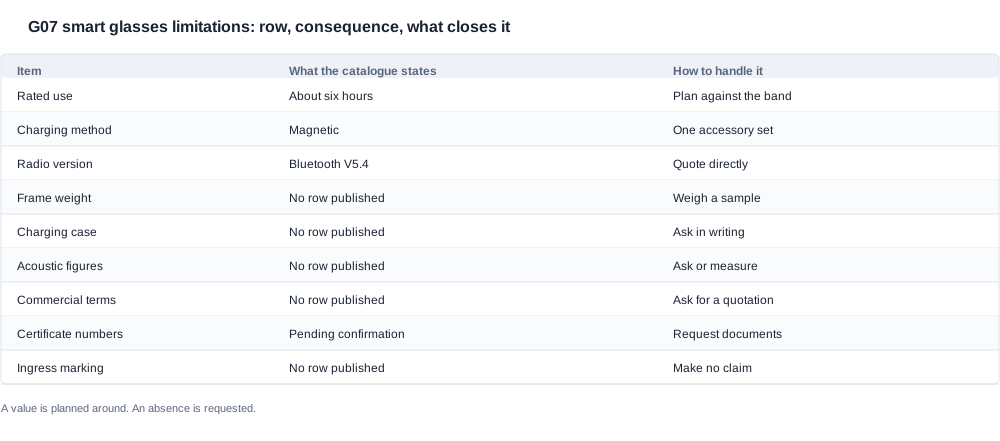
Two entirely different things travel under the word "limitation", and a buying file that treats them as one kind of thing will either overstate the product's problems or understate its risks. The first kind is a published fact that constrains a programme: a rated use of about six hours on the G07, a magnetic charging interface that has to be matched with its own accessory, a radio version that is published as Bluetooth V5.4. Those are facts. They have to be designed around, and no document will change them.
The second kind is a gap. For this model the catalogue publishes no frame weight, no charging-case row, no carton-contents list, no acoustic figures, no ingress marking, no per-model certification line and no commercial terms. Those are absences in a document, not qualities of a product, and the correct handling for each of them is a request rather than a workaround.
This page separates the two for the G07, names the four gaps that block a specification outright, and sets out the three-question test that keeps the separation intact. No commercial term and no certificate number appears on this page, because none is published for the G07 or for any other model in the range.
What the four gaps look like in a specification
When a specification for the G07 is assembled from the catalogue alone, four empty cells appear in it, and each of them is a decision waiting to be made by default.
The weight cell is empty, and the default is to carry a figure across from another model in the audio group. The acoustic cell is empty, and the default is to describe the sound in words drawn from the model's own feature line, which concerns the temple rather than the sound. The accessory cell is empty, and the default is a box containing a charger, a cable and a case, because that is what the accessory sets in the wider catalogue contain. The commercial cell is empty, and the default is a number that arrived in an email once and has been carried ever since.
Each of those defaults is defensible as a working assumption and indefensible as a specification, and the difference is whether anybody recorded that it was an assumption. A specification carrying an unmarked assumption is the worst of the two options, because it is both wrong and invisible. The remedy is cheap: mark the cell as open, name the owner, and set the date by which the cell will be either filled or struck out. A specification with six marked-open cells is usable; a specification with six unmarked cells is a liability that becomes visible at audit.
G07 smart glasses limitations: four things the published rows do not cover
The catalogue pattern explains most of the gaps, and understanding the pattern is what stops a buyer from reading a silence as a defect. The catalogue publishes what each product page carries and no more. That is why the camera models carry case rows in several different states while the audio group carries none at all, and it is why the charge time appears on every single model while a frame weight appears on one model in the whole range.
The four gaps that block a specification
Grouped by what they stop a buyer from doing, the gaps on this model's page fall into four blocks.
The first is physical. No frame weight, no temple length, no lens dimension and no frame profile figure are published for the G07, so any quantity computed from the physical object has to come from a measurement rather than from a published row. The second is accessory. No charging-case row is published for the G07, no case capacity appears for it, and no box-contents list exists for it, so the contents of a carton have to be established separately. The third is commercial. No unit price, order minimum, production lead time, warranty period or defect allowance is published for it. The fourth is documentary: no per-model certification row exists, no certificate number is published, and no test report is available for it.
Why the catalogue pattern explains them
The catalogue publishes row structures that vary by product family rather than by marketing priority, and the variation is informative. Every one of the twenty-eight models publishes a charge time, and twenty-six of them publish it as a ceiling of two hours or less. The only weight in the entire document belongs to one camera model, which publishes 158 g for the eyewear body alone. Case rows appear only in the camera group, in four different states. Feature lines appear on some pages and not others within the same group.
Read against that pattern, the G07's silences look ordinary rather than suspicious. It is an audio model, the audio group publishes no case rows and no weights, and its feature line is a design descriptor rather than a technical row.
What each gap stops a buyer from doing
The practical question for each gap is what work it prevents. The physical gap prevents a freight calculation, a carton design and a shelving decision from being made on published figures. The accessory gap prevents a packing list from being written. The commercial gap prevents a landed cost from being assembled and prevents two supplier quotations from being compared on the same basis. The documentary gap prevents a compliance file from being closed and prevents a distributor who asks for evidence from being answered.
How these two errors survive review
Both errors survive internal review for the same reason: the sentence that carries them is not obviously wrong. An acoustic description written from the feature line is a paraphrase of something the catalogue printed for this model. A weight carried across from a neighbouring model is a figure the organisation already uses. A case mentioned because the wider catalogue contains cases is a statement supported by our own range.
Review catches errors that look like errors. It does not catch a paraphrase, a carry-over or an inference, because each produces a sentence whose parts are individually attributable to a real document. The only defence that works is a source discipline applied when the sentence is written rather than when it is reviewed: every figure and every descriptor in a specification traces to a named row on a named page, and the trace stays visible to the next reader.
There is a second reason the errors persist, and it is commercial. A filled specification sheet gets approved faster than an open one, and the organisation that fills it is rarely the organisation that carries the consequence. A weight that turns out to be wrong is discovered by a customer, and the cost lands on the channel rather than on the person who filled the cell. Marking the cell as open moves the cost to the moment at which it can still be managed.

Facts that read like limitations, and gaps that need an answer
Three published facts on this model are regularly described as limitations, and three absences are regularly described as facts. Both errors are common because the catalogue's format makes them easy to make.
Three facts that look like limitations but are not
The first is the six-hour rating. It is a fact, but it is not a limit in the sense of being the worst figure in the range: the 55 mAh × 2 group it belongs to covers about six to eight hours across its four models, with the LC-105-1 and the LC-105-2 publishing roughly eight hours on the same cell arrangement, and the G07 is one of the two models in that group publishing about six hours. The second is the magnetic charging interface. It is a fact, and it is an ordinary one — six of the eight audio models charge magnetically. The third is Bluetooth V5.4, which is shared with six other audio models and is therefore not a differentiator either.
Describing any of these as a weakness is a comparison error rather than a factual one, and it is usually caused by reading a single model's page in isolation.
Three gaps that look like facts but are not
The first is the absence of an acoustic descriptor on the G07's page. Read as a fact it becomes a claim about sound quality; read correctly it is a silence, and the YK12 in the same cell group publishes a surround-sound descriptor while this model's page does not. The second is the absence of a charging-case row. Read as a fact it becomes "this model has no case"; read correctly it is a silence in a document in which the audio group publishes no case rows for any of its eight models.
The third is the absence of a frame weight. Read as a fact it becomes a lightness claim; read correctly it is a silence, because the only published weight in the whole catalogue belongs to a camera model. Each of the three is a statement about our documentation, and each of them becomes wrong the moment it is copied into a specification as a statement about the product.
The sentence that keeps them apart
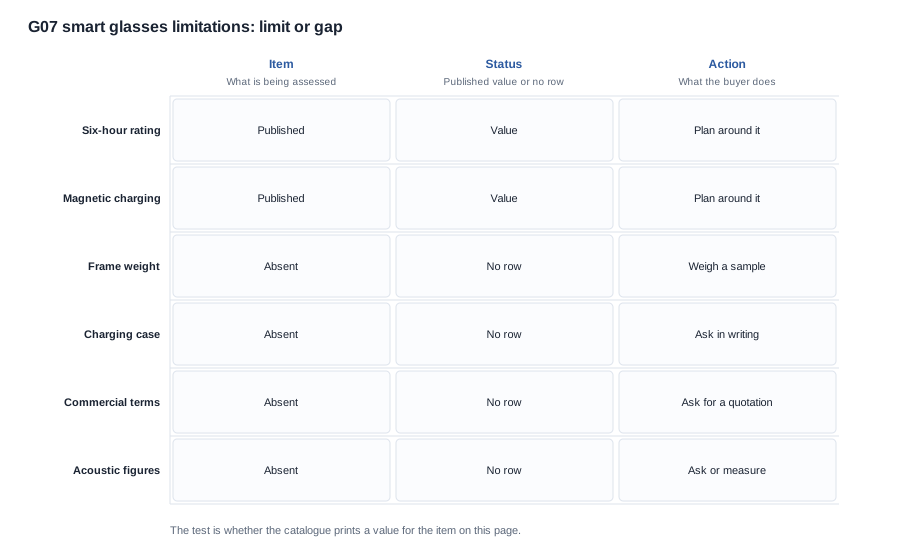
One sentence does the work, and it is worth using in every file that touches this model: the catalogue publishes a value for this item, or it does not. Where it publishes one, the value is a fact and the programme works around it. Where it does not, the item is open, and the entry in the file reads "not published" together with a question and an owner. The temptation to fill the silence with a reasonable assumption is the one thing the discipline is designed to prevent, and the published specification rows for the G07 are what keeps the distinction visible.

The difference between a published limit and a missing row
A three-question test distinguishes the two, and it is short enough to apply while reading rather than afterwards.
A three-question test
The first question is: does the catalogue print a value for this item on this model's page? If it does, the item is a fact, and it moves into the programme as a constraint. The second question is: does the same silence apply to the whole family this model belongs to? If it does, the silence is a pattern of how the document is written, and the request should be framed as a per-model document rather than as a concern about this model. The third question is: what decision is waiting on the answer? A gap with no decision attached to it is not a limitation at all, it is a line item in a curiosity list, and it should be dropped rather than escalated.
Applying the three questions in order usually removes more items from a limitations list than it adds, because a lot of what looks like a limitation turns out to have no decision attached to it.
How to record each kind
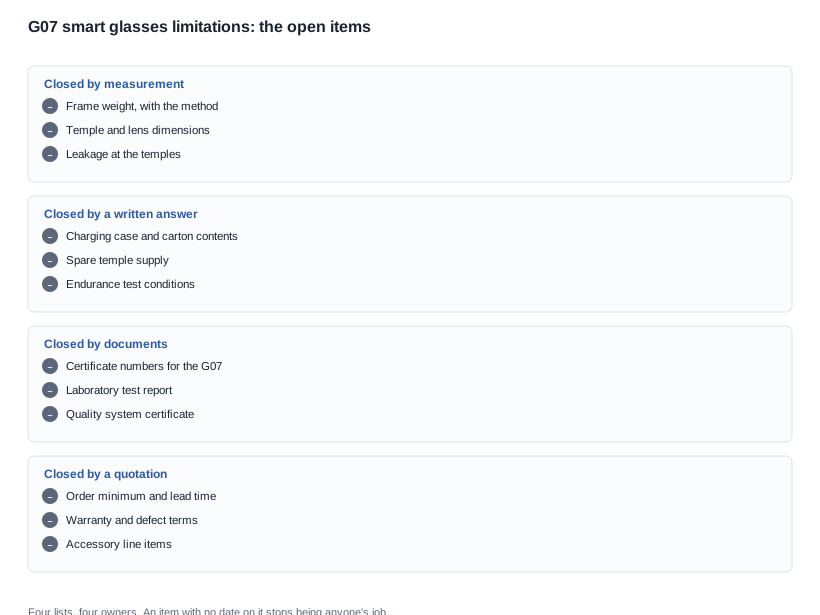
A fact is recorded in the specification, with the model named, and it is then referenced by every document that depends on it. A gap is recorded in an open-items list with three fields: the question, the owner who can close it, and the date by which an answer is expected. The third field is what keeps the list alive, because an item with no date on it is an item that quietly stops being anyone's responsibility.
When an answer arrives, it moves from the open-items list to the specification, and the entry that carried it is updated rather than left in place. A document that keeps the original open entry beside the new answer is a document two readers will interpret differently.
A worked example: the endurance figure
Applying the test to one row shows how it works in practice, and this row is worth using because it is the one buyers argue about most.
First question: does the catalogue print a value for rated use on the G07's page? It does — about six hours. So the item is a fact, and it goes into the programme as a constraint. The programme consequence is that a unit cannot be planned on for more than a six-hour rated block without a stated condition, so rotation and charging have to be arranged around that figure rather than around a hoped-for one.
Second question: does the same silence apply across the family? Partly. The condition behind the figure is missing for every model in the catalogue, so the silence is a pattern of how the document is written. That means the request is framed as a document request for this model rather than as a concern about this particular product.
Third question: what decision is waiting on the answer? Two: whether the figure can be quoted with a condition attached, and whether a warranty position can be written at all. Both are real, so the item stays open with an owner and a date.
The result is a limitation that behaves correctly. It is a published value in the specification, an open document request in the open-items list, and nothing in a customer-facing description of the product that goes beyond what the catalogue printed.
A checklist for the buyer who signs the order
The two kinds of limitation need different handling, and a single checklist that mixes them produces a file nobody can act on. The workable approach is to work through them in a fixed order, because each step depends on the one before it.
Step one is to write the criteria. Before any item is assessed, state what the order has to achieve: the coverage the fleet must deliver, the service response the channel has promised, the destination market whose documents are required, and the total cost ceiling the programme can carry. Items are then assessed against those criteria rather than against a general sense of completeness, and the reason for each judgement stays visible afterwards.
Step two is to check the published rows against those criteria. The question to ask at this point is narrow: does the catalogue print a value for this item on this model's page. A row that answers the criterion is closed. A row that does not is not a failure of the product — it is an item for step three.
Step three is to separate what can be closed from a sample, what can be closed from a document, and what has to come from a quotation. When to open a sample order is itself a decision, and the criterion is simple: it is worth opening one where a measurement settles the outcome, and it is not worth opening one where a written answer would do the same work for nothing.
Step four is to put a date against every open item and a name against the owner of it. Red flags at this stage are not dramatic; they are the items that quietly lose their owner between two meetings, and the way to catch them is to re-read the list before you commit to the order.
Step five is to write the listing from the published rows alone and hold the open items in a separate file. That separation is what stops a working assumption from being copied into a customer-facing page, and it is also the sign-off a buyer can defend long afterwards.
This is a due diligence routine rather than a one-off task, and it is the same routine every time another model is added to the range.
What to write in a listing
A customer-facing page may state published values and nothing else. It may state the six-hour rating as a rating, the magnetic charging method, the two-hour ceiling, the cell arrangement and the detachable temple, because each of those is printed in the catalogue for this model. It may not state a weight, a charging case, a certification mark, an ingress protection, an acoustic characteristic or a runtime guarantee, because none of those is published and each of them would be a claim a buyer cannot substantiate.
The line that does the work in a listing is the one that says what the figure is: a rated use of about six hours, as published, with the test condition to be confirmed. That phrasing is longer than the bare number and it is the reason the number survives contact with a customer's technical reviewer.

What CYNRIN can state today about the G07
On this model, our position is written in the open, because the alternative is a set of limitations that get discovered rather than disclosed.
The five statements we can make
The G07 publishes Bluetooth V5.4. It publishes two 55 mAh cells. It publishes a charge ceiling of two hours or less and magnetic charging. It publishes a rated use of about six hours, and it is one of the two audio models on the 55 mAh × 2 arrangement that publish about six hours. And it publishes one feature line, an ultra-slim build with a detachable temple, which is the only detachable temple published among the eight audio models.
Those five statements are complete, they are traceable to the catalogue page for the G07, and they are enough to write a specification, a comparison and a screening brief.
The statements we will not make
We will not state a frame weight, an acoustic figure, an ingress protection, a charging-case specification, a certificate number, a test report, a price, an order minimum, a lead time or a warranty period. We do not publish those for this model and we do not publish them for any other model, and we do not infer them from a neighbouring model in the same group. We do not describe the model's silence on acoustics as an absence of surround sound, because that would convert a documentation gap into a product claim, and we do not describe the missing charging-case row as evidence that no case exists.
The discipline behind those refusals is the one the battery life analysis for this model applies to a single number: a figure that has not been tested cannot be sold as one that has.
Turning the open items into a request
The four gaps produce four short lists — measure, ask, document, quote — and each of them belongs to a different owner. Measurements are the quality team's, the physical questions are the reviewer's, the document questions are procurement's, and the commercial questions belong with the buyer who signs the order. The buyer review checklist for the G07 covers the measurement half in detail.

The disclosure standard we hold ourselves to
There is a standard behind the list of refusals, and stating it makes the refusals easier to apply.
The standard is that a claim about the G07 has to be traceable to something that exists, and that something has to be a published row for this model rather than an inference from a neighbouring one or a description of the range. Where the evidence is a catalogue row, we state it. Where the evidence is a measurement taken on a specific unit, we say which unit and when. Where the evidence is a supplier's written answer, we say that it is a supplier statement and we file it. Where there is no evidence, we do not state it, and we do not soften the absence into a phrase that sounds like a finding.
That standard is stricter than the minimum, and it is deliberately so. A published catalogue row is unusual in that it can be checked by anybody with the document in front of them, and a claim that survives that check is worth more to a channel than a claim that merely sounds plausible. It also means our own pages can be audited, which is the condition under which a buyer can rely on a catalogue at all.
The practical benefit for a channel is that the pages in this set can be quoted directly. Where a listing needs a claim about the G07, the answer is a row from the published specification, with the model named. Where it needs something the rows do not carry, the answer is a question, and the questions are already written down.
The useful conclusion about G07 smart glasses is not that the model has a long list of weaknesses, because it does not. It is that the list is short, it is legible, and every item on it has a named way to close. What CYNRIN can state today about the G07 is a set of published rows and one design descriptor; what remains open is the part the catalogue has never claimed to cover.
Where to look next
- The published rows — seven entries, each one quoted
- First-article checks — the measurement half
- The endurance figure — a rating and its condition
- The accessory programme — the carton question


