
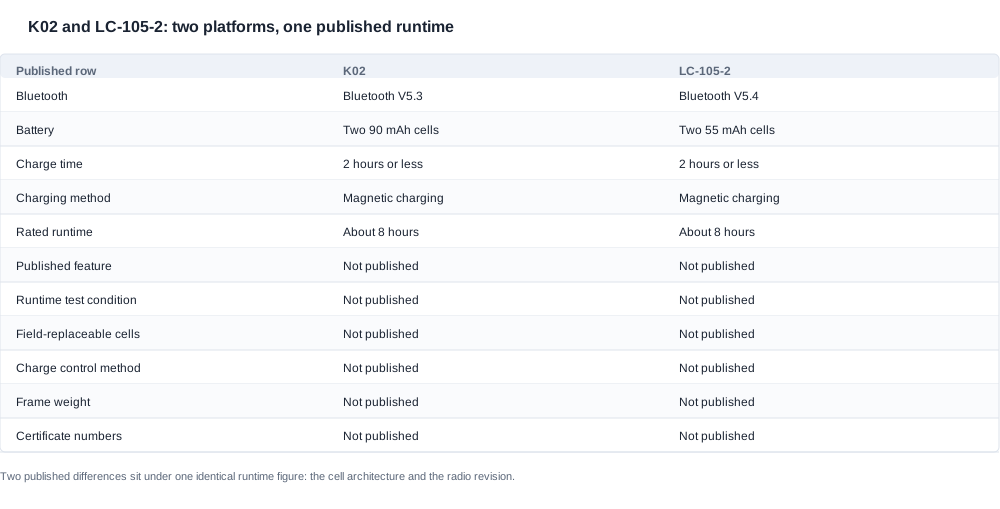
Two audio-tier smart glasses models from the same catalogue publish the same headline endurance figure, and it is easy to stop there and conclude that they are the same product wearing two labels. They are not. The published runtime for K02 and for LC-105-2 is about 8 hours in both cases, and the published charge time is 2 hours or less in both cases, but the cell architecture underneath those two identical numbers is different: K02 ships with two 90 mAh cells while LC-105-2 ships with two 55 mAh cells. On top of that, the radio revision differs, with Bluetooth V5.3 on K02 and Bluetooth V5.4 on LC-105-2. If you are a brand owner or a channel buyer writing a quotation and a purchase order, that is the whole story: identical endurance on the page, materially different power platforms underneath, and a very different set of questions to ask a supplier before you commit samples, tooling, packaging, and spares.
This comparison is deliberately narrow. It looks only at what the published catalogue rows actually say about energy, charging, and connectivity for these two models. Anything the catalogue does not publish — frame weight, dimensions, lens material, colours, ingress rating, certification status, price, MOQ, lead time, sample policy, warranty — is treated here as Not published, and turned into a question for the supplier rather than a guess. That discipline matters more than it sounds. Most product-comparison pages that promise a "winner" end up quietly inventing the numbers that decide the purchase.
K02 and LC-105-2: the same runtime on a different platform
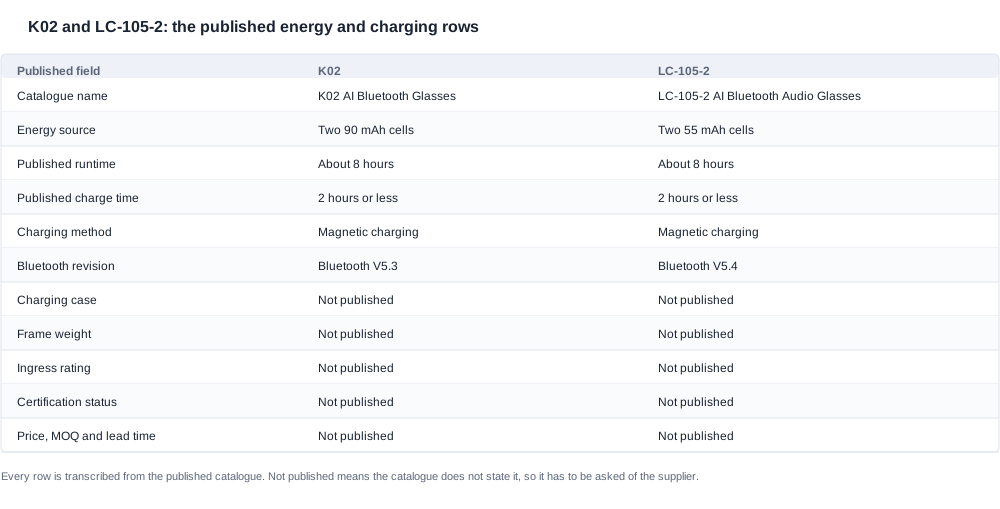
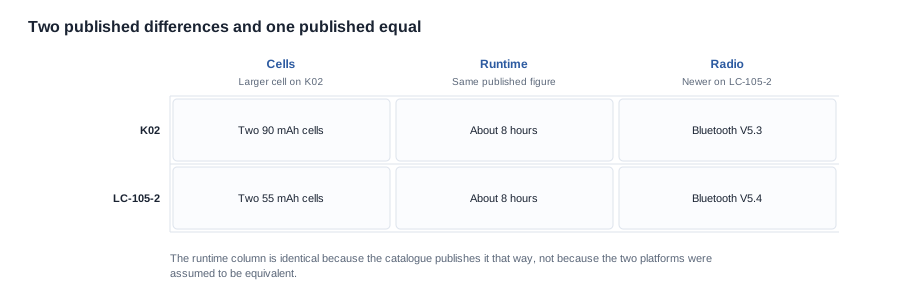
The published rows are short, and that is the point. Read them in full and there is almost nothing to argue about, because the catalogue does the arguing for you: same runtime, same charge ceiling, same magnetic charging approach, different cells, different radio revision.
| Published field | K02 | LC-105-2 |
|---|---|---|
| Catalogue name (translated) | K02 AI Bluetooth Glasses | LC-105-2 AI Bluetooth Audio Glasses |
| Energy source | Two 90 mAh cells | Two 55 mAh cells |
| Published runtime | About 8 hours | About 8 hours |
| Published charge time | 2 hours or less | 2 hours or less |
| Charging method | Magnetic charging | Magnetic charging |
| Bluetooth revision | V5.3 | V5.4 |
Take that table at face value for a moment. Two 90 mAh cells and two 55 mAh cells both end up described as about 8 hours of runtime, and both are described as charging in 2 hours or less. A buyer who stops at the runtime column will conclude the two models are interchangeable from an endurance standpoint. That conclusion is not wrong; it is just incomplete in a way that becomes expensive later.
The gap between the two energy sources is large in relative terms. Ninety milliamp hours against fifty-five is not a rounding difference; it is a materially bigger cell in the K02 platform. Two of them. So why do both land on the same published runtime figure? Because published runtime is an end-to-end system claim, not a cell-capacity claim, and it is measured under whatever conditions the manufacturer tested. The cells are there to be the buffer behind the claim; the claim is the promise. That is why the more useful reading of this comparison is not "which lasts longer" — on the published evidence they are level — but "what does each platform give me to build on".
The buyer should treat K02 and LC-105-2 as two platforms that happen to share one endurance promise, not as two SKUs sharing one platform. In practice that means: the K02 platform gives you roughly two thirds more stored energy per cell, and the LC-105-2 platform gives you the newer radio revision on a smaller energy budget. Those are different engineering decisions with different knock-on effects for certification evidence, spare-parts strategy, and how you negotiate a quotation.
There is also a naming and catalogue-structure point that affects how a buyer searches for these parts later. K02 and K01, LC-105-1 and D12, G07 and D11, and LC-105-2, and YK12 form the complete audio tier in this catalogue — exactly eight models. K02 is the upper of the two K-series audio models and the larger of the two cells. LC-105-2 is the upper of the two LC-105 models and sits in the 55 mAh family alongside LC-105-1, G07, and YK12. Understanding that the audio tier is a small, finite set of eight rows is useful: the comparison surface is narrow enough that a buyer can actually hold the whole picture in their head, and broad enough that the internal differences matter for positioning. The wider pillar entry on Bluetooth Audio Glasses is where the full audio tier sits in context.
Where the runtime claim actually comes from
In this comparison we will stay strictly inside what the published rows state, and we will mark every gap as Not published rather than filling it with an assumption. Because both models publish the same figure, the fair way to talk about endurance is to talk about what the number does not tell you. Published runtime is almost always measured with a defined audio workload, a defined volume level, a defined codec, and a defined ambient condition. The catalogue does not publish the test conditions for either model. It does not publish standby drain, does not publish the effect of the second cell on thermal behaviour, does not publish whether the two cells are wired in parallel or in series, and does not publish how the charge controller behaves when one cell is low.
That last point is worth dwelling on, because it is the single most useful thing to ask about a two-cell magnetic platform. If the cells are managed as one power source with a single charge path, the system behaves like a single larger cell, and the published 2 hours-or-less ceiling is a straightforward number. If the cells are independently monitored, you get better resilience — one weak cell does not strand the whole platform — but you also get a more complex charge cycle, more firmware behaviour to validate, and more questions about what happens if a buyer replaces one cell rather than the pair. Asking which of those the K02 and LC-105-2 platforms use is exactly the kind of question that separates a usable supplier from a catalogue reprint.
A broader note on published endurance figures in this catalogue helps set expectations. Of the eight audio-tier models, four publish about 8 hours of runtime (K01, K02, LC-105-1, LC-105-2), while D11 and D12 publish about 7 hours on a single 100 mAh cell, and G07 and YK12 publish about 6 hours on the 55 mAh pair. In other words, within this audio tier the runtime figure tracks the workload rather than the cell count: a single larger cell and a pair of smaller cells land in different places, and the two models carrying the same 55 mAh pair with the same magnetic charging and the same V5.4 radio land within a couple of hours of each other. The deeper background on how these figures get produced is worth reading before you treat any of them as a contractual number, and the battery life technical note covers how runtime claims are typically framed and tested.
What the two cell architectures mean for a channel
For a brand owner or a channel buyer, the cell architecture is not a spec-sheet detail; it is a commercial variable. It affects what you can promise your own customers, how you plan spares, what a returns analysis looks like, and what you negotiate.
Here is the practical translation of the two energy sources:
- K02 — two 90 mAh cells. Roughly two thirds more stored energy per cell than LC-105-2. The published runtime claim is the same, so the commercial read is that the K02 platform carries more headroom around the claim: more energy available for a heavier workload, a larger feature load, or a margin you can hold while the platform evolves. If you plan to attach a charging case, the case becomes a supplement rather than a necessity for the endurance story.
- LC-105-2 — two 55 mAh cells. The same published endurance on a smaller energy budget. This is the more efficient end of the two platforms, and it is the same cell size used by LC-105-1, G07, and YK12 in the audio tier. That shared cell family is commercially useful: it means spares, packaging, and possibly certification evidence can be shared across a wider product range instead of being locked to one model.
That shared-family point is worth expanding, because it changes the shape of a channel plan. If a distributor carries LC-105-1, LC-105-2, G07, and YK12, four of the eight audio-tier models run on the same 55 mAh cell pair, with magnetic charging and a V5.4 radio. One spare-cell policy, one charging accessory policy, one qualification routine. If the same distributor also carries K01 and K02, that adds a second cell family at 90 mAh — and the full comparison between the two K-series models sits in a dedicated K01 and K02 specification comparison. So the portfolio decision is not really "K02 or LC-105-2" in isolation — it is whether your range runs one cell family or two.
There is a trade-off hiding in that. Two cell families means two spare-part streams, potentially two magnetic charger variants, and two sets of packaging configurations. One cell family means less complexity but a narrower spread of positioning. The catalogue publishes neither the charger part numbers nor the spare-cell availability, so this is a Not published item that has to be settled in the quotation.
We will say plainly what we think this means for a buyer: if you are building a multi-SKU audio range and want operational simplicity, the 55 mAh family around LC-105-2 is the more efficient backbone. If you are building a flagship where the endurance claim needs to survive a heavier workload or a feature roadmap, the larger K02 cell pair gives you the buffer. Neither is a better product in the abstract. They are different answers to different commercial questions, and the published evidence does not rank them, so do not let anyone rank them for you without additional data.
Spares, samples, and the second unit
Two practical consequences follow from the cell difference, and both belong in a purchase order rather than in a conversation.
First, spares. A two-cell magnetic platform needs a defined spare strategy: individual cells, cell pairs, whole units, or chargers only. The catalogue does not publish spare-part availability for K02 or LC-105-2, so it is not published. When you request samples, request the spares list in the same message, because a supplier that has a mature spare-parts programme will answer instantly and a supplier that has not will go quiet.
Second, samples. Ask for the sample units to include the charger, and ask for the sample battery to arrive in the state you would ship — partly charged or factory-reset — because a sample that arrives in a different state than your production unit tells you nothing about the charge curve. Ask how long the sample takes to reach the published ceiling from empty. If the supplier answers with a number close to the published 2 hours-or-less figure on their own measurement, that is a useful signal about how the published claim was derived.
Also worth asking: whether the two cells are replaceable by a customer at all, and if so, whether replacement voids any certification evidence you hold. This is not a hypothetical. Magnetic charging plus a removable cell is a serviceability proposition, and serviceability has a real commercial value in the channel — it reduces warranty return volume and it gives you an upsell story. But it only works if the supplier is willing to stand behind it in writing.
Packaging and shipping reality
Both models charge magnetically, which is convenient at the desk and slightly more involved in a warehouse. Magnetic charging means the charging surface has to be present and positioned correctly for the product to charge, which is a different packaging problem from a fixed-port product. If your channel uses gift boxes, this affects the insert design directly, and insert design is tooling, not a printing decision.
Neither the K02 nor the LC-105-2 has a published charging case row. Across the whole catalogue, only five models publish a case capacity, two have a case without a published capacity, three rows have no case at all, and one model explicitly states no case. So for both of these audio models the honest position is that no charging case is published — and a buyer who wants a case in the box for either model needs to establish whether that is possible before designing packaging around it. We will not assume a case exists, and we will not assume it cannot exist either. It is a question for the supplier.
Note also the contrast with the models that do publish a case: those rows publish a capacity figure in milliamp hours and describe a folding case, which tells a packaging engineer what space to reserve. For K02 and LC-105-2 there is no equivalent published figure to design against, so packaging must be planned after the supplier confirms what ships in the box. This is a normal situation in this industry, but it is a lead-time item: packaging and tooling have long lead times relative to the electronics, and unresolved packaging questions become the critical path to a pilot order.
What the catalogue does not say about either model
Before any of the questions below, it is worth listing the gaps explicitly, because a comparison page that leaves them implicit invites the reader to assume the supplier will fill them.
For both K02 and LC-105-2, the following are Not published: frame weight, frame dimensions, lens material, available colours, ingress or IP rating, certification status, unit price, MOQ, lead time, sample policy, warranty terms, storage capacity, and any surround-sound or feature row. Only one model in the whole catalogue publishes a weight at all, and only one publishes a surround-sound capability. So any of those fields in a quote you receive should be sourced from the supplier directly, with a document behind it, rather than inherited from a catalogue page.
Where the radio revision actually matters
Bluetooth version is the second published difference between the two models, and it is the one most likely to be overstated. K02 publishes Bluetooth V5.3. LC-105-2 publishes Bluetooth V5.4. That is the entire published fact. In this section we will separate what the catalogue states from what a buyer still has to confirm, because the revision label alone does not settle the feature question.
The catalogue publishes a Bluetooth version for 14 of its 28 models. It does not publish one for the 11 camera models, nor for A05, A06, or the bone conduction entry. So for the audio tier the radio is always identified — which means, if you are comparing two audio models, you are never stuck with an unknown on this axis. It also means the comparison surface widens sharply if you step outside audio into camera products, where the radio becomes an open question you must raise with the supplier; the AI camera glasses category is where that shift in evidence quality becomes visible.
Between the two revisions, the platform-level differences that matter to a product team are known. The 5.4 revision is associated with LE Audio work, including an enhanced asynchronous data channel and lower-power periodic advertising, alongside the audio feature work in the 5.4 specification. The 5.3 revision sits behind that. Here is the caution: the catalogue publishes the revision, not the feature set. It does not say whether either model implements LE Audio features, whether multi-device pairing is supported, whether the radio is the same silicon part in both models, or which codec profile is used for the published runtime claim. Those are all Not published items for both K02 and LC-105-2.
That matters commercially in three concrete ways.
First, the host-device matrix. A V5.4 radio does not make a V5.4-capable host necessary, but compatibility behaviour with older phones and older host chips is exactly the kind of thing that generates returns. Ask the supplier for a compatibility matrix covering the phone and platform versions your channel actually sells into, and ask specifically whether the two models are tested against the same host set. If they are not, your support load is larger than your catalogue suggests.
Second, the audio feature set is where a V5.4 label creates an expectation gap. Buyers will assume new-generation audio capability, then be disappointed by conventional pairing, because the specification revision and the implemented feature list are different things. The cleanest way to avoid that is to require the supplier to state the implemented feature set in writing on the quotation. If a newer radio delivers a real advantage for your use case — for example, how a second device is handled — that advantage should appear as a written line, not as a revision number you interpreted.
Third, qualification and compliance workload. Two radio revisions across a channel range can mean two test routines and two sets of radio-related certification evidence to maintain, even where the mechanical platforms are shared. The catalogue body contains no certification markings, no test report references, and no declaration references for any model, so certification status is Not published for K02 and for LC-105-2 alike. The radio dimension is one of the more likely places where that gap shows up, so raise it early rather than at the shipping deadline. The broader mechanics of radio selection are set out in the Bluetooth connectivity technical note.
We will keep the recommendation narrow: the radio revision is a legitimate reason to prefer LC-105-2 on paper, but it is not a reason to prefer it in a quotation until the supplier confirms which features are actually implemented and how the two platforms are qualified. A newer revision with an unstated feature list is a marketing advantage, not a supply advantage.

What to ask a supplier before ordering either model
Everything below is what to ask the supplier before you approve a pilot order or raise a purchase order. Grouped by the commercial decision each question unblocks, this is the checklist we would work through with a manufacturer of either model.
Energy and charging
- Are the two cells managed as one power source or independently monitored, and what happens at end of life when the cells are unbalanced?
- What are the measured charge time and the measured runtime on your own test bench, and under what workload, volume level, and codec?
- Does the published about 8 hours figure hold with the charger supplied, and does the magnetic dock charge both cells simultaneously or in sequence?
- Are the cells user-replaceable, and is a spare cell or cell pair available as a spare part with a part number?
- Is a charging case available for this model, and if so what is its capacity — and does it add to the runtime figure or replace it?
Radio and software
- Which radio part is used, and which of the revision's features are actually implemented in shipped firmware?
- What host devices and platform versions have been qualified, and is the same host set used for both models?
- How are firmware updates delivered and supported, and what is the support commitment for each model?
Commercial and supply
- What are the MOQ per model and per colourway, and what is the lead time from purchase order to shipment, measured against incoterms rather than as an internal factory date?
- What are the sample policy, sample cost, and the tooling cost for a private packaging or branding variant?
- What warranty terms apply, and does the warranty cover the cell pair and the magnetic charging interface?
- What certification evidence can be provided for the finished product, in which form, and who owns the cost of that evidence?
Packaging and channel
- What ships in the retail box — units, chargers, cables, spare cells, manuals — since no charging case is published for either model?
- What packaging tooling is required for a branded variant, and how long does that tooling take once artwork is approved?
- What is the spare-parts and after-sales plan for a channel that stocks both models?
Two more items sit outside the supplier's control but still belong in the commercial conversation: how the two models are positioned against each other so a customer does not read them as duplicates, and what happens to the range if one platform is discontinued. Both are easier to negotiate while the relationship is new and the pilot order is small.
Where this comparison leaves you
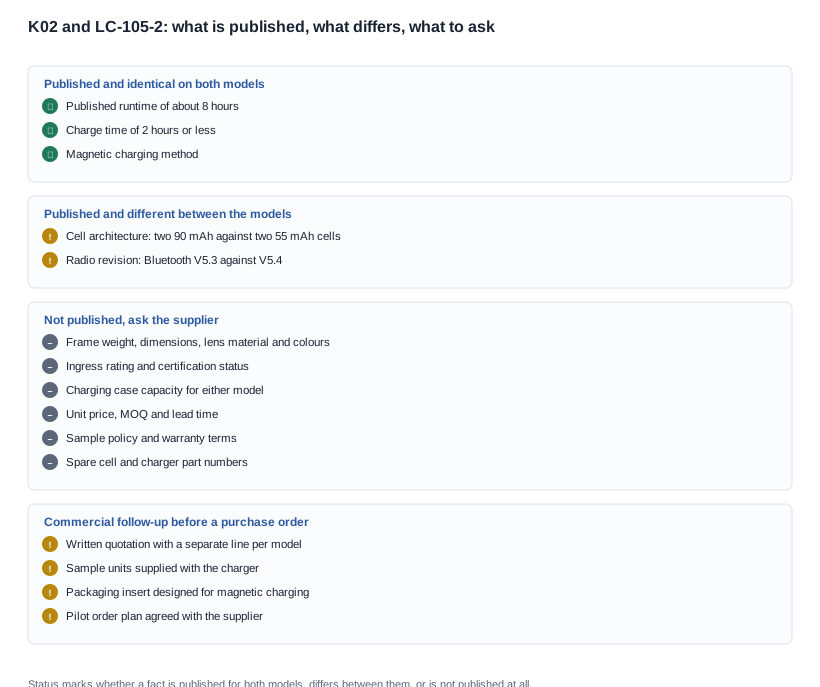
The honest summary is short. On the published evidence, K02 and LC-105-2 are level on runtime at about 8 hours, level on charge time at 2 hours or less, and identical on charging method. They differ on the two published axes that matter most for a channel decision: the cell architecture, where K02 carries two 90 mAh cells against LC-105-2's two 55 mAh cells, and the radio revision, where LC-105-2 publishes V5.4 against K02's V5.3. Nothing in the published rows establishes one model as the better product, and we will not manufacture that conclusion from a page of numbers.
The decision therefore comes down to platform fit rather than a scoreboard. Choose K02 when the endurance promise needs headroom and you are anchoring a flagship. Choose LC-105-2 when you want the newer radio revision and you are consolidating on the 55 mAh cell family that LC-105-1, G07, and YK12 also use. Whichever way you lean, the unresolved items are the same, and they are all items to close with the supplier — certification evidence, warranty terms, spare-parts coverage, packaging configuration, MOQ, lead time, and incoterms — before you commit a purchase order. The practical operating notes for working with the LC-105-2 platform day to day are collected in a separate guide to using LC-105-2 smart glasses, and the full audio-tier lineup sits on the Bluetooth Audio Glasses pillar page. For a buyer still deciding between platforms, the fastest route is a quotation request with the fifteen questions above attached; it turns an open-ended supplier conversation into a comparable set of answers, and it does that faster than any published comparison table, including this one.


