

Kids eye protection glasses technology: settle the boundary
The questions buyers ask most often about a children's smart glasses line are not technical, and the one that matters most is the one everybody avoids: can you put a health or eyesight claim on the box? The answer is no, and it is not a marketing preference — a product whose function is to detect a posture or a distance and to remind is not a clinical intervention, and a listing that implies otherwise creates a regulatory exposure in several markets. Get that boundary settled before you look at a single specification, because it decides what the rest of the programme is for.
The second question is about the certification position, and the honest answer is that ours is not published to us. The third is about what the published rows actually let you claim. Those three answers, taken together, are what most of this article is about.
Who buys a children's line, and what they are approving
There are two buyers in this category and they are not the same person, and the programme fails when they are treated as one. The purchaser is a parent, a school administrator, a procurement officer at a district, or a distributor buying on your behalf. The user is a child. The purchaser is deciding whether to trust a device with their child, and the child is deciding whether to keep wearing it — and the second decision is the one that determines your return rate.
That split has a direct commercial consequence. A parent's decision is made on documentation, on certification and on the claim wording, because that is what a parent can evaluate. A child's decision is made on comfort, on whether the thing nags, and on whether it is embarrassing. Both of those produce returns, and only one of them is fixed by paperwork.
The typical approval in a children's line is also more complex than in an adult one. A children's product attracts regulatory attention that an adult product does not: the frameworks applicable in Europe include EN 71, and in the United States ASTM F963 and the Consumer Product Safety Improvement Act, and these are separate from CE marking and from FCC approval. A product derived from an adult platform does not inherit the adult product's file, because the requirements are different, and because the frameworks work on an edition cycle where a new edition can require retesting a product that has already shipped.
So the buyer's approval is usually three documents: the conformity file for the exact model, the market-specific labelling, and a claim position. All three are gated by the certification status, which is the item with the longest lead time and the one most often left until the product is nearly finished.
Where the cost of a children's programme actually sits
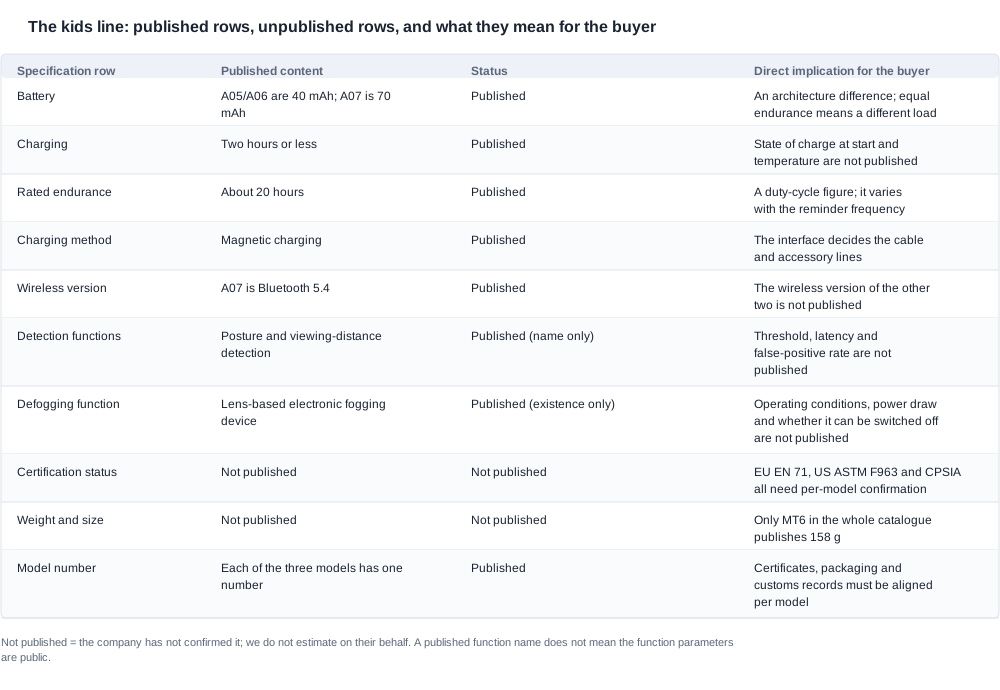
Children's hardware in this category is cheap. The A05 and the A06 publish a 40 mAh cell, magnetic charging and roughly twenty hours of rated use; the A07 publishes 70 mAh, Bluetooth V5.4, the same charge time and the same rated runtime. Simple electronics, small cells, and a cost base that is not where a children's programme goes wrong.
The cost sits in four other places, and only the first of them is a laboratory line.
Certification, per model and per market. The frameworks are per model, per market and per edition, and a line of three models across four markets is a document set rather than a document. This is the fixed cost, and the elapsed time is set by the test body rather than by your order.
The fit programme. Nobody publishes the weight or the dimensions for these models. Fit is established by sampling across a size range with real children, which is a programme of its own, and it is the single largest driver of returns in any eyewear category.
The per-variant cost. Every colour and every configuration creates a new combination. A children's range with three models and three colours is nine combinations, and the per-SKU minimum applies to each.
The support cost of a device that is worn by a child. A parent's query about a device their child is wearing is a longer conversation with more context and more expectation, and it is usually handled by the same team that handles a distributor's stock query. That cost is invisible in the quotation and permanent in the business.
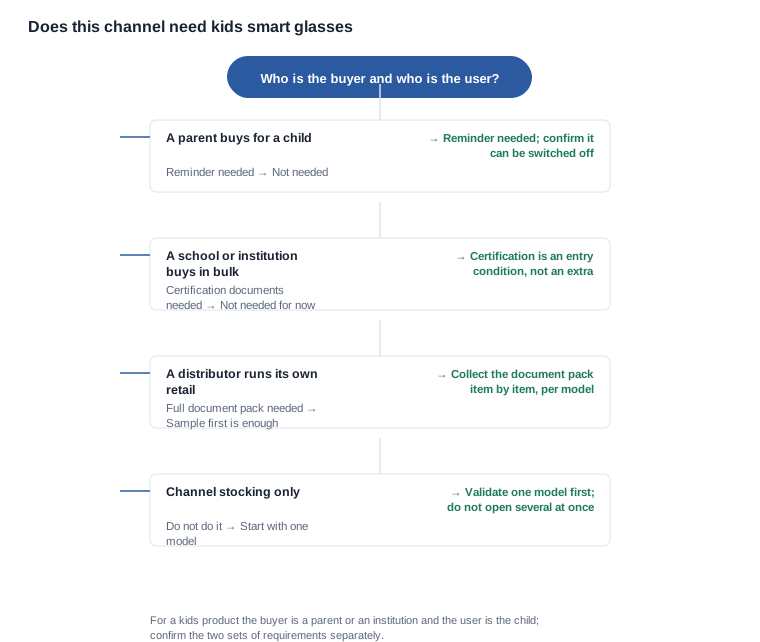
The buyer's negotiating room therefore sits in the number of models and colours committed, the artwork round count, the per-market label scope, the fit programme scope, and the market list itself. The unit price of a forty milliamp-hour cell is not where the money is, and it is the number most often negotiated first.

The rows that decide the purchase, and the ones that decide the market
Here is the published position in full, with what each row settles and what it does not.
| Published row | What it is | What it settles | What it does not settle |
|---|---|---|---|
| 40 mAh on the A05 and A06, 70 mAh on the A07 | Cell configuration | The power budget and the architecture | The runtime, because runtime depends on load |
| Charging in two hours or less | A laboratory result | An upper bound | The starting state, the temperature, the charger |
| Roughly twenty hours of rated use | A rated figure | A ceiling under favourable conditions | The duty cycle behind it |
| Magnetic charging | An interface | The cable and the case geometry | The contact condition and the charger |
| Bluetooth V5.4 on the A07 | A protocol generation | The radio generation for that model | Anything about the other two models, which publish no version |
| Posture and distance detection | A published function | That the function exists | The threshold, the delay, the false-positive rate, the alert format |
| A lens-based electronic fogging arrangement | A published function | That the arrangement exists | How it activates, what it consumes, whether a parent can disable it |
| Certification status not published | A gap | Nothing | Whether the product can be sold in the destination market |
| No weight, no dimensions | A gap | Nothing | Fit, and therefore the return rate |
Two rows deserve more attention than the others, because they are the rows that make the published data useful and the rows that make it dangerous.
The identical twenty-hour figure on a 40 mAh cell and on a 70 mAh cell is informative. A cell that is nearly twice the size producing the same runtime implies a different load profile, and the difference has to be somewhere. The most likely place is the reminder duty cycle: the published figure describes a use pattern that is not published, and the reminder frequency is a setting the brand or the parent controls. This is why the runtime must be treated as a duty-cycle number rather than a continuous one, and why a family that leaves the reminder on a high setting will reach the end of the day sooner than the published figure suggests on a forty milliamp-hour model.
The detection parameters are the product, and they are not published. The presence of posture and viewing-distance detection is published for two of the three models. The threshold, the delay, the behaviour on a repeated trigger and the false-positive rate are not. A threshold expressed as a number with a unit can be tested on a sample, compared across suppliers and written into an acceptance criterion. A threshold expressed as a quality cannot be tested at all. The difference between the two is the difference between a feature and a specification, and in a children's product it is the difference between a product that is used and a product that is switched off in week two.
The one warning that applies to every row: these figures are not directly comparable across suppliers. A runtime measured at a low reminder frequency is not the same measurement as one measured at a high frequency, and a detection threshold measured with one method is not the same as one measured with another. Until the conditions are stated, two numbers in the same row are two different measurements.

Turning a supplier's answer into a file you can defend in a school review
Verification in this category has an unusual property: the buyer who has to be convinced is often not the buyer who signed the purchase order. A school procurement officer, a district compliance team or a marketplace reviewer will ask for the file, and the file has to exist in a form that survives that review.

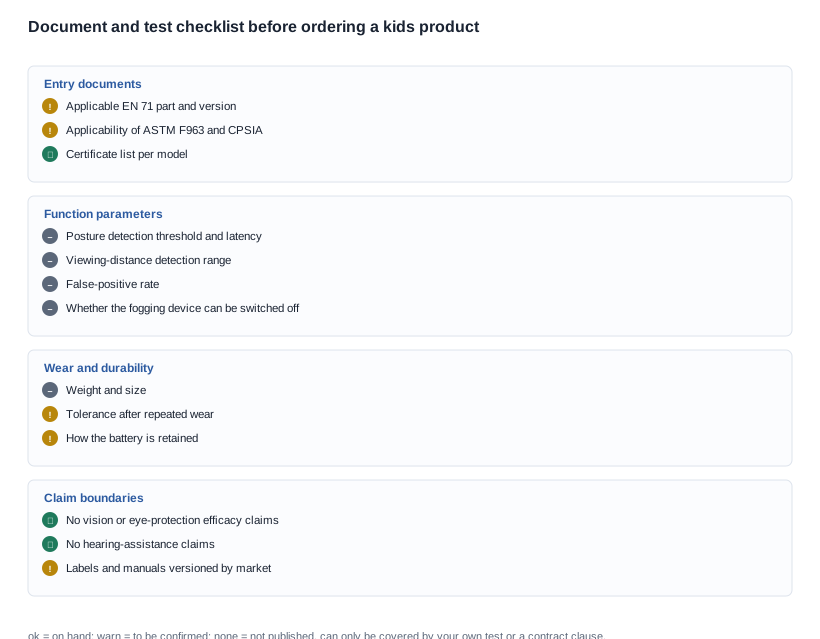
Step one: establish the classification. Before any document is requested, establish which frameworks apply. In Europe the applicable frameworks for children's products include EN 71, separate from CE marking and separate from the General Product Safety Regulation; in the United States ASTM F963 and the CPSC rules apply, and they are not covered by an FCC filing. A product with a valid CE declaration can still be non-compliant for children's use. Everything downstream — the size of the file, the label set, the lead time — follows from this answer, and it is the step most often skipped.
Step two: request the certificate numbers per model, not per family. A number is the only part of a document a procurement officer or a marketplace reviewer can check later. Ask for the list, with the issuing body and the validity dates, per model designation, in the body of the email. A document that covers "smart glasses" rather than a model is not a document for your product.
Step three: check the edition dates. The frameworks work on an edition cycle. A file prepared against a superseded edition is a retest waiting to happen, and finding that in year two of the programme is far more expensive than finding it now.
Step four: measure the parameters on a sample, on a fixed protocol. For the detection function, the protocol is: a fixed trigger distance, a fixed delay, a fixed number of repeated triggers, a stated room, and a stated pass condition. For the fogging arrangement, the protocol is: what happens when it is switched on, how it is replenished, what it consumes, and whether a parent can turn it off. Write the protocol before the first reading.
Step five: run the family trial. A parent who has not seen the product sets it up, unassisted, and the child wears it across a real school week. Record day six, not day one. The fit, the setup flow, the reminder fatigue and the charging routine are all settled in that week, and none of them is settled in a demonstration.
Step six: put the criteria into the purchase order. A criterion that lives in an email is not binding, and a criterion in the order is an acceptance standard. In a category where the supplier's own documentation is often thin, this is where the buyer's own standard becomes the enforceable one.
Six failures that appear in the first three months
The listing is pulled for a health claim. The symptom is a takedown or a complaint citing eyesight. The root cause is that the copy was written from the category name rather than from the device's function. The prevention is to narrow the claim to detect and remind, and to have it reviewed before the artwork is approved rather than after it is printed.
A product ships and the certificate does not name it. The symptom is a customs query, a marketplace rejection or a school that will not take delivery. The root cause is a family-level file treated as coverage for a branded unit. The prevention is to make the exact model designation a condition of the purchase order and to check the string on the units on receipt.
The reminder is switched off in week two. The symptom is a product that stops being worn and a return that arrives without a reason. The root cause is that the false-positive rate was never measured, so the default was too aggressive for a real household. The prevention is to measure it with real children in a real room and to set the acceptance criterion from the result.
The product runs flat by the afternoon. The symptom is a complaint about battery life against a published twenty-hour figure. The root cause is that the published figure is a duty-cycle number and the household ran a heavier one. The prevention is to run a full day at the reminder setting you intend to ship, on both cell configurations, and publish the condition with the figure.
The child takes it off and nobody knows why. The symptom is a return with a description of discomfort. The root cause is that fit was never established, because no weight or dimension is published for these models. The prevention is a fit programme across a size range with real children, and a wearing trial that records day six.
A new edition of a standard arrives and the programme has to stop. The symptom is a hold on the launch while something is retested. The root cause is that the edition was never tracked after launch. The prevention is to record the edition dates in the file, set a review date, and put an obligation on the supplier to notify changes.
The parts of the cost you can negotiate
Negotiable, and worth the effort. The setup cost is the factory's fixed cost rather than a market rate, and it is where a per-configuration minimum moves. The number of models and colours you commit to is the biggest single lever, because every combination carries its own minimum. The artwork round count is negotiable and each round is a week. The per-market label scope, the fit programme scope, and the market list itself are all negotiable numbers. And the re-validation cost per variant, with the trigger that causes it, is worth settling before the first variant is ordered rather than after.
The certification fee and the elapsed certification time are not commercial variables. Certification cost is a fixed cost per model and per market, and the elapsed time is set by the test body. The tooling charge is normally a one-off cost amortised across the first order, and the questions worth asking are over what volume it is amortised and what happens to it if the programme is discontinued. The frame geometry and the battery retention are safety-relevant design decisions, not commercial variables, and the maintenance commitment behind the detection firmware is a term rather than a price.
The documents to request before the deposit. The conformity file references with standard names, edition numbers and model designations, per market. The certificate numbers with the issuing body and validity dates. The detection parameters with units, including the false-positive rate. The alert format and the behaviour on a repeated trigger. The fogging arrangement's activation, consumption and disablement position. The runtime condition. The frame dimensions and weight with the measurement method. And the battery transport documentation for the fitted cell.
The clauses to write into the purchase order. The exact model designations covered by each document, attached to the order. The acceptance criteria from the family trial, with the days and the pass conditions. A clause requiring notice before any change of firmware, detection threshold default, frame material or supplier of a safety-relevant component. A clause requiring the documentation pack to be updated when a standard's edition changes. A clause on who bears the cost when a lot fails the acceptance criteria.
A worked example: a distributor adding a children's line
This is a hypothetical scenario rather than a client project, and it is here to show the sequence.
Assume an Asian distributor already stocking an audio line in three markets, approached by a brand that wants a children's line added under the distributor's own label. The distributor's constraint is not the price. It is that they already had a listing suspended in another category for a documentation gap, and their retailer's technical team now asks for the file before accepting delivery.
Step one: the boundary. The distributor's first question to the brand is whether the copy can say anything about eyesight. It cannot, and the brand confirms that in writing before anything else is designed. That single answer determines the whole product proposition, and it costs nothing to establish.
Step two: the classification. The three destination markets are identified, and the applicable frameworks are established per market. Two of them turn out to need a children's safety file that the brand's adult product does not have, and one needs only the radio approval plus the battery transport documentation. The distributor now knows the size of the file, which is the number they need for the retailer's technical team.
Step three: the model selection. The distributor looks at three models and immediately discovers that the A05 and the A06 publish identical rows, so the choice between them cannot be made from the catalogue. The brand confirms in writing which is which and what the actual difference is, and the distributor narrows to two models rather than three, because the per-model certification cost is per model.
Step four: the fit programme. Because no weight or dimension is published, the distributor commissions a fit sample across a size range before committing to the first order, and treats the result as the first acceptance criterion rather than as a formality. The brand supplies the units and the measurement protocol.
Step five: the paperwork. The certificate numbers are requested per model and resolved, and the model lists are checked against the units. One model comes back with a file that does not name it, and that model is held back from the first shipment rather than carried as a risk.
Step six: the claim. The listing says the product detects posture and viewing distance and reminds. It does not say anything about eyesight, and the retailer's technical team accepts the file because the claim and the evidence are the same width.
The outcome is a two-model launch instead of three, with a fit programme that cost money before the first order and a file that survived the retailer's review. The decisive decisions were the boundary, the classification and the model narrowing — none of which was about the electronics.
What our own children's models can and cannot evidence
The boundary we hold: we publish the rows we hold and mark the rest as open, and we would rather a buyer knows exactly which questions we cannot answer than discovers them in a school review.
What we publish for this tier: a 40 mAh cell with two hours or less to charge, roughly twenty hours of rated use, magnetic charging, posture and viewing-distance detection and a lens-based electronic fogging arrangement on two of the three models, and Bluetooth V5.4 with a 70 mAh cell on the third. What we do not publish, and will not estimate: the detection thresholds, the delays, the false-positive rate, the alert format, the behaviour of the fogging arrangement, the certification status, the frame weight, the frame dimensions, the ingress marking and the size range. We publish no ageing data for the seal or the battery, and we will not estimate a service life for something we have not tested.
We also make no claim about eye-protection, vision or health performance for any of our products, in any market, and no hearing-related claim either. We will not describe a device that detects a position or a distance and reminds as though it changed a child's eyesight, because that is a clinical claim and the product is not a clinical device. If your channel's proposition is an eyesight concern, this is the wrong category, and we would rather say so before the first order than after the packaging is printed.
What we will do is tell you which of the rows above are the ones you can close with a document, which need a sample test, and which need a week in a household. Send us the two models, the three markets and the customer profile, and we will say which of those applies to each.
The four requests to send this week
Send the boundary question in writing. Ask the brand to confirm, in one line, that the listing will not carry a vision, health or eye-protection claim. Get that answer before anything is designed.
Send the document request as a list, per model and per market. Standard names, edition numbers, model designations, certificate numbers, issuing bodies, validity dates. A supplier who answers per model has a documentation habit; one who answers per family is telling you the file does not exist yet.
Send the fit sample request with the protocol attached. A size range, real children, a day-six record, and the weight and dimensions measured rather than assumed.
Send us the models, the markets and the customer. We will tell you which rows our documentation answers today, which have to come from a supplier, and which need a week in a household. The range is at kids smart glasses and the technical background is under kids eye care technology.
Where the decisions come from
Send us the models and the markets, and we will say which rows you still have to close yourself.


