

Kids eye protection glasses technology: the market map
A children's product attracts regulatory attention that an adult product does not, and the frameworks involved are separate from the radio and separate from each other. The practical consequence is that the useful deliverable is not a document set but a map: which framework answers which question, in which market, and which of them is mandatory rather than conditional. The documents are the output of the map, and a buyer who collects documents without a map ends up with a folder of unrelated papers and no way to tell which of them answers which question.
Concretely, we will tell you the compliance scope your market requires and we will not claim our children's models meet it, because certification status for the A05, the A06 and the A07 is not published to us. That gap is a real one, and we would rather a buyer knew it in week one than discovered it at a customs inspection.
Three conclusions follow. First, the first question is never "does the model have a CE mark" but "which frameworks apply in the markets I am actually shipping to", because a product with a valid CE declaration can still be non-compliant for children's use. Second, the highest-yield verification step in this category takes minutes and is almost never done: resolving the certificate numbers in the issuing body's own register, per model designation, per market. Third, the document most likely to stop a shipment is the one that never appears on the product and never appears in the product file — the battery transport test summary, which the freight forwarder asks for and the factory does not volunteer.
The buyer working from a folder rather than a market list
A buyer building a compliance position is usually working from a market list, a launch date and a supplier's conformity folder, and they hold a set of samples and a target price. What they will not hold is a per-market map, because the folder is organised by document rather than by market, and the documents overlap only partly. Each framework covers a different question about the same product, and without a map the buyer reads the folder as a set of requirements rather than as a set of answers to specific questions.
The overlap point is where the work is. A product going to the European Union, the United Kingdom, the United States and a set of South East Asian markets will need a radio approval in each, a children's safety file in some, a battery transport document everywhere, and a set of market-specific labels in all of them. The radio approval is the part most buyers already know about, because it appears on every adult product they have ever sourced. The other three are where the surprises are.
There is a second reason the map has to come first, and it is the one that costs money: the map determines the size of the file, the size of the file determines the lead time, and the lead time determines the launch date. A buyer who asks for documents without a map gets a quotation for one framework and discovers the other three afterwards, which is the point at which the schedule has already been published to the channel.
What a radio approval does and does not settle
The radio approval is the most familiar document in the file and the most frequently over-read. It addresses the radio equipment and the radio behaviour — the frequency band, the emission limits, the radio version. It does not address the safety of the product as a children's item, and it does not address how the product is labelled.
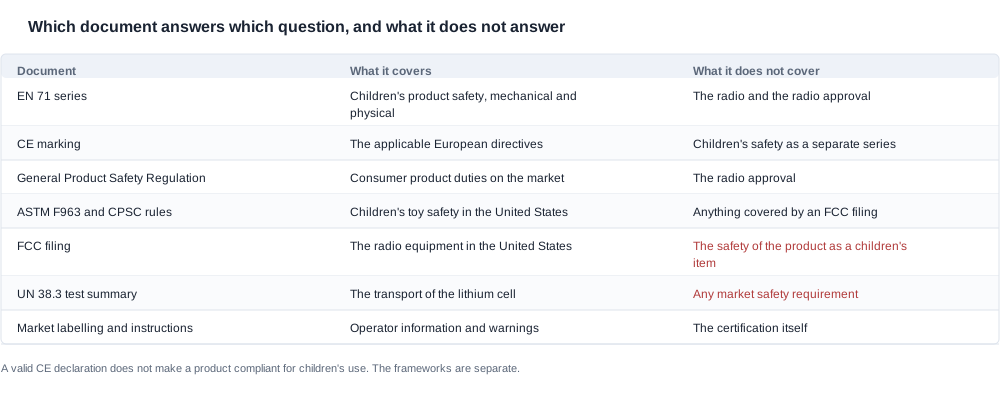
That separation is what produces the two failures this category sees most. The first is a product that ships to the United States with a valid FCC filing and no children's safety file, because the two were treated as one approval. The second is a product that ships to the European Union with a valid CE declaration and no EN 71 file, because CE and EN 71 are different frameworks with different scopes.
The same separation applies in the other direction. A children's safety file does not substitute for the radio approval, and a product that has passed the children's testing still needs its radio approval in each market it ships to. Neither document implies the other, and a buyer who has one of them has half of what is needed for each market.

Which framework answers which question
The table at the top of this article sets out the frameworks that reach a children's smart glasses product and the scope of each. Four separations cause most of the trouble, and they are worth naming individually because each has a specific document behind it.
EN 71 is the standards series covering children's product safety. It covers mechanical and physical properties, flammability, and specific migration testing depending on the category. It is separate from CE and separate from the General Product Safety Regulation, which sets the obligations of a consumer product on the market rather than testing the product against a children's safety standard. A product with a valid CE declaration can still be non-compliant for children's use.
ASTM F963 is the children's toy safety standard and it is mandatory in the United States for children's products. The Consumer Product Safety Improvement Act rules apply alongside it. Neither is covered by an FCC filing, and neither appears on the FCC filing, because an FCC filing addresses the radio and nothing about the safety of the product as a children's item.
Battery transport is checked by carriers, not by customs authorities, and it does not appear on the product. Lithium cells shipped internationally require the transport test summary under UN 38.3, and a gap surfaces at the freight forwarder. This is the single most common documentation failure in the category, and it is entirely invisible from the product itself — which is exactly why it has to be on the request list.
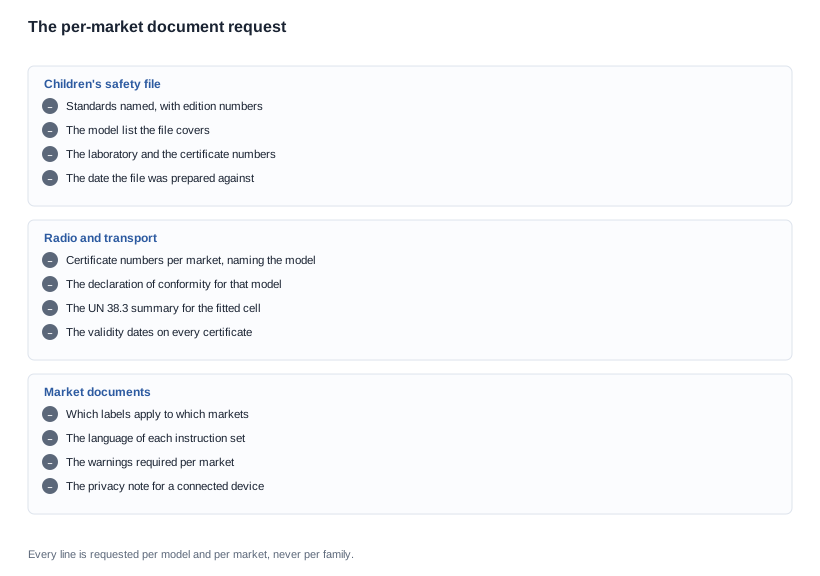
The model list on the file is the row that decides every other question. A family-level file does not cover a branded unit, and a file on the factory's own model designation does not cover yours. Ask which model designations each document names, and check them character by character against the units on receipt.
The label carries the claim, and the claim is reviewed there
The label and instruction set is per market, and it is where the claims get read. A label that says the product protects a child's eyesight is a compliance question in several markets, and we make no vision, health or eye-protection efficacy claim for any of our products in any market. The same discipline applies to the copy a buyer writes for a listing.
The practical instruction is to put the label and the product page through the same review as the technical file, at the same time. A claim is easier to narrow before the artwork is approved than after it is printed, and a label is a piece of packaging with a lead time, a print run and a minimum order quantity attached to it. A claim narrowed at the artwork stage costs a design change; a claim narrowed after the print run costs the run.
The privacy question that a connected device raises
A children's smart glasses product in this tier connects to an app, and the app is where the data question appears. We publish no data-handling position for any model in this tier, and the published position on app and firmware customisation is unverified, so the buyer has to obtain the answer rather than read it.
The three questions worth asking are what the device collects, where the data is stored, and who can access it. A school, a district procurement officer or a retailer's technical team will ask all three, and in a children's product the answer has to be defensible rather than reassuring. This is also the documentation item with the widest variation between suppliers, because the data path is the part of a children's product that most often comes from a platform built for adults.

Building the map market by market
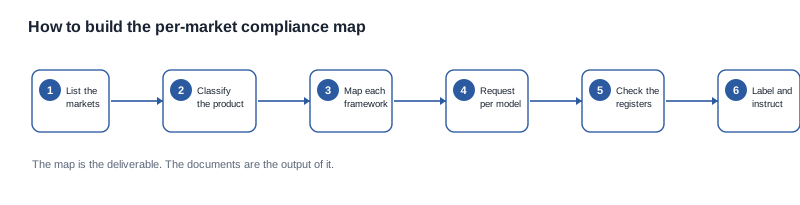
Step one: fix the market list. Not the countries you might sell into — the countries you will ship into in the first twelve months, with the channel for each. The market list is what scopes the file, and a list written optimistically is the most common cause of a documentation cost that was not budgeted.
Step two: classify the product. Establish which frameworks apply on the basis of the product's function, its user and its presentation, per market. A product marketed for children attracts the children's frameworks even when its electronics came from an adult platform.
Step three: map each framework to the question it answers. The map is the deliverable; the documents are its output. A one-page map with four rows per market is worth more than a folder of forty documents, because it tells you what is missing.
Step four: request per model designation. With the standard names, the edition numbers, the certificate numbers, the issuing bodies and the validity dates. Per model, never per family.
Step five: resolve the certificate numbers in the issuing body's register. Check that the model designation matches the model you are ordering, that the document covers the radio band and the functions you are shipping, and that the validity date has not passed. This takes minutes per document and it is the highest-yield check in the category.
Step six: build the label and instruction set per market. Which labels apply, in which language, with which warnings. And put the claims in the same review pass as the artwork.
The document that lives at the freight forwarder
The UN 38.3 test summary is the item that most often appears late, and the reason is structural rather than procedural. It is checked by carriers rather than by customs authorities, it does not appear on the product, it is not part of the conformity file that a compliance team assembles, and therefore it is nobody's document in the organisation until a forwarder emails about it.
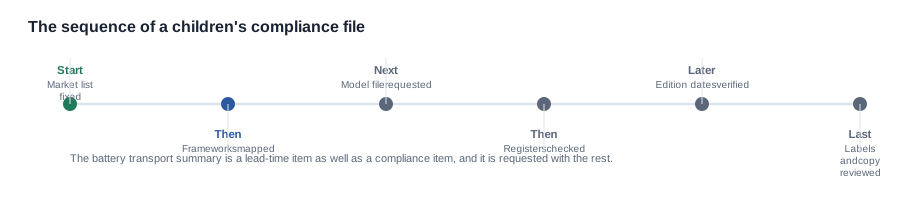
Treat it as a lead-time item as well as a compliance item. Request it with the other documents, at the same time, and make it a condition of the first shipment booking rather than a line in the freight paperwork. The difference between the two treatments is usually measured in weeks, because a test summary that has to be arranged after the booking is a test summary that has to be expedited.
Where the sequence stalls
Three points in that sequence stall, and they stall for the same reason: each of them depends on something that was not asked for at the start.
The first stall is between steps two and three, where the classification turns out to include a framework the supplier did not anticipate. The second is between steps four and five, where the certificate numbers arrive but the model list on the document does not include the buyer's designation. The third is between steps five and six, where the edition dates turn out to be behind the current editions and a retest is needed.
In each case the recovery is the same: the missing item becomes a condition of the purchase order rather than a request to the supplier. That way it is a delivery obligation with a date attached, and the buyer can decide whether to proceed, narrow the market, or wait.
How to run the register check in ten minutes a market
The register check is the step most buyers skip and the one that catches the most, because it is the only verification in the file that does not depend on the supplier telling you the truth. The certificate number is public, the issuing body maintains a searchable record, and the check takes a few minutes per document.
For each certificate number, look up three things and write them down. First, the model designation on the register entry, compared character by character with the designation on the purchase order — including the suffix, because the suffix is where a variant, a lens tint or a cell change lives. Second, the scope: whether the entry covers the radio band and the functions you are actually shipping, rather than a base configuration. Third, the validity date, compared against the date you intend to ship rather than the date you intend to sign.
The comparison between the register entry and the purchase order is the one that pays. Where a supplier's catalogue, the document and the purchase order name three different designations, the discrepancy is the finding, and it is found before the first unit ships rather than after a container is held.
Where a children's line fails on paperwork
A product ships to the European Union with a CE declaration and no EN 71 file. The root cause is that the radio approval and the children's safety approval were treated as one thing. The prevention is to build the per-market map before the request for quotation, with the children's safety file on it as a separate line.
A container is held by the carrier for missing transport documentation. The root cause is that the UN 38.3 summary was never requested, and it does not appear on the product. The prevention is to request it with the other documents and treat it as a lead-time item.
A new edition of a standard requires a retest in year two. The root cause is that the edition was not tracked after launch. The prevention is to record the edition dates in the file, set a review date, and put an obligation on the supplier to notify changes.
The label makes a claim the file does not support. The root cause is that the copy was written by someone who did not read the file. The prevention is to review the label and the product page together, and to keep the claim set to functions.
A file covers the factory's model and not the branded unit. The root cause is that similarity was treated as coverage. The prevention is to ask which designations the file names and make the answer a condition of the purchase order.
Where the commercial room is, and where it is not
The minimum order quantity is negotiable, and a children's line is often the first order for a brand in a new category, which is where a supplier has the most incentive to be flexible. Packaging and insert design — including the market labels, the language of the documentation pack and the required warnings — is a low-cost negotiation with no tooling implication, and in this category it carries real weight because each market adds a separate label set.
Delivery splitting against a certification milestone is usually granted more easily than a price concession, because it moves the approval risk onto the schedule where it belongs, and it is the right structure here precisely because the certification duration is the one span nobody controls. Payment instalments are the standard area: a deposit held against the order pending inspection, a balance tied to the inspection sign-off, and a holdback released with the document set protects the buyer on the failure that costs most in this category, which is a product that arrives with paperwork that does not cover it.
The certification cost and the certification time are not a commercial lever. They are a fixed cost per model and per market, and the elapsed time is set by the test body. A one-off charge for tooling is usually amortised across the first order, so the useful questions are over what volume it is amortised and what happens to it if the programme is discontinued. The safety documentation itself is not negotiable either, and neither is the supplier's willingness to permit an independent check of it.
The clauses to write into the purchase order are the exact model designations covered by each document, attached to the order; a clause requiring notice before any change of firmware, detection threshold default, frame material or supplier of a safety-relevant component, and before any new edition of a standard is adopted; a clause requiring the documentation pack to be updated when a standard's edition changes; and a clause on who bears the cost when a lot fails the acceptance criteria.

The map we will build with you
What our own position is, and what we cannot say
We will tell you the compliance scope your market requires, and we will not claim our children's models meet it, because certification status for the A05, the A06 and the A07 is not published to us. We publish the electrical rows for these models — the 40 mAh and 70 mAh cells, the charge time of two hours or less, the roughly twenty-hour runtime, magnetic charging, Bluetooth 5.4 on the A07, and the presence of posture and viewing-distance detection on the two sensing models — and we publish the absence of the certification position with the same prominence.
We also make no vision, health or eye-protection efficacy claim for any of our products, in any market, and we would advise anyone building a listing in this category to run the copy past someone qualified for the target market before it goes live.
What we can do is build the per-market map with you and tell you which document answers which question in each market, so that the request for quotation is scoped correctly the first time. Send us the market list, the channel for each, and the two models you are considering, and we will say which parts of the map we can complete from our own documentation and which have to come from a test body. The background is under kids eye care technology, the document-side process is in certification checklist, and the child product boundary is under child product compliance.
Where the compliance map comes from
Send us the market list and we will tell you which document answers which question in each one.


