

Kids eye protection glasses technology: cost, not price
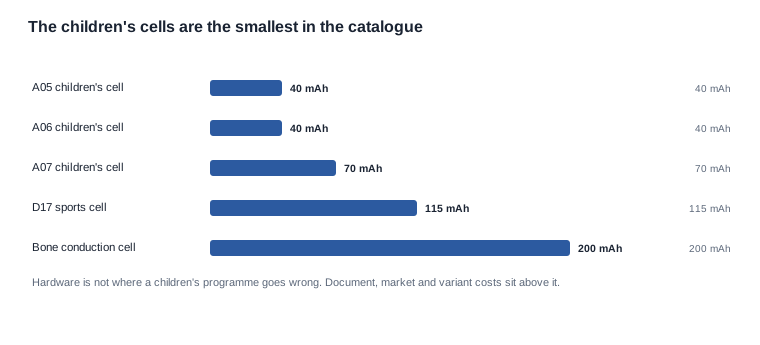
The hardware in this tier is cheap and the compliance is not, and that inversion is the first thing a buyer should understand before the first quotation lands. The A05 and the A06 publish a 40 mAh cell, a charge time of two hours or less and roughly twenty hours of rated use; the A07 publishes a 70 mAh cell on the same charge time and the same rated use. Those are among the smallest cells in the whole catalogue, and a buyer who prices this category off the unit price is pricing the cheapest part of it. Kids eye protection glasses technology smart glasses cost factors is a cost model built around the opposite idea: one large unavoidable cost, three controllable ones, three that nobody plans for, and the request that gets a supplier to itemise all of them.
The single most useful thing a buyer can do before writing the first RFQ is decide which object each cost attaches to. A line that attaches to a market, a line that attaches to a model, a line that attaches to a variant and a line that recurs every year behave completely differently at volume, and a supplier quote that does not distinguish between them is not a quotation — it is a number.
The cost answer, in three sentences
A children's line in this category is costed as a per-market, per-model and per-variant structure with a recurring tail, not as a unit price multiplied by a quantity. The unavoidable line is children's safety testing, which is charged per market and per model and whose elapsed time belongs to the laboratory rather than to the factory. The controllable lines are the feature set, the packaging and the artwork. The lines nobody plans for are the retest exposure when a standard edition changes, the support burden that a parent-facing device creates, and the certification cost of every variant added after launch.
What the buyer is holding when the cost model starts
A buyer building a children's cost model is usually working backwards from a target retail price and a set of supplier quotations, holding a market list, an expected first order quantity, a channel plan and a launch date. What they are not holding is the split between one-off setup and recurring cost, and that split is the reason a children's line looks cheaper than it is. Firmware and app maintenance, the parent's account system, the certification of each new colourway, and the support queries that arrive in a language your team does not speak are all real costs, and all of them arrive after the invoice you modelled.
The other thing the buyer is usually not holding is the answer to the question "how many models". The per-model safety testing line makes the number of models the single largest lever in the structure, which is why the model count deserves a decision before the quotation rather than after it. Three models across three markets is nine per-model testing events, and the ninth is not a rounding error.

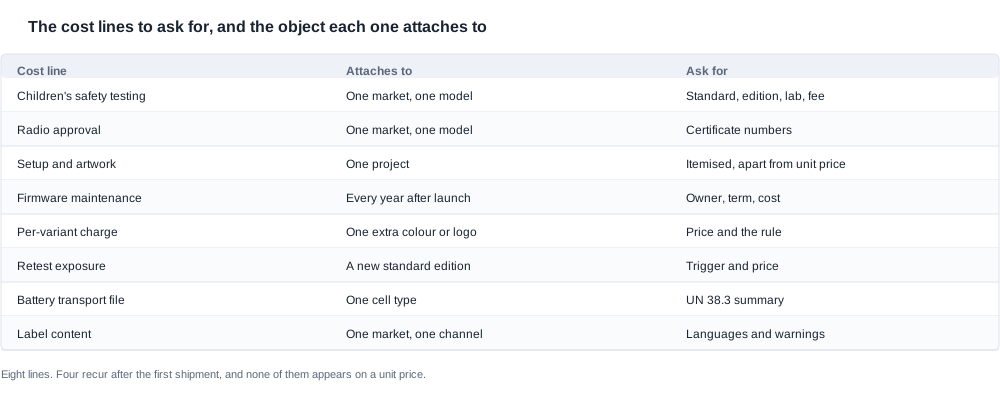
Eight cost lines, and the object each one attaches to
The reason a children's programme is hard to cost is that its lines attach to different objects. Unit price attaches to a piece. Testing attaches to a model in a market. Artwork attaches to a market and a channel. Maintenance attaches to a year. A cost model that mixes them will produce a total that is arithmetically correct and commercially useless, because the four behave differently when the volume doubles, when the market list changes and when the standard edition moves.
The unit price line attaches to a piece of product. It is the only line a buyer can negotiate per unit, and in this category it is the smallest one. The A05 and the A06 sit on 40 mAh cells and the A07 on a 70 mAh single cell, so the electronics in a children's unit are a fraction of the bill.
The testing line attaches to one model in one market. The frameworks that apply to a children's product in Europe, including EN 71, and the United States frameworks including ASTM F963 and the CPSC rules, are separate from CE marking and separate from radio approval, and they are charged per model per market per edition. This is the line that decides whether a children's line is viable.
The artwork and label line attaches to one market and one channel. The label carries the warnings, and the warnings are market-specific, and a school channel and a retail channel do not accept the same label set. Every additional channel is a separate artwork.
The variant line attaches to one additional colour, logo or private-label derivative. Every one of them is a configuration question, and the answer decides whether it is a documentation cost or a test cost.
The maintenance line attaches to a year, every year, for as long as the product is in the market. A reminder function implies firmware behaviour and possibly a parent-facing component, and neither survives a supplier who has moved on.
The retest line attaches to a decision made by a standards body. Nothing the buyer does controls it, and it can arrive in year two of a programme that has already shipped.
The battery transport line attaches to one cell type. A UN 38.3 test summary for the cell, and it is a lead-time item as well as a cost item.
The support line attaches to a language and a tone. A parent querying a device that their child is wearing is a different conversation from a customer querying a pair of earbuds, and it takes longer.
The request that turns a quotation into a cost model
Use the list below as the cost request in the RFQ. The right-hand column separates a supplier who can itemise the programme from one who will only quote a unit price, and the test is simple: a supplier who answers every row has a costing system, and a supplier who answers the first two has a price list.
| Cost line to ask for | The pass line | What a soft answer sounds like |
|---|---|---|
| Children's safety testing | Per market, per standard, with the edition, the laboratory and the fee | "Certification is extra" |
| Whether the report names your exact model | A model list, not a family name | "It covers the range" |
| The radio approval | Per market, with certificate numbers and the fee | "CE and FCC included" |
| Setup costs, itemised separately | A line-by-line list, not folded into the unit price | "Included" |
| Firmware and app maintenance | Who maintains it, at whose cost, for how long | "We maintain it" |
| The battery transport documentation | The UN 38.3 summary for the fitted cell | Not offered |
| Labelling content in the artwork | Which labels, in which languages, included | "We can do that" |
| The cost of adding a variant | A per-variant cost and a rule for when it applies | Not offered |
| The retest trigger and its cost | A price and a condition | Not offered |
| Model designation | A published designation for the exact configuration | A series name only |
The cost thresholds in plain language
The first threshold is the model count, and it should be settled before the RFQ goes out rather than negotiated afterwards. Every model in the range carries its own testing line, so the difference between a two-model and a three-model launch is not one line, it is a per-market cost multiplied by a per-model count multiplied by the number of destination markets. A brand opening a new category with one model has the most room to move on quantity; a brand launching three models has already spent the money that a negotiation would otherwise recover.
The second threshold is the variant rule, and the question is not "what does one more colour cost" but "what is the rule, and what triggers it". A supplier who quotes a price per extra colourway has given you a number; a supplier who quotes a rule has given you a cost model, because the rule tells you what the fifteenth colourway costs and what the fiftieth would do to the programme. The first variant is a cost, and the fifteenth is a different programme.
The third threshold is the maintenance term. A parent-facing reminder function that the factory stops maintaining in the second year of a retail listing is a returns problem, not a support problem, because the failure arrives as a device that stopped reminding. The term, the scope and the owner of the maintenance are all contractual, and none of them is on an invoice.
The fourth threshold is the retest trigger, which is the one nobody prices. Because the frameworks work on an edition cycle, a new edition of an applied standard can require retesting a product that has already shipped, and the trigger sits outside the buyer's control. The right response is not to argue about it but to establish what the supplier charges when it happens and who owns the decision to adopt a new edition.

Checking the cost structure against the invoice you will actually pay
A quotation tells you what the supplier expects to be paid. It does not tell you what you will pay, because the two differ wherever a line is scoped to something that changes after the quotation is accepted. These six checks are the ones that find the difference, and each of them has a completion standard that does not depend on the supplier being forthcoming.
- Recompute the total from the itemised setup list and the unit price. If the quotation does not contain an itemised setup list, the total you have been given excludes the largest part of it, and that is a question to send rather than a number to accept.
- Check that the testing line names your exact model designation, per market. A report that covers "smart glasses" rather than a model designation is not coverage for the units on your order, and the difference between those two positions is the difference between a line item and a project.
- Confirm the per-variant price and the trigger rule in writing, before the first variant is ordered. Both are cheap to agree early and expensive to discover after a colourway is already in the artwork.
- Get the maintenance commitment, its scope and its term into the agreement. A recurring cost that lives only in an email is a cost you will re-discover annually.
- Ask for the UN 38.3 test summary for the fitted cell. It is a lead-time item as well as a cost item, and the freight forwarder is a poor place to discover it.
- Ask which labelling content is included in the artwork, and in which languages. A children's label carries market-specific warnings, and a label revision is a re-approval cycle rather than a print run.
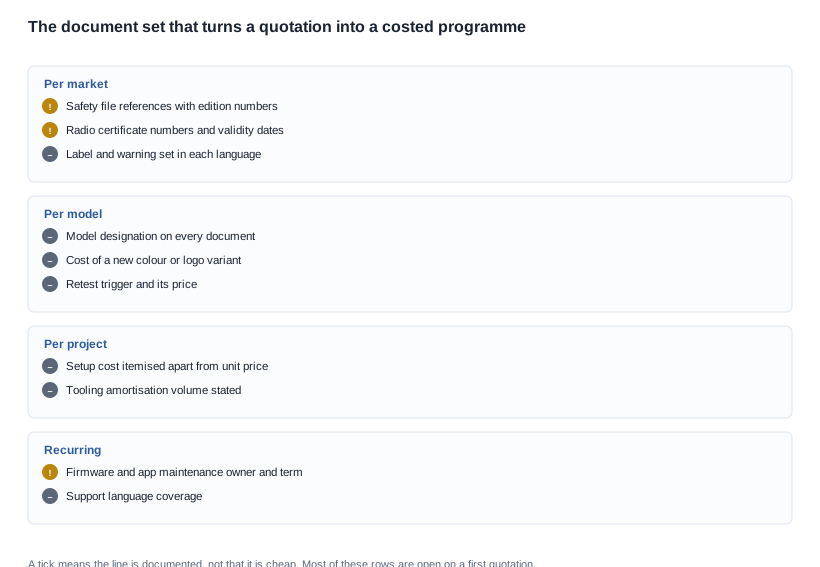

Where a children's cost model quietly understates itself
Five cost models that only work on paper
The launch market turns out to need a test nobody budgeted. The symptom is a budget line that cannot be moved because it belongs to a laboratory queue. The root cause is that the market list was treated as one market. The prevention is to price the safety testing per market at the quotation stage and to put the market list in the request, so the supplier is answering the same market list you are.
A variant ships and the certification bill arrives with it. The symptom is an invoice that references a configuration nobody asked for. The root cause is that the per-variant rule was never established. The prevention is the rule and the price, in writing, before the first variant is ordered.
The firmware is abandoned after launch and the reminders stop working. The symptom is a wave of returns that no fault report will explain. The root cause is that maintenance was never contracted. The prevention is a maintenance commitment with a defined term and scope, and a notification obligation on the supplier before any change to the reminder behaviour.
The parent's support load lands on the brand at month three. The symptom is a support queue built on questions nobody costed, arriving in languages the team does not read. The root cause is a support cost treated as zero because it does not appear on the factory's invoice. The prevention is to cost it, to identify the languages before launch, and to write the languages into the channel requirement rather than discovering them from a ticket.
A new edition of a standard requires a retest in year two. The symptom is a hold on a variant that was already in market. The root cause is that the edition cycle was never tracked. The prevention is to record the edition dates in the file, set a review date, and put an obligation on the supplier to notify changes before they force a decision.
The lines you can move, and the ones you cannot
The moveable lines in a children's cost model are mostly scope rather than price. The order quantity is negotiable, and a first order in a new category is where a factory has the most incentive to be flexible. The packaging and artwork scope is negotiable, including the number of artwork rounds and the languages in the documentation pack, and each round is a week of calendar. Delivery splitting against a certification milestone is often granted more easily than a price concession, because it moves the approval risk onto the schedule where it belongs. The instalments on a payment are standard ground — a deposit staged with the order, a balance released once the inspection is closed, and a holdback against the documentation set, which is the protection that matters most in this category, because the failure that costs a buyer the most here is a product that arrives with paperwork that does not cover it.
The lines that do not move belong to other people's timetables and other people's property. Certification cost and certification time are not a commercial lever: the fee is per market and per model, and the elapsed time is set by the test laboratory and its review queue, and pressing on either does not make the product arrive faster. A tooling cost is a one-off item usually amortised across the first order, and the questions worth asking are over what volume it is amortised and what happens to the tooling if the programme is discontinued. The recurring maintenance obligation is a term rather than a price, and the frame geometry and battery retention are safety-relevant design decisions rather than commercial variables.
Four documents should be in hand before the deposit, and four clauses should be in the order. The documents are the certification file references with standard names, edition numbers and model designations per market; the radio approval certificate numbers with issuing body and validity dates; the itemised setup cost list; and the per-variant cost and retest trigger. The clauses are the exact model designations covered by each document attached to the order; a maintenance commitment with a defined term and scope; a notice requirement before any change of firmware, detection threshold default, frame material or supplier of a safety-relevant component; and a statement of who bears the cost when a lot fails the acceptance criteria.
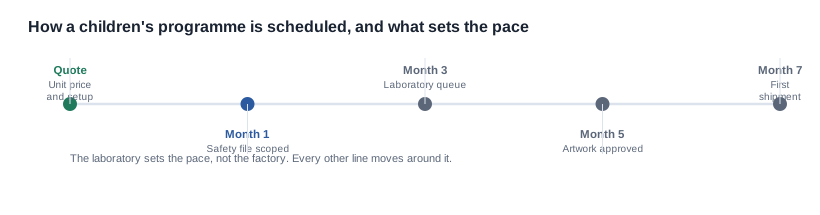
A worked case: a three-market children's line priced from the top down
This is a hypothetical case rather than a client project, and it is here to show the order of operations.
Assume an online retailer already listing an adult audio line wants to add a children's line under its own label, with a fixed target retail price, a first order it intends to be modest, and three destination markets. The buyer's first instinct is to negotiate the unit price down by a few percentage points, because the unit price is the only number on the quotation.
The first decision changes the structure rather than the price: how many models. The catalogue publishes the A05 and the A06 with identical rows, so a three-model range would carry a third per-model testing line across three markets in exchange for no additional published function. The buyer narrows to two models, and the difference is not a discount to ask for but a line to remove before the quotation is even requested.
The second decision is the market list, because each destination market needs its own children's safety file and its own label set, and a fourth market would add both. The buyer keeps three and writes the market list into the RFQ, so that the supplier is answering the same market list rather than a general one.
The third decision arrives when the quotation lands as a unit price and a one-off setup figure. The buyer's request is for the setup list itemised, and the answer splits that figure into a per-market testing line, a per-model radio line, a per-market artwork line, a project-level tooling line and a per-variant rule. The total is unchanged. What changed is that four of the five lines now have an object attached to them, and each behaves differently if the market list changes, the model count changes or a colourway is added.
The fourth decision is the colourway plan. Two colourways on the first order, with the per-variant price and the trigger rule confirmed in writing, because the artwork is where a third colourway would otherwise be discovered — after the label, the warnings and the model list have already been approved.
The fifth and last decision is the maintenance term, because the A05 and the A06 publish posture and viewing-distance detection and the A07 publishes Bluetooth V5.4, and every one of those published functions implies behaviour that somebody has to maintain after the launch. The term, the scope and the owner are settled before the deposit.
The outcome is a two-model, three-market launch with a cost model in which no single number dominates. The decisive decisions were the model count, the market list and the itemisation request, and none of them was a negotiation on unit price.
What our cost position can and cannot tell you
The boundary of what we publish on cost
Concretely, we publish the children's models' electrical rows accurately, and we will not price a programme we cannot describe. Certification status for the A05, the A06 and the A07 is not published to us. The front of our catalogue shows export certification as a company capability, and we will not convert a company-level capability into a model-level children's certification position, because the two are different things and the gap between them is where a buyer gets hurt. Unit prices, minimum order quantities and lead times are confirmed per enquiry rather than published as fixed numbers, and we would rather quote you a real number than a plausible one.
We also make no health, vision or eye-protection efficacy claim for any of our products in any market, and a cost model built on a claim the documentation cannot support is a cost model with a second, unplanned cost attached to it — the cost of a relisting.
What to send us for the cost model
Send the market list and the variant plan, and ask for the cost of both as structures rather than totals. Which lines are per market, which are per model, which are per variant and which recur after launch is the whole answer, and it takes one email to get.
Send the model count as a decision rather than a question. A two-model launch and a three-model launch differ by a per-market, per-model line multiplied across your destinations, and that multiplication is not recoverable later by negotiating the unit price.
Send the maintenance term, the variant rule and the retest trigger as three named questions. They are the three lines that recur or compound, and they are the three most often answered with a sentence that is not a term.
Send us the market list, the model count and the variant plan, and we will tell you which cost lines attach to which object. The background is under kids eye care technology, the documentation side is in kids certification requirements, and the range is kids smart glasses.
Where the cost model comes from
Send us the market list and the variant plan and we will tell you which cost lines are per market and which are per unit.


