
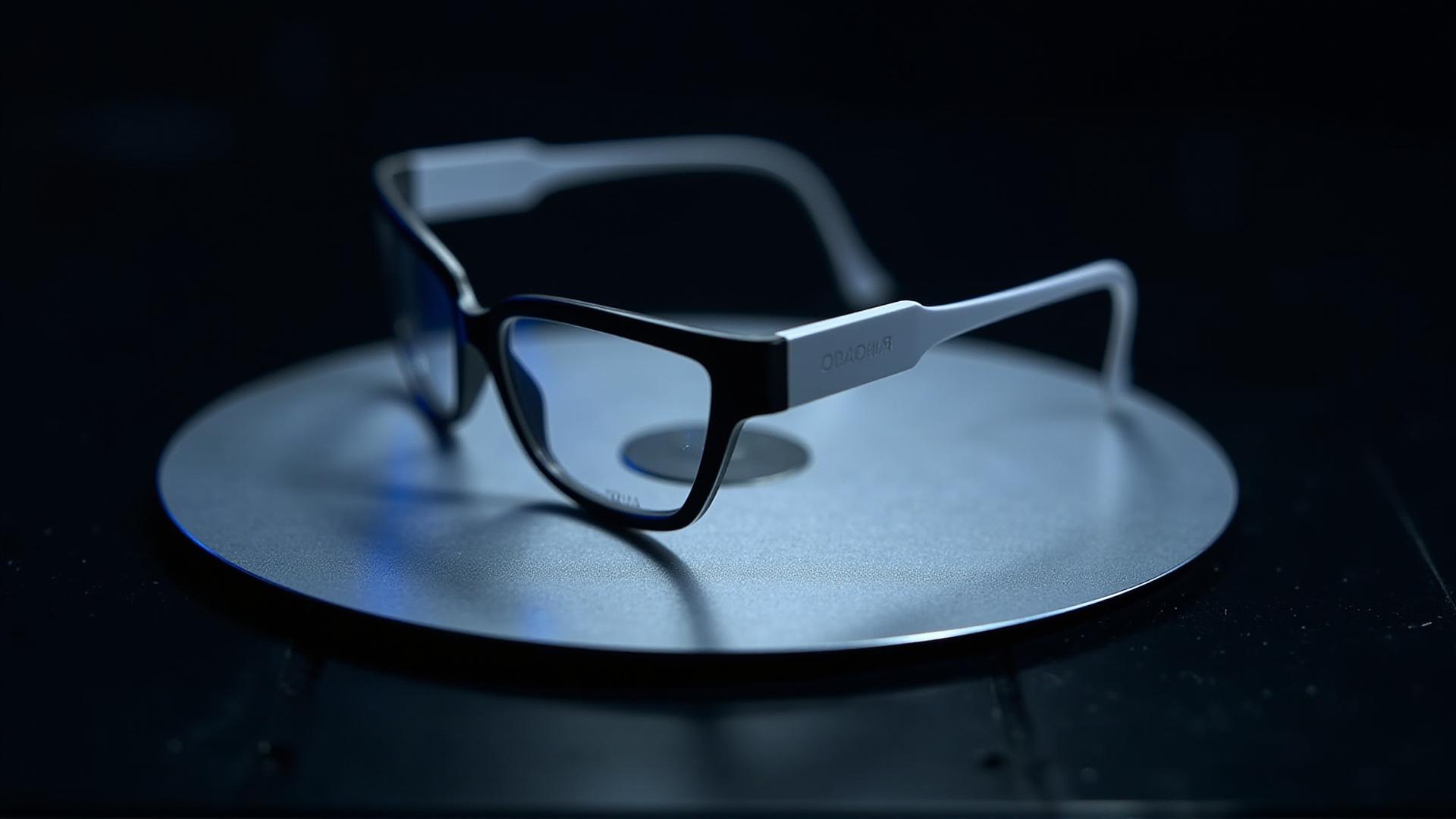
Kids eye protection glasses technology: three function sets
Three models sit in this tier, and only one of them can be chosen from published data alone. Kids eye protection glasses technology smart glasses for different use cases is a mapping of use cases onto the models, with the honest note attached: the A05 and the A06 publish identical parameters, so a buyer choosing between them is choosing on something that is not in the catalogue, and has to go and get it in writing before the order.
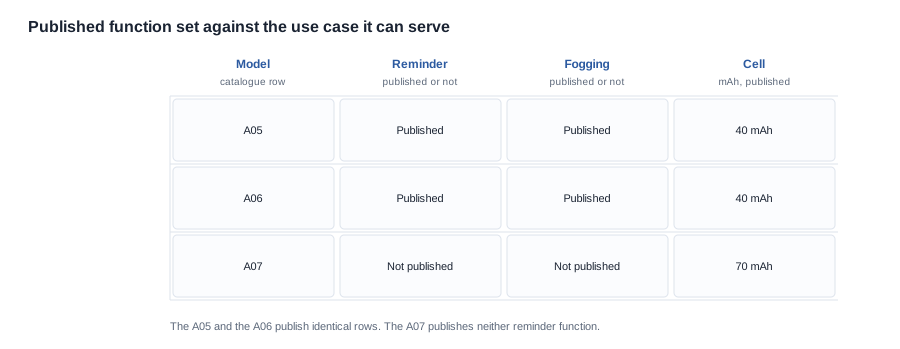
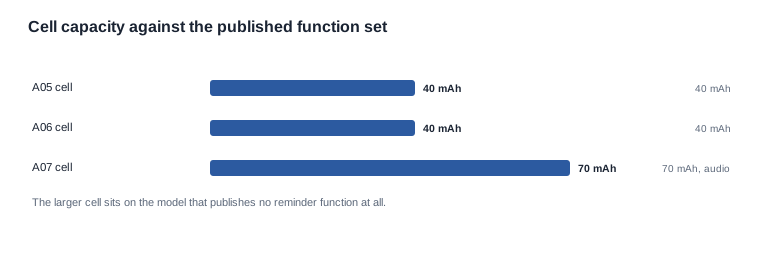
The models are the A05, the A06 and the A07. The A05 and the A06 are published with identical parameters — a 40 mAh cell, charging in two hours or less, roughly twenty hours of runtime, magnetic charging, a lens-type electronic fogging function, and posture and viewing-distance detection. The A07 is published as a children's smart audio glasses model: Bluetooth V5.4, a 70 mAh cell, two hours or less to charge, roughly twenty hours of runtime and magnetic charging, with no fogging function and no detection function published for it at all.
That is the entire published map, and it is enough to eliminate most of the wrong answers. It is not enough to finish the job, and the difference between the two statements is the difference between a buyer who is ready to place an order and one who is ready to place an order after one more exchange of emails.
The mapping answer, in three sentences
The published data points to the A05 or the A06 for any use case that needs a reminder, because posture and viewing-distance detection is their published function, and to the A07 for an audio-led use case, because its published entry carries Bluetooth V5.4 and the larger cell while carrying neither reminder function. The A05 versus the A06 choice is not decidable from data and must be settled in writing. And the market access question is a gate rather than a use case, because it decides whether you may sell the model at all and it has the longest lead time of anything in the programme.
What the buyer already holds when mapping models
A buyer mapping models to use cases is usually building a range, or deciding which single model to open a line with, and holds a customer profile, a channel, a market list and a target price. What they will not hold is the A05 and the A06 difference, because it is not published, and because in this category a buyer who assumes the newer model is better has selected on nothing at all.
The other thing they will not hold is the certification position, and the certification question is a gate rather than a use case. Children's products typically face EN 71 requirements in Europe and ASTM F963 and CPSC requirements in the United States, separate from CE marking and separate from FCC approval, and for the A05, the A06 and the A07 that position is not published to us. A mapping exercise that treats this as a paperwork item produces a plan whose schedule is wrong by months.

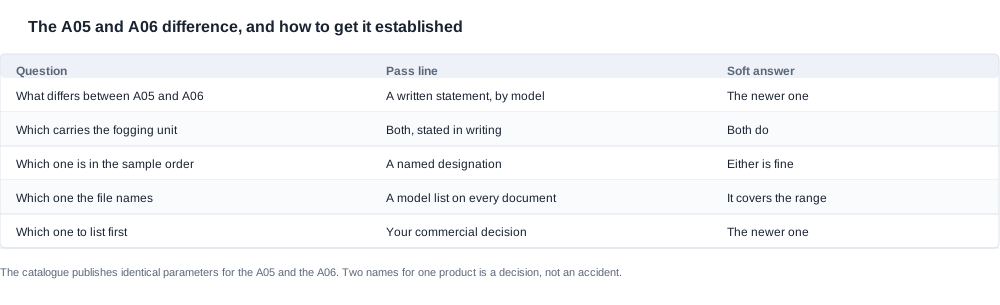
The A05 and A06 choice that no published row can settle
Two models publishing identical rows is an unusual position, and it produces an unusual procurement problem. There is no specification on which to choose between them, and there is no price difference in the catalogue either, so a buyer who has three quotations in front of them will find that the comparison does not discriminate. That is the moment a buyer is most likely to make a decision on the model number, and the model number is the one input that carries no information.
The question to put in writing is short: what differs between the A05 and the A06, by model designation, and does either of them carry a certification position the other does not? A supplier who answers "they are the same" has saved you a per-model testing line in every market, and that answer is a commercial asset. A supplier who answers with a difference you did not expect — a different lens treatment, a different hinge, a different frame material — has handed you the part of the range that will actually differentiate two listings.
The request that settles it, and what to do with the answer
Three things follow from the answer, and the order matters because two of them carry money.
If the answer is that there is no difference, narrow the range to one of the two. Every model in a range carries its own per-model testing line in every market, so removing a duplicate model removes a multiplication rather than a single line, and it is the cheapest schedule improvement available in this category.
If the answer names a physical difference, make that difference the listing's organising principle, and make sure the artwork for each model is scoped separately, because a different lens or a different hinge can change the label as well as the photo.
If the answer is that the difference is commercial — a different minimum order, a different price band, a different lead time — then the range can be two models with one function set, and the buyer's job becomes pricing rather than specification. That is a legitimate structure, and it is a decision a buyer can make openly.
What the answer must not be is a soft answer. "The newer one" is not a difference; it is a way of ending the conversation. When you get one, ask the second question: what specifically changed, and which published row will show it.
Which use case the published data actually points to
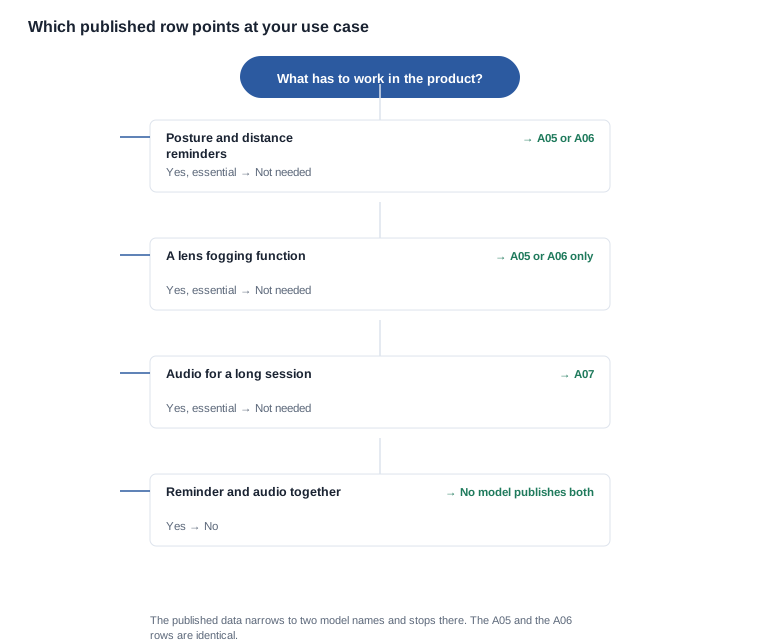
The data narrows the field in a specific way. It is not that a use case maps neatly to a model; it is that a required function maps to the model or models that publish it, and everything after that is your decision rather than the catalogue's.
A use case that needs posture and viewing-distance detection points to the A05 and the A06, and to nothing else, because the A07's published entry contains neither function. A use case that needs a lens fogging function points to the same two models. A use case that needs audio for a long session points to the A07, because its published entry carries Bluetooth V5.4 and a larger cell, and it is the only model in the tier that publishes a radio version at all.
There is a fourth case that the catalogue does not answer, and it is worth naming because a buyer will eventually hit it: a use case that needs a reminder and audio in the same product. No model in this tier publishes both. That is a range design question rather than a sourcing question, and the honest answers are to build two products, to change the brief, or to accept that the market wants a different product from a different range. What is not an answer is listing the A07 with the reminder functions of the A05 on the same product page.
Two numbers a buyer will misread in this mapping
The twenty-hour figure. The A07 publishes roughly twenty hours of runtime on a 70 mAh cell, and the A05 and the A06 publish roughly twenty hours on 40 mAh. The obvious inference — that the larger cell is what carries the session — does not follow from the published rows, and a listing that claims the A07 "lasts longer" is claiming something the catalogue does not support. The cell size is a real difference and it has real uses, but the published runtime is the same figure on both, and no test condition is published for either. The A07's advantage in an audio use case comes from its published radio row, not from a longer day.
The twenty-hour figure against the rest of the catalogue. It is the longest rated runtime published anywhere in this range, and the camera and audio models in the same catalogue publish between roughly five and eight hours. That is a genuine product difference and it is worth having. It is also, on its own, not a use case: a device that lasts all day and reminds nobody about anything is a long-lasting device that solves nothing, and the use case is carried by the detection function rather than by the cell.

Testing a model against the room it will be used in
A mapping on paper tells you which model carries which function. It does not tell you whether the function survives the environment, and in this category the environment is where most of the disappointment lives. The A05 and the A06 publish a detection function; whether it fires usefully in a classroom, at a kitchen table or on a school bus is a separate question that only a test answers.
Four observations that become acceptance criteria
- The trigger distance in the real room. Fix a distance, fix a posture, and record whether the device responds. A detection function that only works at the distance of the demonstration table is a function that will not work on a desk that is 30 cm deeper.
- The repeat-trigger behaviour. Fire the condition repeatedly and record what happens. A reminder that fires on every subsequent frame is the fastest way to have a teacher disable it, and a teacher is a customer, not a user.
- The full-day duty cycle at the shipping setting. Run the A05 or the A06 on its 40 mAh cell and the A07 on its 70 mAh cell through a real day at the reminder frequency you intend to ship, and record where the charge ends up. The difference between the two is the margin you actually have.
- The fogging function, on and off. Run it, disable it if it can be disabled, and observe the difference in the lens and in the child's willingness to keep wearing the product. The catalogue publishes that the function exists; whether a parent can switch it off is not published, and it is the question with a returns answer attached.
Each of the four observations becomes a number with a pass condition, and each of them is written into the purchase order rather than into a meeting note. That is the point at which a mapping stops being a catalogue exercise and becomes an acceptance standard.

What a range built from three models costs you in positioning
A range of three models in this tier is not three versions of a product. It is one product with two published functions, one product with a single published function and a different radio row, and one duplicate whose relationship to the first is not published. Presenting them as a single line is the most common positioning error in the category, and it fails in two directions at once.
In the first direction, the range over-claims. If a single product page carries all three function sets, then somewhere on that page the A07 is described with a reminder it does not publish, and a buyer who orders the A07 against that page receives a product that does not do what the page said. In the second direction, the range under-claims. If every page is reduced to "safe for children" and a battery figure, the two models that carry the actual differentiators become indistinguishable, and a retailer who has a choice between them will pick on price — which means the supplier's price becomes your price.
The positioning that works is one line per published function set, with the model's own designation attached to every claim on that line, and the A05 and the A06 relationship stated honestly rather than implied. If the two are genuinely identical, saying so is a strength with a channel buyer and a liability with a parent, and the way to manage it is a different listing structure for each rather than one merged page.
Five ways a model mapping goes wrong in market
The A06 is selected over the A05 because it is newer. The symptom is a range that carries two near-identical models with no story. The root cause is that the difference was assumed rather than established. The prevention is to ask for it in writing before the order.
A classroom deploys the reminder and the teacher disables it within a week. The symptom is a request to return the quantity. The root cause is that the false-positive rate was never measured in a classroom-like environment. The prevention is to test the trigger behaviour in the real room and set the acceptance criteria from the result.
A listing presents all three models as one product. The symptom is a complaint that the product does not do what the page described. The root cause is that the range was written as a feature list rather than as a set of configurations. The prevention is to write each model's published function set separately and never to carry a function across.
The product runs flat before the end of the school day. The symptom is a battery complaint against a published twenty-hour figure. The root cause is that the runtime was published without a condition. The prevention is to measure it at a realistic load and publish the condition with the figure.
The product is launched into a market it cannot be sold in. The symptom is a shipment held at the border or refused by a marketplace. The root cause is that the certification question was scheduled after the product work. The prevention is to treat it as a gate, and to start it first.
What a model mapping costs in a children's supply chain
The cost structure of this category follows from the mapping, because the number of models in the range is the number that multiplies. Every model carries a per-model testing line in every market, every model carries its own label scope, and every model carries its own artwork round. A buyer who narrows a three-model range to two has not saved one line; the saving is one line multiplied across the market list.
The second cost that follows from the mapping is the positioning cost, and it is paid at the channel rather than at the factory. A range that presents three models as one product produces a support load rather than a sales load, because every order arrives with a question about which model was shipped. A range that presents one product per published function set produces three listings, each of which can be judged on its own.
The third is the line that appears in no quotation: the cost of a variant. A private-label derivative of a model that was chosen for its function set is a new configuration, and whether it is a documentation cost or a test cost depends on a rule that the buyer should have before the first derivative is ordered rather than after.
The commercial lines a mapping gives you leverage on
Minimum order quantity is negotiable, and a single-model launch is the place where a supplier has the most incentive to be flexible on quantity, because a one-model range is a one-model programme with a single per-market line. Packaging and insert design — the size guidance, the market labels, the required warnings — is a low-cost negotiation with no tooling implication, and the insert is where the model's own function set should be described rather than the range's. Delivery splitting against a sample-approval milestone is often granted more easily than a price concession, because it moves the approval risk onto the schedule where it belongs. The staging of a payment is standard ground: a deposit on the tooling, a balance held until the inspection is signed off, and a holdback on the file, which protects the buyer against the failure that costs most here — a product that arrives with paperwork that does not cover it.
Certification cost and certification time are not a commercial lever, because the fee is per market and per model and the elapsed time belongs to the test laboratory and its review queue. A tooling cost is a one-off item usually amortised across the first order, so the useful questions are over what volume it is amortised and what happens to it if the programme is discontinued. And the published function set of a model is not a commercial variable at all: a supplier who will not tell you what the A07 actually does is telling you the range is not a range.
The part of the mapping we can and cannot complete
The boundary of what we publish on the mapping
We publish each model's rows accurately, including the fact that the A05 and the A06 are identical in their published parameters, and the difference between them is not published to us. We publish no detection threshold, no delay, no false-positive rate, no frame weight, no dimension, no ingress marking and no certification position for this tier, and we will not estimate them from typical values. The catalogue front page shows export certification as a company capability, and we will not convert that into a model-level children's position.
We also make no efficacy claim on eye protection, vision or health for any of our products, in any market. The claim boundary is the thing that most often decides whether a product in this tier can be sold at all, and it is worth settling before the product page is written rather than after it is published.
What to send us about the use case
Send the use case and the market list, and we will tell you which model the published data points to and which decision still needs a supplier. The mapping above is the part that closes in a single reply.
Send the A05 and A06 difference question in the same message, and treat the answer as a commercial input rather than a curiosity. "There is no difference" is a per-model testing line you can remove from every market in your list.
Send the detection parameters with units, the false-positive rate over a stated number of attempts, and the runtime condition. Those three answers are what turns a mapping into an acceptance criterion, and they are the numbers a buyer's checklist cannot be closed without.
The background is under kids eye care technology, the measurement method is in how to test kids eye protection glasses, and the range is kids smart glasses.
Where the mapping comes from
Send us the use case and the market list and we will tell you which model the published data points to, and which decision still needs a supplier.


