
Kids eye protection glasses technology: a protocol written before the sample
Children's eyewear is the category where the gap between what is published and what a buyer needs is widest, and the reason is that the two published figures that do exist are not the ones that decide whether the product is safe for a child to use.
Our catalogue entries in this range publish a 40 mAh battery for the two models with the lens-based electronic atomiser feature, charging in two hours or less, roughly twenty hours of runtime, magnetic charging, and posture and distance detection. The A07 in the same range is an audio model with a 70 mAh battery, the same charge time, the same runtime, magnetic charging and Bluetooth V5.4, and no camera in the published specification. Certification status for these models is not published at all. So the specification tells you about the battery and tells you almost nothing about the sensing behaviour that is the entire reason a parent would buy the product.
This creates an unusual measurement problem. There is no published figure to reproduce, so you cannot audit the manufacturer. You can only establish your own criteria and test against them, which means deciding what "detection" means before you have anything to test.
So kids eye protection glasses technology smart glasses how to measure is a protocol design problem, and the protocol has to be written before the sample arrives. The short answer for a buyer: define the two detection behaviours separately, because posture and distance are different claims with different test designs; fix the four environmental conditions, because a sensing product will otherwise measure your room; and record five fields per run, because the time to reminder is what a parent complains about, not the detection rate. Set the thresholds in the RFQ, because a threshold agreed after the first run is a threshold that has already been missed.
The buyer behind a children's range, and the liability that shapes it
The reader here is usually a brand-side product manager or a procurement manager assembling a children's line, and occasionally a channel buyer stocking one. The decision in front of them is rarely "which sensor is better". It is whether the product can be described in a listing at all, in a market where the description is the thing that attracts the most attention when something goes wrong.
What makes this category different from the rest of the range is not the electronics. It is that the person who buys it is not the person who uses it. The buyer of a pair of children's glasses is a parent or a guardian who cannot evaluate the detection behaviour themselves, so the product page is the entire evidence surface. A product page in this category is therefore a set of claims made to a third party on behalf of a child, which is a different drafting standard from the rest of the catalogue.
That standard produces a specific set of fears. The first is a claim the brand cannot defend if the product is returned: a number for detection accuracy that nobody measured, or a health-related sentence that nobody can support. The second is a safety file that does not exist: the certification position for a children's product is not a documentation formality, it is a question about whether the product may lawfully be placed on the market in the destination country at all. The third is a return reason that is impossible to interpret, because "the reminders are annoying" and "the reminders never happen" are the same complaint from the buyer's side and completely different findings.
The commercial shape of the category follows from that. A children's line carries a disproportionate share of its risk in the first ninety days, and the cost of getting the wording wrong is not a reprint but a recall conversation. Everything in this article is written for a buyer who wants to settle the wording and the thresholds while they are still cheap to change.
Defining detection: posture, distance, and two different test designs
This is the step most buyers skip, and skipping it is why the evaluation stalls. Posture detection and distance detection are two different claims, and they need two different test designs.
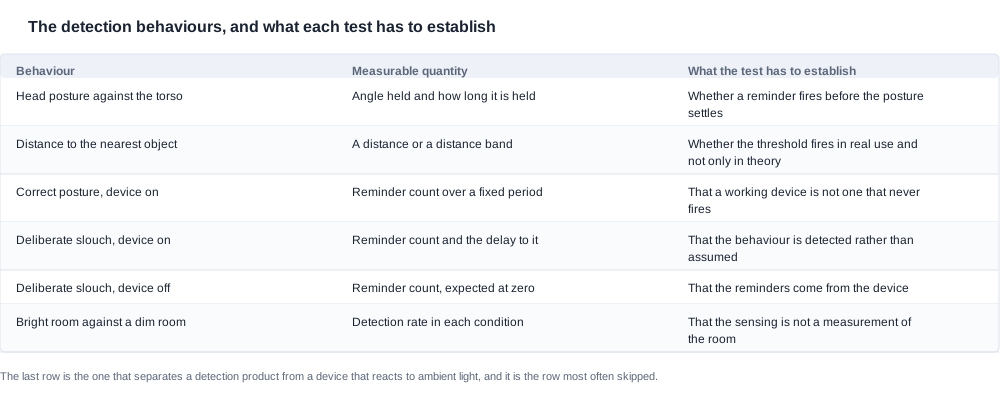
Posture detection is a claim about the relationship between the head and the torso. The measurable quantities are the angle between the head axis and the vertical, and the duration for which that angle is held. The failure mode to look for is not a missed detection but a false one — a child slouched slightly while reading, then straightened, then slouched again, generating a stream of reminders that the child learns to ignore. A reminder system that becomes noise gets switched off, and a product that is switched off provides nothing. This is the failure that a parent will describe as "it nags", and it is the one that is invisible in a detection rate.
Distance detection is a claim about proximity to an object, usually a screen or a book. The measurable quantity is a distance or a distance band, and the failure mode is a threshold that is set either so tight that it fires constantly or so loose that it never fires. Both settings are possible on the same hardware, and neither can be detected without a test.
The false reminder rate is the number that decides the product, and it is the one nobody asks for. A detection product that fires correctly every time it should and also fires four times an hour when it should not will be switched off within a week, and the brand will see it as a return of "not as described" rather than as a threshold problem. Ask the supplier for the false reminder rate, and if they do not have it, that is the finding that shapes the programme.
The point of writing all this down is that the supplier can then be asked a specific question: what threshold does this model use, and is it adjustable. A threshold that is fixed in firmware is a design decision you cannot influence; a threshold that is adjustable is a specification you can set in your acceptance criteria and in the copy.
The four test conditions and the five fields that close them
Once the behaviours are defined, the test environment needs to be controlled, because a detection product will otherwise measure your room rather than the device.
-
Room light. A sensor that uses optical sensing behaves differently in a bright classroom and a dim bedroom. Record the illumination at the test position, and run each test at least once in a second condition. The two conditions are not interchangeable: a product that only works in a bright room is a desk product, and a listing that does not say so will produce returns from a bedroom.
-
Child and adult wearers. A range of head sizes and neck lengths. If the product is specified for children, the adult result is not informative, and the smaller the wearer, the more the geometry changes. The adult run is not a formality either: it is the control that tells you whether the device is reacting to the wearer's head or to the room.
-
Duration of the behaviour. A single bad posture held for five seconds proves almost nothing. Test holds of a minute or more, because reminder fatigue is a time-dependent failure and a ten-second test cannot produce it.
-
A control condition. A child sitting correctly, with the device on, for the same duration. Without it you cannot tell a working detection from a device that simply never fires, and this is the control most often skipped, because the tester is impatient to see something happen.
For each test, record five fields. The behaviour that occurred and whether it was detected. The behaviour that occurred and whether it was correctly not flagged. The elapsed time to the reminder. The illumination at the position. The wearer's head size and, where it is relevant, the distance to the nearest object.
The third field is the one people forget, and it is the one that decides whether the product is acceptable. Detection accuracy is close to binary and therefore uninformative on its own. Time to reminder is what users experience, and it is what a parent will complain about. A device that is accurate but takes eight seconds to remind is a different product from one that is accurate and takes one, and no accuracy figure distinguishes them.
The certification question this category cannot avoid
Children's products attract regulatory attention that adult products do not, and the standard frameworks in the European Union and the United States — EN 71 in the EU, ASTM F963 and the Consumer Product Safety Improvement Act in the US — work on an edition cycle, where a new edition can require retesting. The certification requirements by market piece sets out the list per destination.
For the models in our range that carry the lens-based atomiser feature, the certification position is not published to us. That is the honest position and it is also the most important gap in the file, because a certification question for a children's product is not a documentation formality — it is a question about whether the product may lawfully be placed on the market in the destination country at all.
Ask which standards were applied, against which edition, and on which models. If the answer is that the work is in progress, the commercial consequence is a launch date that depends on someone else's laboratory, and that belongs in your plan rather than in a footnote. The supplier verification path sets out the order to ask it in.
There is a second line in this category that no certificate can close. A product that reminds a child to correct their posture and to take a break at a distance is a behaviour-change product, and the temptation in the listing copy is to describe the benefit that the parent is hoping for rather than the mechanism that exists. Nothing in the published specification supports a statement about eyesight, about the prevention of any condition, or about the effect of screen use on a child's eyes. No measurement closes that gap, because the gap is not a measurement gap. The wording of the reminder feature is the whole of the claim, and it should be written in mechanism terms — the device reminds the child to sit upright, and it reminds the child when the viewing distance drops below the set threshold.

Five ways a children's programme goes wrong, and the terms that move
The device fires correctly and nags constantly, and the brand hears about it as "not as described". Root cause: the false reminder rate was never measured. Prevention: measure it over a full control period with a correctly seated child, and set the threshold in the acceptance criteria.
The reminder arrives eight seconds late and nobody wrote the limit down. Root cause: only a detection rate was recorded, and detection rates do not capture delay. Prevention: record time to reminder as a required field, and set a maximum in the RFQ.
The product works in the showroom and not in a dim bedroom. Root cause: the illumination condition was never recorded. Prevention: run every test at two illumination levels and record both.
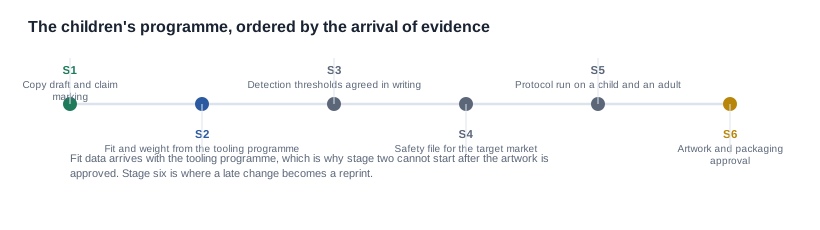
The certification position is discovered after the artwork is approved. Root cause: the file was treated as a formality rather than as a precondition of the launch. Prevention: settle the certification route for the target market before the copy, because the copy depends on the age band and the warnings it carries.
A health-related sentence appears in the listing and the product is reclassified. Root cause: the copy was written from the parent's hoped-for outcome rather than from the published mechanism. Prevention: keep the wording to the two reminder behaviours and the published rows, and have the copy reviewed for the target market before the artwork is approved.
The commercial terms of a children's programme sit unusually close to the copy, because the packaging carries the age band, the warnings and the reminder behaviours. The terms worth negotiating time on:
- Minimum order quantity.
- Packaging and insert design, including the market labels, the age band and the language of the documentation pack, which in this category is a compliance-adjacent negotiation rather than a cosmetic one.
- Delivery splitting against a sample-approval milestone, which is often granted more easily than a price concession because it moves the risk onto the schedule where it belongs.
- Payment timing: a deposit covering the artwork, a second payment tied to the inspection pass, and a retention on the documentation package.
- The warranty period with a stated response, and the returns policy, which for a children's product in a consumer market is the number most likely to protect the brand.
Two costs in a children's programme are quoted but not negotiated. Certification cost and certification lead time follow the testing body and the review queue rather than your order size, and in this category they are per build rather than per product family. Tooling is often amortised across the first order — how far the charge is spread, and whether the tool is still yours if the programme stops, are the two questions that decide what it really costs. Below both sits the detection hardware and the threshold firmware, because a supplier who will not change them is telling you the behaviour is fixed.
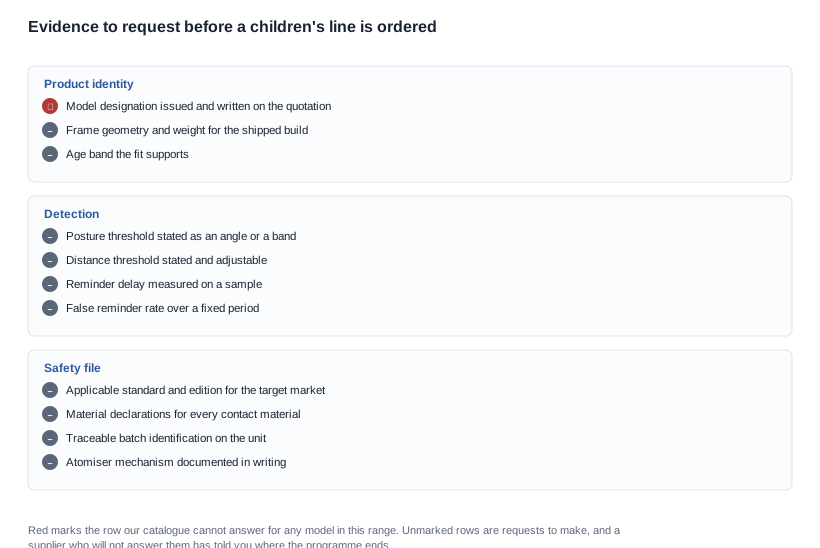
The file to request before the deposit is: the certification position per target market, with the standards and editions named; the posture and distance thresholds, and whether they are adjustable; the false reminder rate and the time to reminder, with the conditions attached; the model designation, the frame geometry and the weight for the shipped build; the material declarations for every contact material, and the atomiser mechanism documented in writing; and the certificate numbers for the rest of the conformity file, with the issuing body and validity dates.
The purchase order is where a children's programme becomes enforceable, so the clauses that belong in it are these: the model designation as a line item, with the certificate numbers attached; the acceptance criteria from the detection protocol, with the illumination, the duration, the cycle count and the maximum time to reminder stated; a clause requiring notice before any change of sensor, threshold firmware or fit geometry; and a clause on who bears the cost when a lot fails the acceptance criteria.
A children's line written and tested, and the boundary of our own claims
The case below is invented for the sake of the reasoning, not a client project. Assume a brand-side buyer assembling a children's line for a school-supply channel in one European market and one consumer market, with two candidates that differ mainly in the detection configuration, and a retail partner who has asked how the product knows the child is sitting too close.
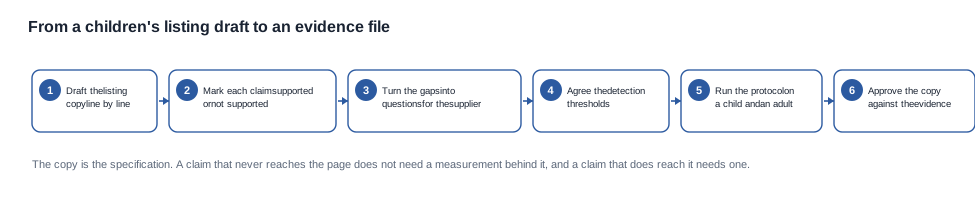
Step one: the claim file. The buyer drafts the listing copy line by line before anything is tested, and marks each sentence as supported or not supported. The two sentences that survive are the mechanism statements — the device reminds the child to sit upright, and it reminds when the viewing distance drops below the set threshold — and everything about eyesight, screen use or protection is marked unsupported and removed rather than deferred. Two thirds of the draft copy disappears, which is the point of doing it this way: a claim that never reaches the page does not need a measurement behind it.
Step two: the thresholds. The buyer asks each candidate for the posture threshold, the distance threshold, whether they are adjustable, and the false reminder rate. One candidate names both thresholds and confirms they are adjustable; the other will not say whether the distance threshold is adjustable, which means the buyer has to fix it in the acceptance criteria and accept that it cannot be changed later. That asymmetry is the first real difference between the two platforms and it costs nothing to establish.
Step three: the protocol. Four conditions, five fields, two wearers, and the control period with a correctly seated child. The result is that both platforms detect the deliberate slouch, that one of them reminds within a second and the other takes several, that the one with the unstated threshold fires repeatedly during a control period with a correctly seated child, and that the false reminder rate is the finding that decides the comparison.
Step four: the lighting condition. The same protocol is repeated in a dim condition, and the difference in behaviour between the two is larger than the difference in the bright condition. The buyer adds the second illumination level to the acceptance criteria as a permanent clause rather than as a one-off observation, because the channel is a bedroom and a study rather than a classroom.
Step five: the commercial structure. The certification route for the two target markets is settled before the artwork, the copy is written to the mechanism sentences, the packaging carries the age band and the warnings that the target market requires, and the first delivery is split against the sample-approval milestone. The result is a line with a small set of defensible claims rather than a broad one with a certification gap behind it.
Our own position is that we will not publish a detection accuracy, a reminder delay or a certification status for the children's models in this range, because none of them is published to us and a plausible-looking number in a children's product file is exactly the kind of thing that ends up on a product page as a safety claim.
We will tell you which figures exist — the 40 mAh battery, the charge time of two hours or less, the roughly twenty-hour runtime, magnetic charging, and the presence of posture and distance detection — and we will tell you that the certification position and the detection thresholds are Not published. We will also tell you that the twenty-hour figure is a published row without a stated duty cycle, which means it is not a continuous-use claim, and that a listing which describes twenty hours of continuous use has gone past what the row supports.
If you are running a tender for a children's line, ask us for the standard list that applies in your market and we will tell you which parts of it we can answer and which have to come from the testing laboratory. The range is at kids smart glasses and the background is under kids eye care technology.
What to do next.
- Draft the listing copy line by line and mark every sentence supported or unsupported.
- Ask each candidate for the thresholds, whether they are adjustable, the false reminder rate and the time to reminder.
- Write the protocol before the samples arrive: two illumination levels, two wearers, a control period, and five fields per run.
- Settle the certification route for the target market before the copy, and before the artwork.
- Put the thresholds, the acceptance criteria and a change-notice clause into the purchase order, and publish no number you have not measured on your own units.
Related reading
- Kids eye care technology
- Kids certification requirements by market
- Kids supplier verification path
- Kids smart glasses range
Tell us the destination market and the age range and we will say which tests have to be in your acceptance criteria.


