
Kids eye protection glasses technology: the damaging word
The vocabulary in this category is small and every term in it is used loosely somewhere. Kids eye protection glasses technology smart glasses glossary is a working list for buyers: the function terms, the compliance terms, and the terms to avoid, with the claim limit attached to each one. A buyer who can separate the terms that describe a function from the terms that assert a benefit can also stop the benefit ending up on the product page — and in a children's category, the product page is the document a parent, a retailer and an inspector all read.
How to choose a term for a children's listing is a question of evidence rather than of tone, and the first term to get right is "child-safe". It is an undefined adjective that implies a testing standard has been met, and it appears on more listings in this category than any other term, including listings where no children's safety test has been performed. A buyer who writes it without a report behind it has made a statement about a child's safety on a commercial document, and there is no version of that statement that survives a query from a parent or a school. The rule is simple and it is not negotiable: name the standard and the report, or do not use the word.
That gap is the first item to close in any children's programme, and it should be closed before the copy is written rather than after it is published.
The glossary's answer, in three sentences
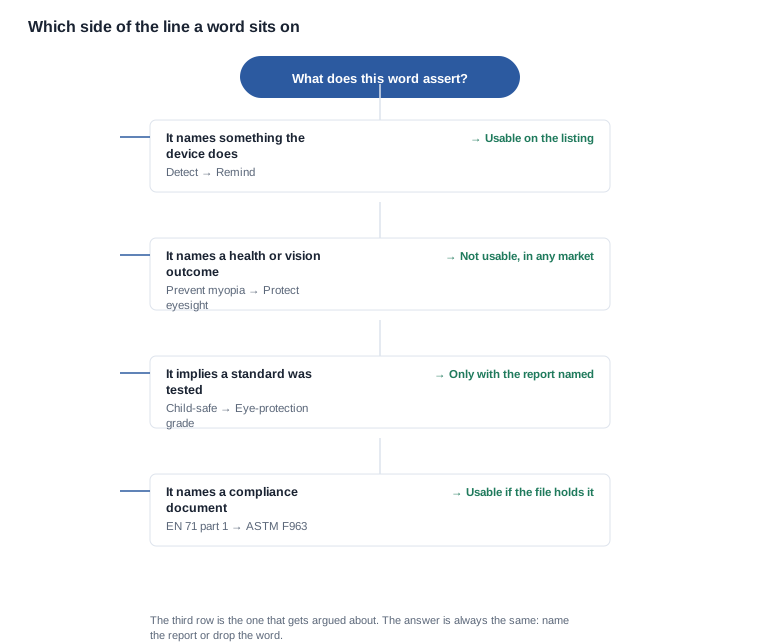
A glossary in this category is used for one purpose: deciding which words may appear on a listing and which may not, and it is the criteria a copy reviewer actually works from. A function term describes what the device does and can be used; a benefit term asserts an outcome the device cannot evidence and cannot be used, in any market. The third category is the adjectives that imply a standard has been tested, and the rule there is that a term survives only if a document is named next to it. Everything else in this article is the working list behind those three sentences.
What the copy writer already has in hand
A buyer writing a children's listing is usually holding a catalogue entry, a competitor's page, a feature list and a set of product photos. What they are not holding is the distinction between the two categories of word, because the catalogue itself uses the category name to describe a use case that the device does not deliver, and a buyer reading a catalogue entry as a description of the product inherits the imprecision without noticing it.
The practical reason this matters is that the terminology is where the compliance exposure is generated. A listing that says "helps prevent myopia" has made a claim that no document supports and that a parent will rely on. A listing that says "posture and distance detection with a reminder" has described a function, and the parent can decide whether that is the thing they wanted. The first listing is a regulatory event; the second is a product description.
Function words and benefit words, and the line between them
The line between the two categories is not a matter of tone or of marketing conservatism. It is a question about what the device can evidence, and in this category the answer is visible in the catalogue for two of the three models.
The published function set for the A05 and the A06 is posture and viewing-distance detection, plus a lens-type electronic fogging function that our catalogue describes as a lens-type electronic atomiser. The A07 publishes Bluetooth V5.4, a 70 mAh cell, magnetic charging and a two-hour-or-less charge time, and publishes neither of those functions. Those are the only function words available for a listing in this tier.
The function set, and the limit attached to it
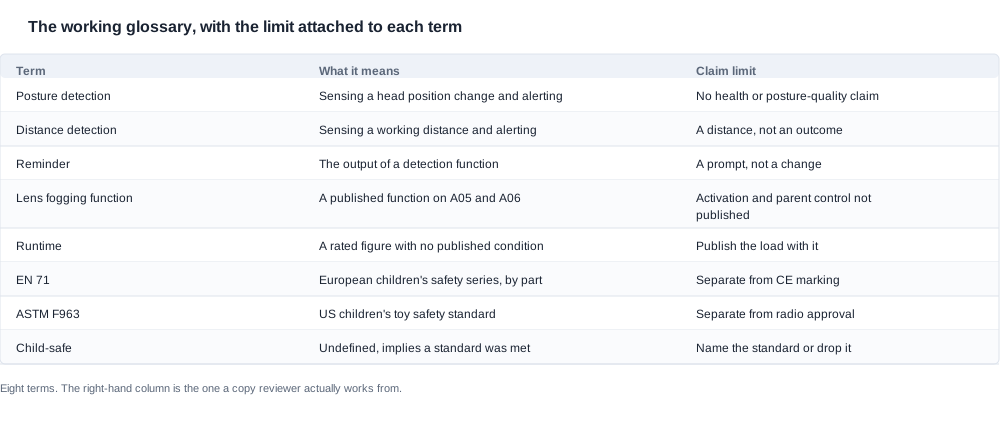
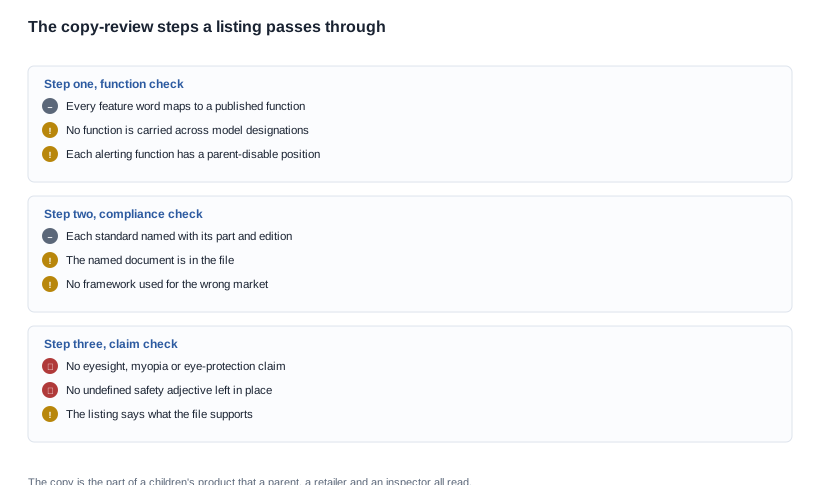
Posture detection describes sensing that the wearer's head position changed, and alerting them. It does not describe any assessment of health, posture quality or development, and it does not describe a correction. The limit on the word is therefore: no claim about the child's posture improving, and no claim about development.
Distance detection describes sensing a working distance and alerting. The output is a distance, not an outcome about eyesight, and the limit is: no claim about near-sightedness, eye strain or screen damage.
Reminder and alert describe the output of a detection function. A prompt is not a change in behaviour, and the limit is: the product reminds, it does not train, and it does not enforce.
Lens fogging function describes a published function on the A05 and the A06. What is published is the existence of the function. What is not published is how it activates, what it responds to, and whether a parent can disable it. The limit is: it acts against lens fogging, and it is not a vision correction device and not a comfort or eyesight claim.
Runtime describes a rated figure, and in this tier the rated figure is roughly twenty hours on both the 40 mAh and the 70 mAh configurations, with no published test condition. The limit is: publish the load alongside the figure, or do not publish the figure at all, because a bare twenty-hour number in a comparison is a claim that two suppliers' numbers mean the same thing.
The terms that assert an outcome the hardware cannot carry
Eye protection, myopia control, screen-time protection and blue-light protection as an outcome are benefit terms with no documentary basis in this category. They are not adjectives that can be softened; they are assertions of a clinical or protective effect, and no published document for the A05, the A06 or the A07 supports any of them. We make no such claim for any of our products in any market, and a listing that carries one is a listing that has to be rewritten after it is published.
Correcting posture is a subtler version of the same error, and it is the one that appears most often in good-faith listings, because the feature genuinely does relate to posture. The device senses and alerts; it does not correct, and the difference between those two words is the difference between a description and a promise.
Kid-safe, child-friendly, safe for children are undefined safety adjectives. A child cannot be a grade, and "child-safe" implies a testing standard has been met without saying which one. Replace it with the standard and the report reference, or remove it.
Compliance words that are not interchangeable
Four compliance terms are routinely used as if they were one, and a buyer who uses the right word in the wrong place has created a false impression of coverage that a retailer or a regulator will find.
EN 71 is the European standards series covering children's product safety, running to multiple parts covering mechanical and physical properties, flammability, migration of certain elements and specific chemical testing depending on the category. It is separate from CE marking, and it is separate from the General Product Safety Regulation, Regulation (EU) 2023/988, which is the framework that sets the obligations on whoever places a product on the European market. A product with a valid CE declaration can still be non-compliant for children's use, and the two documents answer different questions.
ASTM F963 is the mandatory children's toy safety standard in the United States, and it applies alongside the Consumer Product Safety Commission rules rather than as part of them. Neither of them is covered by an FCC filing.
CE marking and FCC approval address different things again. CE is a manufacturer declaration covering the applicable European legislation, and FCC addresses the radio and the electromagnetic behaviour of the device. An FCC filing says nothing about whether a product is safe for a child, and a CE declaration on a general radio product says nothing about EN 71. Buyers routinely produce the CE declaration when the EN 71 report is asked for, and the buyer who accepts that exchange has accepted an unanswered question.
UN 38.3 is a transport document for the battery rather than a product-safety framework, and it belongs on the request list for a different reason: it is a lead-time item as well as a compliance one, and the freight forwarder is a poor place to discover it.
The practical rule that follows is worth stating in a form a copy reviewer can apply: for every compliance word on a listing, name the document that supports it and the model designation it covers. It is also the question to ask a supplier before the artwork is scoped, because the answer determines how many label variants you need. A term used in the right framework but for the wrong model is the same error as a term used in the wrong framework.
Turning the term list into a copy-approval step
A glossary that lives in a document nobody opens is not doing its job. A glossary attached to the copy approval is. The difference is procedural rather than editorial, and it is the part of this article that is worth building into a buying process rather than into a style guide.
Five steps from a published function to a listing line
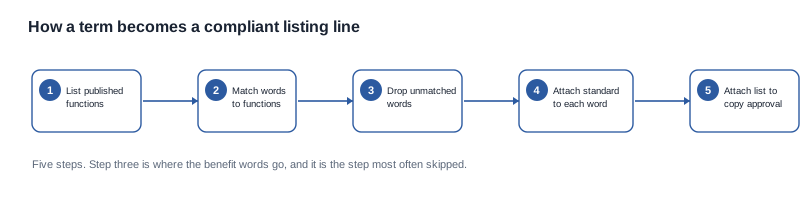
- List the published functions per model. Two models, a two-function set, and one model with a different radio row and cell size. Everything in the listing has to come from that list or from the electrical rows.
- Match every candidate word on the page to a function. A word that matches nothing is either a claim you cannot evidence or a word that has to come out.
- Drop the unmatched words. This is the step most often skipped, and it is the step that removes "child-safe", "protect" and "correct".
- Attach the standard and the report to each compliance word. "Meets EN 71 part 1, report reference on file" survives review; "EN 71 tested" does not, because it does not say which part, which edition or which model.
- Attach the term list to the copy approval itself. The sign-off that approves a listing should not be able to happen without the list in front of the approver, and the approval should be recorded per model designation, because the function set differs between the A05, the A06 and the A07.
A worked case: a listing rewritten from benefit language to function language
This is a hypothetical case rather than a client project, and it is here to show what the term list does in practice.
Assume a channel buyer has drafted a listing for a children's smart glasses product. The product carries the A05, and the draft's first paragraph reads as a promise rather than a description: it tells the parent the glasses are child-safe, protect the child's eyes during screen time and correct poor reading posture. The second paragraph lists the functions correctly — a 40 mAh cell, magnetic charging, roughly twenty hours of rated use, and posture and viewing-distance detection with a reminder — and ends with a claim that the device reduces the risk of myopia.
Applying the term list changes both paragraphs, and the change is smaller than it looks. The first paragraph becomes a description of what the device does: it senses a change in head position and a change in working distance and alerts the wearer, and it carries a lens-type electronic fogging function. The words "child-safe" and "protect" come out, because nothing in the published file supports them. The word "correct" comes out of the posture sentence, because the device senses and alerts and does not correct.
The second paragraph keeps the electrical rows, which are published, and loses the myopia sentence entirely, because no document in the buyer's file supports it. The buyer adds three things in exchange: the certification status stated as not yet published rather than implied, the runtime condition stated alongside the twenty-hour figure, and the model designation attached to every claim, so the same page can be reissued for the A07 without a rewrite.
The commercially interesting part of the case is what does not change. The price, the channel, the product photography, the target customer and the launch date are untouched, and no supplier negotiation is required to get there. What changed is the claim set, and the claim set is the part that determines whether the listing survives a review by the retailer's technical team, a school procurement officer or a parent. The buyer's comment at the end of the exercise is usually the same one: the new page sells less loudly, and it is the only version of the page that can be reissued for a second model.

What happens when a listing uses a term the file cannot carry
Five ways a term list fails in practice
A listing is pulled for a health claim and the product is relisted. The symptom is a takedown or a complaint citing eyesight. The root cause is that the copy was written from the category name rather than from the device's function. The prevention is to narrow the claim to detect and remind, and to review the copy against the function list before publication rather than after it.
A retailer asks for the EN 71 report and the CE declaration is produced instead. The symptom is a delayed listing and an awkward follow-up. The root cause is that the two frameworks were treated as one. The prevention is to check the framework for each claim and to name the document that supports each one.
"Child-safe" appears on the box with no report behind it. The symptom is a packaging reprint or a warning from the platform. The root cause is that the term was used because it was available. The prevention is to remove it, or to replace it with the standard and the report reference, and to run the artwork copy through the same list as the product page.
A parent cannot disable the reminder and returns the product. The symptom is a return that cites a function rather than a fault. The root cause is that the parent-disablement question was never asked and the term list was written from the catalogue rather than from the device. The prevention is to ask it, and to test it on the sample, and to record the position next to the term.
The listing describes a feature the shipped model does not have. The symptom is a complaint that the product does not do what the page says, which is the most expensive version of this failure because it arrives with a stock position. The root cause is that the copy was written for the range rather than for the configuration. The prevention is to write each model's function set separately and to check every claim against the model designation on the purchase order.
The commercial lines a term list gives you leverage on
Minimum order quantity is negotiable, and a term list costs nothing to produce and is worth more than it costs, because it is the one document in a children's programme that reduces risk rather than adding scope. Packaging and insert design, including the market labels, the language of the documentation pack and the required warnings, is a low-cost negotiation with no tooling implication, and it is also where the size guidance card lives — a term list is what stops the insert from carrying an age claim nobody can evidence. How a payment is staged is standard ground: a deposit against the artwork, a balance on the inspection ahead of the shipment, and a retention against the documentation pack, which protects the buyer against the failure that costs most in this category, a product that arrives with paperwork that does not cover it.
Certification cost and certification time are not a commercial lever, because the fee is per market and per model and the elapsed time belongs to the test laboratory and its review queue. Tooling is a one-off cost that is usually amortised across the first order, so the questions worth asking are over what volume it is amortised and what happens to it if the programme is discontinued. The claim boundary itself is not a commercial variable either: a supplier who will agree to put a health claim in writing is telling you something about the documentation behind it.
The terms we will sign off, and the terms we will not
The boundary of what we publish on terminology
Concretely, we publish the functions our documentation supports and mark the rest as open, and we will not use a benefit term for a device whose function is to detect a position or a distance and to remind. Certification status for the A05, the A06 and the A07 is not published to us, and we will not infer it from the company-level export certification shown at the front of our catalogue. We publish the electrical rows — the 40 mAh and 70 mAh cells, the two-hour-or-less charge time, the roughly twenty-hour runtime, magnetic charging, Bluetooth V5.4 on the A07, and the presence of posture and viewing-distance detection on the A05 and the A06 — and we publish the absence of the detection parameters, the fit dimensions and the certification position with the same prominence.
We will also tell you plainly that a term list only works if it is attached to the copy approval, and that the copy is where the exposure in this category is actually generated. A term list that lives in a document nobody opens has changed nothing, and in that case the risk is unchanged. The trade-offs it does make are real, because a narrower claim set is a claim set a buyer can defend to a reviewer.
What to send us for the term review
Send a draft listing and we will tell you which of the terms on it are functions and which are claims. That is a one-pass review and it is the fastest way to find out whether a listing is publishable.
Send the function list you have built, per model, and we will confirm it against the published rows. Most disagreements about what a model does are disagreements about whether a function belongs to one model or to the range, and that is worth settling before the artwork rather than after it.
Send the list of terms you intend to use on the packaging, the product page and the insert, and we will mark the ones that need a document next to them. A term with a document is a term you can defend; a term without one is a term you are choosing to take on.
The background is under kids eye care technology, the compliance terms are set out in kids certification requirements, and the range is kids smart glasses.
Where the glossary comes from
Send us a draft listing and we will tell you which of the terms on it are functions and which are claims.


