

Kids eye protection glasses technology: reading sheets defensively
The conclusion the sheet does not tell you
Three models, two of them indistinguishable on the published data, and a runtime figure that looks wrong until you work out why. Kids eye protection glasses technology smart glasses spec sheet explained is a read of a supplier's sheet in this tier, and the conclusion is that the capacity number is not the thing to optimise. In this category a 40 mAh cell is the consequence of a light workload rather than a compromise, and a buyer who specifies on runtime will pick the wrong model in a way that is invisible on the sheet.
The A05 and the A06 publish the same parameters, line for line: a 40 mAh cell, charging in two hours or less, roughly twenty hours of rated use, magnetic charging, three lens options, a lens-type electronic fogging device, and posture and viewing-distance detection. Our source document notes the difference between the two is unconfirmed, and we are not going to invent one.
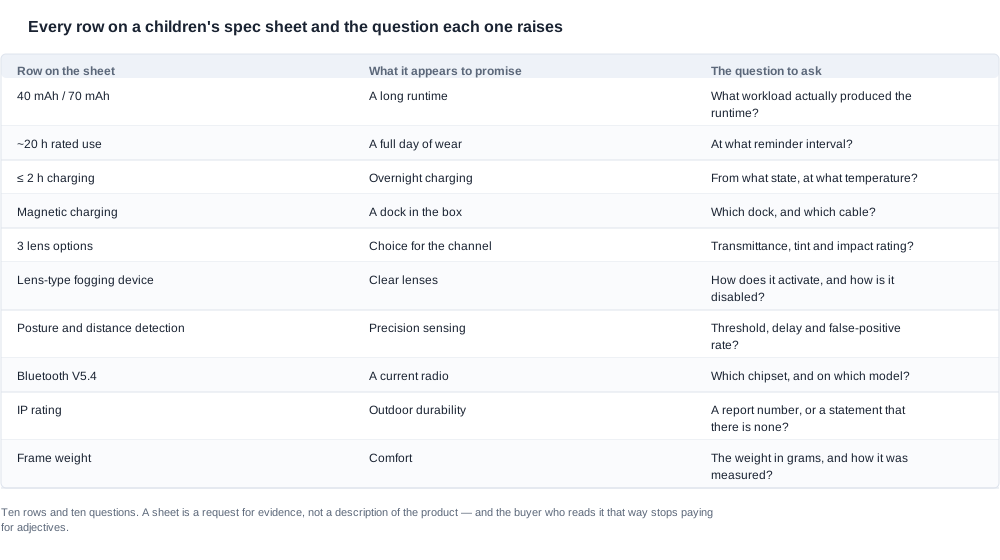
The five questions a sheet can actually answer
A sheet read defensively is a sheet read as a set of questions. For this tier the sheet resolves five decisions and leaves three open, and knowing which is which is the whole skill.
Do you need the sensing function? It is published for the A05 and the A06 and not listed for the A07. That is the largest functional difference between the three models, and it is a bigger decision than any battery number. If the sensing function is why the channel wants the product, the A07 is not a candidate at all.
Do you need a stated radio version? Only the A07 publishes one, at V5.4. The A05 and the A06 publish no radio version, which is a documentation gap rather than a statement about the radio — and it matters because a sheet that omits a version cannot be used to satisfy a channel's requirement for a stated generation.
Do you need app and firmware customisation? Our source marks the app and firmware customisation capability for this class as unverified. We are not going to tell you it exists, and we are not going to tell you it does not. It is a question to ask, and if the answer is yes, the scope and the maintenance obligation belong in the agreement.
The other three are open on every model in this tier, and a sheet that appears to answer them is either carrying rows we do not hold or carrying somebody else's numbers. Do you need a frame weight? None of the three publishes one. Do you need an ingress rating? None of the three publishes one. Do you need a certification position? None of the three publishes one, and for a children's product that is the row that decides whether the programme can proceed.
The runtime anomaly, and why it is not a design flaw
The A05 and the A06 publish roughly twenty hours from a 40 mAh cell. Compare that with the camera platforms in the same catalogue, which publish roughly seven hours from a 290 mAh cell — more than seven times the capacity for a third of the runtime. Read on its own, the comparison looks like a quality ranking, and the ranking is wrong.
The explanation is that the camera is the dominant load in that platform and the sensing duty cycle here is light. The capacity number reflects the workload rather than the quality of the design, and a buyer who reads it as a ranking will conclude that the camera platform is a better product and the children's models are a cheaper compromise. What has actually happened is that the children's models are optimised for a different job: a low-power reminder that sits on a child's face for a school day.
The commercial consequence is that the capacity column should not be optimised in this tier at all. What should be optimised is the sensing function, because that is where the products differ in what they do rather than in how long they last.
Decoding the language suppliers use on a sheet
Six phrases and what each one is hiding
A spec sheet in this category mixes published rows with adjectives, and the adjectives are where the cost hides. Six phrases recur, and each one has a specific gap behind it.
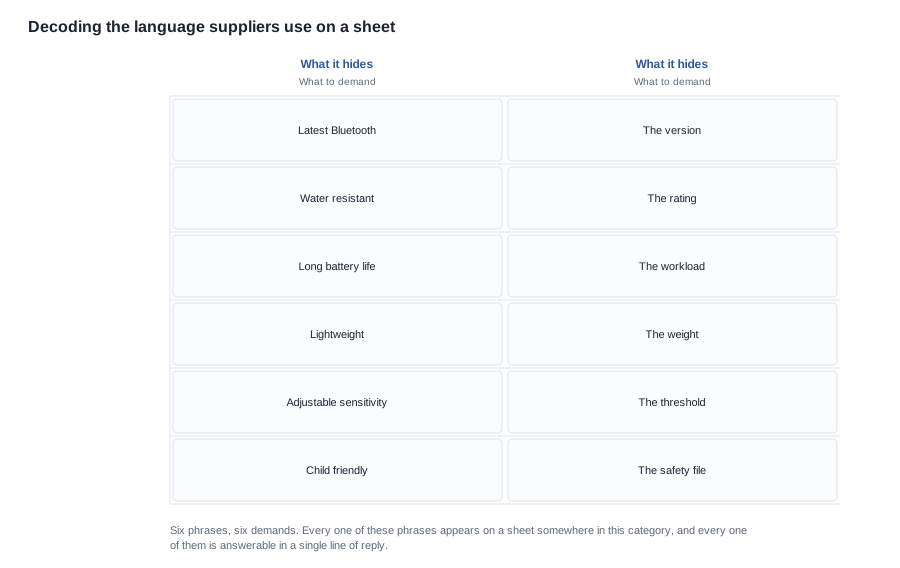
"Latest Bluetooth" hides the version. "Water resistant" hides the rating, and in a children's product an ingress question is a blocker for a school or outdoor channel rather than a detail. "Long battery life" hides the workload. "Lightweight" hides the weight. "Adjustable sensitivity" hides the threshold. "Child friendly" hides the safety file.
The demand behind each phrase is the same shape: a number with a unit, or a document with a model designation. A supplier who cannot produce either has answered in adjectives, and the adjectives are the part of the sheet that carries no obligation.
The rows a sheet states plainly, and the question each one raises
Ten rows appear on most sheets in this category, and each one carries an implied question that the sheet does not answer. The 40 mAh and 70 mAh cells raise the question of what workload produced the runtime. The roughly twenty-hour rated use raises the question of the reminder interval. The two-hour-or-less charging raises the question of the starting state and the temperature. Magnetic charging raises the question of which dock and which cable ship in the box. Three lens options raise the question of transmittance, tint, impact rating and coating. The lens-type fogging device raises the question of how it activates and how it is disabled. Posture and viewing-distance detection raises the question of threshold, delay and false-positive rate. Bluetooth V5.4 raises the question of the chipset and of the model it applies to. An ingress marking raises the question of a report number or of an explicit statement that there is none. A frame weight raises the question of the weight in grams and of how it was measured.
Who owns each row of the sheet
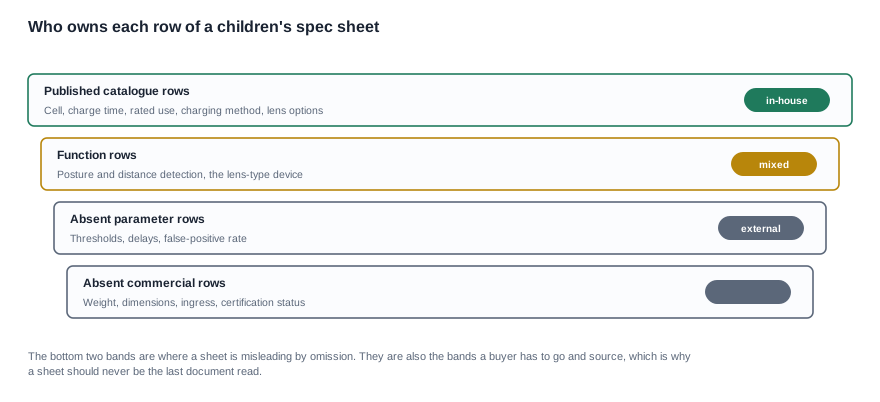
The ownership picture is what tells a buyer where a sheet is reliable. The top band — cell, charge time, rated use, charging method, lens options — is published and repeatable, and a sheet that gets these wrong is a sheet that cannot be trusted at all. The second band, the function rows, tells the buyer what exists but not how it behaves. The third band, the parameter rows, belongs to the supplier and has to be requested. The fourth band, the commercial rows, belongs to the market and has to be sourced from a document or from a measurement.
A buyer who reads a sheet as if all four bands carried the same authority will treat the top band as evidence of the bottom band, and that is how a programme ends up with a product page that states a frame weight it cannot support.
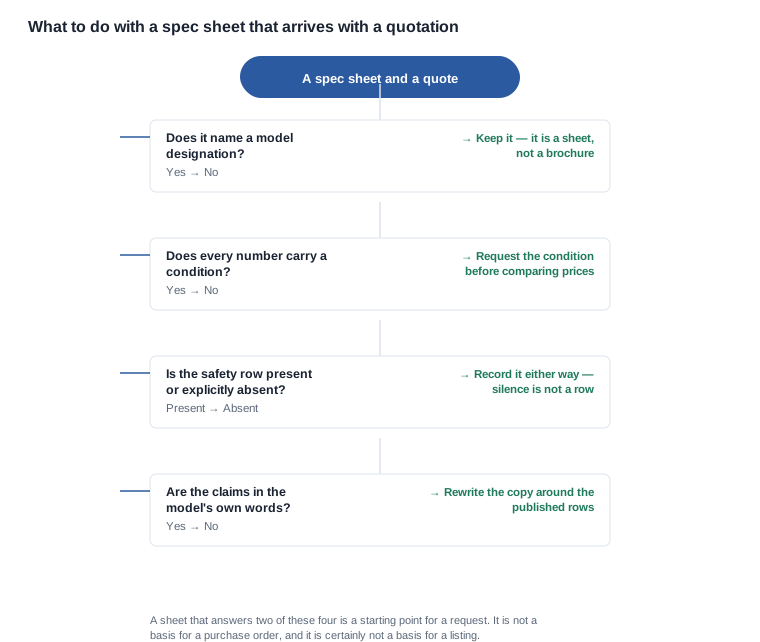
What to do with a sheet that arrives with a quotation
Four questions sort the sheet before it is compared with anything else. Does it name a model designation? If it does, it is a sheet rather than a brochure, and it can be worked with. Does every number carry a condition? If it does, the sheet can be used for comparison; if it does not, the conditions have to be requested before the numbers mean anything. Is the safety row present or explicitly absent? Either answer is workable, and silence is not a row — a sheet that says nothing about safety has not answered the question, it has deferred it. And are the claims in the model's own words? If they are not, the copy has to be rewritten around the published rows rather than around the sheet.
The last question is the one with the longest reach, because the sheet is a document a competitor can read and therefore effectively a claim document. Whatever a sheet says about a twenty-hour runtime or a fog-free lens becomes something the buyer's own listing will be compared against.
Turning a sheet into a shortlist that holds up
How to evaluate three sheets against each other
The comparison that works is not a scoring model. It is a rebuild: take each supplier's sheet, list every row it contains, and mark each row as published, conditional or absent. Three sheets rebuilt this way sort themselves without a spreadsheet, because the differences show up as differences in which bands are filled.
The first thing the rebuild reveals is usually a documentation ranking rather than a quality ranking. A supplier whose sheet is full of adjectives and whose file is thin is more expensive than a supplier whose sheet is modest and whose file is complete, because the adjectives will have to be replaced later, at the buyer's cost, with either a measurement or a removal.
The second thing it reveals is a vocabulary problem. It is common for two suppliers to describe the same function with different words — a reminder, a prompt, an alert — and each word implies a different delivery mechanism, a different level of intrusiveness and a different support expectation. Compared on the page, two suppliers appear to be offering different products. Compared on the evidence, they are often offering one product described two ways, and the shortlist has been longer than it needed to be.
The third output is the request list, and it falls out of the rebuild for free. Every conditional row that has no document behind it becomes a line in a request, and because the request is derived from the sheets rather than from a generic template it is short, specific, and answered per model by a supplier who has a documentation habit. The same four rows always come back for all three sheets in this tier, which is itself informative: it tells the buyer that the category's evidence gap is a category-level gap rather than a supplier-level one, and that a buyer who is comparing suppliers is partly comparing documentation rather than products.
The selection criteria this tier actually turns on
The A07 is not "the same product with a bigger battery". It shares the runtime figure and the charging method with the other two but changes two substantive rows: the battery rises from 40 mAh to 70 mAh, and the posture and distance detection and the lens-type fogging device are not listed for it. It is a different product that happens to share a runtime figure, and a buyer who selects on the capacity column will pick it for the wrong reason.
The A05 and the A06 are a genuine problem and the honest answer is that we will not tell a buyer which one to order unless we can base it on something. We will not fill the weight, ingress or certification rows with values from elsewhere in the industry, and a buyer who selects one of the two on a guess is building a range on an assumption.
The criteria that survive the read, in the order they matter, are: the sensing function set, the detection parameters, the radio version if the channel needs a stated one, the app and firmware customisation position, the frame weight and size range, the ingress position, and the certification position per market. Seven criteria, five of which need a supplier's answer.
The verification path behind each row
The verification path is short because the rows are short. The function set is checked per model designation, against the units received. The detection parameters are measured on a sample in the room the product will be used in, with the trigger distance, the delay and the repeated-trigger behaviour recorded, and the measurement method is set out under battery life and power for the endurance rows and in the sample evaluation route at sample evaluation. The frame weight and the dimensions are measured on two units per model and checked against the size range the buyer intends to serve. The certification position is checked per market with the model list on each document before the artwork is approved.
What a buyer cannot verify internally is the position of the factory itself, and that is where the audit route comes in: factory audit and supplier verification covers how a buyer's own quality team confirms what a supplier says it does.

A shortlist walked through, and where the terms land
A scenario: three sheets, one shortlist
This is a worked case rather than a customer case. One reason is to show the order.
Assume a channel buyer is comparing three sheets for a children's line and has already established that the sensing function is required, which removes the A07 from consideration and settles the first of the seven criteria.
The second sheet publishes a full set of rows with no conditions attached. The third publishes fewer rows, each with a condition, and names the model designation on every line. The rebuilt comparison shows the second sheet to be more complete and the third to be more defensible, and the buyer chooses the third on the grounds that a row with a condition can be turned into an acceptance criterion while a row without one can only be turned into another request.
The remaining criteria are then sourced. The detection parameters are requested and answered with units. The radio version is confirmed per model. The app customisation position comes back as a scope with a maintenance term, and the term goes into the commercial terms rather than into the technical file, because it is a three-year obligation and not a specification.
The frame weight and the size range are closed by measuring two units per model, because no sheet in this comparison carried them. The ingress position is closed by a statement that there is none, which is a legitimate answer and a usable one, as long as the channel can live with it. The certification position becomes the last open item, and it is the item that dates the launch.
Where the negotiating room sits once the sheet has been read
Once the sheet has been read as a set of questions, the commercial conversation is about numbers rather than about adjectives. The negotiable numbers are the number of models and colours committed, the artwork round count, the per-market label scope, the fit programme scope and the market list, and each of them is worth more than a percentage point on the unit price because each model and lens combination carries its own compliance cost.
Minimum order quantity is negotiable, and a single-model launch is where a supplier has the most incentive to be flexible on quantity. Packaging and insert design, including the size guidance, the market labels and the required warnings, is a low-cost negotiation with no tooling implication. Delivery splitting against a sample-approval milestone is usually granted more easily than a price concession. Payment node structure is a standard area, and a retention held against the documentation package protects the buyer on the failure that costs most in this category, which is a product that arrives with paperwork that does not cover it.
The compliance cost and the elapsed time of testing are per model and per market and are set by the laboratory rather than by the buyer. Tooling being a one-off usually amortised across a first order, the two points to settle are the volume it is spread across, and what happens to it once the programme is discontinued. And the function set of a model is not a commercial variable at all: a supplier who will not state the sensing function per model is telling the buyer that the range is not a range, and no price moves that.
The clauses worth writing into the order are the exact model designations and their function sets, the acceptance criteria for the sample referencing the detection observations and the duty-cycle run, a statement of the customisation scope with a maintenance obligation if customisation is in scope, a requirement for notice before any change of firmware, detection threshold default, frame material or safety-relevant component supplier, and a clause on who bears the cost when a sample does not meet the acceptance criteria.
What we publish, and what we will not fill in
The working rule we apply: we publish the parameters our documentation states, including the fact that the A05 and the A06 are indistinguishable on the published data. We will not tell you which one to order unless we can base it on something, and we will not fill the weight, ingress or certification rows with values from elsewhere in the industry. We also make no performance claim about vision, health or eye protection for any of our products in any market, and a spec sheet is a document a competitor can read, so the claims in it are the claims on the product page.
What we can do is tell you which of the seven criteria our documentation answers and which have to come from a supplier, and we will put the gap rows in the order in which they matter rather than in the order that flatters the product. The range is kids smart glasses and the background is under kids eye care technology.
The two models and the channel to send us
Send us the two models, the channel and the sheet you are reading, and we will tell you which of the seven criteria you actually have to ask about. Most programmes need two of them. Naming the two stops the other five from becoming a research project.
Where the reading method comes from
Send us the two models and the channel and we will tell you which of the seven criteria you actually have to ask about.


