
Every serious question a buyer asks about kids eye protection glasses falls into one of five groups, and four of the five have the same answer: the published documentation does not cover it. The three children's models in this range — the A05, the A06 and the A07 — publish their mechanisms and their battery figures clearly, and publish nothing about certification. Answering these questions honestly is the difference between a channel partnership and a dispute, because every one of them will be asked again by the retailer's compliance team or the school's procurement officer, and the answer given at the sample stage is the answer that has to hold.
The buyer behind these questions is usually not a general merchandise buyer. In this category it is a channel buyer in optical retail, an education procurement officer, or a brand owner building a children's line as a range extension. All three are working to a different standard from ordinary consumer electronics, and all three will encounter a documentation gap that did not appear in the sample.
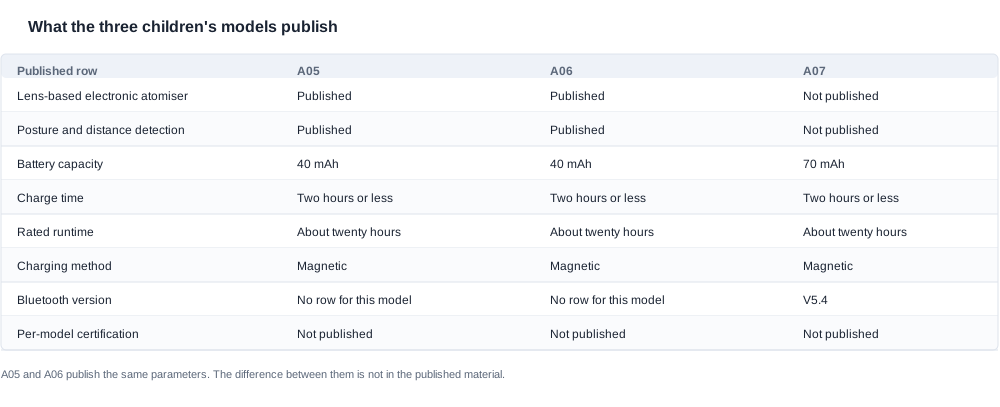
Kids eye protection glasses technology: what models publish
| Published row | A05 | A06 | A07 |
|---|---|---|---|
| Lens-based electronic atomiser | Published | Published | Not published |
| Posture and distance detection | Published | Published | Not published |
| Battery capacity | 40 mAh | 40 mAh | 70 mAh |
| Charge time | Two hours or less | Two hours or less | Two hours or less |
| Rated runtime | About twenty hours | About twenty hours | About twenty hours |
| Charging method | Magnetic | Magnetic | Magnetic |
| Bluetooth version | No row for this model | No row for this model | V5.4 |
| Per-model certification | Not published | Not published | Not published |
Read that table as a buyer rather than as a reader. The last row is the one that decides whether this is a product or a project. Per-model certification is not published for any of the three, and the children's requirements in the destination market sit separately from the general consumer obligations that the rest of this range addresses.
Two other rows carry weight that is easy to miss. The Bluetooth row exists for the A07 and does not exist for the A05 or the A06, which means the two models carrying the atomiser and the posture and distance detection have no published radio generation at all. And the battery capacity row differs by 30 mAh between the A07 and the other two, while the rated runtime row does not differ at all — a twenty-hour rated window on 40 mAh and a twenty-hour rated window on 70 mAh are different products in terms of power management, and the catalogue publishes the outcome without publishing the mechanism.
The five groups of question, and where the answers live
Product and claim. What the mechanism is, what it does, what difference exists between the models that publish the same rows, what the buyer will claim, and confirmation that no vision claim is being made.
Certification. What certification the exact model carries, what the destination market requires for children's products, and who owns the work of closing the gap.
Data and app. What the app does, how the firmware behaves, where the data goes and how long it is kept.
Commercial. Unit price, minimum order quantity and lead time, which are confirmed per enquiry rather than published as fixed numbers.
Timeline. How long the whole thing takes from an agreed claim boundary to a channel submission pack.
The honest observation is that the first group is answered by the catalogue and the second, third and fifth are not answered at all. The fourth group is answered by a quotation. That distribution is the reason this category takes longer than a comparable consumer product, and it is worth pricing before the sample rather than after.
The question buyers ask first, and why the answer is not a marketing choice
The first question is whether the product prevents myopia or protects a child's vision. The answer is no, and the published documentation for the A05, the A06 and the A07 does not support any vision, myopia or eye-health efficacy claim.
This is the most important answer on the page, and it is important for a reason that has nothing to do with caution. A claim about myopia prevention or vision protection changes the intended use of the product, and intended use is what determines the regulatory route. In the United States, the FDA's general wellness policy distinguishes between low-risk products that do not claim to diagnose or treat and products regulated as devices, and the determination turns on intended use and on the claims made. A claim about myopia prevention moves the product out of the first category. The underlying device regulation is at 21 CFR 800.30, and the general wellness guidance sits alongside it.
In the European Union the boundary runs through whether the product claims a therapeutic effect. The same principle applies: the claim, not the hardware, decides the route.
Why the answer is not a marketing choice is the important part. Marketing restraint in this category protects the buyer rather than limiting them. A substantiated-claim dispute involving a children's product is a withdrawal and a notification, not a fine, and it reaches further than the single listing: a withdrawal history affects the whole brand's channel standing, and in education channels it can affect more than one product line.
What the A05 and the A06 do publish is a lens-based electronic atomiser, and combined posture and distance detection with reminder behaviour. Those are descriptions of mechanisms, and they can be published. What cannot be published is any claim about what those mechanisms achieve for a child's vision, because the documentation does not substantiate one.
The claim boundaries to write down, in writing, before anything else
The single most useful document a buyer can produce for this category is a one-page claim boundary statement, written before the listing copy, before the artwork and before the packaging is finalised. It sets out four things.
- The mechanism being relied on, described in the supplier's own words and in the buyer's own words, and confirming they mean the same thing.
- The claims that will be published, written as copy, ready for the artwork.
- The claims that will not be published, written explicitly. A list of forbidden claims is more useful than a list of permitted ones, because the drafting team will propose the forbidden ones.
- The confirmation that no vision, myopia or eye-health efficacy claim is made, signed by whoever owns the listing.
That document costs an afternoon and it settles the argument that otherwise happens between the product team and the compliance reviewer three weeks after the artwork is locked.
Choosing between A05, A06 and A07 when the published rows do not separate them
The A05 and the A06 publish identical parameters in every row: a lens-based electronic atomiser, posture and distance detection, a 40 mAh cell, a charge time of two hours or less, a rated runtime of roughly twenty hours, magnetic charging, and no Bluetooth version row. The difference between them is not in the published material.
That is a real sourcing problem rather than a documentation quibble, and it has three possible causes: the two models share a platform and differ in cosmetic or configuration detail that the catalogue does not list; they differ in a way the catalogue has not captured; or they are the same product with different references. A buyer cannot tell which from the published rows, and the practical consequences differ sharply.
If they share a platform and differ only cosmetically, then carrying both is a merchandising decision and there is no sourcing risk. If they differ in a way that matters — a different sensing behaviour, a different atomiser output, a different firmware branch — then the buyer needs that difference in writing before the range is planned, because it affects the listing, the artwork, the certification scope and the sample programme. If they are the same product, then carrying both creates a channel problem rather than a range.
The questions that resolve it
- What is the documented difference between the A05 and the A06? Ask for it in writing and ask for the document it comes from. If the answer is that there is no documented difference, that is also an answer, and it is an answer the buyer needs before planning two SKUs.
- Does the difference change anything a certification assessment would examine? If the mechanism differs, the certification scope differs. If the atomiser output or the sensing behaviour differs, the assessment is not the same job.
- Can both be supplied from the same production line, and does that change the lead time? Two models on one line is a supply-chain advantage. Two models on two lines is two qualification cycles.
- Is the A07 actually the same product with a radio added? The published rows describe a different feature set, so the working assumption should be that it is a different product, and it should be verified.
What the A07 is, and what it is not
The A07 publishes Bluetooth 5.4, a 70 mAh cell, a charge time of two hours or less, a rated runtime of roughly twenty hours and magnetic charging. No atomiser or sensing function is published for it. That makes it an audio product with a Bluetooth connection rather than a sensing product, and it should be evaluated against the audio models in the range rather than against the A05 and the A06.
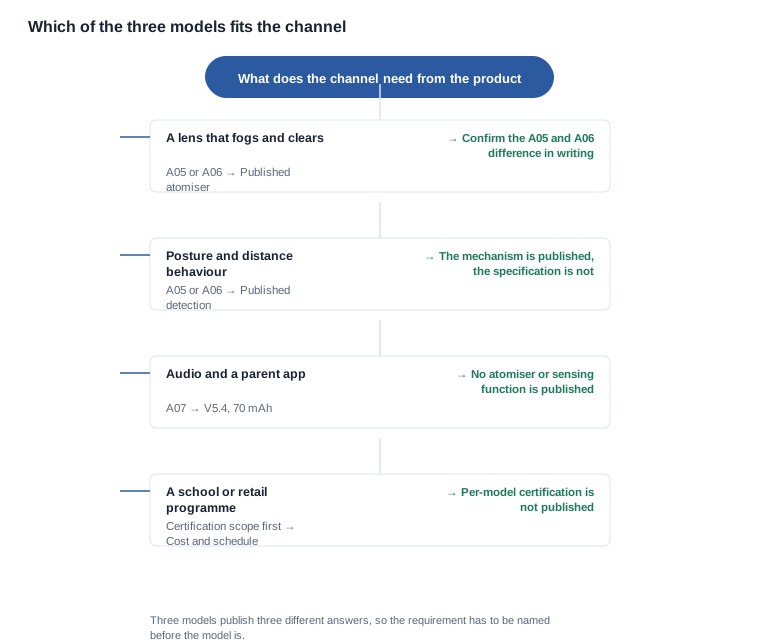
There is a practical consequence for channel selection. A channel that wants a lens that fogs and clears, or a child whose posture and viewing distance should be monitored, is considering the A05 or the A06 and has to resolve the difference between them. A channel that wants audio with a parent-facing app is considering the A07, and the atomiser is not part of that offer.
The trade-off between the two paths is not only technical. The A07 has a published Bluetooth version and the A05 and the A06 do not, which changes the documentation request. And the A07 at 70 mAh with a twenty-hour rated window has a different power profile from the 40 mAh models, which changes the charging logistics in a school or a retail environment where a batch of units comes back to charge at once.
Scoping the certification work for a children's channel
Children's products attract additional requirements in their destination markets that sit separately from general consumer obligations. EN 71 in the European Union, and CPSC or ASTM F963 requirements in the United States. None of that work is documented for these three models, and the right way to handle it is as a project with a schedule and a budget rather than as a box to be ticked later.
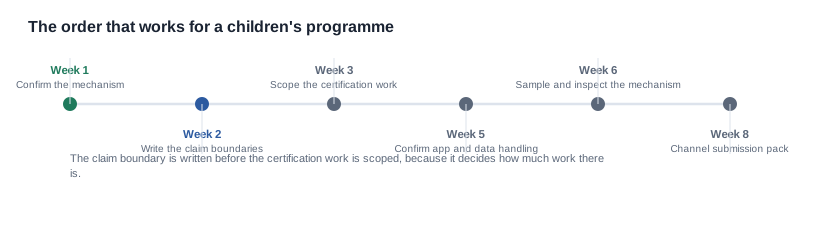
The order of the programme is what makes it manageable. Week one, confirm the mechanism the product relies on. Week two, write the claim boundaries. Week three, scope the certification work. Week five, confirm app and data handling. Week six, sample and inspect the mechanism. Week eight, produce the channel submission pack.
The claim boundary comes before the certification scope, and that ordering is the whole point. The scope of the certification work is decided by what the product claims and what it does. A buyer who scopes the certification first and writes the claim later will either over-specify, and pay for work the claim does not require, or discover in week six that the mechanism does not match what was assessed.
The question that decides who owns the work
Who owns the certification work? Not as a matter of blame — as a matter of schedule and cost. There are three defensible positions, and the buyer should know which one it is before the programme starts.
The factory owns it and the buyer receives the documentation. This is the normal position, and it requires the factory to hold a per-model position for the specific destination market, which is not currently documented for these three models.
The buyer owns it, using the factory's product as the basis. This is a realistic option when the channel is education, because the school's or the retailer's own requirements may go beyond what the general market needs, and it also puts the buyer in control of the schedule.
The work is split. The factory provides the product-level information and test samples, and the buyer's compliance owner runs the market-specific assessment. This is the arrangement most education channels require in practice, because the channel is the party that knows the local requirement.
Whichever position applies, it has to be written down with a date against it. A certification programme without an owner and a date is a programme that will not finish before the channel deadline.
What a children's channel will ask before it buys
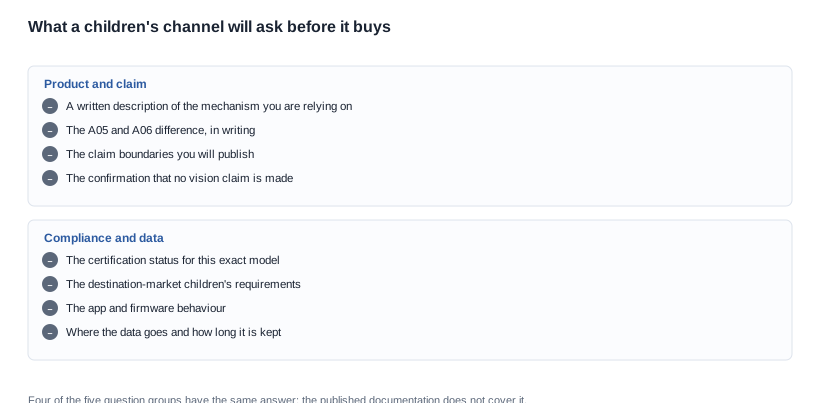
Two groups of four. In the first group, every item is answerable from the catalogue except the A05 and A06 difference, which is answerable only by asking. In the second group, none of the four is currently answered by the published documentation, and three of them need work rather than an answer.
The wording of that last point matters for a buyer. "Not documented" is not the same as "does not exist", and it is not the same as "will not be provided". The honest statement to a channel is that the certification status for the exact model is not provided to us, that the destination-market children's requirements are a separate workstream, that the app and firmware behaviour is recorded as requiring verification, and that the data handling position is not documented. A buyer who writes "no certification" into a channel submission pack has made a claim of their own, and a buyer who writes "certification status to be confirmed" has made an honest one that a compliance reviewer can act on.
The battery, the app and the data questions a compliance team will raise
Is the twenty-hour runtime real
The published figure is roughly twenty hours of rated use, against 40 mAh on the A05 and the A06 and 70 mAh on the A07. That is the longest rated runtime in the catalogue, and an unusually large ratio to the stated capacity, which means the difference lies in the feature set rather than in the cell.
Two caveats apply, and they apply to every runtime figure in this range. No test condition is published, so treat the figure as a ceiling rather than as a typical day. And standby current is not published for any model in the range, so overnight retention cannot be modelled from the documentation. For a product that a child may leave on a desk for days, that is the figure a channel buyer would most want, and it is the one that is not available.
What does the app do, and where does the data go
App and firmware customisation capability for the children's models is recorded in the documentation as requiring verification. Treat it as unconfirmed.
The parent-facing view is described in the catalogue entries, but the delivery mechanism, the offline behaviour and any data handling are not documented. For a product aimed at minors, this is the question most likely to be raised by a school's or a retailer's compliance team, and it is not one that can be answered from published material.
The reason it is asked at all is worth understanding. A children's product with a sensing function and a connected app implies a data flow from a child to an application to a service provider, and in most markets that flow attracts obligations that sit outside the product itself: consent, retention, access and deletion. A channel buyer asking where the data goes is not being difficult. They are establishing whether the product can go into their channel at all.
The three questions to put to the factory, in this order
- What is the documented difference between the A05 and the A06? This has to be answered first because it determines the sample scope and the certification scope.
- What is the app and firmware behaviour for this exact model, and where does the data go? Ask for the behaviour, the retention period and the deletion route, in writing, for the model being ordered.
- What certification does this exact model carry for our destination market? Ask for the per-model position and the documentation behind it, and treat the answer as needing to be filed rather than summarised.
Those three, in that order, are the difference between a channel submission pack and a channel dispute.
How to choose between the three when the shortlist has more than one
The selection criteria in this category are narrower than they look, and a buyer who writes a conventional shortlist will find that most of it does not discriminate.
Mechanism fit is the first filter, and it is nearly a decision. A channel that needs a lens that fogs and clears is in the A05 and A06 group; a channel that needs audio with a parent-facing app is in the A07. There is no third path in the published material, so this filter usually leaves two candidates rather than three.
The second filter is the documented difference between the A05 and the A06. Until that difference exists in writing, the two are one candidate for practical purposes, and a shortlist treating them as two is misleading. How to choose between them is therefore not a specification comparison; it is a question to the factory, and the answer may be that the choice is a merchandising decision rather than a technical one.
The third filter is the certification position for the destination market. Because no per-model position is published, this filter is currently answered by a schedule rather than by a document: the buyer has to establish what work is outstanding and what it costs before the shortlist can be closed. A buyer who closes the shortlist without this has closed it on the basis of a published table that does not contain the deciding row.
The fourth filter is the documentation burden the buyer is willing to carry. Every unanswered question in this category lands on the buyer's compliance owner, and the cost of that is a real cost with a real number attached to it, even though it is not on the quotation. The checklist is short enough to apply directly: the A05 and A06 difference, the certification status for the exact model, the app and firmware behaviour, and the data handling position. Four questions, four named owners, four dates.
The trade-off the buyer is actually making is between speed and coverage. A channel launch that skips the difference question and the data question will be faster, and it will also be the launch where the compliance review finds the gap rather than the buyer finding it first. Because the cost of a substantiated-claim dispute in a children's category is a withdrawal rather than a correction, the sensible trade-off is to spend the month of questions before launch rather than after it.
The claim boundaries we will hold, and what we need from you
It is worth being precise: we will describe the published mechanisms accurately and decline to attach any clinical, vision or myopia claim to them, even where a listing would sell better with one. Certification status for all three models is not provided, and we will say so plainly rather than implying that a general compliance statement covers a child-safety requirement. Unit prices, minimum order quantities and lead times are confirmed per enquiry rather than published as fixed numbers.
What we need from a buyer is narrower than what we can give, and it is worth stating because the programme stalls without it.
- Establish the mechanism actually needed — atomiser, posture and distance detection, audio, or none of them — because the three models publish three different answers.
- Confirm the A05 versus A06 difference in writing before a range is planned.
- Name the destination market, because the children's requirements and the claim boundaries both follow from it.
- Confirm who owns the certification work and against what date.
- Write the claim boundaries down before the listing is written, and hold them.
The mechanism detail behind these answers is at kids eye protection technology explained, the category and its use cases are at Kids eye care overview, the documentation to obtain is listed at certification checklist, and what those channels require is at Solutions for retail and education.
Tell us the destination market and the mechanism you need, and we will tell you which published models carry it and what work is outstanding.
Related reading
- Kids eye protection technology explained — the published mechanisms
- Kids eye care overview — the category and its use cases
- Solutions for retail and education — what those channels require
Tell us your destination market and which mechanism you need, and we will tell you which published models carry it and what work is outstanding.


