
A product aimed at children is not a smaller version of a general consumer product. It sits under a different regulatory regime, it carries design constraints that cannot be corrected once tooling exists, and it is the only category in this range where a marketing claim can move the product from a general product into a regulated one. The spec sheet you are handed describes the electronics and almost nothing else. The rows that decide whether the programme is lawful in the market you chose are rows about the market, the age band, the cells, the detachable parts and the wording on the box.
Kids eye protection glasses technology: market, not product
What the buying task actually is
The reader here is usually a brand-side product owner or a category manager who has been asked to open a children's line because the channel is asking for one. The request arrives as a product idea, and the first decision is not which model to take. It is which markets the line will serve, because the markets decide the documentation set, the age grading, the physical design constraints and the claims language. A product that is lawful in one market is not automatically lawful in another, and the differences are not cosmetic.
That decision has a commercial consequence which is easy to miss at the quotation stage. Each destination market brings its own conformity route, its own labelling treatment and its own file, and each of those carries a cost and a duration that a unit-price comparison between two suppliers will never reveal. Entering three markets is three documentation sets. A programme quoted as one SKU sold into three markets is really three programmes sharing a bill of materials, and the cost of the second and third one falls entirely on you.
There is a second audience in this category and it often has the stronger claim on the decision: the person who writes the listing and the packaging. Their question is not whether the product is compliant. It is what sentence the evidence supports, because the answer is usually narrower than the sentence they were hoping to write.
Why the market list is the first commercial decision
A regime is not a formality. It is a set of design constraints that reach into the bill of materials and the factory floor, and a set of claims that reach into the artwork. Children's product rules in the European Union and in the United States are the clearest example, and the product rules for the United States are written around the age band and the small-parts dimension rather than around the function. That means the age grading is not a label decision, it is a configuration decision, and a product that has already been built for an adult age band may need a different cell, a different enclosure or a different fastener to be placed in a lower band.
The practical sequence follows from that. The destination markets come first, then the strictest regime in that list is written into the specification, and only then does the supplier quote a configuration. A programme that quotes against the seller's home market and adds the other markets later discovers the constraints after the sample is approved, and the cost of discovering them at that point is a redesign, a new sample and a new artwork cycle.

The claim set is the real specification
There is one claim in this category that is not available, and it is the claim most often requested. A marketing request for an eyesight benefit, a developmental benefit or a hearing benefit has the same answer in every market: the claim is not available. Products that make medical claims fall under device rules such as the United States FDA 21 CFR 800.30, and the evidence burden changes completely. The safe answer to the request is a different message about the same hardware, agreed in writing before a single asset is produced.

The claims that are available are narrower and, in practice, better for a channel. What the product does can usually be described: a detection function, a response to a detected condition, a runtime figure, a charging method, a Bluetooth version where one is published. What the detection achieves for a child cannot, and the difference between the two sentences is the difference between a listing that survives a marketplace review and one that does not.
The discipline that protects the programme is to collect every claim in one place before production starts, including the packaging artwork, the listing copy, the product photography, the quick start guide and the scripts the support team reads to customers. A claim that appears in one asset and not the others is still a claim, and the channel will find the asset nobody reviewed, usually at the worst possible moment.
Three rules make this workable in practice. The first is that the permitted claim set is written down as a document, with a version and a date, rather than agreed in a meeting. The second is that the supplier sees the set before the assets are made, so that a claim which the hardware cannot support is caught while it is still a sentence. The third is that the same document goes into the technical file, because the file is what a successor buyer, a compliance reviewer or a marketplace will ask for.
How to assess the regime, and when to check whether toy rules apply
- Which regime applies to this category in each destination market, and which of them is the strictest?
- Is the product sold as a general product or presented in a way that brings toy rules into scope?
- What does the category require of the cell, of any magnet, and of any detachable part in the build you have quoted?
- What age grading applies to the configuration, and where does that grading have to appear?
- What is the permitted claim set for the destination market, in writing?
- Who owns the technical file, where is it held, and what happens to it if the relationship changes?
- What is the acceptance basis at goods-in, and does it arrive with the shipment or after it?
- Which of these rows are already evidenced for this model, and which are opened per order?
The reason to ask all eight in the first round is that a quotation which answers them is a complete quotation, and a quotation which answers two of them is telling you where the risk sits. The checklist above is the shortest version of a supplier evaluation that catches the problems which cannot be fixed after tooling.
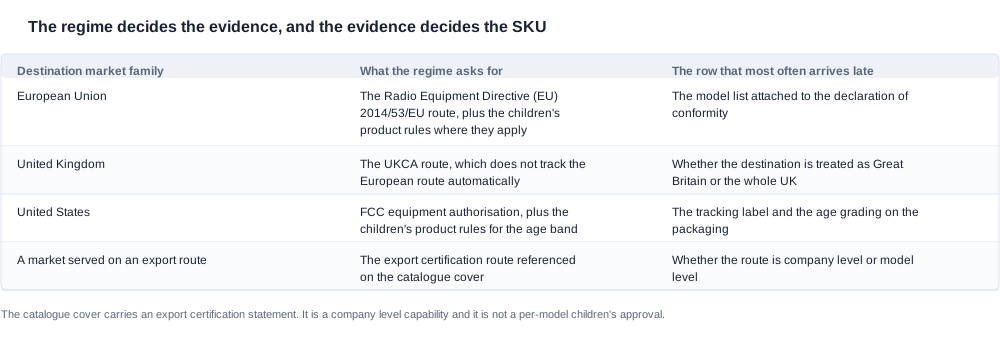
The rows that decide whether the configuration is lawful where you sell it
The design constraints that cannot be fixed at the end
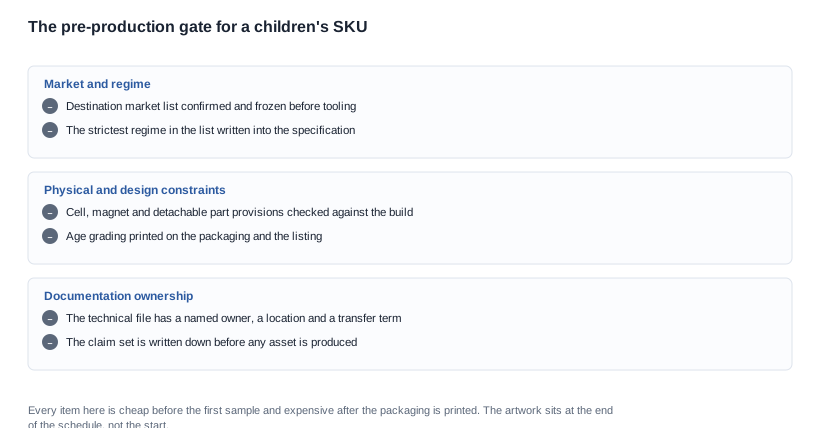
Four areas of a children's configuration are decided before production and are effectively closed afterwards. Understanding this is what keeps a children's programme on schedule.
The cell and the charging arrangement. The category carries specific requirements for cells, and a magnetic charging arrangement that is entirely normal in an adult product can raise a question in a children's configuration. The cell capacity is a published fact in our catalogue, and it is also a design input, because the cell size and its protection affect the enclosure and the age band.
Magnets and detachable parts. What is detachable, how it is attached and whether a small part can be separated by a child are configuration questions with physical answers. They cannot be handled by a packaging instruction, because the instruction arrives after the product does.
The age grading and its labelling. The grade has to appear on the packaging and on the listing, and the artwork is the last item in the schedule, which means the grade has to be decided before the artwork is produced.
The technical file. The file is the document that makes the product lawful, and it is also the document a successor buyer would need. It needs a named owner, a known location and a transfer term if the relationship changes.
The table that turns a category into a set of questions
The table above is the working version of the evidence set, and each row is a question with a document behind it. The point of setting it out this way is that every row can be answered before a purchase order is placed, and every row that is answered late is a row that moves the launch date.
Two further items belong on the same list and are routinely left off it. The first is the ingress position, because a product aimed at younger users is more likely to be exposed to rain and to handling than an adult product, and an unpublished marking is a gap the channel will find. The second is the returns position, because a product for a younger user is more likely to be returned for reasons that are not defects, and a channel that has not agreed a returns position absorbs that difference in its own margin.

The evidence checks to run before the artwork is released
The checks below are the same kind of checks, applied to the evidence rather than to the electronics. Each one assumes the previous one passed, and each one produces a document rather than an opinion.
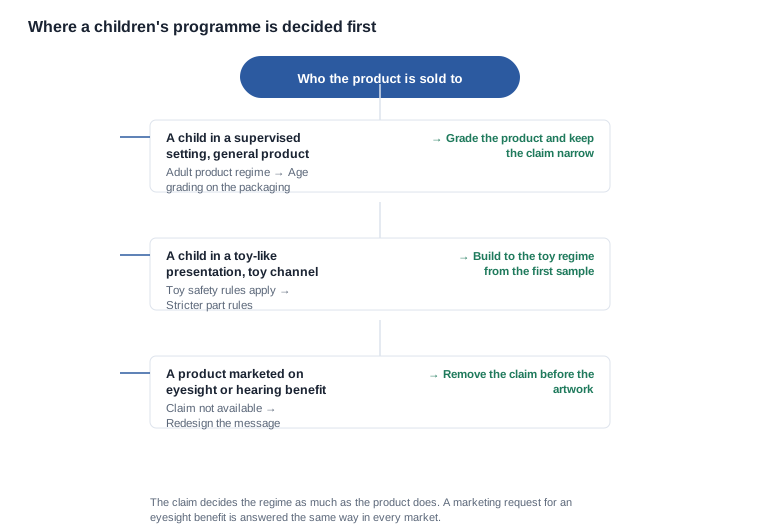
Check the regime against the market list, not against the product. For each destination market, identify the regime that applies to the category, then confirm that the configuration on the order meets the requirements of the strictest one. The strictest is the one that governs the build, even if the programme is weighted towards a more forgiving market, because the configuration cannot be assembled market by market.
Check the claims across every asset. Compare the listing, the packaging, the artwork, the product photography and the support script against the permitted claim set. Where one of them differs, the difference is the defect.
Check the physical constraints against the ordered build. Cells, magnets, detachable parts and the age grading have to be true of the unit that ships, not of the sample that was approved and not of the product family in general.
Check the documentation route. Establish where the technical file is held, who owns it, what goes into it, and how it is transferred if the relationship changes. A file that exists in one person's inbox is not a file, and neither is a file that nobody has been told exists.
Check the acceptance basis. Decide what evidence will be accepted at goods-in, and write it into the order. In this category the acceptance basis is more often documentary than functional, which means the documents have to arrive with the shipment rather than after it.
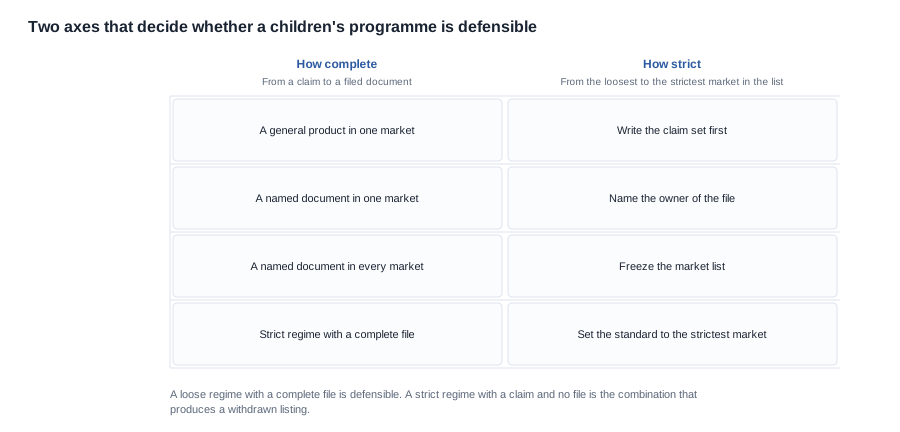
The last of those checks is the one that turns the programme from a product into a defensible product. A regime with a claim and no file is the combination that produces a withdrawn listing and a reprint, and both of those costs sit in the artwork cycle at the end of the schedule rather than in the unit price.

Where a children's programme goes wrong, and who carries the cost
The claim that appeared in the listing copy. A marketing asset carried a language the category does not permit. The symptom is a complaint from a marketplace reviewer or, worse, a question from a parent that nobody in the chain can answer. The root cause is that the claim set was agreed verbally and never written down. The control is a versioned claim document, reviewed by compliance before production.
The packaging without the age indication. The market required a grading and the artwork did not carry it. The symptom is a shipment held or a reprint. The root cause is that the age band was decided in the specification but not carried into the artwork brief. The control is to put the grading into the artwork brief as a pre-production check, not as a pre-shipment one.
The design that met the adult regime. The product was configured against a general consumer regime, and the children's regime added a constraint afterwards. The symptom is a change request against a tool that has already been cut. The root cause is that the market list was confirmed after the quotation rather than before it. The control is to freeze the market list and configure against the strictest regime in it.
The technical file nobody owned. The file existed, the route was unclear, and the documentation trail was incomplete. The symptom is a market access question that nobody can answer from the supplier side. The root cause is that the file was treated as an administrative output rather than as a deliverable with an owner. The control is a named owner, a known location and a transfer term, agreed at the start.
The returns difference that nobody priced. The line sold well and came back, for reasons that are not defects. The symptom is a margin that erodes in one channel and nowhere else. The root cause is that the returns position was never agreed with the channel. The control is to agree the position in the agreement, and to state it in the listing rather than leaving the customer to find out.
None of these is a reason to change supplier. They are reasons to put a line in the order, and a line in the order costs nothing while a redesign costs a quarter.
What you can and cannot negotiate in a children's programme
The commercial questions in this category are about scope and documentation rather than about unit price, and the buyer who compares two quotations on unit price alone is comparing the least informative line on the page.
The part that genuinely moves is the setup work that is the factory's own fixed cost rather than a market rate: the number of markets a single conformity route is issued against, the number of artwork rounds, the per-configuration minimum for a variant, and the retention held against the documentation package. Those numbers are larger than the unit-price difference, and they are the ones worth spending negotiation effort on.
The part that does not move is the cost and the duration of the third-party work itself. A laboratory fee is a laboratory fee, the queue belongs to the laboratory rather than to your order size, and the age grading and the labelling treatment are decisions rather than variables. A supplier who offers to absorb a conformity cost for free is either carrying it in the unit price or has not yet asked the laboratory what it costs.
The total cost of a children's programme is the unit price plus the per-market documentation cost plus the rework risk of a late claim correction plus the returns reserve. The trade-offs between those are settled in the quotation, and the decision about which to negotiate hardest follows from where your own programme is weakest.
A worked example: a brand opening a children's line for two markets
This is a worked case rather than a client project. The purpose is the sequence.
Assume a brand that already sells an audio product into three European markets and has been asked by two retail buyers to add a children's line. The binding constraint is not the product. It is that the buyers want a claim, the claim is not available, and the brand has three weeks before the artwork is locked.
The market list comes first. The brand writes down the two markets, checks the regime that applies in each, and identifies which of the two is the stricter one. The configuration is written against the stricter regime, and the second market is then treated as a subset rather than as a variation. That single decision, taken in the first meeting, is the one that removes most of the later risk.
The claim is rewritten, not argued. The buyers' requested claim is removed before a single asset is produced, and the replacement sentence describes what the detection function does rather than what it achieves. The supplier reviews the wording against the hardware, in writing. The rewritten sentence is narrower than the brief, and the buyers accept it because the product page now matches what the file can evidence.
The evidence request goes out as a list. The regime question, the cell and detachable-part question, the age grading question, the file ownership question and the acceptance basis question all go to the supplier together. Four of the five come back answered from existing documentation. The fifth — the detection parameters — comes back as not available, which is itself an answer, because the brand now knows that no sample will close that row and it stops waiting for one.
The acceptance basis is written into the order. What will be checked on receipt, and against which document, is a line in the purchase order rather than a habit at the warehouse. The artwork is released after the claim set is versioned and the grading is on it.
The result is a programme with one narrow claim, one open row that is honestly open, and a documentation set that arrives with the shipment. The decisive decisions were all made before the artwork was locked, and none of them was about the electronics.
What our catalogue publishes for the children's tier, and what it does not
The published rows for the children's tier are the part of the specification we can stand behind, and the rest is a question for the supplier's own file. We publish what our documentation states, we mark the rows that are open, and we will not fill an open row with a plausible figure.
The rows our published data does settle are these. Our catalogue entries for the A05 and the A06 publish a 40 mAh battery, a charge time of two hours or less, a runtime of roughly twenty hours, magnetic charging, a lens-mounted electronic atomiser and a posture and distance detection function that shows a clear lens in the correct posture and distance and a fogged lens otherwise. The A07 publishes a 70 mAh cell, the same two-hour charge ceiling, the same roughly twenty-hour runtime, magnetic charging and Bluetooth 5.4. We publish the 40 mAh and 70 mAh cells, the charge times, the runtimes, the charging method, the Bluetooth version and the presence of the detection function.
The rows we do not publish are these. The parameters that make a detection function useful — the threshold, the delay, the trigger behaviour on a repeated event, the response time and the response granularity — are not published, and asking for them is the right move because a detection function without a threshold is a demo rather than a specification. The certification status of the individual models in this tier is not published, and the catalogue cover carries an export certification statement that is a company-level capability rather than a per-model children's approval; a buyer should read it as the former and not convert it into the latter. The frame weight, the material grades and the ingress position for these models are not published either.
We will also draw a line where our data runs out. We will not present the detection function as a clinical result, as a protection outcome, or as a developmental benefit, and we will not supply a weight, a material grade or a certification number that the company has not confirmed to us. If you need one of those rows, ask for it in the document request, and the answer will be either the document or a clear statement that it is not available.
If this category is on your list, send us the destination markets, the age band, the quantity and the price band, and we will tell you which configurations exist in the children's tier, what the published rows settle, what has to come from a third-party laboratory, and where the claims have to be written more narrowly than the brief asks. The background is under kids eye care technology and the range is at kids smart glasses.
Related reading
- Kids Eye Care Technology — the pillar this article sits under
- Kids detection measurement method — for the two gaps a sample can close
- Kids smart glasses range — the entries behind every row quoted above
Send the markets, the age band and the quantity, and we will say which parts of the children's evidence are settled and which are yours.


