

A bulk order for a children's line is usually planned as a quantity problem, and it is actually a document problem with a quantity attached. The electronics are the simple part of this order: the two protective models carry forty milliampere-hours, the audio model carries seventy, endurance across the three is rated at about twenty hours, every model charges magnetically within a two-hour ceiling, and a radio generation is published for one of them. None of that is where a children's order goes wrong. What goes wrong is the part of the order that nobody counts, because it does not appear on a purchase order form: the label sets, the document sets, the artwork rounds, and the per-variant minimums that sit behind a "unit count".
The second thing to settle before the first enquiry goes out is what our catalogue does not contain. There is no published minimum order quantity, no published price tier, no published lead time, no published capacity figure and no published warranty term for any of the three children's models. Those belong in a quotation, and a quotation is something a buyer negotiates rather than something a catalogue confirms. What the catalogue does contain is the specification set, and that is what determines how much documentation the order needs, how many label sets it needs, and how many variants multiply the file count.
This article is a working checklist rather than an argument. It takes the order apart into the counts that matter, splits it into tranches so that a problem in one stage cannot contaminate another, and sets out what a quotation for a children's line should say in writing before anybody commits a deposit.
Nothing in it is a health or eyesight claim, and no clinical product claim is made for any of the three. The kids eye care technical background covers the range background, and the certification checklist covers the file items this article keeps referring to.
Kids smart glasses bulk ordering is a document problem before it is a quantity problem
Consider what a single order for a children's line actually contains. A channel thinks of it as a number of units. In practice it is a multiplication of seven separate counts, and each of the seven has its own minimum, its own lead time and its own failure mode.
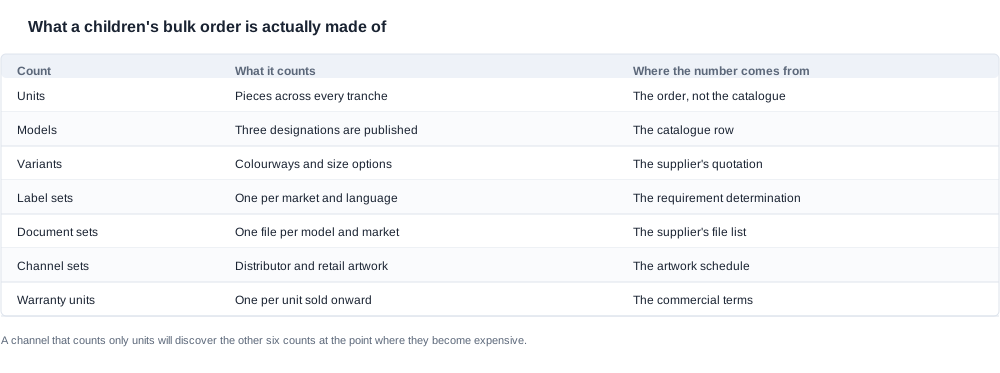
The multiplication is where the cost sits. Three published designations multiplied by several colourways multiplied by several destination markets multiplied by one document set each is a considerable number of separate things to get right, and the three inputs that multiply are not equally difficult. Units are easy, because units are fungible. Colourways are easy in the same way, once the artwork exists. Markets are hard, because each one has its own label set and its own requirement determination, and a children's product is governed, market by market and for the age band the channel intends, by a determination the buyer's own compliance party makes rather than by an assumption.
The document count is the least visible and the most expensive, because it is the count that has to be right before the units move rather than after. A file that does not name the ordered designation, a label that does not carry the warnings required in the destination market, an artwork approval that has not been given: each of these is capable of stopping a consignment that is otherwise complete and paid for.
Two published facts make this sharper for the children's line specifically.
The two protective designations publish identical rows. Forty milliampere-hours each, the same rated endurance, the same charge ceiling, the same charging method, the same feature rows. A buyer who orders both is therefore ordering two documentation tracks for what may be a single product platform, and the only way to know whether it is one track or two is to establish what each of the two protective designations refers to at platform level, and whether one file is enough for the pair. That question should be asked before the order is split, because it changes the per-designation file count.
The audio model is a different commercial object, not a larger version of the same one. Seventy milliampere-hours, a radio generation published against it, and no sensing rows in its catalogue entry at all. It brings a different set of documentation questions, a different channel proposition, and a different labelling treatment, and folding it into the same tranche as the protective models means a delay in one holds up the other.
The four counts to put on the first page of an enquiry
- Units per designation per variant. The number that arrives on an enquiry form, and the only one most suppliers ask for. It is also the least informative of the seven, because it is the one count that does not multiply.
- Variants per designation. Colourways, and any size or fit option. Each variant multiplies the artwork approvals and, in most categories, the per-configuration minimum.
- Markets and languages. Each destination market carries its own label set, its own warnings and its own requirement determination. This count is usually invisible in an enquiry and is frequently the one that invalidates a schedule.
- Document sets per designation per market. The count that decides the elapsed time, and the one the supplier's quotation should be explicit about.
A channel that sends all four on the first enquiry receives a quotation that can be compared. A channel that sends only the first receives a number, and discovers the other three during the delivery schedule.

How to split a children's order into tranches that can actually clear
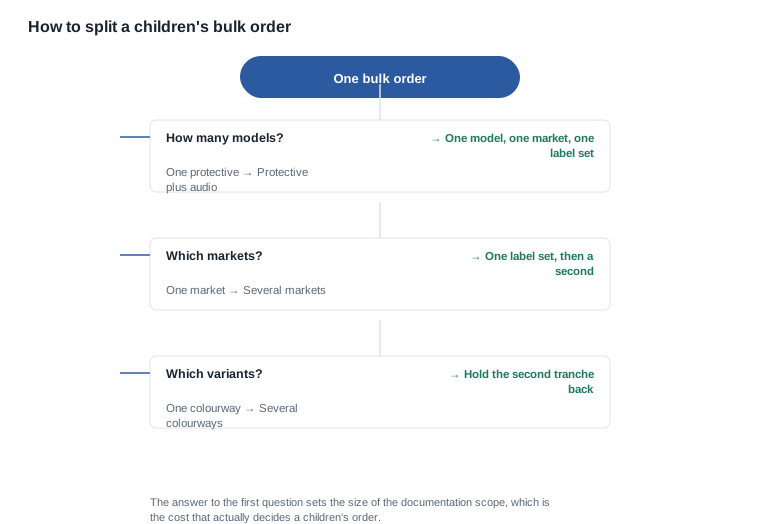
The reason tranches matter in this category is not conservatism. It is that the children's line has a failure mode that other categories do not: a product that meets the specification and still fails in the channel, because the fit, the routine and the claim position were never tested against a real week with a real child. A tranche is a way of finding that out while the order is still small enough to change.

Tranche one carries one protective designation, one market, one label set and one variant. Its purpose is not volume. Its purpose is to produce the three things that cannot be bought: a measured fit across the size range the channel serves, a charging routine that a household will actually follow, and an observed set of return reasons. Each of those is cheap to fix at one tranche's volume and expensive to fix after three.
Tranche two adds the audio model and the second market. Adding two variables at once is the temptation, and it is worth resisting, because the audio model behaves differently enough that a problem in it can be mistaken for a problem in the protective models. Adding the second market at the same moment is the bigger risk still, since a label question in the new market and a product question in the new model look identical from the outside.
Tranche three adds the colourways, and it comes last deliberately. A colourway is an artwork event, an approval round and a re-approval of everything that has changed on the label. Doing that once, on a proven configuration, is manageable. Doing it six times in parallel, on a configuration that has not yet been through a term, is how a schedule slips past the point where it can be recovered.
Why the two protective designations should not share a first tranche
Because their published rows are identical, a buyer has no way to tell from the catalogue which one is the better choice for a given channel, and a buyer who puts both in the first tranche has no way to tell which one caused a return. The temptation is to treat the pair as a set because they look like a set in the catalogue, and that is exactly the error.
Split them. Put one in the first tranche, keep the other back, and put the question to the supplier in writing: what is the documented difference between the two designations, and does the documentation file cover both or each separately. If the answer is that the difference is commercial rather than technical, that answer is worth having in writing, because it tells the buyer how many per-designation file sets to budget for and it gives the second tranche a reason to exist.
The document deliverables that have to exist per model and per market
This is the list that a quotation should attach, and it is the list most often missing from one. A supplier who quotes a children's line and cannot itemise the documentation deliverables has not priced the work, and the schedule that follows will move later.
- The conformity file for each ordered designation, naming that designation.
- The requirement determination for each destination market, with the standard names and the edition dates it was made against.
- The label artwork for each market, with the warnings and the instructions that the determination requires.
- The cell documentation for the fitted cell, including the transport reference.
- The evidence for any optical or behavioural wording the packaging intends to carry, referenced line by line.
- The artwork approvals already obtained, listed rather than described.
- The date on which the documentation pack was last refreshed, and the trigger that will cause it to be refreshed again.
The list is short, but item two is the long pole. The elapsed time belongs to the test body, not to the order, and it is the one item on the list that a buyer cannot accelerate by paying more. Everything else can be sequenced.

The per-SKU items that multiply when a kids line carries colourways
Two multipliers deserve their own attention, because they behave differently and because they are frequently confused with one another.
The artwork multiplier. A colourway is a set of artwork changes: a shell colour, a lens tint, a print, a carton, and any label that carries the variant. Each one is an approval round, and each approval round is a delay that starts when the artwork is submitted rather than when the order is placed. The commercial question worth asking is how many rounds are included before a charge applies, because the number of rounds a channel actually needs tends to be higher than the number a supplier plans for.
The document multiplier. A colourway may or may not change the evidence behind the claim. This is the point at which the two multipliers interact, and it is where the checklist earns its keep: the file for the base variant does not automatically cover the other colourways, and a buyer who assumes it does has built a schedule on an assumption. Ask which variant the evidence names, and ask what happens to a colourway added later.
The pattern generalises. Any property that varies across the range — the tint, the shell finish, the printed language, the plug or the contact geometry — is a potential multiplier of both artwork approvals and evidence, and it has to be checked in both dimensions rather than one.

What a quotation for a children's bulk order should state in writing
A quotation is a schedule dressed as a price, and in this category the schedule is where the risk lives. Ten things belong in writing, and a quotation that omits any of them is not comparable with one that includes it.
- The minimum order quantity, stated per designation and per variant, not per product family. A family minimum applied to a three-designation order is a hidden commitment to a split the buyer may not want.
- The price structure, stated as the tiers that exist and what triggers a move between them.
- The tranche structure, with the gate that opens the next tranche and who signs it.
- The elapsed time, stated per tranche and per market rather than as a single figure for the order.
- The document deliverables, itemised, with the designation each one covers.
- The label and artwork scope per market, including how many approval rounds are included.
- The packaging specification, and which parts of it are the buyer's to supply.
- The warranty and the defect replacement terms, and the period they run for.
- The notice period owed before a safety-relevant component, a lens material or the cell is changed.
- The validity period of the quotation, and the events that would cause it to be requoted.
None of these is a request for a concession. They are requests for the commercial terms to be visible, so that two quotations can be compared on the same basis. A quotation that answers all ten is worth more to a buyer than a cheaper one that answers three, and the difference shows up as schedule risk rather than as a difference on the invoice.
The questions that separate a usable quotation from a number
- Which platform does each of the two protective designations refer to, and can one file cover both? The answer changes the file count, and the file count drives the elapsed time.
- How many minimums apply, and at which level is each one set? Designations, variants, markets and label sets each attract their own, and a buyer who has not asked will be told the largest one.
- What is the documentation scope per designation per market, and which of those items is already complete?
- What is the artwork round allowance, and what happens to the schedule when it is exceeded?
- How is a variant added after the first tranche handled, and does it need its own evidence?
A supplier who answers these has a documentary system, and a supplier who does not has a price list. Both can serve a buyer; only one of them can serve a buyer who is asked to defend a file.
Which terms a kids buyer can move, and which stay put
Three things in a children's order are genuinely open for negotiation, and they are worth spending the negotiating capital on. The first is the tranche structure itself: a supplier who has assumed a single large delivery will usually accept a staged one, and the staging is worth more than a small movement in the unit figure because it changes what happens when something is discovered late. The second is the artwork round allowance, which is a count rather than a cost and therefore easier to raise than a price. The third is the scope of the documentation review, because a channel that identifies the lines it wants checked pays for less review and gets a faster answer on the lines that matter.
Three other things are not commercial variables, and it is worth being precise about them because a negotiation that appears to be moving one of them is usually moving something else. The elapsed time of a test body is what it is. The requirement determination for a children's product in a given destination market is the compliance party's determination to make, and a deadline placed on it does not change what it concludes. And the set of claims a listing may carry is a boundary, not a price.
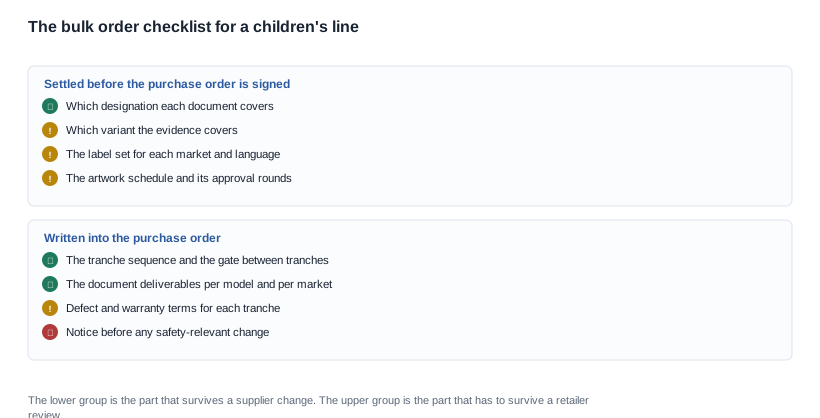
The clauses that belong in the purchase order follow from that split. The tranche sequence with the gate condition. The document deliverables per designation and per market, listed against the order itself rather than described in a covering letter. The acceptance criteria from the first tranche, applied to the second. A requirement for notice before any change to a safety-relevant component, a lens material, the cell or the detection defaults. An obligation to refresh the documentation pack when a standard's edition changes. And a statement of who carries the cost when a lot ships against artwork that was approved against a document that has since been withdrawn.
A worked order, described step by step
The scenario is constructed to show the sequence rather than to describe a customer.
Assume a distributor with an existing adult line in two markets is asked to add a children's line under its own label, with a target of three colourways and a launch in one market first. The distributor's first enquiry contains all four counts rather than one, and the reply is a quotation that itemises the documentation deliverables per designation and per market.
The second question the distributor asks is which platform the two protective designations refer to. The answer is that they are two channels of one platform, and that the file can cover both. The file count drops by one, and with it a meaningful part of the elapsed time.
The distributor then splits the order. Tranche one is one protective designation, one market, one label set, one colourway. Over a term, the fit is measured across the size range, the charging routine is tested with real households, and the returns reasons are collected. Two problems appear: the routine card in the box is too long to be read by a child, and the label in the second language needs a second approval round. Both are cheap to fix at this volume.
Tranche two adds the audio model and the second market, and the first protective designation joins it. Tranche three adds the remaining colourways once the artwork schedule is fixed. The final reconciliation, matching the document set against the units that actually shipped, is the step that catches the last gap: a colourway whose evidence named a different variant.
The outcome is a three-tranche launch instead of one shipment, and a documentation set that matches the goods. The decisive decisions were the four counts, the platform question and the tranche structure. None of them was about the unit figure.
What our own records can and cannot settle
Our catalogue covers the specification side of a children's order: what each of the three models is built around electrically, the charging method, the published bound on the charge time, and the radio generation of one of them, together with the feature rows carried by the other two. We publish no minimum order quantity, no price tier, no lead time, no capacity figure and no warranty term for any of them, because none of those is ours to publish and all of them belong in the quotation.
We also do not publish a per-designation conformity file, a label set, or a claim of any kind about eyesight or health for any of the three, and we do not present them as clinical devices. The catalogue's export-certification page carries images of patent certificates, which establish novelty of a design and nothing about conformity, so the conformity documentation and the manufacturer's declaration are items to request rather than items to assume.
What we can do is tell a buyer which parts of the bulk order our documentation settles today and which have to be negotiated in writing, and where each of the seven counts actually multiplies. Bring the four counts, the market list and the variant plan, and we will mark each one against the published rows and tell you which of them is a document task rather than a price task. The range itself is at kids smart glasses, and the specification behind the two protective models is set out in the A05 specification piece.


