

Care instructions are not a courtesy for a B2B buyer, they are a commercial instrument, and in a children's product they earn their place twice. First, a routine a household can actually keep is what separates a unit that gets used from one that is put away and forgotten, and the gap between those two outcomes shows up as a returns figure. Second, a printed routine is the reference point against which a later claim of damage is judged, which means the routine has to be written by whoever is responsible for the product rather than by whoever is writing the listing. A channel that writes its own care wording for a part it has not documented inherits a warranty argument it cannot win.
That second point is the one buyers tend to miss. The specification pages for these three models settle only part of the routine. What they settle is the charging interface, which is magnetic on all three, and the bound on the charge time, which is two hours or less, and the fact that nothing in our documentation rates any of the three for water, sweat or rain. What they do not settle is the lens material, the approved cleaning method, the replenishment method for the fogging unit listed on the two protective models, the frame geometry, the frame weight, and any ageing behaviour for the fitted cell. A care card built only on what is published will be short, and a care card built on what a channel assumes will be wrong in a way that surfaces as a dispute.
This article sets out the daily routine leg by leg, the wording a channel can responsibly print, and the terms that decide how a repair or replacement request is judged. The range background is at kids eye care, and the models themselves are at kids smart glasses. Nothing here is a health or eyesight claim, and none of these units is presented as a clinical device.
Kids smart glasses care instructions are a routine, and a routine has to be designed
A routine that nobody designed still happens; it just happens badly and differently in every household, and then the support desk is asked to explain the difference. The design principle for a children's routine is narrow: every step has to be doable by whoever is actually present, which is usually a child aged six or an adult who is also making dinner.
That principle rules out a lot of what a product page usually says. "Maintain the product in accordance with the manufacturer's guidelines" is not an instruction. A step that requires a specific cloth, a specific solution, a specific interval and an adult's attention will be skipped, and the skipping is invisible until it becomes a complaint.
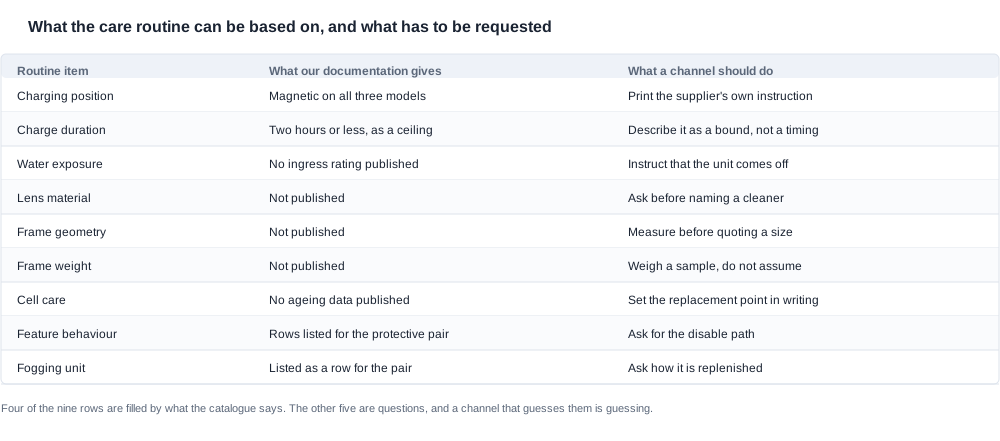
The table above is the working version of that point. Four of the nine rows are answered by what we publish, and those four are enough to build a usable daily routine. The remaining five are supplier questions, and a channel that answers them by assumption has published an instruction it will be held to.
The four items our documentation does settle
The charging interface is magnetic on all three models. This is the most useful single fact for designing a routine, because a magnetic contact rewards a fixed position. A child who seats the unit on the charger and leaves it there overnight has done the whole charging task correctly, with no cable, no connector and no orientation to get wrong. A routine that leans on this is shorter and more reliable than one that asks for a plug.
The charge time is bounded at two hours or less. That is a ceiling on an interval, not a timing, and it should be described in a care card as a bound rather than as a figure to plan around. It is also why the routine is written around a nightly charge rather than around a top-up: an overnight window is longer than the bound, so it always suffices, and a short top-up may not.
Nothing in our documentation rates any of the three children's models for water, sweat or rain. No such marking is published against the A05, the A06 or the A07, so there is nothing to support a water, sweat or rain claim for these units. That is precisely why the care routine has to contain an instruction to take the unit off before an activity session. The instruction is not a warning about damage; it is the honest consequence of there being no published rating.
The two protective models list a fogging unit, and prompt rows for correct and incorrect posture and distance, together with rows for lens clarity and lens fogging. They are catalogue lines recording what the unit registers and what it prompts on, and the position we take on what that can be used to say is set out in the age-band article. For a care routine, the relevant item is the fogging unit: whether it is replenished, with what, and how often, is a supplier question, and a card that names a refill method without asking has invented a consumable.
The five items that have to be requested
- The lens material and the approved cleaning method. Not published for any of the three. A generic dry cloth is a safe default; anything more specific, including any named solution, has to come from the supplier, because a solvent applied to an undeclared substrate is exactly the kind of thing a care card should not invent.
- The replenishment method for the fogging unit listed on the two protective models, and how the unit is handled when it is refilled.
- The frame geometry and the frame weight, measured rather than assumed, because a card that tells a parent to adjust a frame that cannot be adjusted is a card that will not be followed.
- Any ageing behaviour for the fitted cell, so that a channel can set a replacement point in writing rather than discovering it in a returns analysis.
- The disable path for the prompting functions on the two protective models, so that a parent who finds the prompts too frequent has something to do about it, and so that the support desk can tell a settings problem from a fault.

The morning: what the routine has to get right before the school gate

The morning is short and it is where the routine is won or lost, because everything after it depends on the unit having been charged and on the child having put it on without an argument.
Three things happen before the house, and each of them is there for a reason a buyer can state.
A wipe and an inspection. A dry wipe over the lenses and the arms takes a few seconds, and the inspection of the charging contacts takes as long as looking. The reason to inspect the contacts is specific and mechanical: a magnetic contact that has picked up a fibre does not seat properly, and a unit that did not seat properly is a unit that did not charge, and a unit that did not charge is a unit that runs out during the afternoon and generates a complaint about a battery.
Seating the unit on the charger, and confirming it has seated. We do not publish an indicator for these three models, so the confirmation has to be physical rather than visual, and the card should say so. This is a small point with a large consequence: a card that tells a parent to look for a light that does not exist on this product teaches the household to distrust the rest of the card.
Noting the time. This sounds like pedantry, and it is the step that makes a battery question answerable. If a parent can say when the unit went on the charger and when the child came home with it flat, the support desk can distinguish a charging problem from a usage problem in one exchange. If they cannot, the exchange becomes an argument about a rated endurance figure that nobody has the test condition for.
The rest of the morning is the child's business, and the routine should stay out of it. A care card that is read every morning is a care card that will be skipped by the second week, so the instructions that matter have to be attached to an object rather than to a habit. A card taped inside the lid of a school bag, or a two-line note on the carton, survives longer than a twelve-page manual.

Between a classroom and a sports hall
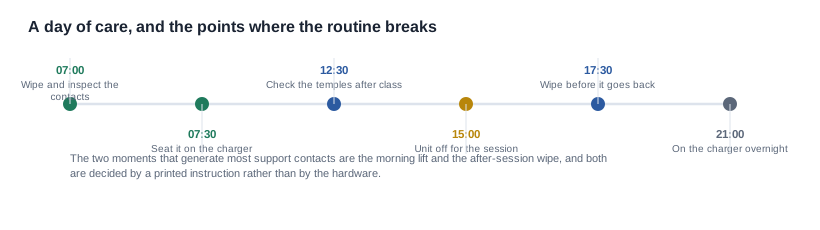
The middle of the day is where the two product ideas differ most, and where a care routine written for one of them will be wrong for the other.
The classroom block. On the two protective models the load is a prompting function, and a prompting function in a classroom is a source of exactly one kind of support contact: the child turns it off. A routine that does not tell the parent how to turn it back on, or what to expect when it is off, will generate a second contact from a parent who believes the product has stopped working. The prompt behaviour itself is a catalogue row; the configuration and the disable path are supplier questions, and the care card should carry the answer to the second of those rather than an instruction to consult a manual.
The transition to an activity session. Here the absence of any published rating for exposure has to become an instruction, because a child will not make that inference. The instruction is simple and it is honest: the unit comes off and stays off for the session. What a card must not do is explain the reason in terms of a failure mode the supplier has not described, because that converts an absence of information into a claim about what the product can survive.
The return from the session. A wipe of the arms and the frame, then back to the charger. The wipe is a routine step rather than a damage-repair step, and the card should say that plainly, because a card that implies the unit needs cleaning after every session reads as though the supplier expects it to come back damaged.
The audio model is a different case. It has no prompting function, so the classroom question does not arise, and its care routine is shorter: the wipe, the inspection, the charge, the storage position. The temptation is to reuse the protective models' card for it because the products look similar, and the result is a card that describes a function the audio model does not have. A card for a product the household can see does not have is the most common form of unusable care documentation.

Storage, the charging position and the end of the day
Storage is where most of the remaining questions sit, and it is the part of the routine most likely to be improvised.
The charging position is part of the routine, not part of the packaging. A magnetic contact needs a flat, clean, dry surface, and it needs to stay on it for the whole night. A surface that is used for other things during the day is a surface that will be cleared, which means the unit may be picked up and put down repeatedly, which means the seating is never checked. A card that says "on the charger overnight, on the same surface each night" is doing more work than it appears to, because it removes a nightly decision.
The contact surface is the part of the product most exposed to loss. A unit left on a bedside table overnight is a unit that can be knocked off, sat on, or swept up with a cloth. That is a household risk rather than a product claim, but it belongs in the routine because it is the situation in which a unit is most often found on the floor.
The overnight position should be out of reach. For a children's product, the charging position is the one place where the unit is stationary and unattended, and the card should place it accordingly. It should not be under a pillow, and it should not be where a child sleeps. This is a household instruction any supplier can stand behind, which means it does not need a test report.
The end of the day is also the measurement point. A routine that is going to be used to answer battery questions has to record something. The minimum useful record is the time the unit went on the charger and the time it came off, and the second is the number of days on which the child came home with the unit flat. A channel that prints a small log line on the card, and that tells the support desk to ask for it, converts a battery complaint into a diagnosable problem.
The care card a channel prints, and how a repair request is judged
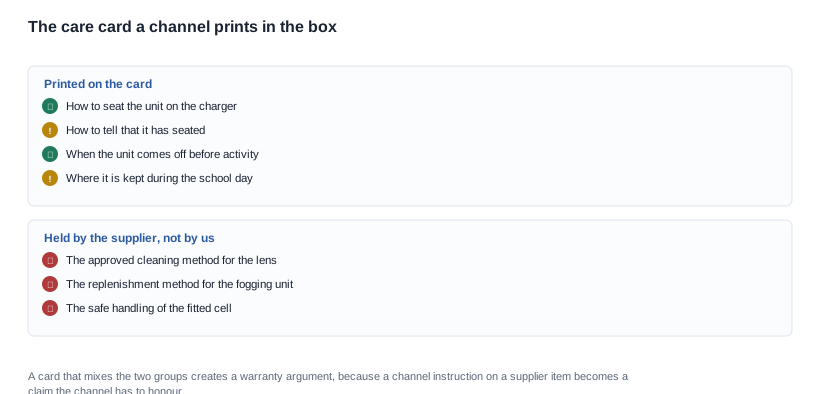
The card in the image is deliberately short. Its upper group can be printed today, because each item follows from something we publish. Its lower group cannot, and until the supplier answers, the card should not mention it. Printing a supplier item that the supplier has not confirmed is what turns a maintenance instruction into a warranty obligation, because a household that followed the card reasonably believes the channel told them to do it.
How to judge a repair claim once the routine exists
The routine's second commercial job is to give the after-sales desk a reference point, and a reference point only works if the claim is judged against the routine rather than against the supplier's opinion.
- Establish the routine the household was given, and in which language. The card version, the date it was released, and the copy in the pack are the reference. A claim judged against a routine the household never received is not a fair test.
- Establish what the supplier's own instructions said for the parts in question. Where the card and the supplier instruction differ, the supplier's document governs, and the difference is a documentation defect to be fixed rather than a claim to be refused.
- Separate a settings problem from a fault. On the two protective models, a prompt frequency the household cannot live with is a configuration outcome rather than a defect, and the disable path is the first thing to check. The prompt rows are published, so the function existing is not in dispute; only its behaviour is, and that behaviour has to be the supplier's to describe.
- Separate a handling outcome from a defect. A unit that has been sat on, stepped on or left off a charger for a week cannot be assessed against a routine that was not followed. This is not a refusal; it is the reason the routine is printed.
- Decide the disposition against a written criterion, and write it down at the time. A repair, a replacement, a refund or a refusal are all defensible, and all of them are indefensible if they are decided ad hoc and the next identical claim is decided differently.
The same logic applies to a replacement, and it applies with more force in a children's product, where a replaced unit re-enters the same routine and the same risk. A channel that replaces a unit without establishing the routine has not solved the problem, and it will see the same claim again.
What to put in the after-sales terms
The terms that make the above enforceable are unglamorous. That the routine card is supplied with every unit, in the language of the market, with a version and a date. That the supplier's instructions for the lens, the fogging unit and the cell are attached to the file rather than paraphrased. That the replacement and repair criteria are written before the first claim rather than drafted in response to one. That a claim is assessed against the routine in force at the time of purchase. And that where the card and the supplier document disagree, the supplier document is the one that applies.
A routine, put through a real week
The scenario is built to show how the parts connect rather than to describe a customer.
A channel launches a children's line with a twelve-page manual and no card. Within the first term the support desk receives three categories of contact: a parent saying the unit does not work because a light did not come on, a parent saying the prompting function stopped, and a parent asking how to put the lenses back as they were. The first two have causes in the documentation; the third is a question the channel should have had answered before launch, because the lens material is not published.
The channel replaces the manual with a one-page card, arranged exactly as the image above. It carries the four items our documentation settles, and it carries nothing else. The three items that the supplier had to answer are requested separately, and until they arrive, the card says so.
A second term shows what the card bought. The contacts about a missing light disappear, because the card tells the parent to check that the unit has seated rather than to look for an indicator. The contacts about the prompting function are answered from the disable path. The lens question is still open, but it is now an open item with an owner rather than a complaint without one.
The commercial point is the second term rather than the first. The card did not prevent damage and it did not make the product better. It made the failure modes legible, which is what lets a channel decide a claim instead of arguing about it, and it put a supplier question on the schedule where it belongs.
The questions to settle before the card goes to print
A buyer commissioning a routine for these models has a short list of questions to ask, and the order matters because the answers determine which lines the card can carry. Treat this as a checklist to work through before you order, not as a formality to be closed after launch.
- What is the approved cleaning method for the lens, and what does the supplier forbid? This is the single question that decides whether the card names a product or names nothing at all.
- What is the replenishment method for the fogging unit on the two protective models, and does the household do it, or does the supplier do it? The answer changes who the routine addresses.
- How is a seated unit recognised on this charger, given that no indicator is published? Whatever the answer is, it has to be a physical action rather than a light.
- What is the disable path for the prompting functions, and what does the unit do when a prompt is switched off entirely?
- What should the channel judge a replacement against, and does the supplier's own position differ from the channel's?
- What ageing behaviour does the supplier expect from the fitted cell, and what does it recommend as a replacement point?
Now evaluate the answers against three criteria, in this order. First, can each line be traced to a document, a measurement or a published row? Second, can the action be performed by a child or by an adult in under a minute? Third, if the line is wrong, who is exposed? A line that satisfies the first and the third but not the second is a line that will be skipped, and a skipped line is a line that cannot be used to judge a later claim.
Two trade-offs are worth naming before the card is written. A longer card covers more situations and is read less often, so the trade-off is between coverage and obedience. A card that names more supplier items covers more of the product, and it also transfers more of the supplier's responsibility to the channel, so the trade-off is between coverage and the risk of a warranty argument. Neither trade-off can be resolved by the buyer alone, which is why the questions above go to the supplier before the design work starts rather than after it.
The four rows our documentation fills in are enough to write a daily routine for all three of these models, and the routine is short. What we cannot supply is the approved cleaning method for an undeclared lens material, the replenishment method for a fogging unit whose handling is not published, the frame geometry and weight, and any ageing data for the fitted cell. We do not publish a care card for these models, and we will not write one that names a cleaner, a refill or a size that our documentation does not carry.
Nothing in the maintenance advice on a packaging panel may imply that a unit was chosen for what it does to a child's eyesight, and the position we take on that is written up in the age-band article. A panel carrying that implication is selling a different proposition from the one we document.
Bring us the three models, the markets you intend to print a card for, and the routine you already run in the field, and we will mark which lines of it our documentation supports, which lines have to come from the supplier, and which lines in the current card you should take out.


