
The honest answer to the question this article is named for is that our catalogue prints six feature rows for two of the three products in this family and none of them is a monitoring specification. The A05 and the A06 publish 透镜式电子, 雾化器, 正确姿势和距离, 不良姿势和距离, 镜片清晰, 镜片雾化. Read carefully, those are rows describing what is fitted and what is listed — a lens-based electronic item, a fogging unit, a correct posture and distance indicator, an incorrect posture and distance indicator, a lens clarity note and a lens fogging note. They are not a claim about an effect, they are not a measurement, and they are not a performance statement. A buyer who can reproduce the rows accurately can say what the product is fitted with. A buyer who converts them into an outcome has moved away from everything our published material supports.
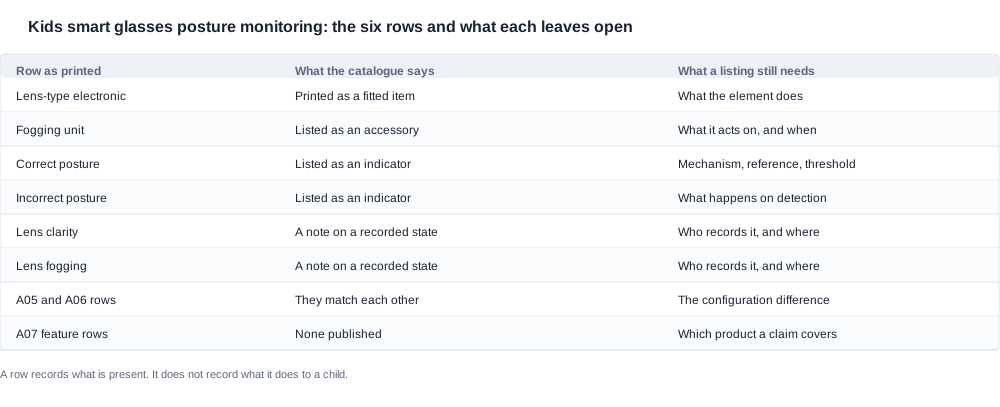
Kids smart glasses posture monitoring: the rows our catalogue prints
The six rows are printed for the A05 and the A06, and the A05 and the A06 are the two products published as 儿童智能防护眼镜 in our catalogue. The A07 is published as a 儿童智能音频眼镜 and carries no feature rows at all, which means that a category-level statement about posture or distance applies to two of the three products and not to the third. A buyer assembling a range page has to make that distinction visible rather than letting a category title imply a capability that one of the products does not publish.
Two of the six rows are the ones the market conversation runs on, and they are the two most likely to be misdescribed. 正确姿势和距离 and 不良姿势和距离 are published as a pair, and they read as an indicator that distinguishes a correct posture and distance from an incorrect one. What they do not say is what is being observed, by what mechanism, against what reference, at what threshold, or what happens when the incorrect condition is detected. There is no published sensor, no published measurement principle, no published reference geometry, no published trigger point, no published accuracy figure and no published reaction — no light, no sound, no vibration and no recorded entry. The rows name a condition; they do not specify a system.
The remaining four rows sit on the other side of the boundary. 透镜式电子 is a lens-based electronic item, which our catalogue does not describe further. 雾化器 is a fogging unit, and it is listed as an accessory or a fitted element rather than as a lens specification. 镜片清晰 and 镜片雾化 are notes on lens condition, and they describe the two states the catalogue records rather than a function the buyer can quote.
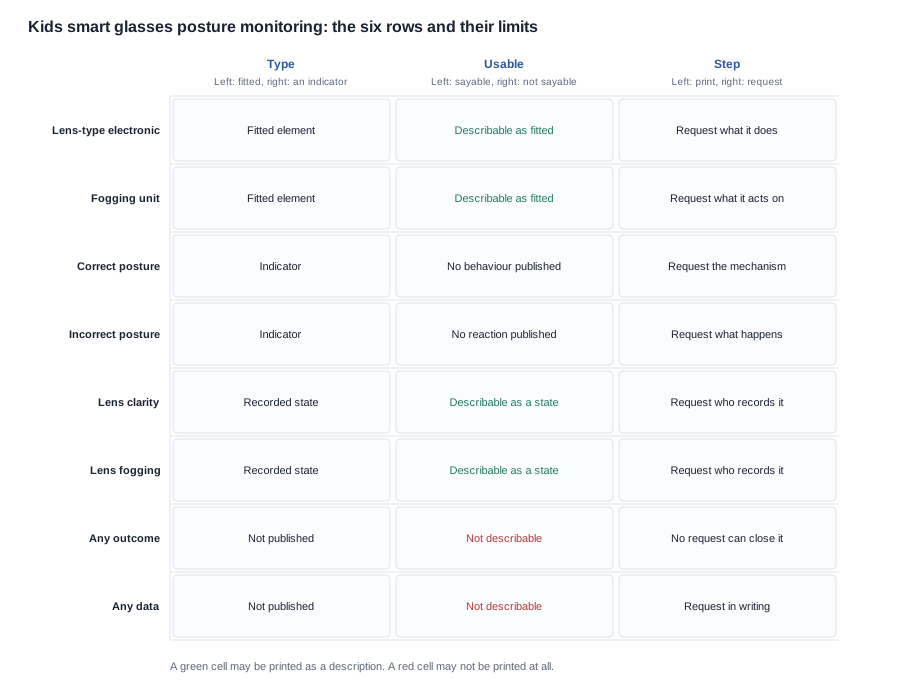
The matrix above is the version to keep in the buying file, because it does the work that a feature row on a product page cannot. The left-hand column is what the catalogue prints; the middle column is what a listing may state; the right-hand column is the request that has to go to the supplier before anything more than the row itself can be said. A buyer who carries that matrix into a supplier meeting gets a specific answer to each row rather than a general assurance, and a buyer who does not gets a general assurance that will have to be treated as an assumption.
What the A05 and A06 rows do and do not establish
There is a limit to what a catalogue row can carry, and in this category the limit sits in a specific place. A row establishes that something is present in the product. It does not establish what that something does to a child, and it does not establish that the presence of it is beneficial. That distinction is not pedantry, because the product category is aimed at children and the subject of these rows is the position of a child's head and the state of a lens. A listing that moves from "the catalogue lists a correct posture and distance indicator" to "the product helps a child avoid straining their eyes" has introduced a physiological outcome, and our published material contains no measurement, no study, no test method and no result that would support it.
The same limit applies to the fogging unit and to the two lens condition notes. A fogging unit may be described as a fitted element. It may not be described as something that reduces fatigue, that clears condensation on demand, that improves comfort, that affects a child's ability to concentrate, or that does anything at all beyond being present. The lens condition notes describe two recorded states and may be reproduced as such. They may not become a promise of clarity, of protection, or of any effect on a child's eyesight.
There is a second limit, and it concerns the two protection models rather than the six rows. Their published specification rows match one another in every respect — a 40 mAh cell, an endurance figure of roughly twenty hours, a charging ceiling of two hours or less, and a magnetic charging method with no published radio version — so nothing in the published data distinguishes the A05 from the A06 except the model name and the designation printed beside it. A buyer who presents the two as different specification options is presenting a difference that the data does not carry, and a supplier who quotes them at different prices is quoting a distinction rather than a published specification. The question worth putting to a supplier is therefore not "how do these two differ" but "what does the production configuration for each model actually consist of, and what is the documented basis for the difference".
The third limit is the one most easily forgotten, and it is the absence of a data row. A product that lists a correct posture and distance indicator and an incorrect posture and distance indicator is describing something that observes a condition, and a buyer cannot tell from the catalogue whether that observation leaves the product, is stored, or is transmitted. Our catalogue publishes no storage arrangement, no data description and no radio version for either of these two products, so the data question cannot be answered from our material and has to be put to the supplier in writing. The data side of that question is taken up in the data section of this family's material, and the wider published row set for one of the two products is in A06 smart glasses specifications and features.

The word monitoring, and what a listing may and may not do with it
A category label is not a specification, and the gap between the two is where most of the difficulty in this product family sits. The word in the title of this article is the shorthand a reader brings to the page; what the catalogue prints is a pair of indicator rows. A buyer who keeps the two apart can write a listing that says what is fitted. A buyer who uses the shorthand as though it were a published capability has produced a marketing claim that our catalogue does not support, and in a category where the subject of the claim is a child's head, that is the kind of claim that attracts attention rather than sales.
The practical test for a piece of listing copy in this area is simple, and it can be applied without a committee. Ask whether the sentence can be rewritten so that every noun in it appears in a published row. If it can, the sentence is a description of the product and is defensible. If it cannot — because it contains a verb about outcomes, or a benefit, or a physiological term, or a word like detects, prevents, corrects, protects, relieves or improves — then the sentence is a claim, and a claim in this category belongs to the buyer's own compliance function before it goes anywhere near a product page.
There is one further question a buyer should put to the supplier before any of this copy is written, and it is the one that decides whether the rows are usable at all: what does the product do when the incorrect condition is present? The answer determines whether the rows describe an output the customer sees, a record the product keeps, a signal sent to a companion device, or a condition that is simply noted in the catalogue. Each of those four behaviours leads to a different listing, a different privacy position and a different data file, and the catalogue does not indicate which one applies.
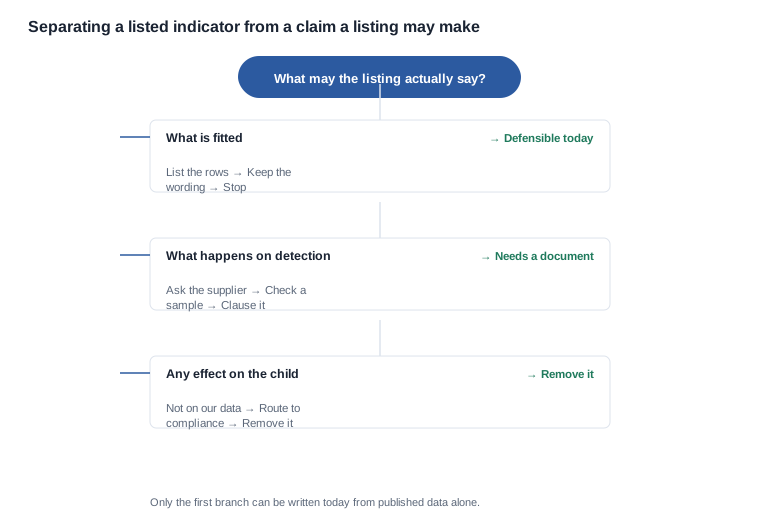
The decision structure above exists because the same six rows can support several very different listings, and the choice between them is a commercial and legal one rather than a writing one. A descriptive listing shows the rows and asks for the rest. A functional listing states what happens on detection, which requires the supplier's answer. An outcome listing is not available on published data at all.
Questions that turn a listed indicator into a verifiable specification
The request list below is the practical output of this page, and it is ordered by what the absence blocks. Each item is answerable by a supplier who has the documentation, and each one closes a specific gap between a catalogue row and something a channel can describe.
- The mechanism behind each of the six rows, and specifically what is observed for the posture and distance indicators.
- The reference the correct and incorrect conditions are judged against, and how that reference is established for an individual child.
- The threshold or trigger point, and whether it is adjustable.
- What happens when the incorrect condition is present: an output on the product, a record, a signal, or nothing further.
- Whether anything is stored, for how long, and whether anything is transmitted to a companion device or an application.
- The power draw of the indicators, and whether they are active continuously or only under a condition.
- The maintenance, calibration and consumable requirements, and what a channel has to stock.
- The factory test record for the indicators, and what a buyer's incoming inspection can verify.
- The user-facing description the factory recommends, which is the best available starting point for the copy.
- The configuration difference, if any, between the A05 and the A06, and its documented basis.
The last item is the one most likely to be answered with a general assurance rather than a document, and it is the one a buyer should not accept that way. A production configuration that differs between two models whose published rows are identical is a real and useful thing to know — it may justify a price difference, a feature difference or a market segment difference — and it is exactly the kind of information that belongs in the file rather than in a sales conversation. If a supplier cannot state it, then the two models are the same product to the buyer, and the range page should say so.
There is a third item that a buyer in this category should add to the same list, and it is easy to overlook because it does not concern the indicators at all. The two protection models publish no radio version, which means the questions about pairing, about an application and about a companion device are all open for them, and a buyer who has spent the whole conversation on the six rows can easily reach the end of it believing the product is a standalone item. Asking whether the product is a standalone item, a companion to a phone, or a companion to a separate application is a single question with a large number of consequences, and it belongs at the top of the list rather than at the bottom of it.
It is also worth asking what the product does with a fault in an indicator. A fogging unit that has stopped fogging, or an indicator that no longer distinguishes the correct condition from the incorrect one, is a product whose printed rows no longer describe it, and a channel has no published specification against which to recognise that. The supplier's position on how such a unit is detected, whether it is replaced under warranty, and whether the failure is detectable by the customer or only by a factory test is the difference between a manageable service position and an unmanageable one, and it is not something our catalogue addresses for any model in this family.
Two more items belong in the file even though they are not about the indicators. The first is the ingress position: nothing in our catalogue states that any of the three products resists water or dust, so a buyer who wants a wet-environment statement has to obtain it in writing, and a buyer who cannot obtain it has to keep the statement out of the listing. The second is the transport documentation for the cell, which for the two protection models means the documentation for a 40 mAh cell, and which is a separate file from the conformity record and is commissioned separately. The catalogue is explicit about what it does not print, and both of these are on that list.

The sequence above is the order that avoids rework. Ask the mechanism questions first, because the answers determine what the other questions mean. A supplier who cannot describe the observation mechanism will produce an answer to the threshold question that is a guess, and a guess in a purchase order becomes a defect claim later. Then ask what happens on detection, because that is the question that decides whether the product is a standalone item or part of a system, and the answer changes the accessory, the application requirement and the data file all at once.
Selecting between the two protection models and the audio model
The three products in this family are not three configurations of one thing, and a buyer who treats them as a single range will end up quoting a capability to a customer who has the wrong product for it. The A05 and the A06 publish the six rows described above and a 40 mAh cell, and neither publishes a radio version. The A07 publishes no feature rows, a 70 mAh cell, and Bluetooth version 5.4. All three publish an endurance rated at approximately twenty hours, a charging ceiling of two hours or less, and magnetic charging, and none of the three publishes an ingress marking, a frame weight, a lens material, a control method or a pairing procedure.
So the selection logic in this family is short, and it is structural rather than a ranking. A buyer whose customer needs the listed indicators and the fitted fogging unit is looking at the two protection models, and the choice between them depends on the production configuration that the supplier has to document, because our published rows do not separate them. A buyer whose customer needs a connected audio product is looking at the A07, and for that product the relevant open questions are entirely different ones: the pairing procedure, the application requirement, the radio file, the acoustic position, and what the audio product does with data. A buyer who needs both is buying two products, and the range page should say so, because the category title otherwise implies a single capability that only one of the three products publishes.
There is a fourth consideration that belongs in the same place, and it is the one that most often turns a technically complete shortlist into a commercially unusable one: the effort of writing the listing. The two protection models demand a great deal of careful copy, because every sentence has to be either a row or a document, and a channel that launches two of them has to maintain two of those copy sets, each of them reviewed against a file that a supplier can change between orders. The audio model asks for less of that and more of something else. Neither is better, and the decision belongs to a channel that knows its own cost of publishing, not to a comparison between the two.
The trade-off worth naming is commercial rather than technical. The two protection models have the narrower published file, which makes a shortlist easy to build and a launch harder to write, because every sentence in a listing for them has to be either a row or a supplier document. The audio model has the wider published file, which makes the specification conversation shorter and the data conversation longer. Neither is a reason to prefer one; both are reasons to build the shortlist on the evidence each model can carry and to stop comparing them on a capability dimension that only one of them publishes.
A short note on the order of work, because it is the part buyers most often get wrong. The structural questions have to be settled before the commercial ones, and the commercial ones before the copy is written. The structural questions are the ones above: what is fitted, what happens on detection, what the data position is, and how the two protection models differ in production. The commercial questions follow: what the price difference is between the protection models and the audio model, what the packaging has to carry, and what the inspection regime has to verify. The copy comes last, because copy written before the first two stages are closed has to be rewritten, and in this category rewriting published copy is more expensive than publishing nothing.
The broader product-selection questions for this family sit in the common-questions page, and the compliance side of the same file is worked through in the structural safety work for this family.
Put the six rows in front of us exactly as you intend to reproduce them, together with the copy that surrounds them, and we will take both apart line by line: which sentences rest on a published row, which are waiting for a supplier document, and which are a reading of the rows that the rows themselves do not carry. Bring the copy before it has been designed rather than after, because in this category the second half of that sequence is an expensive place to find a boundary.


