
The A06 is published as a kids frame with a 40 mAh cell, a charge time of two hours or less, about twenty hours of rated use, magnetic charging, a lens-type electronic atomiser, and posture-and-distance indication. It does not publish a Bluetooth version, and it publishes rows identical to another model in the same range. Both of those facts change how you should read the sheet.
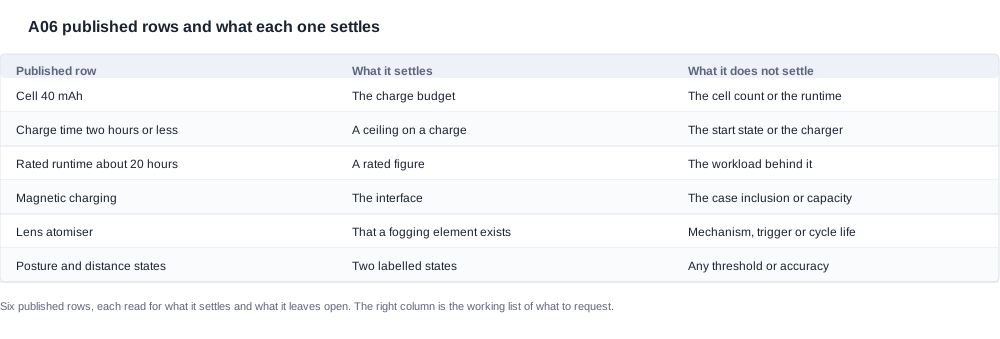
The most common mistake in this category is treating a specification row as a completed test result. A published row is a number and its label — it is not the measurement protocol behind it, and it is not a statement that the number holds under your programme's conditions. Read that way, the A06's sheet is short but unusually usable. Read the other way, it is a set of claims waiting to be checked by a customer.
A06 smart glasses specifications and features, row by row
The six published rows
The cell is 40 mAh. The A05 in the same range publishes the same figure, and the A07 publishes 70 mAh. The published value does not include a cell count, and that is worth asking about rather than assuming: a 40 mAh figure could describe one cell or more than one, and the number of cells determines what happens when one side of the frame fails.
The charge time is two hours or less. That is a ceiling, and it is the wording to use. It is not the same assertion as "under two hours", because a ceiling of two hours permits a charge that takes exactly two. The row does not publish the starting state of the cell, the charger used, or the ambient temperature, and without those the figure cannot be reproduced.
The rated runtime is about twenty hours. This is the longest rated runtime published anywhere in our catalogue, and it is the row most likely to be misread. No test condition accompanies it — not what was active, not what was idle, not the indication frequency, not the sample size, not whether it is a mean or a best case. It is a stated figure and it should be labelled as one.
The charging method is magnetic. That settles the interface and therefore the dock, the cable arrangement and the case geometry. It does not settle whether a case is included at your quantity, or what capacity a case would carry.
The lens-type electronic atomiser is published as a feature. The model page carries it as a labelled element, and the page carries four labelled state illustrations: correct posture and distance, poor posture and distance, lens clear, and lens fogged. What is not published is everything about how it behaves — no mechanism, no power draw, no activation trigger, no response time, no cycle life, no sensing accuracy, no range, no indication interval, and no statement of whether a reminder can be dismissed.
What each published row does and does not license
Read row by row, the sheet divides cleanly into three groups, and the grouping tells you what you may put in a specification sheet and what you may not.
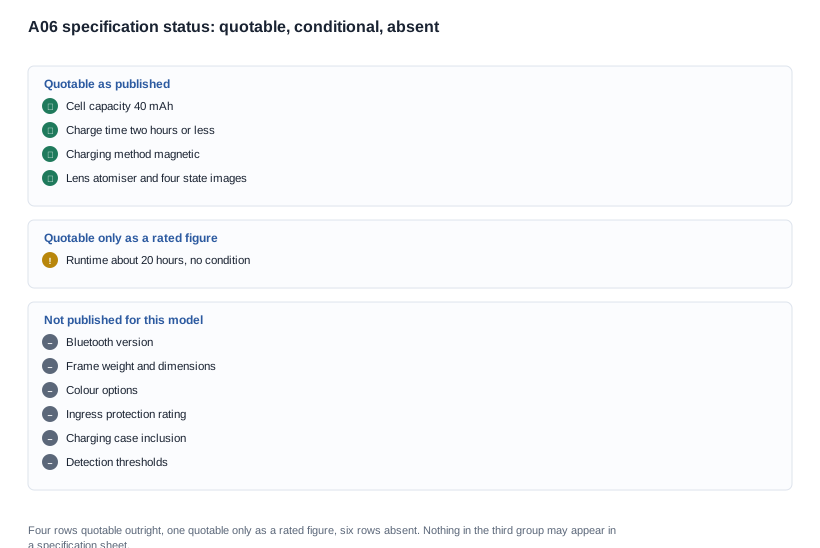
Four rows are quotable as published. The cell capacity, the charge ceiling, the charging method, and the atomiser with its four state illustrations. These can go into a comparison sheet, a quotation request and a product page without any further evidence, provided the wording matches the catalogue and the claims stay inside what the illustrations show.
One row is quotable only as a rated figure. The twenty-hour runtime. It can be quoted; it cannot be compared against another manufacturer's figure, because the two figures were almost certainly produced on different workloads. It can be used for internal capacity planning if your own duty cycle is conservative. It cannot be written into a warranty condition, a retailer agreement about expected performance, or a comparative claim.
Six rows are absent and cannot appear at all. Bluetooth version, frame weight and dimensions, colour options, ingress protection rating, charging case inclusion, and detection thresholds. An absent row is not a negative value and it is not a hidden weakness — it is simply not information, and it has to be requested or measured.
The two facts that change how you read the whole sheet
The missing Bluetooth version is the single most consequential absence on this page. The A07 in the same range publishes V5.4; the A06 publishes no radio version row at all. If your channel needs a pairing instruction, a compatibility statement, a support script, or a returns policy based on a specific radio generation, none of those can be written from published evidence for this model. That is a programme question, not a copy question, because the fix is a request or a sample, and the cost of finding out late is a support script you have to rewrite.
The identical rows with the A05 change what a specification sheet is for. When two models publish the same rows, a specification sheet cannot tell a customer which one they are receiving. That is a problem for the range, the artwork and the inventory plan rather than for the specification sheet itself — but it means the sheet is not sufficient to support a listing, however complete it looks on its own.
A06 versus A07 on cell capacity
The cell comparison is the one place where the two kids models separate on a number, and it is worth reading carefully because the obvious reading is wrong.
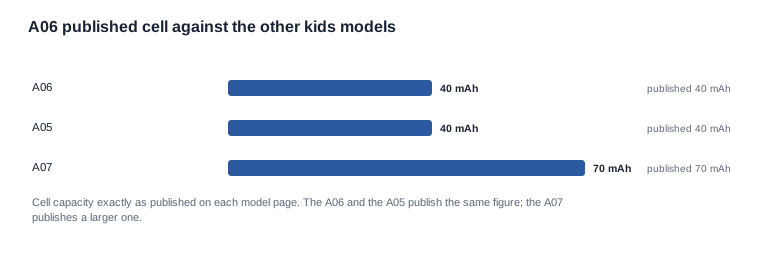
A 75 per cent larger cell on the A07, producing an identical published runtime, is evidence about duty cycle rather than about battery quality. The runtime figure across this category is describing intermittent operation with long idle periods. It follows that the A06's smaller cell is a consequence of the volume taken by the fogging element and its electronics inside the temple, and that it is a structural fact about the architecture rather than a specification choice that a software update could reverse.
That inference has a practical consequence for how you plan the product. A device that is genuinely idle for most of a school day does not need the same charging logistics as one that is continuously active, and the charging plan you build for the A06 should be built around a nightly charge and a dock, not around a spare-unit pool. It also means the runtime figure should not be treated as a limit you are at risk of exceeding — there is a large gap between a rated twenty-hour figure and a continuous-use figure, and the published evidence does not say where in that range the product actually sits.
Reading an A06 specification row before you quote it
The discipline that keeps this category's copy defensible is a three-question test applied to every row before it goes into a document.
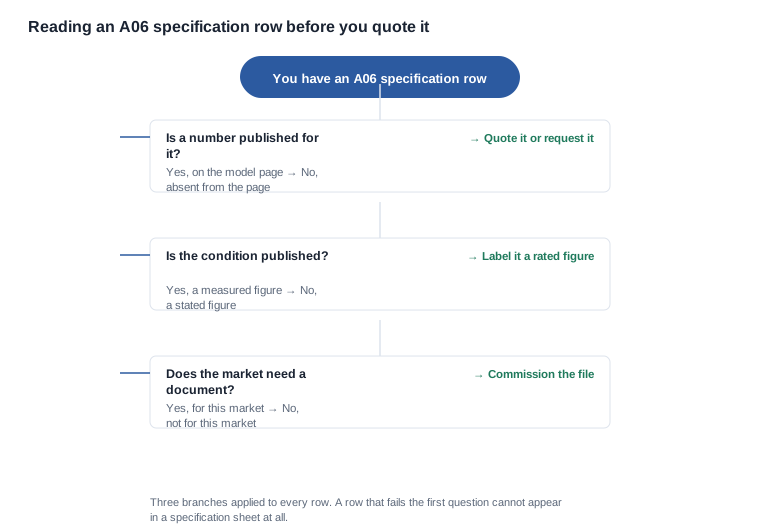
Is a number published for it? If yes, it goes into the sheet. If no, it is not in the sheet at all — not as a blank, not as an estimate, and not as a typical value for the category. A specification sheet with a row marked "not published" is an honest document; a specification sheet with a row marked with somebody's guess is a liability that surfaces at the first customer who checks.
Is the condition published? This is the question that separates a measured figure from a stated one, and it is the one most often skipped because it requires reading past the number. A measured figure has a method, a sample and a condition attached. A stated figure has none of those. Both are quotable; only one is usable as an acceptance criterion.
Does the market need a document? A published row is not a conformity statement, and no row on this page is one. Where a destination market requires a per-model file, that is a separate workstream with its own schedule and its own cost, and it does not begin because the specification sheet is finished.
Building an acceptance test from the published rows
Once the rows have been read, the useful next step is to convert them into acceptance criteria, because a criterion written before the measurement is what protects the buyer and the supplier equally.

The protocol comes before the reading. Write down what was active, what was idle, the indication frequency, the number of units, the ambient temperature and the charge state, and then measure. A protocol designed after the first reading is a description of what you found rather than a test, and it cannot be applied to a later production lot.
Record your own numbers, not ours. The twenty-hour figure is a starting point for a test, not a substitute for one. Run the protocol on sample units from the lot you are actually buying, and use those results in the purchase order. That converts a stated figure into an acceptance criterion, and it is the single highest-value thing a buyer can do with the rows on this page.
The sample also settles three of the six absent rows. Frame weight and temple length are measurements. Colour options are an observation of what was supplied. Case inclusion is an observation of what was in the box. None of them needs a laboratory, and all of them need a sample.
A one-week evaluation that produces usable figures
This is a hypothetical sequence rather than a client programme, and it is written to show the order of operations.
Day one. Send the written requests: the Bluetooth version for the A06, the frame weight, the temple length, the lens dimensions, the available colour options, and the case inclusion and capacity. Send them per model designation and per destination market, with the market list attached. In parallel, ask for the difference between the A05 and the A06 in writing.
Day two. Write the measurement protocol for the runtime test, the atomiser observation and the physical measurements, and get it agreed before the sample arrives. The protocol names the duty cycle, the sample count and the conditions.
Day three. Receive the samples. Measure the frame. Record the colourways supplied. Open the box and record what is in it. Run the runtime test under the agreed protocol rather than under the manufacturer's stated condition.
Day four. Observe the atomiser and the posture-and-distance indication under normal indoor light, and record what happened as an observation with a date, not as a specification.
Day five. Write the results into the purchase order as acceptance criteria, and write the remaining open items — the conformity file, the child-product assessment — into the schedule with dates and owners.
The point of the sequence is that nothing in it depends on a unit price negotiation, and every item in it changes what the price buys. A buyer who has done this has a specification sheet, an acceptance protocol, a measured runtime and a scheduled compliance plan. A buyer who has only done the price negotiation has a number.
What the state illustrations are worth on their own
The four labelled state images on the model page — correct posture and distance, poor posture and distance, lens clear, lens fogged — are the most useful thing about this specification sheet, and they are useful in a way that is not obvious.
They describe a product that changes state in front of the wearer. The lens is either clear or fogged, and the posture-and-distance indication is either correct or not. That is a behavioural design, not a measurement: the product communicates back to the wearer through the lens rather than through a screen, a notification or an app. For a procurement decision, that is a bigger deal than any of the electrical rows, because it tells you the product's primary output channel is optical and visible, and it tells you that the interaction model does not depend on the wearer holding a device.
It also tells you what the copy can honestly promise. A listing can say the lens presents clear or fogged, and can say the product indicates correct and incorrect posture and viewing distance. It cannot say the fogging discourages myopia, it cannot say the indication corrects behaviour, and it cannot say the wearer can dismiss a reminder, because none of those three is published. The illustration carries more usable copy than the specification sheet does, which is unusual and worth recognising.
And it marks the boundary of the sample test. Because the output is a visible lens state, an observer can record what the lens does under a stated condition without a laboratory and without instrumentation. That is why the atomiser observation is a sample-stage item in the evaluation sequence above rather than a programme-stage one. What you cannot do is convert the observation into a cycle life, a response time or an activation threshold — those need a protocol with a defined failure criterion, and that is a programme cost.
How the feature set compares across the range
One more reading of the same sheet is worth making, because it determines whether the A06 is the right model for a given channel at all. Compared with the A07 in the same range, the A06 publishes the atomiser and the posture-and-distance states, and the A07 publishes a Bluetooth version and neither of those. Compared with the A05, it publishes the same rows on every count.
So the A06's feature advantage exists over one model in the range and against the other two. Against the A07 it is a real and substantial advantage, because the published sensing set is the entire proposition. Against the A05 it is not an advantage at all on the published evidence — the rows are identical, and the only difference is the designation. A buyer who wants the indication functionality and wants to compare two options has one specification and two model designations; a buyer who wants the radio has one model. That is a narrower choice than a three-model range usually implies, and it is worth stating before the range plan is drawn rather than after.
The commercial terms this sheet can and cannot support
A specification sheet eventually gets read by someone who has to sign for it, and the difference between what it supports and what it does not becomes a commercial question.
The unit price is not the first line to negotiate. For this model, the published set gives a buyer everything they need to plan capacity, charging, accessory and copy — and gives them nothing on compliance, sizing or the sensing performance. Those are the lines where the programme cost is decided. A negotiation conducted on unit price while the conformity file, the child-product assessment and the measurement programme are all unpriced has negotiated the smallest number in the plan.
The lead time and the minimum order quantity are not published for this model, and we will not put a figure against either without the actual production position. What we can say is that they depend on things a buyer controls: the range decision, the market list, the number of models in the programme and the artwork approval count. Fixing those four early is the fastest available route to a real lead time, and it is faster than any negotiation.
Payment and warranty terms follow the same logic. A warranty written against a published row is enforceable; a warranty written against a measured figure you have not taken is an argument waiting to happen. The kids buying guide covers the category decision, and the A06 versus A05 price positioning covers the range-structure question that sits underneath a quotation for either of the sensing models.
The rows you may quote and the rows you may not
A short, explicit list is more useful to a copywriter than a long caveated one.
Quotable as published: 40 mAh cell capacity; a charge time of two hours or less; magnetic charging; a lens-type electronic atomiser; correct and incorrect posture-and-distance states; clear and fogged lens states; a rated runtime of about twenty hours, labelled as a rated figure.
Not quotable, because not published: any Bluetooth version; any frame weight; any dimension; any colour option count; any ingress rating; any case capacity; any detection threshold, accuracy or range; any indication interval; any atomiser mechanism detail or cycle life; any statement of how the A05 differs from the A06.
Not quotable in any form: any claim about myopia, vision development, vision protection or eye health. We make no such claim for this model, we hold no clinical data, no test protocol and no regulatory assessment for this category, and we will not help draft copy that implies one. A product that indicates posture and viewing distance is a behaviour-indication product, and the boundary is set out in our medical boundary guidance.
What we will confirm and what stays open
We will confirm the published rows as they stand — the cell, the charge ceiling, the rated runtime, the charging method, the atomiser and the four state illustrations — and we will confirm which of them are stated figures rather than measured ones, because that distinction is the one a buyer needs and it is not visible on the page.
We will tell you plainly which open items we can close directly, which need a sample, and which need a test programme, and we will not estimate a value for the ones we cannot close. Where the catalogue publishes nothing, the honest answer is a request or a measurement, and we would rather give you a dated request than a number nobody can defend.
Where we will not go: filling a gap with a typical industry value, describing the A05 and the A06 as different when our documentation does not say they are, presenting the runtime as an active-use figure, or presenting a company-level export certification page as a per-model conformity record. The catalogue carries a company-level export certification page that holds images rather than text, and the catalogue wording names no CE, FCC or RoHS. There is no per-model certification row anywhere, and a per-model file for the A06 is a request, not an inheritance.
The A06 limitations analysis works through the same gaps from the commercial side, and the published A06 specification list that you are reading is the honest baseline for the range as a whole.
Related reading
- How the indication function should be described — posture monitoring
- The alternative with a documented radio — A06 versus A07
- Kids smart glasses category overview — kids smart glasses
Send the target market, the buyer type and the claims the programme needs and we will come back with what is documented.


