

Our catalogue publishes no defect rate, no incoming inspection procedure and no factory test record for any of the three products in this family, and it publishes no weight, no lens material, no ingress marking, no control method, no pairing procedure, no charging-case capacity and no per-model conformity record either. That is the correct state of a catalogue that publishes product rows rather than quality data, and it places the whole of the quality position with the buyer and the supplier. What follows is the inspection scheme a buyer should build for this family, the four failure modes it catches, and the reason a sample order and an incoming inspection are not substitutes for one another.
Kids smart glasses quality checks: what goods-in should actually verify
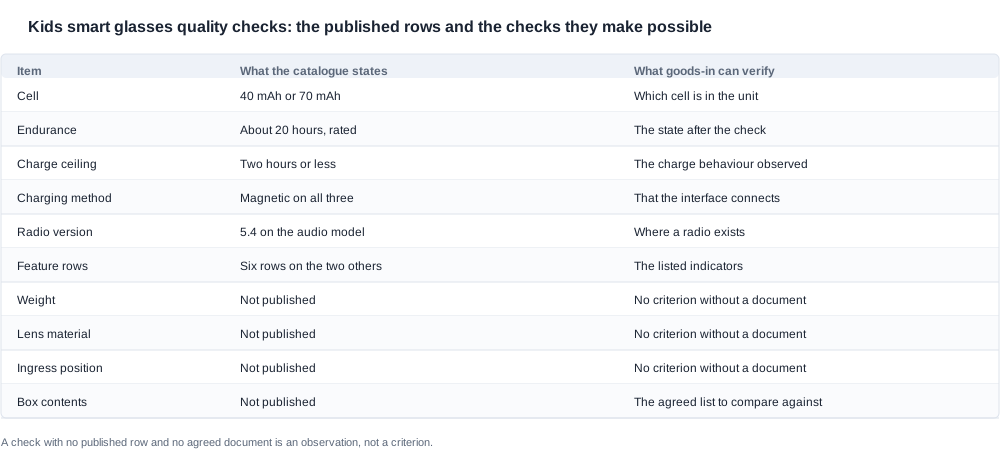
The product positions a buyer is inspecting are narrow and should be written down before the first container arrives. The two protection models carry a 40 mAh cell; the audio model carries 70 mAh. All three use magnetic charging, all three publish a rated endurance of around twenty hours, and all three are capped at two hours of charging. The two protection models publish no radio version and carry the same six feature rows; the audio model publishes Bluetooth version 5.4 and carries no feature rows at all. Everything else a checker would want — the weight, the lens specification, the edge treatment, the ingress position, the box contents, the pairing procedure, the warranty — is not published, and therefore has to be specified by the buyer and verified against a document the supplier has provided.
That last point is the organising principle of any inspection scheme worth building. A check that has no published row and no agreed document behind it cannot be a pass-or-fail criterion; it can only be an observation, and an observation that a quality team files is worth less than the hour it costs. So the scheme has to be built in two layers: the checks that are anchored to a published row or an agreed document, and the observations that are recorded but do not decide anything. Buyers who mix the two end up with a report full of findings and no way to act on them, and buyers who skip the second layer end up blind to the early signals that would have told them a shipment was going wrong.
It is worth adding one observation about how these layers behave in practice, because it explains why a scheme that works on one shipment can fail on the next. The top layer depends entirely on the file being current, the middle layer depends on the criteria being written down, and the bottom layer depends on the team being briefed. All three can be true on the day a scheme is introduced and all three can quietly stop being true three months later, usually for innocent reasons: the file is updated for a new box without anyone telling the receiving team, the criteria are reworded in an email, and the briefing is skipped because the same people are on shift. A buyer who reviews the record periodically will see all three of these happening, and the review is the mechanism that keeps the scheme alive.
There is a third layer that sits above both and is the one that catches most of the real failures. It is the comparison against the quotation and the agreed specification: not "is this unit working" but "is this unit the unit that was ordered, with the accessories and the documentation that were agreed, in the configuration that was quoted". A shipment can pass every functional check and still be the wrong shipment, and the check that catches it is the one that reads the box, the marks and the paperwork against the file.
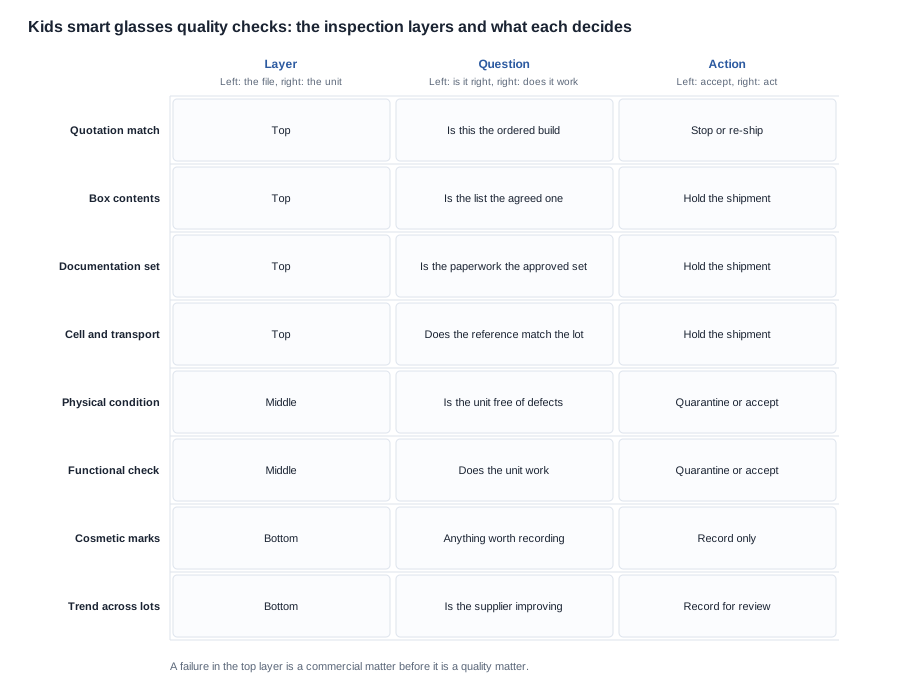
The matrix above is the version to brief a goods-in team on, because a team that knows which layer a check belongs to knows what to do with the result. A failure in the top layer is a commercial matter before it is a quality matter, because the answer is usually to stop the shipment rather than to quarantine a unit. A failure in the middle layer is a quality matter with a defined disposition. A failure in the bottom layer is a signal about the supplier's process, and it is the one that is most often ignored and most expensive.

Four failure modes that incoming inspection catches and a sample order does not
The distinction between a sample order and an incoming inspection is the distinction between a product and a shipment, and the four failure modes below are all shipment-level: they are not visible in a unit that a supplier selected and sent to a buyer directly, and they are all visible in a unit that comes out of a production run.
The first is a configuration mismatch. The unit that arrives is not the build that was quoted — a different colourway, a different accessory set, a different box, or a different variant entirely. Nothing about it is defective, and every functional check will pass. The only thing that catches it is a comparison of the unit and its marks against the quotation, and the reason it happens is that the specification was agreed in a document and the production run was built from a file that has since changed.
The second is a box contents difference. The list that was agreed has been altered: a cable is missing, an accessory has been substituted, the insert is a different insert, or an item has been added that nobody ordered. The consequence is not a defective product; it is a product that does not match its own documentation, which is exactly the kind of discrepancy that a household or a school discovers in the first minute of use.
The third is a documentation difference. The warnings are absent, they are in the wrong language, they are the wrong version, or the traceability marking is missing or illegible. A document failure is invisible on a product that works, and it is the failure mode with the longest tail, because a warning that was never delivered is a warning that was never given.
The fourth is a cell and transport documentation mismatch. The cell documentation and the transport reference for the cell are what allow a consignment to move and a lot to be traced, and when they do not match the unit in the carton, the problem surfaces at the wrong point in the chain — at a carrier, at a border, or in a recall. For this family that means a 40 mAh cell for the two protection models and a 70 mAh cell for the audio model, with the reference matched to the model and the lot rather than to the range.

The sequence above runs from the outside in, which is deliberate. Opening a box before checking what was supposed to be in it destroys the evidence for the second failure mode; reading a documentation pack before checking the unit destroys the evidence for the fourth. A buyer who has been through this once tends to keep the order afterwards, and the order is worth writing into the receiving procedure rather than leaving to habit.
There is a fifth failure mode that is not a failure of the shipment at all but of the file, and it is worth naming because it is invisible until a claim is made: a unit that was produced against a documentation set that has since been superseded. A supplier that changes the accessory set, the box or the artwork without telling the buyer has created a mismatch between what was approved and what arrived, and the buyer will only find out when a customer returns a unit with instructions that do not match the ones in the file. A written change process is the cheapest insurance in the whole scheme.

Setting the acceptance sample when the catalogue publishes no defect rate
Because no defect rate is published for any of the three products, a buyer cannot quote a supplier's quality level and cannot compare one against another on published data. What a buyer can do is set its own acceptance scheme, and the honest way to set one is to start from the checks rather than from a number. The order of work is: decide which checks are critical, decide what a failure of each means, decide the sample, and only then decide the number that the sample is large enough to detect.
The criticality split is usually obvious once it is written down. A configuration mismatch, a documentation failure and a cell-document mismatch are critical, because each of them means that the shipment cannot be accepted into the channel as it stands. A box contents difference is a critical case where the missing item is safety-relevant and a normal one otherwise, and the way to express that in a procedure is to name the items on the list that are critical rather than to split the check itself. A cosmetic defect on a frame is a judgement call that a quality team can make at the bench, and it does not need to be in the sampling plan at all.
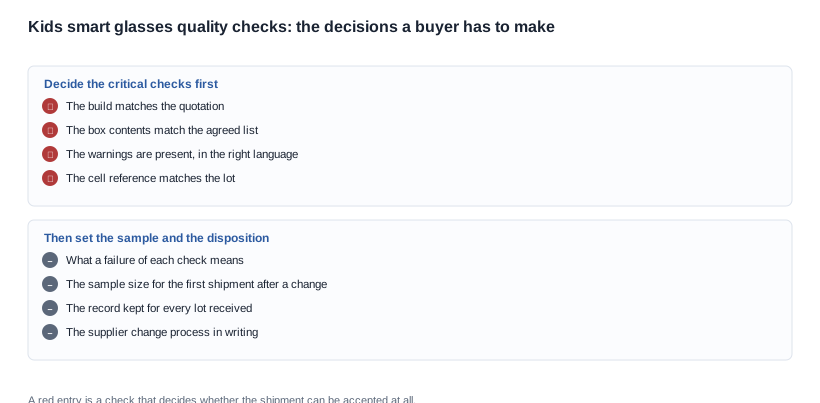
The checklist above is the decision half of the scheme, and it is the half that is usually skipped in favour of talking about sample sizes. It is also the half that determines whether the inspection is worth running: a scheme in which every failure has the same disposition is a scheme that has not been thought about, because the dispositions are not the same. A documentation failure and a cosmetic defect do not cost a buyer the same thing, and a procedure that treats them the same will eventually treat a documentation failure as a cosmetic one.
On the sample size itself, the practical advice for a category this small is to keep the scheme proportionate and to run the first inspections at a higher level than the routine plan, because the first shipment after a configuration change is where the mismatches are. Once the supplier's process has been observed under load, the routine level can be reduced — but it should be reduced on the basis of the buyer's own record, not on the basis of anything the supplier says about the product. No published figure supports it, which is the whole point.

The cell documentation and the transport reference, checked at goods-in
The cell documentation and the transport reference for the cell are the two documents that make a consignment of these products lawful to move and a lot traceable once it has moved, and they are also the documents most often assumed rather than checked. For this family the check is specific: the cell is 40 mAh in the two protection models and 70 mAh in the audio model, and the reference has to match the model that is actually in the carton. A reference that covers the cell type but not the configuration, or that covers the range rather than the model, is not a reference for the unit in the box.
The second thing to check is the scope of the reference. The cell is not travelling alone: it is travelling inside a product, inside a pack, alongside a charging accessory and an insert, and a reference written for the bare cell does not necessarily describe the packaged unit. A buyer should therefore ask the supplier to state what the reference covers — the cell, the assembled product, or the packed consignment — and should not accept a reference whose scope is ambiguous, because an ambiguous scope is a scope that can turn out to be wrong at the worst possible moment.
The third check is the lot. The transport reference has to be usable for the lot that was shipped, and the traceability marking has to be present and legible on both the product and the box so that the link between the unit and the reference can actually be made. A buyer who has a reference and a lot marking that do not correspond has neither, and the file is worse than useless because it looks complete.
The general procedure for the cell documentation is developed in battery transport compliance for buyers. The export-side questions for this family are covered on the export-considerations page, and the product-level checks that sit alongside the documentation checks are worked through on the structural safety page and on the page about the listed posture and distance indicators.
Lot records, traceability and the file that outlives the shipment
The record itself is short, and a buyer who has written it once will not have to think about it again. For every lot received, the file carries six fields.
- The supplier's own lot identification, exactly as it is marked on the product and the carton.
- The configuration that was built, recorded against the model and the quotation it was filled against.
- The revision of the documentation set that was in force on the day the lot was produced.
- The sample that was drawn, and the result for each check in the scheme.
- The disposition of anything that failed, and the evidence that was retained for it.
- The date of receipt, and the name of whoever signed the shipment in.
The last part of a quality scheme is the part that gets used years later, and it is the part that is rarely built. What a buyer needs to be able to do, at any point, is to take a unit from a shelf and establish which lot it came from, which configuration it was built to, which documents were in force when it was made, and what was agreed with the supplier at the time. That is four pieces of information, and only the first is usually on the product.
So the receiving record has to carry the rest. For each receipt: the supplier's own lot identification, the model's configuration as quoted, the revision of the documentation set that was in force, the sample and the results, and the disposition of anything that failed. Kept per lot, that record is what lets a buyer answer a question about a unit two years after it shipped, and a buyer who cannot answer that question is carrying a risk that the inspection did not touch.
One further point belongs with the record, and it is about what a buyer should do with a supplier who records well. A supplier that keeps lot records, marks units legibly and provides a change process in writing is a supplier whose quality position can be audited, and that is a commercial advantage to the buyer and a reason to keep the relationship. A supplier that does none of these is not necessarily worse, but the buyer is carrying the risk personally, and the difference between the two situations is worth recognising when the commercial terms are discussed — not as a way of extracting a discount, but as a way of knowing which costs in the quality scheme are the buyer's own.
The same reasoning applies to the checks that cannot be automated. Most of the checks in this scheme are visual and comparative, which means they need a trained eye and a written criterion, and the training is the part a buyer should not skip. A team that has been given a list of checks without being given the criteria will produce records that cannot be compared between shifts, and a record that cannot be compared between shifts is not evidence. Half an hour of briefing, repeated when the scheme changes, is the cheapest quality investment available in a category where no published quality data exists for the buyer to fall back on.
The commercial point behind it is worth making, because it is the point a procurement panel will ask about. A quality scheme that is run well and then not recorded is a scheme that produced a good shipment once. A quality scheme that is run and recorded produces a trend, and a trend is what lets a buyer negotiate a defect position, forecast a replacement cost, and demonstrate a supplier's performance at the point where a contract is being renewed. In a category where our catalogue publishes no defect rate at all, the buyer's own record is the only quality data that will ever exist for it.
The practical discipline is small: one record per lot, retained for the life of the product in the channel, with the inspection results attached rather than summarised. The receiving instruction that produces it is one page, the data is written at the bench while the unit is open, and the resulting file is what a buyer can put in front of a customer, a school or an auditor who asks where a particular unit came from. It is also the document that lets a buyer evaluate its own supplier: the trend across lots is the only quality data that will exist for this family, because our catalogue publishes none, and a buyer that keeps the record is the only party in that conversation able to say whether a shipment has been improving or deteriorating.
The related material for this family is on the range buying guide and on the page about what belongs in the box; the aftersales side of a received unit is covered on the warranty and setup page; the general fault-finding flow is on the troubleshooting page; and the model-level review checklist is on the buyer review checklist for one of the protection models.
Send us the acceptance criteria you have set, the box contents you have agreed and the lot marking you have specified, and we will mark them against what our published rows can actually support, identify the ones that have no document behind them yet, and tell you which of the four failure modes your current receiving procedure is most likely to miss.


