

The KY06 publishes an 8 MP camera, a 260 mAh cell, a charge time of two hours or less, a rated runtime of 6 to 8 hours, magnetic charging and a charging case. It publishes no case capacity, no sensor model, no field of view, no video specification, no frame weight and no certification numbers. That combination — a coherent specification next to an empty compliance file — is what determines the shape of the review, and it is why this review starts with the documents and moves to the hardware.
A production review is not a product evaluation. The purpose of a review checklist is to establish what the delivered goods actually are, so that a purchase order can carry enforceable terms and a returns process can carry named categories. Running it as a product evaluation wastes the one stage where the buyer's own measurement is still authoritative. The rule that follows from this is simple: settle the paperwork first, because a documentary failure stops the shipment, while a hardware failure usually does not.

KY06 smart glasses buyer review checklist: the sequence we would run
Six steps, in this order, each with a written completion test.
- Request the certificate file for this model. Not provided. Ask for the number, the issuing body, the validity date and the model coverage. The starting list is the certification checklist.
- Confirm the model coverage matches your purchase order. This is where certification claims most often fail — a family-level or brand-level certificate does not cover a specific model, and a mismatch causes friction at customs and in the event of a quality claim.
- Weigh the frames across several units. Not published for this model, so establish a baseline and record the spread. Note that the sibling models in this range publish similar rows, so a weight measured here is also useful context when comparing across them.
- Time a full charge, and record where the contact is. The catalogue publishes the charging method as magnetic but not where the contact sits, so time the whole cycle rather than a partial one, and note which part of the frame the charge actually uses.
- Run low-light test captures and compare across units. No sensor model or field of view is published, so you cannot test against a specification. What you can do is expose identical units to identical low indoor light and compare the results — batch consistency is the useful question when correctness is not measurable. See AI camera glasses imaging.
- Verify markings on randomly drawn production units. Not the first carton. A compliant document does not guarantee the marking is on every unit.

Why the document file comes before the hardware in this review
The order is not a preference, and the reason is worth understanding because it is the opposite of how a sample evaluation is usually run.
A hardware failure is recoverable and local. A unit with a loose temple is one defective unit; it can be quarantined, claimed and replaced against a returns term. A documentation failure is neither local nor recoverable at that stage. A shipment held at the border, a marketplace listing delisted for a missing certificate, or a distributor who cannot answer a retailer's compliance question — none of those is resolved by replacing the defective unit, and all of them surface after the goods have moved and the money has been committed.
There is a second reason, which is subtler and in this category more decisive. The catalogue does not publish a certification position for the KY06 at all. No document in our material names this model. The catalogue carries a company-level export certification page whose content is images rather than text, and the catalogue text contains no reference to CE, FCC or RoHS, so there is no per-model certification row to read, quote or rely on.
That does not mean the product is uncertified, and it is important not to say it does. It means that on this model the compliance file is something the buyer has to assemble from the supplier's evidence rather than something the catalogue can supply. For a camera model with a radio, the Radio Equipment Directive (EU) 2014/53/EU is the framework to ask a supplier about, and the battery transport evidence for the fitted cell is a separate document question that sits on the same timeline.
The three grades of evidence a buyer can actually file
Documents are not equal, and the review becomes much shorter once they are sorted into three grades. The first grade is a register entry: a certificate number that an issuing body will confirm, carrying a validity date and a model string on the document. That is the only grade that survives a dispute with a customs authority, a marketplace platform or a distributor's compliance team, because it can be re-checked by somebody who is not the buyer.
The second grade is a readable report: a test report that states what was tested and against which standard, but carries no number that can be looked up afterwards. It tells you the product was assessed and what it was assessed against, and it belongs in a technical file, but it cannot be verified after the fact by a third party. Ask for it regardless, and ask for the laboratory's name and its scope, because a report covering radio behaviour is not a report covering electrical safety, and the two are routinely confused in a supplier's document pack.
The third grade is a claim: an email stating that the product is compliant, a catalogue line, a seller's assurance. It costs nothing to obtain and it settles nothing. It cannot be filed, it cannot be shown to a platform, and it cannot be relied on when a consignment is held.
Sorting the pack into these three grades is a five-minute exercise that changes the review, because it separates the question "does the supplier hold documents" from the question "can I prove what the documents say". Only the first of those two questions can be answered by asking.
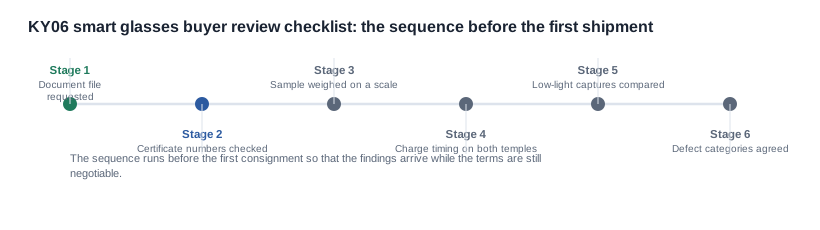
The consequence for the review is that step one is not administrative overhead. It is the step that determines whether steps three, four and five are worth running on units that can actually be sold.
Weighing and charging: the two measurements a buyer can take in an afternoon
Two of the six steps can be closed without any help from the supplier, and they are the two that most often get skipped because they produce a number rather than a document.
Weighing. No camera model in this catalogue publishes a weight except the MT6 at 158 g, and that figure describes the glasses body including the battery and the camera and excluding the foldable charging case. It is a different cell, a different camera and a different case form from the KY06, so it cannot be used as a proxy. A buyer who wants a weight for the KY06 has to put a unit on a scale, and the useful discipline is to record the configuration that was weighed: the unit as shipped, with the cell fitted and without the case. Then weigh the case separately and the packed unit together, because the three numbers answer three different commercial questions.
The spread across units is the part that matters more than the average. A single unit gives a number; ten units from the same production lot give a tolerance, and a tolerance is what can be written into a purchase order as an acceptance criterion and enforced when a later lot arrives.
Charge timing. Magnetic charging makes the seat a variable rather than a fixed geometry. Timing one temple and calling it the charge time is the most common shortcut in this category, and it systematically misses the failure that matters: a contact that seats reliably on one side and intermittently on the other. Time both sides, on several units, and record how the units behave when the seat is imperfect rather than only when it is perfect.
One further point on the charge row. The published figure is a ceiling of two hours or less, which permits exactly two hours and also permits less. A review that records "two hours" as if it were the typical value has recorded a limit as a measurement, and the difference shows up as a customer expectation you cannot meet.
How many units make a measurement worth writing down
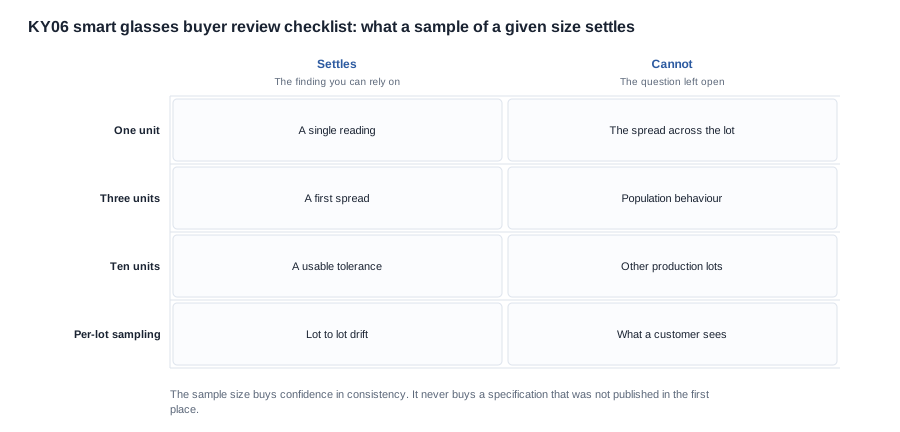
A measurement taken on one unit is an observation. A measurement taken on ten units from one carton is a carton profile. A measurement taken across cartons and across the production run is a tolerance, and only the third of those can be written into a purchase order as an acceptance criterion that a later consignment can be judged against.
The sampling plan does not need to be large to be useful, but it does need to be stated before the units are opened, because a plan designed afterwards is only a description of what happened. The version that works in practice is simple: draw units from at least three cartons, take at least one unit from the first and last packed position in each, and record which carton and which position each unit came from. If the spread turns out to be driven by carton or by position, that is a packaging or a stock rotation finding rather than a manufacturing one, and the two have entirely different remedies.
Record the configuration as well as the number. On this model the frame cell and the charging case are separate physical items, so a unit weight without its configuration is three numbers compressed into one. The frame with the cell fitted and without the case is a specification figure. The case on its own is a logistics figure. The frame, the case and the packing material together are the freight figure. Three weighings, three different commercial questions, one afternoon.

Comparing low-light output when no sensor model is published
Low-light performance is where an unpublished sensor specification does the most damage. Without a model number you cannot know the pixel size, and pixel size is what determines how an 8 MP sensor behaves indoors or at dusk. A buyer cannot calibrate an expectation against a specification; they can only establish whether their batch agrees with itself.
That is still worth doing, and it is worth doing carefully. The protocol that works is a fixed one: the same units, the same room, the same light level, the same settings, the same subject at the same distance, captured in the same order. Write it down before the first capture, because a protocol designed afterwards is a description of what happened rather than a test.
What you are looking for is not excellence. You are looking for consistency, and specifically for a spread between units that is larger than the spread between repeat captures of the same unit. The second figure is the noise floor of your own setup; the first is the manufacturing variance. If the second is much larger than the first, the setup is the problem and you should rebuild it before drawing any conclusion about the product.
A spread in low-light output across units from the same batch points at a component or assembly variation, and finding it at sample stage is far cheaper than finding it in returns. The red flag to watch for is a single unit that is visibly different from the rest of the batch, because that is usually a different component revision rather than a manufacturing tolerance.
Writing the protocol so a second buyer can repeat it
The value of a batch-consistency measurement is not only the number it produces on the day. It is whether the next inspector, your own second reviewer, or the supplier's quality team can run the same measurement and get a comparable answer. That requires the protocol to be written down in a form that survives the loss of the person who built it.
Six fields cover it: which units were used and where they came from, the room and the light source, the settings, the subject and the distance, the order of capture, and how each capture was scored. Score it simply — a ranking rather than a luminance figure, because a ranking is reproducible by eye and a luminance figure needs equipment the second inspector may not have.
Keep the file with the purchase order rather than with the samples. A protocol that lives in one person's spreadsheet is unavailable to everybody else, and a protocol that lives in the quality file is what turns a one-off measurement into a repeatable acceptance test.

Recording findings per unit rather than per batch
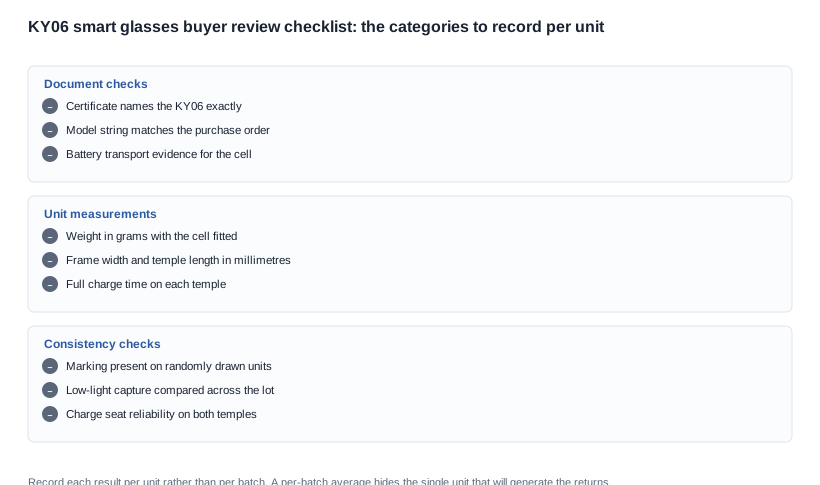
The commercial output of the review is not the measurements. It is the vocabulary they produce.
A unit weight with a measured spread, a frame width with a tolerance, a charging seat that seats reliably on one temple and intermittently on the other, a marking that is present on three units out of ten — each of those becomes a named category rather than a general complaint, and named categories are what a returns policy and a warranty claim are written against. A general complaint cannot be priced, cannot be argued and cannot be refused.
This is also the moment to agree the categories with the supplier, and it is the cheapest moment, because the supplier has not yet priced them into a production lot. A category agreed at sample stage is a line in a contract. A category discovered in a returns cycle is a concession.
Three questions to ask the supplier before the review, because each one changes the protocol rather than the outcome.
- Is the cell removable? If it is, the weight, the endurance and the end-of-life handling all change, and the review should be structured around the cell separately from the frame.
- What does the charge indicator do? A charge time published as a ceiling has no published end point without it, and an indicator that never settles changes what "fully charged" means during the review.
- Does the packed configuration vary between units? A case that is present in some units and absent in others is a packing instruction problem rather than a product defect, and it needs to be found as one.
Recording findings per unit also changes the conversation with your own customer service team. A team working from a per-batch summary can only escalate; a team working from per-unit findings can triage, and triage is what keeps a small defect cluster from becoming a channel-wide return problem.
Turning the findings into acceptance criteria
A measured finding only becomes commercial when it is written as a criterion, and the translation is straightforward once the format is known. Four elements are needed: the measurement, the configuration it was taken in, the tolerance, and the consequence of a result outside it.
The measurement is the one you already have. The configuration is what makes the number repeatable — a unit weight is only comparable when the case is included or excluded consistently, and a charge time is only comparable when the start state is stated. The tolerance comes from your own spread: if ten units differed within a narrow band, that band is the tolerance you can defend, whereas a tolerance you invented is a tolerance a supplier will negotiate down. The consequence is the part buyers most often leave out, and leaving it out is what turns an acceptance criterion into a discussion. Whether an out-of-tolerance unit is quarantined, replaced or accepted against a concession is a decision that is cheap to agree in advance and expensive to agree afterwards.
Agree these four elements with the supplier while the sample is still on the table. At that point the criteria cost nothing, because they have not yet been applied to any shipment. After a first consignment has been accepted against a criterion that was never written down, the supplier's historical record becomes the position and the buyer's position becomes an assertion.
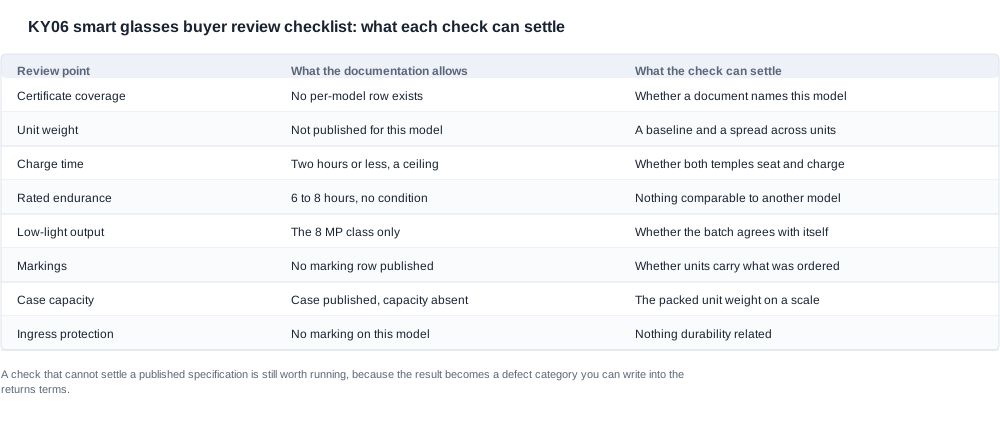
The checks this review cannot settle
There are questions this review raises and cannot answer, and knowing which ones they are saves a buyer from waiting for an answer that will not come.
The 6 to 8 hour rating carries no stated test condition, and no test condition is published for any model in this range — so the figure cannot be compared against another model's figure. The review can measure a runtime on its own units under its own protocol, and that measurement is worth having, but it will not tell you whether the published range was produced the same way.
No ingress rating means no durability claim is supportable. Other frames in the catalogue carry an IP54 marking; this model carries no marking at all, and a marking on a different model is not evidence about this one. A review can observe whether a unit survives a splash, but an observation is not a rating.
No case capacity means shipping weight cannot be modelled from the documentation. It can be measured on a packed sample, which is a real answer and a slow one.
Pairing procedure, the companion application, storage behaviour and whether the case ships by default are all unanswered. These are the items that most often turn into a customer support cost rather than a returns cost, and they are closed by a written answer rather than by a physical inspection.
Logging an open item so it does not become a dispute later
An open item is a fact about your own process, and the way it is recorded determines whether it becomes a decision or an argument. Four fields are enough: what is not known, what it is worth, what it depends on, and who owns it by when.
What it is worth does the real work, because an unknown that has been costed stops being an unknown. A case capacity that has not been published can still be bounded: the packed weight lies somewhere between the frame weight and the frame weight plus a case, and the case with its own cell sits in a range that a comparable model on the same platform suggests. That is not a published figure, but it is a bound, and a bound is something a freight estimate can be written against and flagged as provisional. An unknown with no value attached has no urgency and no owner.
What it depends on identifies the transaction that would settle it. A case capacity depends on the supplier's production documentation. A certification position depends on a test report. A cell chemistry depends on the bill of materials. Naming the dependency converts a general question into a specific request, and a specific request is answerable.
Finally, the owner and the date. An open item without a name attached to it is an assumption the organisation is carrying silently, and assumptions of that kind are precisely what surface later as a claim that somebody agreed to something. The owner does not have to be the person who asks the question. It has to be the person who will notice if the answer does not arrive.
Where does this model sit against its neighbours? Against the V03 Pro and the V03, and the MT5 the published rows are close — 8 MP across the group, with the KY06 holding the larger cell at 260 mAh against 220 mAh. Against the CY03 and the CY05 the trade runs the other way: a smaller cell at 260 mAh against 290 mAh, and a case whose capacity is published at 1400 mAh against a case with no capacity figure. That context is in the KY06 limitations analysis, and the document side of the review is covered in the KY06 certification status.
This model's reviewable claims are about compliance, cell capacity and batch consistency, and we will fill the absent rows from our own test data where we hold it rather than from industry-typical values. We will not supply a weight, a case capacity, a colour list or a certificate number that our material does not contain, and we would rather the review returns a short accurate list than a long list of claims we cannot substantiate.
Related reading
- The certification position for this model — KY06 certification status
- Why resolution is not image quality — AI camera glasses imaging
- The document set to request — certification checklist
- Where the review sits in the wider range — AI camera glasses
Tell us your market, volume and channel and we will tell you which rows we can evidence today.


