

A limitation in a factory catalogue is usually read as a defect, and for the KY06 that reading is wrong in a specific and useful way. What the published record leaves out is not evidence of weak hardware. It is a set of rows that were never written. The catalogue publishes a model name, a 260 mAh cell, an endurance range of 6 to 8 hours, a charge ceiling of two hours, magnetic charging with a charging case, and an empty Bluetooth column. Everything else a programme leans on — the capacity of that charging case, the ingress rating, the frame weight, the certification references, the commercial terms — is simply absent from the record.
Treating those absences as documentation exposures rather than as product weaknesses is the whole purpose of this article. Each exposure below is given a cost, an owner and a closure route, because that is what an absence actually is once it reaches a procurement file. A team that reads an empty row as a weakness will either reject a model that is fit for purpose, or worse, accept it and fill the blank with a figure lifted from a neighbouring model. Both outcomes are avoidable, and the avoidance is procedural rather than technical. Nothing here requires the factory to redesign anything; it requires the factory to put a document in front of you.
What the catalogue publishes for the KY06
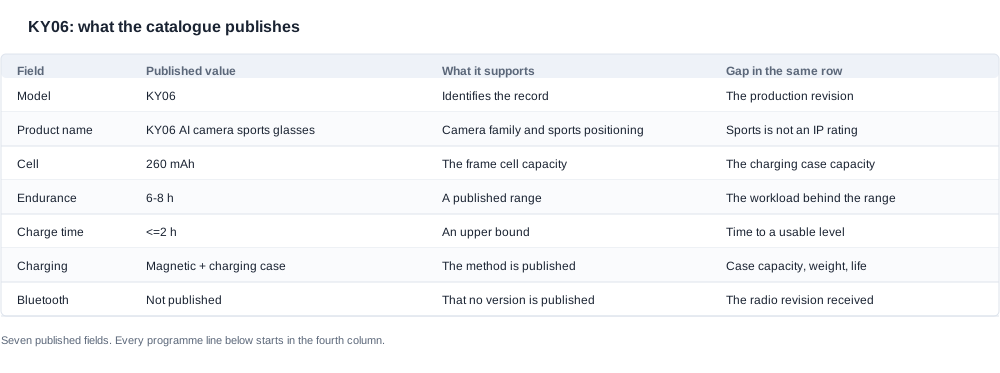
The published KY06 record is a single row, and it is worth reading field by field, because every published field does less work than a buyer usually asks of it.
| Catalogue field | Published KY06 value | What it supports | Gap in the same row |
|---|---|---|---|
| Model | KY06 | Identifies the record | The production revision behind the name |
| Product name | KY06 AI camera sports glasses | Camera family and sports positioning | Sports is a name, not an ingress rating |
| Cell | 260 mAh | The frame cell capacity | The charging case capacity |
| Endurance | 6–8 h | A published range | The workload behind the range |
| Charge time | ≤2 h | An upper bound | Typical time to a usable level |
| Charging | Magnetic + charging case | The charging method is published | Case capacity, weight and service life |
| Bluetooth | Not published | That no version is published | The radio revision you receive |
Two of those rows need a second reading before anything else can be built on them.
The charge figure is an upper bound. The catalogue writes two hours with a ceiling sign, not an equality. Two hours is the longest the published record permits, and real charge curves are not linear, so a frame that reaches a usable state earlier is entirely normal. The practical consequence is that a buyer must not turn ≤2 h into a planning promise in either direction. It is a defensible ceiling to write into a specification and an indefensible average to schedule a warehouse around. Ask what the figure describes — the frame, the case, or the full case-to-frame cycle — because the row publishes one number and does not break it down, and because the difference between those readings is a meaningful chunk of turnaround time in a distribution operation.
The endurance figure is a range. Six to eight hours is published as a band, and the catalogue attaches no test condition to it. The band is honest; what is missing is the workload that produced it. Whether the camera captured continuously, whether the radio stayed connected, whether a display was lit and how bright it was, the ambient temperature, the audio level — those are the variables that separate the bottom of the band from the top of it. A buyer should read the range as "measured under conditions we have not been told", and should treat the upper figure as a ceiling in the same way. The battery-life analysis for this model sets out the measurement discipline that turns a published range into a usable specification, and the specifications and features page shows how the rest of the published record is normally read.
The Bluetooth column deserves one paragraph of its own, because a blank is easy to misread in three different directions. The KY06 belongs to the camera series of the catalogue, and for this series the catalogue publishes no Bluetooth version at all. That is not the same as publishing that the product has no radio, and it is not the same as the version printed against a neighbouring audio row. The honest handling is to treat the field as unanswered and to request the revision that ships in the unit you are buying, together with the declaration that covers it.
The product name completes the published picture. KY06 AI camera sports glasses tells a buyer that the model belongs to the camera family and that it is positioned for active use. It does not tell a buyer that the model is rated for water, and the catalogue publishes no ingress rating for it at all.
Where a KY06 programme is exposed
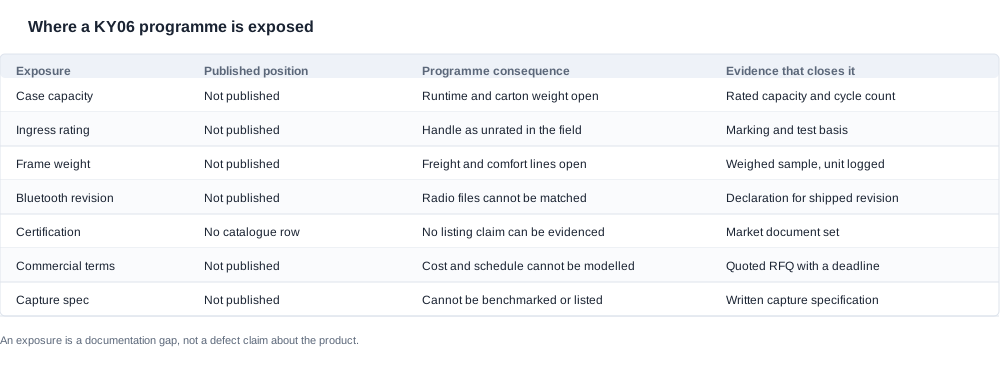
Seven exposures follow from the published row. Each one is a documentation gap that a programme carries until somebody closes it, and each one has a commercial consequence that is larger than the effort required to close it.
The charging case exists, but its capacity is not published
The charging method is published — magnetic, with a charging case — and the case capacity is not. Those are different statements, and conflating them is the most common error on this model. Two other camera frames in the catalogue publish their case capacities explicitly, which makes the absence here look like an oversight rather than a deliberate omission, but a buyer cannot transfer a neighbouring model's case capacity into a KY06 specification no matter how convenient that would be.
The exposure is not cosmetic. A camera frame that ships with a case is a two-part hardware proposition: the frame and the case. The case is the charger, the storage object and the travel protection for the frame, which means it adds a line to the packing list, mass to the carton, a spare-parts line to the after-sales policy, a second unit to the defect allowance and a second column in the landed cost calculation. When the case capacity is missing, all five of those lines carry an assumption instead of a figure, and the assumption propagates into the freight calculation, the retail price and the warehouse stock model. The charging case options analysis sets out how the case changes the configuration of a camera glasses programme and which case-related questions are worth asking before that configuration is fixed.
No ingress rating is published for this model
The catalogue publishes an ingress marking against two models — the V06 and the S7 — and only those two. The KY06 is not one of them, and a marking on another model is not evidence about this one. A second trap sits in the product name, where "sports" describes positioning rather than a protection class.
For a camera sports glasses model this is a live commercial question rather than a technical footnote. Outdoor and sports distribution carries sweat, rain and washing into the warranty conversation, and a model with no published rating has to be handled in your own documentation as a model with no rating. In practice that means no water-resistance claim in a listing, a returns and warranty process that anticipates moisture-related faults without asserting that the product resists moisture, and a clear answer to any channel partner who asks. If the route to market genuinely demands a marking, that is a factory development request with a cost and a schedule attached, not a catalogue lookup. The water resistance options analysis explains what the marking would and would not mean if it applied here.
Frame weight is not published
Not for the KY06. The one weight figure that appears anywhere in this catalogue belongs to a different model, so it cannot be carried across. This is the least defensible gap on the model, because a finished unit can be put on a scale in seconds, and a factory that has not published a number for an existing product has made a documentation decision rather than a manufacturing one.
Three commercial lines depend on it. Comfort perception is the input that drives returns and review scores in a consumer channel. Freight and packaging cost in a wholesale shipment are driven by the packed weight rather than the bare weight, so both numbers are needed. And the classification decision on the packing list depends on the gross carton weight, which is a third number. The shipping and weight analysis covers how that figure is normally carried into a quotation and a freight model, and the weight comparison across the sports range puts the missing number in context against the models that do publish one.
The radio revision is not published, and the radio documents follow it
No Bluetooth version is published for this model, which means no radio declaration and no test report reference can be quoted either, because both are written against a specific revision of the hardware and the software. A buyer who needs compliance documentation for a market with radio rules cannot select a document from a list, because there is no list for this model in the published record.
The risk here is unusually well-timed to hurt. A mismatch between the shipped revision and the document set does not fail in the factory; it fails at customs clearance or at the point of a market surveillance check, which is the most expensive place for it to fail and the hardest to fix inside a delivery schedule. The export documentation analysis covers how a technical file is assembled for a camera glasses programme and which documents have to be matched to the shipped revision rather than to the model name.
There is no certification line and no certificate number to copy
The catalogue body does not print the words CE, FCC, RoHS or RED against any model, and the export certification page is an image page rather than a per-model certification table. So for the KY06 there is no certification row, no certificate number, no test report number, no laboratory name and no report date that a buyer can quote in a listing, paste into a tender response, or hand to a market surveillance authority.
That is a materially different position from a model whose certificates exist but whose paperwork is incomplete, and it should be handled differently. The action for a specific programme is to request the document set that applies to the destination market, to confirm in writing which product revision those documents cover, and to file them against the purchase order rather than against a folder. The certification analysis for camera glasses sets out the difference between a model with published certification and a model with none, and the export documentation page covers the file assembly that has to happen either way.
No commercial terms are published
The catalogue publishes no unit price, no minimum order quantity, no lead time, no sample order cost or sample policy, no warranty period and no production capacity figure for this model. Every one of those must be requested, and each one changes the calculation that matters.
A landed cost model built on an assumed price and an assumed lead time is not a cost model; it is a guess with a currency symbol on it, and it will be used to justify a volume that the factory has never committed to. The same applies to the deposit structure, the payment terms and the incoterms, none of which appear anywhere in the record. A buyer who cannot state a warranty period in the order file will find that the returns provision in the channel contract has no matching factory obligation behind it, and a quality control dispute without a written defect definition has no anchor on either side of the transaction.
The capture specification is not published either
The name, the cell and the charge method are published, and no capture detail is: no still resolution, no video container, no frame rate, no field of view, no storage destination, and no statement about whether capture runs continuously or on a trigger. A camera glasses programme cannot be planned, benchmarked against a competing platform or written up for a retail listing without that detail, so it belongs in the same open-row list as the commercial terms rather than being treated as a later refinement. The camera imaging page covers the technical framing for those requirements.
Where a gap cannot be closed, another model may fit better
Some documentation gaps close with a document and a signature. Others close only by changing the hardware, and a programme that cannot tolerate a development request needs a different candidate. The use-case fit comparison against the CY05 and the comparison of the V06 platform are the two internal documents that answer the question of when a different model is the cheaper answer, and the choice between them is a question of which published rows matter to your route to market, not of which model has the longest specification table.
Closing each gap before the purchase order is placed
Closing a documentation gap is a procurement activity with a sequence, an owner and a paper trail. The sequence below is the one that works, and every step exists because skipping it produces a gap that reopens at the worst possible moment.
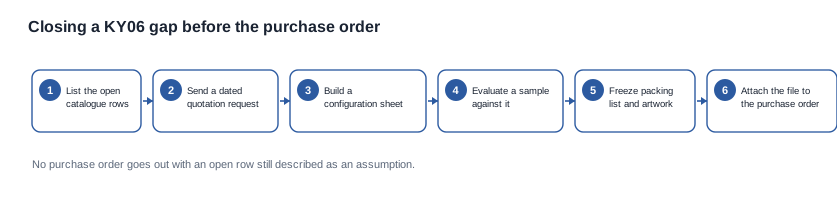
- Assemble the open-row list. Put every unpublished row for the KY06 into one document, with the published rows next to them so the reader can see the full picture of what is and is not known. Name the field, the unit, and the format you want the answer in. A list of fifteen questions sent one at a time produces fifteen partial replies; a single dated request produces a document.
- Send it as a quotation request with a response deadline. Attach the open-row list to a request for quotation and set a date by which you need the answers. The deadline matters because the answers are needed to build the cost model, not after it. The supplier should be asked to answer every line, including the lines where the answer is that a figure does not exist.
- Convert the replies into a configuration sheet. One page per programme revision: published value, confirmed value, source, date, and the name of the person who confirmed it. Version the sheet rather than editing it in place, because a change to the sheet after the purchase order is a change to the order.
- Evaluate the sample against the sheet. The sample is where a documentation answer becomes a measured one. Weigh the unit and record the identity of the unit you weighed. Charge it under your own duty cycle and time it. Cycle the case and count the frame charges it delivers. Capture with it and check the output against the capture specification the factory confirmed. The sample evaluation process sets out the stages, and the result of each stage is evidence attached to a specific unit.
- Freeze the packing list and the packaging artwork. With a frame and a case in the box, the packing list carries two hardware lines, and the carton has to carry both. Packaging artwork approval is a long-lead item, and it is the cheapest moment to discover that the case configuration has changed.
- Build the order file. The file should contain the configuration sheet, the technical file and the declarations that cover the shipped revision, the certificate set for the destination market, the packing list, the packaging artwork version, the quality control criteria, the defect definition, the warranty period, the quoted lead time, the payment terms, the deposit structure and the incoterms. A purchase order that does not carry this as an annex will be fulfilled against whatever the factory treats as the default.
- Set change control before the first shipment. Any change to the cell, the charging interface, the camera module, the case, the packaging or the artwork should require a written change request and re-approval of the affected annex lines. The purpose is not distrust. It is to keep the goods arriving matching the goods that were ordered, and to keep a factory audit from turning into a dispute about which version was in the carton.
- Carry the open rows into the comparison table. Even the rows you closed belong in the comparison, next to the models you rejected. That is what makes the selection defensible during due diligence: a reviewer can see that the alternative was considered, that the criteria were explicit, and that the decision followed the criteria rather than the other way round.
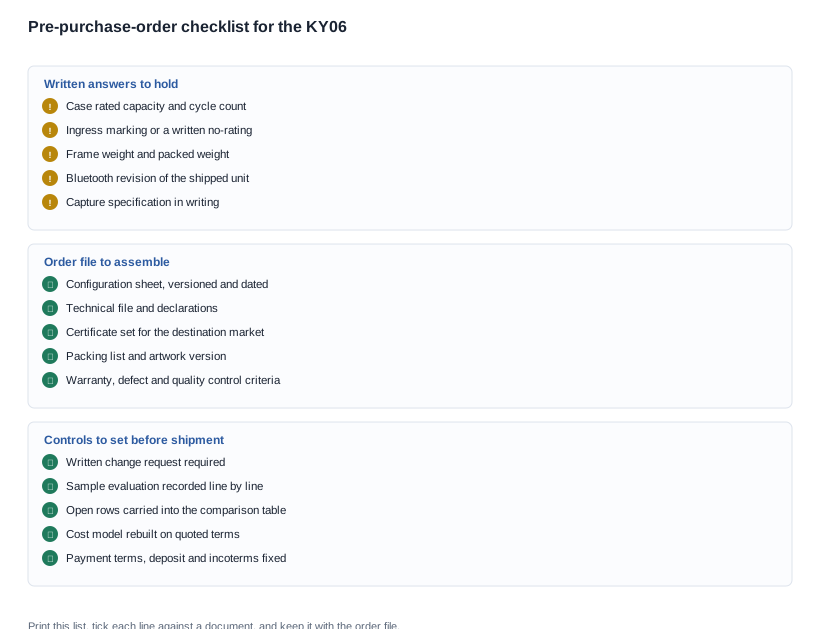
Three negotiation points deserve to be raised before the quotation rather than after the first delivery. On the sample order, agree in advance what it costs, what it is credited against, and what it does to the production lead time that follows, because those three answers decide whether your evaluation schedule and your delivery schedule can coexist. On the document set, agree the list and the delivery date in the same exchange as the commercial terms, since a compliance file that arrives after the first production run has almost no value to the business that ordered it. And on the bulk order, decide before you sign what the price tier is tied to and what happens to it if the quantity changes, because a price that is only valid at one volume is a negotiation you have not started yet.
A risk register is worth keeping alongside this work. For each open row, record the likelihood that it reopens, the commercial consequence if it does, and the trigger that would make you act on it. A row that is closed by a written answer with a date has a low probability of reopening. A row that is closed by an assumption has a high one, because nobody has yet confirmed it and nobody is currently watching it.

The limits of the published KY06 record
An unpublished row and a confirmed row are not the same instrument, and a buyer should always be able to tell which one they are holding. For the KY06 the published record offers a name, a 260 mAh cell, an endurance range of six to eight hours, a charge ceiling of two hours, magnetic charging with a charging case, and no Bluetooth version. The remaining rows in this article are open, and we do not present them as closed.
We will not fill a gap in the catalogue with an assumption, so a buyer who needs the charging-case capacity or the ingress rating should ask for both in writing before the sample is approved. We do not publish a charging-case capacity, an ingress rating, a frame weight, a capture specification, a certification reference, a unit price, a minimum order quantity, a lead time or a warranty period for this model, because we do not hold those figures in a form we can defend in a document or in an audit. Nor do we carry a value across from a neighbouring model, even when the neighbouring model is close enough to look like a fair proxy.
What we will do is specific and practical. Send the model, the destination market, the quantity band and the claims your listing needs to make, and we will go back to production and tell you which open rows can be closed for that programme with a document, which can only be closed by evaluating a sample, and which cannot be closed on the current hardware at all. Where the answer to the last category is that the hardware has to change, the model comparison pages are where that conversation starts, because the cheaper answer to an unclosable documentation gap is usually a different candidate model.
Related reading
- Published specification for this model — KY06 specifications and features
- Runtime and the endurance range — KY06 battery life
- Case configuration — AI camera glasses charging case options
- Certification position — AI camera glasses certification
- Export paperwork — OEM ready platforms and export documentation
- Ingress marking — Sport smart glasses water resistance options
- Weight and freight — AI camera glasses shipping weight
- Weight across the range — Sport smart glasses weight comparison
- Capture requirements — Camera imaging
- Model alternatives — KY06 versus CY05 use-case fit and V06 smart glasses compared
- Product family — AI camera glasses
Send the target market, the quantity band and the claims your listing needs to make, and we will come back with what is documented and what is not.


