
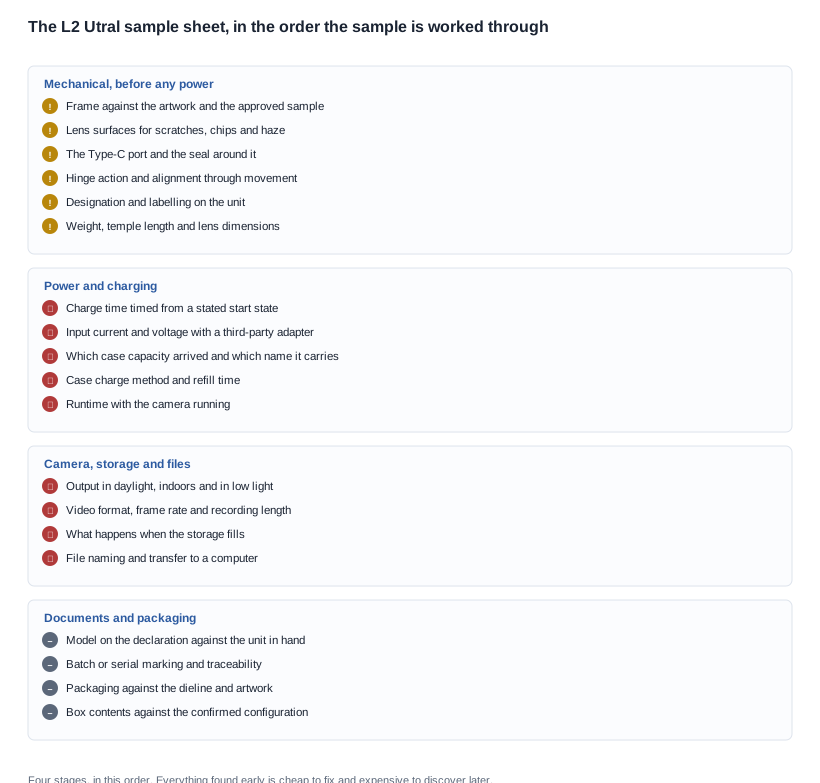
This checklist is for the moment the sample arrives, not for the moment the quotation is signed, and it is deliberately ordered the way a sample should be worked through: mechanical checks first, then power, then the camera, then the paperwork. The ordering is the most expensive part of the discipline. A designation mismatch found at the first stage is a message to the factory; the same mismatch found at the last stage is a rejected shipment.
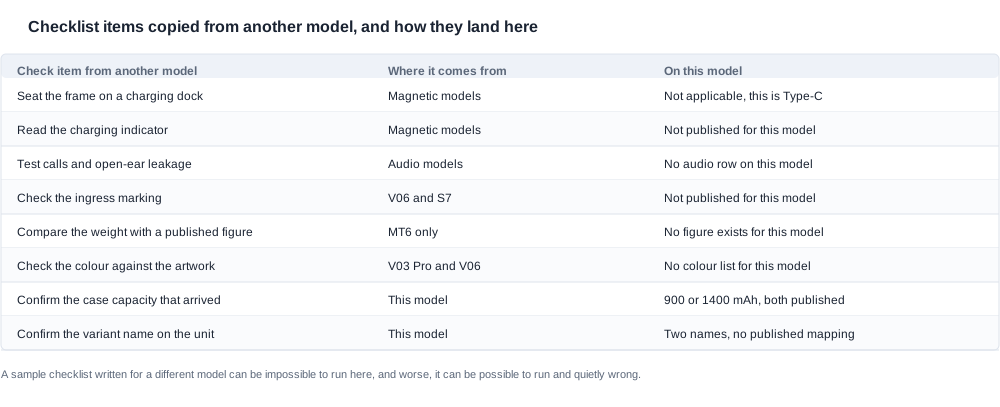
It is also model-specific, and that matters more than it sounds. A sample checklist written for a different model in this range can contain checks that are impossible to run on this one, and checks that will run and quietly produce the wrong answer. This model charges over a Type-C interface rather than a magnetic dock, so a check that says seat the frame on the dock cannot be performed. It is a camera platform with no audio row published, so a check that says test the calls is measuring a feature this catalogue does not describe. And the camera range publishes a colour list for two models, an ingress marking for two, and a weight for one, so a check that compares the unit against a published figure has nothing to compare it to here.
The published rows this sheet is built against are the eight the catalogue carries for this model: 13 MP, 290 mAh, a charge time of two hours or less, a rated endurance of about seven hours, a charging interface named as Type C, a case offered at 900 mAh or 1400 mAh, and two variant names printed as Utral and Pro Max. Everything the sheet asks for beyond those rows is a measurement or a document, not a fact.
L2 Utral smart glasses buyer review checklist: why the sheet has to be model-specific
The checks that will not run here
Three groups of checks have to be removed from a generic sheet before it is used on this model. The first is the magnetic-dock family. A frame that charges over a Type-C port has no dock to seat it on, so the checks that depend on a dock indicator responding, and on a contact that appears seated but is not, describe a fault mode this model does not have. The second is the audio family. The catalogue publishes no audio row for this model, so a check that times a call and measures open-ear leakage is measuring something the documentation never describes.
The third group is the comparison-with-a-published-figure family. This is the quiet one, because the check appears perfectly reasonable and returns a number. Across the camera range, exactly one model publishes a weight, two publish an ingress marking and two publish colours. A sheet that asks a reviewer to compare the unit against the published figure for weight, protection or colour therefore has nothing to compare against on this model, and a reviewer who cannot find the figure may substitute a figure from another model, which is exactly the kind of number that ends up in a listing.
The checks that do run, and what each one produces
The rest of a sheet survives the move, and each surviving check produces one of three kinds of output. A measurement produces a number the buyer owns: the weight with the cells fitted, the temple length, the charge time from a stated start state, the runtime with the camera running. A confirmation produces a fact that can be written into a document: which case capacity arrived, which of the two names is printed on the unit, which variant the packing list carries.
The third output is the one that decides the order. A comparison produces a finding that is either a rejection or a negotiation, and the criteria for telling those two apart have to be settled before the sample is opened, not while it is on the bench. The published rows for this model are set out in the specification list, and the sample evaluation page covers how the process is normally run.
Stage one — mechanical checks, before any power is applied
The frame, the lens and the markings
Six checks belong here, and every one of them is cheaper to make now than later. Compare the frame against the approved sample and the artwork: the profile, the lens shape, the surface finish, the branding or customisation marks and the position of each control. A cosmetic difference at this stage is a conversation; the same difference found after a production run is a stock-writing task.
Then the lens surfaces: scratches, chips, coating inconsistency and haze. On a camera product the lens is doing optical work, so a marked lens is a permanent defect in the captured image rather than a cosmetic one, and it is the defect a customer notices first in every photograph they take.
Then the port. This model charges over a Type-C interface, so the check is the connector, the insertion of a cable in it, and the seal around it. It is the one visible opening in the frame, and on a unit with no published ingress marking it is also the opening nobody can make a durability claim about.
Then the hinge and the alignment. Work the frame through its range of movement and watch the alignment of the two lenses while it moves. A frame that has been dropped can hold the optical carrier slightly out of square, and that changes what the camera captures without changing anything on the specification sheet.
Then the markings: the product designation, the batch or serial marking and the market labelling. This is the moment to get the designation confirmed in writing, and the moment to note something specific about this model. The catalogue prints two names on the page, Utral and Pro Max, beside the two case capacities, and it does not publish which capacity belongs to which name, or which of the two names is the base build. So the check is not "does the name read correctly" but "which of the two published names is on this unit, and does the packing list carry the same one".
Measure what the catalogue does not hold
Finally, measure and record: the weight of the frame with the cells fitted, the temple length, the lens dimensions, and the case weight on its own if a case is present. These are the numbers the documentation does not hold, and the moment they are written down they become the buyer's numbers, usable on a listing, in a freight calculation and in an acceptance note. The camera range publishes a weight once, on a different model with a different cell and a foldable case, so it cannot stand in here and must not be borrowed.
Stage two — power, the Type-C port and the case
Timing the charge from a stated start state
The published figure is a ceiling of two hours or less, and it comes with no start state and no end condition. So the check is not whether the unit charged within two hours; it is how long it took, from what start state, to what end condition. Record all three. A charge measured from an unknown start state is not comparable to the ceiling, and a charge measured without an end condition is not comparable to another sample.
The input current and voltage are not published either, so the second check is what happens with a third-party adapter rather than the supplied one. This is a question about the product rather than about the accessory, and it is the one a channel will be asked most often, because a customer who has a drawer full of cables will try them.
Which case arrived, and under which name
If a case is in the box, three things need confirming and only the first is published. Which capacity arrived, 900 mAh or 1400 mAh. Which of the two variant names is printed on it, if either is. And how the case itself is charged, by what interface, and how long it takes to refill, none of which is published for any camera model that has a case row.
The charge method of the case is the one that decides whether the customer needs two routines or one, and it is the number a customer will ask about before they ask about the frame. If the case turns out to be a storage cradle rather than a power source, the whole case decision changes shape, which is why the check comes before the decision rather than after it.
Runtime, and charge state reporting
Run the runtime test yourself, with the camera active, because the published seven hours carries no condition and the camera is the dominant load on a platform of this kind. Write down what you got and what you were doing while you got it, in the same sentence.
Then check the charge state reporting: whether a customer can see how much charge is left on the frame, and whether they can see it on the case. Neither is published, and both belong in the manual you ship, which means they are product decisions rather than observations, and the sample is where you find out whether you can make them.

Stage three — what the camera does, and what happens when the files fill
Judging the output rather than the resolution figure
The camera row reads 13 MP, and the sensor model, the field of view, the video format, the frame rate and the storage arrangement are not published for this model or for any other camera model in the range. That makes the sample the only place this can be judged, and it makes the judgement a comparison against the brief rather than against a number.
Record in daylight, indoors and in low light, and inspect the output rather than at the resolution figure. Two questions matter more than the rest for a camera product: whether the recorded material is usable for the use the channel has in mind, and whether the recording is continuous. Neither can be answered from the catalogue, and both can be answered in ten minutes with the unit in your hand.
The questions about files that nobody has published
Then the storage questions, which are where camera products generate support tickets. What happens when the storage fills: does recording stop, does it overwrite, or does it drop files. What format the files are in. How they are named, and how they are transferred. Whether a recording survives a restart. And how long a single recording can run before something stops it.
None of these are published for this model, and none of them are exotic. They are ordinary product behaviour that a camera platform has to have an answer for, and a brand that finds out after launch is a brand that finds out from a customer. The criteria for the review are simple: each question has one observable answer, and the answer goes into the manual.
What is not on this model at all
Two checks should be struck from the sheet rather than adapted. There is no audio row for this model, so there is nothing to compare a call test against, and adding one to a camera-platform sheet is an error of category rather than of judgement. And there is no published control method for any model in the catalogue, so the check on controls is not a check of a named control but of whatever the unit responds to when it is pressed, held and pressed twice, with the outcome written down.

Stage four — designation, documents and packaging
The documents that have to match the unit
Check the regulatory and traceability documentation against the unit in your hand. The model on the declaration should be the model on the unit, and the batch or serial marking should be traceable back to a production run. Certificate numbers, issuing bodies, validity periods and the schedule of covered models are not published for this model, so this is the stage where documents either arrive or the gap is recorded — which is a legitimate outcome, provided it is recorded rather than assumed.
The variant names make this stage sharper than it is for a single-name model. The catalogue publishes two names on one page and does not publish the correspondence between them, so a file that names one of the two, or that names a case capacity without naming a configuration, covers one configuration rather than both. The request is a document that names the model string and the case option together, for each configuration being ordered, because a file that covers one capacity and is silent on the other has to be reissued the first time a customer orders the other.
Packaging, contents and the configuration
Check the packaging against the approved dieline and artwork: print quality, colour accuracy, the insert tolerance, and whether the unit is protected in the position that was designed. Then check the box contents against the confirmed configuration, item by item. The contents list is not published for this model, which means the review is the first place it is actually known, and it has to be compared against the configuration the order was placed against rather than against a general expectation.
The record the review has to produce
A review that is not written down is a memory, and a memory does not survive a supplier question six months later. The output of the four stages is one document with four parts: the identification of the unit that was tested, the measurements with the state each was taken in, the findings with their classification, and the open items with an owner.
The identification part is where this model needs the most care. It needs the sample's own identifier, the date, the two names printed on the unit and on the case, and the case capacity that arrived, written out in full and character for character. A record that says "the L2 Utral with the large case" is worth very little, because "the large case" is the ambiguity the review was supposed to close.
The measurement part is worth as much as the effort put into it. A weight without the state is half a number; a charge time without the start state and the end condition is not a comparison against the published ceiling; a runtime without what was running is an anecdote. The criteria for the record are simple: every measurement carries the state it was taken in, in the same line, because the state is what makes the number usable by somebody who was not there.
The findings part needs the classification attached, not implied. A finding that is described as a defect and not classified invites a negotiation the reviewer did not intend, and a finding that is described as acceptable and not classified becomes a precedent for the next shipment. The final part is the one most reviews omit and the one that matters most operationally: the open items, with an owner and a date, because an open item without an owner is not tracked at all.
What stops the order, and what is only a negotiation
Five findings, one of which is a negotiation
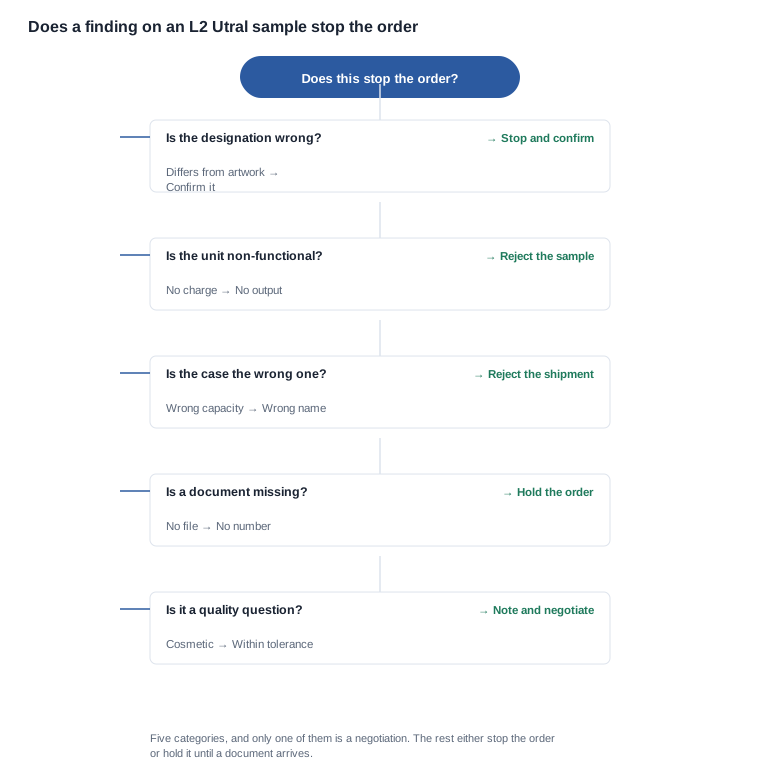
A sample review is only worth the time it takes if the reviewer knows in advance what would make them stop. There are five categories of finding, and they are not equal.
A designation that differs between the artwork, the packing list and the supplier's document stops the order, because every one of those three becomes a real document at a customs or a quality-claim moment and the disagreement will be about which string is correct. A unit that does not charge, or a camera that produces nothing, is a rejection of the sample itself. A case with the wrong capacity or the wrong name printed on it is a rejection of the shipment rather than of the sample, because it is a configuration error that will repeat on every unit in the run.
A missing document holds the order rather than stopping it, and the distinction matters: a hold can be released when the file arrives, a stop usually cannot. Everything else is a negotiation and most of it is a question rather than a defect — a cosmetic difference within an agreed tolerance, a runtime shorter than the rating but longer than the brief requires, a colour difference that the artwork does not cover.

Our position on this review
A sample review is only worth the time it takes if you know what would make you stop, and a sheet written for a different model is worse than no sheet at all, because it produces findings that read like facts. We will not tell you that a sample passed, and we will not tell you that a fault is acceptable. We will publish the rows that are published, and we will not present a number we have not measured as though it were one.
The compliance side of this model is set out in the certification status, the camera family is on the AI camera glasses range page, and the published rows behind every check above are in the specification list. If you tell us the target market, the volume and the required configuration, we will come back with what is available and what is not.
Related reading
- This model's published figures — L2 Utral specifications
- The compliance side of this model — L2 Utral certification status
- How the sample process is normally run — sample evaluation


