
The L2 Utral publishes more rows on its catalogue page than most camera models in this range: 13 megapixels, a 290 mAh cell, a charge time of two hours or less, a rated endurance of about seven hours, a charging interface named as Type C, a case offered at 900 mAh or 1400 mAh, and two variant names. Read carefully, that is eight rows, and three of them are not yet fully connected to each other: the two case capacities are not matched to a variant, the two variant names are not matched to a build, and the interface is named without saying where it sits. This article takes the published rows one at a time, states what each one can carry in a catalogue, on a listing and in a contract, and marks the five items this page does not publish.
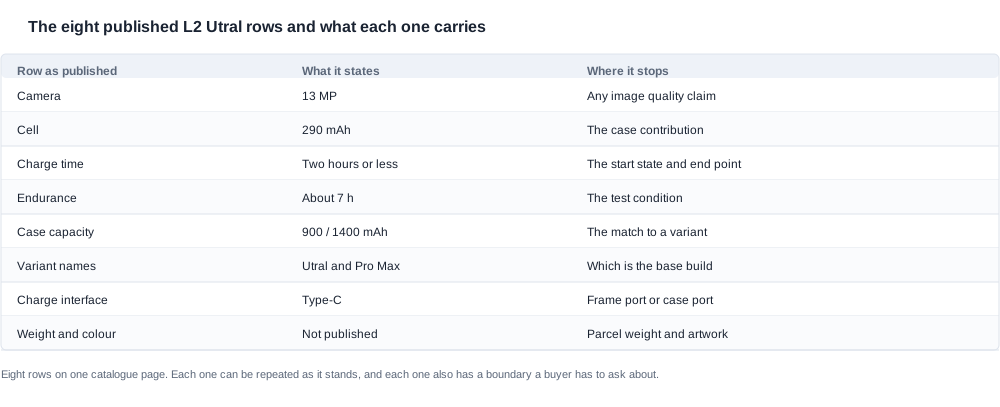
L2 Utral smart glasses specifications and features: the eight published rows
The camera row
The camera row reads 13 MP. Across the camera range that puts this model in the upper of two published pixel tiers: eight models are published at 8 MP and three at 13 MP, this one, the L1 Pro and the S7. What the number is not is an image quality statement. No sensor model, no field of view, no video format, no frame rate, no stabilisation behaviour and no storage arrangement are published for this model, so the resolution is an input to an imaging chain rather than a result from it, and it can be repeated on a listing without any of the adjectives that usually follow it. The camera and imaging page sets out why a pixel count cannot carry that second job.
The cell row
The cell row reads 290 mAh. Four camera models publish that figure, this one, the CY03 and the L1 Pro, and the CY05, and each of them also publishes the same endurance figure of about seven hours, which makes this a group of four rather than a set of coincidences. The row is a single capacity for the product, with no count and no position published, so nothing should be added to it about how many cells sit where. A buyer who needs the cell arrangement should ask for it as a document item, and a buyer who needs the shipping consequence should ask for the frame weight, which is not published for this model.
The charge-time row
The charge-time row reads two hours or less. That is a ceiling, and it is worth being precise about what a ceiling permits: two hours exactly is inside the published claim, while a claim of under two hours is not, because the two statements exclude different boundary values. Every model in the range publishes a charge time in the same way, so this is a catalogue-wide convention rather than a property of this product, but the distinction still matters the moment a buyer turns a published ceiling into a promise in a listing or an operational assumption in a shift plan. No start state of charge and no end condition are published, so the figure cannot be turned into a charging routine without more information.
The endurance row
The endurance row reads about seven hours. It is a rating, and a rating stands on conditions that the page does not list: the volume, the recording state of the camera, the temperature, the number of connected devices and whether the figure was produced with the case in use. Because the camera is the dominant load on a platform of this kind, the difference between a rating measured with the camera running and one measured with it idle decides whether a deployment works. For a buyer the row is usable as published and unusable as a duty-cycle figure, and how to evaluate the gap is covered in the limitations analysis for this model.
The case capacity row
The case row reads 900/1400mAh, two values inside one row. This is the only camera page in the range that publishes two case capacities, and it is also the only camera page that carries a variant-name line. What the page does not publish is the correspondence: which of the two capacities belongs to which of the two names, whether the two are alternatives within one variant, or whether one of them is the standard build and the other an addition. The row is therefore repeatable as two published values, and not repeatable as a single case for this model. The charging solutions page covers how a two-capacity choice changes the accessory arithmetic.
The two variant names and the interface row
Two names appear on the page alongside the model name: Utral and Pro Max. They are printed as two separate strings, and the page does not say which is the base build, which is derived from which, or whether they differ in more than the case. Below them sits the feature line, a Type C charging interface, which is more than several camera models publish, since four of them carry no charging-method row at all. The page does not say whether that interface sits on the frame, on the case or on both, and it does not say whether the case is a power source or a cradle.
What each published row can carry, and where it stops
The same row means different things in three documents
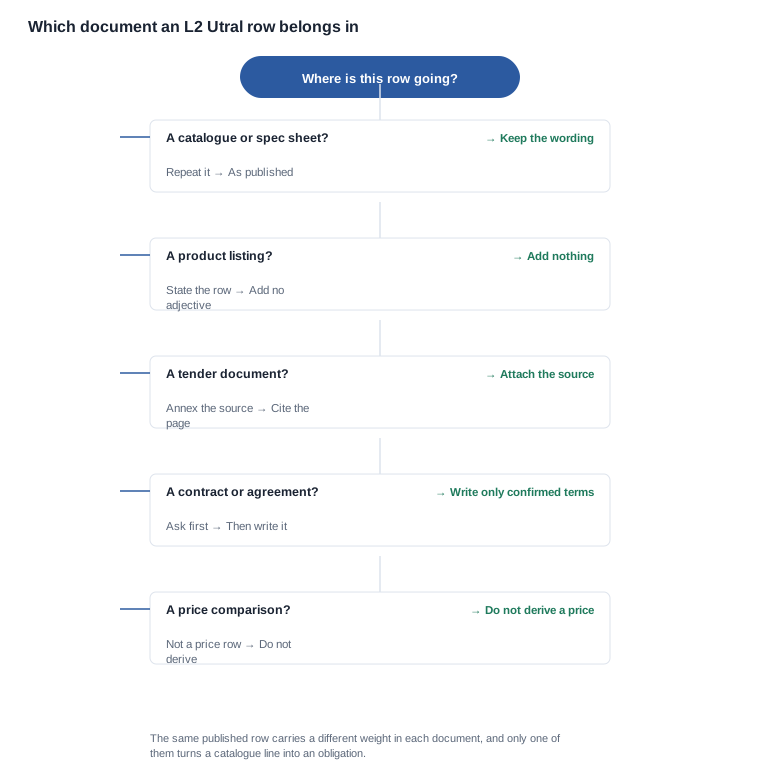
A published row is read three times over in a buying process, and each reading gives it a different weight. In a catalogue or a specification annex it is a description of the product and can be repeated as it stands. On a product listing it becomes a customer-facing claim, which means it can be repeated only as it stands and without an adjective that the page does not support. In a contract or a purchase order it becomes an obligation, which means it should not be written at all until the fact behind it has been confirmed in writing by the supplier.
That third reading is where specifications go wrong. A row copied from a catalogue into an agreement is not a neutral transfer; it converts a descriptive statement into something the buyer can reject goods against, and the buyer has usually done that copy without anyone asking whether the underlying number is complete enough to carry that weight. A 13 MP camera row in an agreement is defensible. A seven-hour endurance row is defensible only as a rating, because the condition behind it is not published, and a case capacity row is defensible only with the variant written next to it.
The criteria for repeating a row
A buyer building a specification from this page should apply three tests to each row before it is written down. The first is whether the row is on the page at all, because a page that is short of a row is short of a fact rather than silent about one. The second is whether the wording preserves the published precision, so a ceiling stays a ceiling and a value stays a value without a count invented for it. The third is whether the row is being moved into a document that turns it into a promise, and if so, whether the supporting evidence exists in the same file.
Applied to this model, the three tests produce a clear split. The camera row, the cell row, the charge-time row and the endurance row can go into a specification annex unchanged. The case capacity row and the two variant names can go into a specification annex as published values but cannot enter a quotation or a purchase order until the correspondence is answered. The interface row can go into a specification annex and can support an accessory question, but it cannot support a box-contents claim until the location of the port is known. What to ask for each is set out in the document list for this model, and the buyer review checklist turns the same split into a sample-stage review sheet.
The three wording rules that keep these rows accurate
Ceilings, values and counts
The first rule concerns the charge time. Two hours or less is the published form, and it is the form that has to survive into any downstream document, because a tightened version of a ceiling becomes a supply commitment that nobody agreed to. The second rule concerns the cell row, which publishes a capacity and nothing else: no count and no position. A cell figure that is split across two positions in a downstream document describes a product the page does not describe, and the difference matters to anyone calculating a charging budget.
The third rule concerns the two capacities in the case row. Publishing two values is not the same as publishing a matched pair, and a document that shows 1400 mAh as the case for this model, without the variant attached, has resolved a question the page leaves open. The same rule applies to the two names: they are two designations printed on one page, and stating that the model is also known as a second name states an equivalence the page does not make. A buyer who needs the equivalence should ask for it and record the answer, which is a different act from inferring it.
A resolution is not an image quality statement
The second set of rules concerns what may be added to a row. The camera row is the most frequently extended row in the range, because a pixel count reads like an incomplete sentence and invites a finishing clause. It is not incomplete; it is a resolution, and the page publishes nothing that supports a clause about picture quality, first-person capture or low-light behaviour. The AI camera glasses range page is the right place to compare the tier structure, and the correct comparison between the two published tiers is a statement of which models sit in which tier, not a statement of which one produces a better picture.
The same applies in the other direction. A buyer who wants to know whether the difference between this model and the L1 Pro is an imaging difference can answer it from the published rows: both publish 13 MP, 290 mAh and about seven hours, so the published difference is the interface line and the case capacities, and nothing in the imaging rows. That is a narrower statement than a preference, and it is the one the evidence supports.
Checks to run before a row is reused
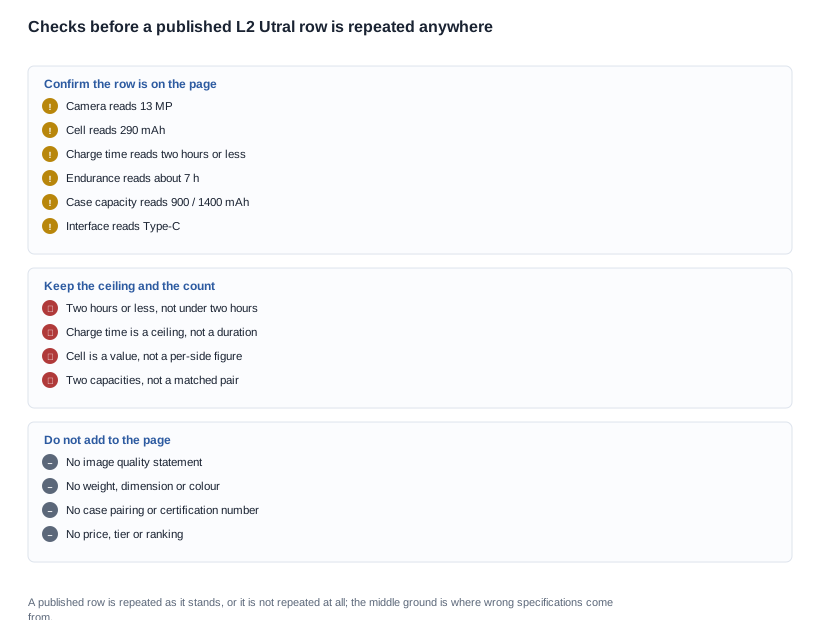
Running the checks as a list rather than as a habit is what keeps a short page from being over-read. Confirm the row exists on the page, preserve the ceiling and the value, and add nothing that is not there. The last of those three is the one that fails most often, and it fails quietly: a specification that is correct in every number and wrong in one adjective is harder to catch than a specification with a missing row, because a missing row announces itself and an added adjective does not.

The camera group that shares this cell and this endurance figure
Four models, two pixels, one interface row
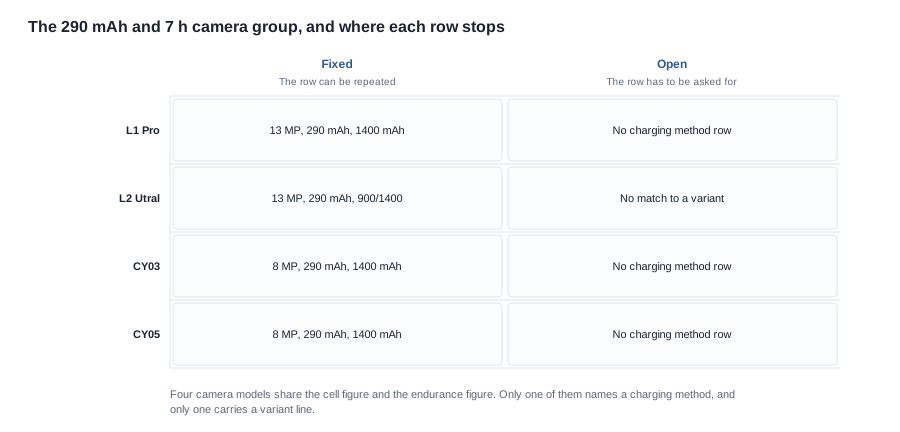
Four camera models publish 290 mAh and about seven hours. This one and the L1 Pro publish 13 MP, and the CY03 and the CY05 publish 8 MP. All four publish a single case capacity except this one, which publishes two, and three of the four publish no charging-method row at all, whereas this one names a Type C interface. That is the entire published difference between the group, and it is worth stating in that form because it is the form the evidence supports.
The group is also the reason a row-level answer can mislead. A buyer comparing this model against the L1 Pro sees an identical cell row, an identical charge-time row and an identical endurance row, and may read that as an identical product with a different name. What differs is the interface row and the case row, and those two differences are commercial rather than technical: they change what has to travel in the box, what has to be stocked as an accessory, and what the carton weighs. A buyer who evaluates this model should therefore evaluate the accessory and packaging consequences rather than the electrical rows, because the electrical rows are shared with three neighbours.
Why the shared rows are not a problem
Three models publishing the same numbers is not a defect in the catalogue, and it is not a reason to avoid the group. It is a reason to understand which rows are shared and which are not, because a comparison built on shared rows produces no information and a comparison built on the two rows that differ produces the entire commercial case. A buyer who wants to know which one to shortlist should start from the case configuration and the interface, and should treat the shared electrical rows as a fixed point that all four candidates sit on.
The same logic applies one level up, across the whole range. The camera range publishes two pixel tiers, a handful of cell figures, a consistent charge-time ceiling and a split on charging method. A shortlist written from those four dimensions is defensible; a shortlist written from adjectives is not. How to build that shortlist and what to ask before you commit is covered in the best-for analysis for this model.
What the shared rows mean at the sample stage
Because the electrical rows are identical across the group, a sample comparison has to be designed around the rows that differ, or it will produce the same result four times. That is a practical instruction rather than a theoretical one, and it changes what a buyer asks a supplier to send. A comparison that re-measures the cell or the charge time on four models tests the same four numbers again; a comparison that measures what is not published — the frame weight with the cells fitted, the case weight on its own, the time from a stated start state to a stated end condition — produces four different sets of numbers and is the only kind that narrows a shortlist.
The same design rule applies to the paperwork that arrives with a sample. When four candidate models arrive with four sets of documents, the useful comparison is not which set is longest but which set answers the rows the catalogue left open, because the shared rows will be identical in all four. How to evaluate what arrives against what was asked is covered in the comparison method for this model, and the buyer review checklist sets out the sheet it should be checked against.

The rows this page does not publish
Weight, dimensions and colour
No weight, no dimension and no colour list is published for this model. The only weight figure in the whole catalogue belongs to the MT6, on a different model with a different cell and a different case, so it cannot be used as a proxy here, and a listing that needs a shipping weight has to wait for a weighed sample. Colours are published elsewhere in the range, three for the V03 Pro and four for the V06, which makes the absence on this page a gap rather than a deliberate omission. A colour list is not a preference question: it is the number of packaging SKUs, the artwork set and the stock position a brand is committing to, and it should be answered before the artwork is drawn rather than after.
Ingress and the protection question
No ingress marking is published for this model, and only two camera models in the range carry one at all, the V06 and the S7, both at IP54. The absence means there is no durability or protection statement to make, and a buyer whose deployment involves dust, rain or handling has to obtain the answer as a document item or design the channel around the uncertainty. The criteria for that question are simple: whether the model is built to a sealed standard, what the standard is, and whether the marking applies to the variant and the case as supplied.
Certification, stated correctly
The catalogue carries an export certification page at company level whose content is presented as images, and it carries no per-model certification row. That distinction has to be stated carefully, because the page is easy to misread as a claim that applies to every model. It is not a per-model statement, and it is not a list of certificate numbers, and no document in the catalogue names this model, its variant names or its case. The certification checklist sets out the route a buyer has to build, and the certification status work for the camera range covers the per-model file in detail.
The practical criteria for a buyer are the same as for any model: which conformity regime the product is built for, which certificate numbers will appear on the declaration, who signs it, which test reports sit behind it, and whether the test reports name the variant that will actually be shipped. The last of those is the one that matters most for this model, because the two case capacities and the two variant names give a supplier more than one way to describe the same object, and a certificate that names a different string from the carton creates a problem at the border rather than in the office.
The publication position of the L2 Utral specification
This is a well-documented model whose documentation still does not support a product page written from the catalogue alone. We will publish the 13 MP as a resolution and not as an image quality claim, we will publish the 290 mAh as a cell figure, we will publish the charge time as a ceiling of two hours or less, we will publish the endurance as a rating of about seven hours, and we will publish the case capacity as two values without matching them to a variant. We will not quote a weight, a dimension, a colour, an ingress marking, a certificate number or a sensor model that the source does not contain, and we will not turn a published row into a promise in a document before the fact behind it has been confirmed in writing.
For a buyer, the practical conclusion is that the electrical rows of this model are settled and can be written today, and that the configuration rows are not. Send us the target market, the quantity and the configuration in mind, and we will tell you which rows can be repeated as they stand, which need a measured sample, and which have to wait for a written reply.
Related reading
- Where this model sits in the camera range — AI camera glasses
- How case capacity changes your economics — charging solutions
- Why resolution is not image quality — AI camera glasses imaging


