
The questions buyers ask about the L2 Utral are ordinary ones — how many megapixels, how big the cell is, how long it runs, whether it records video, whether it comes with a case — and the catalogue answers most of them directly. What makes these questions harder than they look is that the camera range does not answer them the same way twice. Across the eleven camera models the pixel row and the endurance row are complete, while the case row, the charging-method row, the colour row, the ingress row and the weight row are each published for a different subset of models. So the honest answer to most questions about this model is a two-part one: here is what the page for this model publishes, and here is how far that answer travels inside the range.
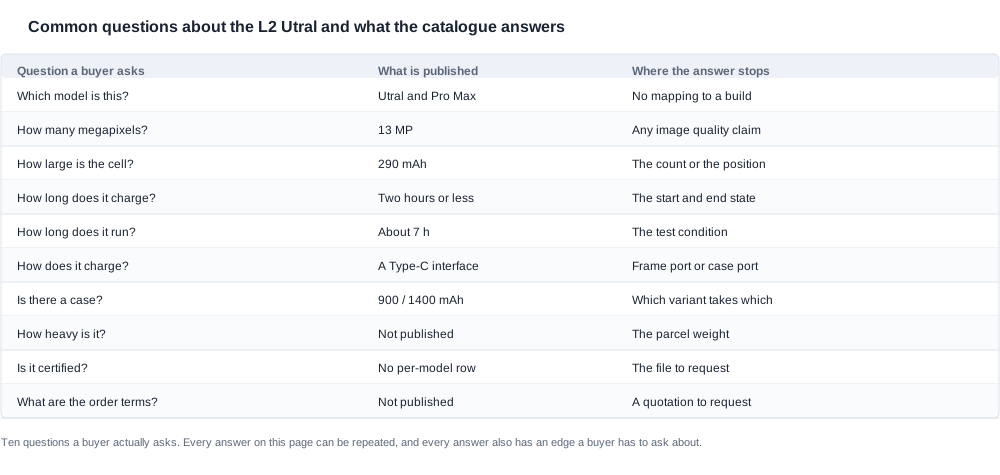
For this model the catalogue publishes eight rows: 13 MP, 290 mAh, a charge time of two hours or less, a rated endurance of about seven hours, a charging interface named as Type C, a case offered at 900 mAh or 1400 mAh, and two variant names. The rows it does not publish are the sensor model, the field of view, the video format and frame rate, the Bluetooth version, the frame weight, the ingress marking and the test condition behind the endurance figure.
L2 Utral smart glasses common questions: the answer depends on the model
The first question is which model the reply is about
A buyer who writes "the 13 MP model with a 290 mAh cell and about seven hours" has, on the published rows, narrowed the range down to two candidates rather than one, because this model and the L1 Pro publish identical figures for all three of those rows. Add the case capacity and the charging interface and the narrowing is complete, but only if those two rows are present in the document being answered.
That is the general condition for any camera-model question, and it is worth stating before the individual questions because it changes how a request has to be written. A question addressed to "the camera glasses" is answered with a range summary; a question addressed to a model designation, a variant name and a configuration is answered with a fact that can be written into a specification. The camera and imaging page covers how the published pixel row has to be read once the model is fixed.
There is a second reason to fix the model before asking. The catalogue uses several different labels for the same kind of row, and one of those labels changes meaning between pages. On this model the endurance row is labelled 续航 and reads about seven hours. On three other camera pages the same kind of figure sits under a label that reads 充电时长, on a page that also carries a separate 充电时间 row for the charging duration. The same word therefore carries two different meanings inside the camera range, and a buyer who copies a row across models can copy the wrong figure without noticing.
What that means for how a question is written
How to evaluate a reply starts with checking what it was actually answering. A reply that says "two hours or less" may be quoting the charge-time row of one model and the endurance row of another. A reply that says "five to eight hours" may be quoting a rating that was produced with the camera idle. The criteria are simple and cheap to apply: ask which model the reply is about, ask which row the figure came from, and ask what the figure was measured under.
The same three questions apply to any model in this range, and they are the reason a catalogue can be complete on paper and still leave a buyer unable to write a specification. What to ask, in the order that avoids wasted effort, is set out later in this article, and the smart glasses battery life page sets out why a rating without a condition is a rating rather than a duration.
The questions the camera range answers differently
Does it come with a case, and of what size
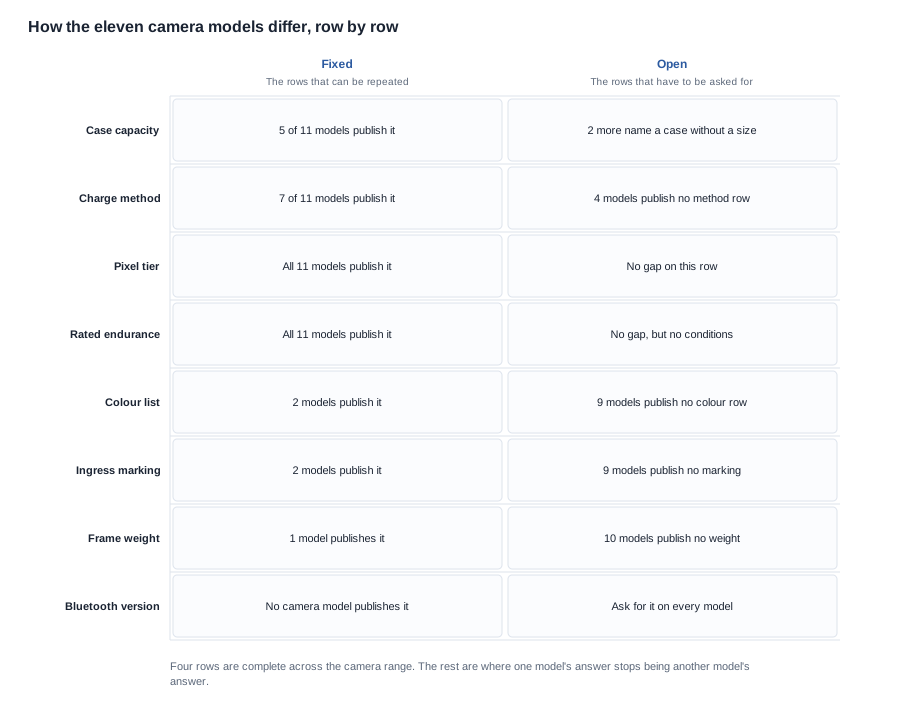
This is the question where the range divides most sharply, and where a generic answer is most likely to be wrong. Five of the eleven camera models publish a case capacity: three at 1400 mAh, one at 1200 mAh for a foldable case, and this one at 900 or 1400 mAh. Two more name a charging case without publishing its size, and four publish no case row at all. This model is the only one in the range that publishes two capacities in a single row, and also the only one that carries a variant-name line.
For this model the case question has a second half that the page does not answer: the catalogue prints the two names Utral and Pro Max beside the two capacities, and it does not say which capacity belongs to which name, or whether the two are alternatives within one variant. That is the one question on this page where the answer cannot be assembled from what is written, and it is the question to ask first, because the case determines the carton, the freight class and what the customer receives.
How does it charge, and is the method published
Seven of the eleven camera models publish a charging method: five on magnetic charging and two on a Type-C interface, this model and the V03 Pro. The remaining four publish no charging-method row at all, which means the method for those models is a document item rather than a catalogue item, and a specification that assumes magnetic charging for every camera model will be wrong for four of them.
For this model the interface is published but its location is not. The page names a Type C charging interface and does not say whether it sits on the frame, on the case or on both, nor whether the case is a power source or a cradle. That single missing fact decides whether a cable has to travel in the box, and it decides it in a way a buyer can act on: ask where the port is, and ask what a customer needs in the box to charge the product.
How long does it run, and how long does it take to charge
Both rows are published for every camera model, and both rows need their conditions attached before they can be used. The endurance figures across the range run to about five to eight hours on four models, six to eight hours on two, and about seven hours on five, this one included. The charge time is two hours or less on all eleven, which is a ceiling rather than a duration and permits exactly two hours.
The criterion that separates a usable figure from an unusable one is simple: a rating without a stated condition is a rating, not a duration, and it cannot be turned into a duty cycle or a charging routine. What to ask is whether the camera was running during the measurement, what the volume and temperature were, how many devices were connected, and what state the cell started the charge from. A supplier that cannot answer those has not measured, and the honest answer is better than a confident number that nobody can reproduce.
What is the camera, and does it record video
The camera row for this model reads 13 MP, which places it in the upper of the two published tiers, alongside the L1 Pro and the S7. The other eight camera models publish 8 MP. That is the whole of the imaging information for every model in the range: no sensor model, no field of view, no video format, no frame rate and no storage arrangement are published for any of them.
So the question of whether it records video has no catalogue answer at all, for this model or for any other. That matters more than the resolution question, because a camera platform that captures stills and one that records continuous video are different products with different storage, different thermal behaviour and different expectations from the person using them. The right way to ask is to put video into the quotation as a line item with the format and the frame rate named, rather than to infer it from a megapixel figure.
Is it durable, what colours does it come in, and how heavy is it
Three short rows, three different answers across the range. Only two camera models publish an ingress marking, the V06 and the S7, both at IP54, so for this model there is no protection statement to make at all; the IP ratings and durability page explains what such a marking would and would not settle. Only two models publish colours, the V03 Pro with three and the V06 with four, so this model publishes none and a brand with a merchandising plan has to ask for the list. And exactly one model in the whole catalogue publishes a weight, the MT6 at 158 grams on a different cell with a foldable case, so it cannot stand in as a proxy here.
The common thread across those three rows is that a buyer planning a listing, a carton or a channel has to obtain them, and each of them is a cost or a commitment rather than a preference. The colour list multiplies the packaging SKUs and the artwork set. The ingress marking decides whether the product can be described as protected. The weight decides the freight class and the shipping figure on the listing.
The questions every camera model leaves open
The rows that are empty across the whole range
Four rows are empty for every camera model, and a buyer who knows that can stop asking for them from a catalogue and start asking for them from a supplier. The Bluetooth version is not published for any of the eleven camera models, so a specification that needs it has to obtain it, and a listing that omits it is making no false claim. The sensor model, the field of view, the video format and the frame rate are not published for any of them either. The frame weight is published once in the range, on a different model with a different cell. And the case weight, the case charge time and the case interface are not published for any model that has a case row.
That last group is worth stating precisely, because a case is usually treated as an accessory while it is in fact one of the three heaviest and most expensive objects in the parcel. A camera model with a case is a two-object product with a power question attached to it, and the case row publishes a capacity and nothing else.
Certification, stated correctly
The catalogue carries an export certification page at company level whose content is presented as images, and it carries no per-model certification row. That page is easy to misread as a per-model claim, and it is not one: it is not a list of certificate numbers, it does not name this model or its variants or its case, and no document in the catalogue names any of them. The AI camera glasses range page sets out the range structure, and the per-model file has to be assembled for the market the product is going into.
The criteria for that file are the same as for any model in the range: the conformity regime, the certificate numbers, the signatory, the test reports behind them, and whether the reports name the configuration that will actually be shipped. The last one is the item that catches people out on this model specifically, because two case capacities and two variant names give a supplier more than one way to describe the same object, and a certificate naming a different string from the carton creates a problem at the border rather than in the office.
What the Bluetooth gap means in practice
The absence of a published Bluetooth version is a documentation gap rather than a defect, and it is the same gap for all eleven camera models. Its practical weight comes from what a buyer does with it: a specification that names a radio version is a specification that can be checked against a device list later, and one that says "Bluetooth" cannot. The question to ask is the radio version, the profile set and the qualification route, and the answer belongs in the specification annex with a source next to it.
It is worth knowing where this model sits in that respect, because the gap is not uniform across the catalogue. The audio models publish their radio version: two of them at V5.3 and six at V5.4, with the version written on the page next to the cell and the charging rows. The camera models publish none of it. So a buyer who has already worked through an audio-model specification knows the shape of the question and the kind of answer that is usable, and the camera range simply has one row fewer to give. What to ask for is the radio version, the profile set and the qualification route; what not to do is carry a figure across from an audio model, because a camera platform and an audio platform are different products even when both sit in the same catalogue.
Three ways a buyer can group the camera models
Because the rows are published unevenly, the most useful way to work with the camera range is to group it rather than to read it model by model. Three groupings carry most of the decision, and each of them can be built from published rows alone.
The first is the pixel tier: eight models at 8 MP and three at 13 MP. The second is the charging method: five on magnetic charging, two on a Type-C interface, and four that publish no method row at all. The third is the case: five models with a published capacity, two that name a case without publishing a size, and four with no case row. A shortlist built across those three axes is defensible and can be written into a document, and a model that falls into the "no method row" group should be treated as a model with a known documentation task attached to it rather than as a model with an unknown feature.
The value of this method is that it turns a question about one model into a question about its group. When a buyer asks whether the charging method published for this model applies to the L1 Pro, the honest answer is that it does not, because the L1 Pro publishes no method row and this one does. That is a shortlist decision, and it can be made before any sample arrives.
How to ask so the answer is usable
The three moves that make a reply usable
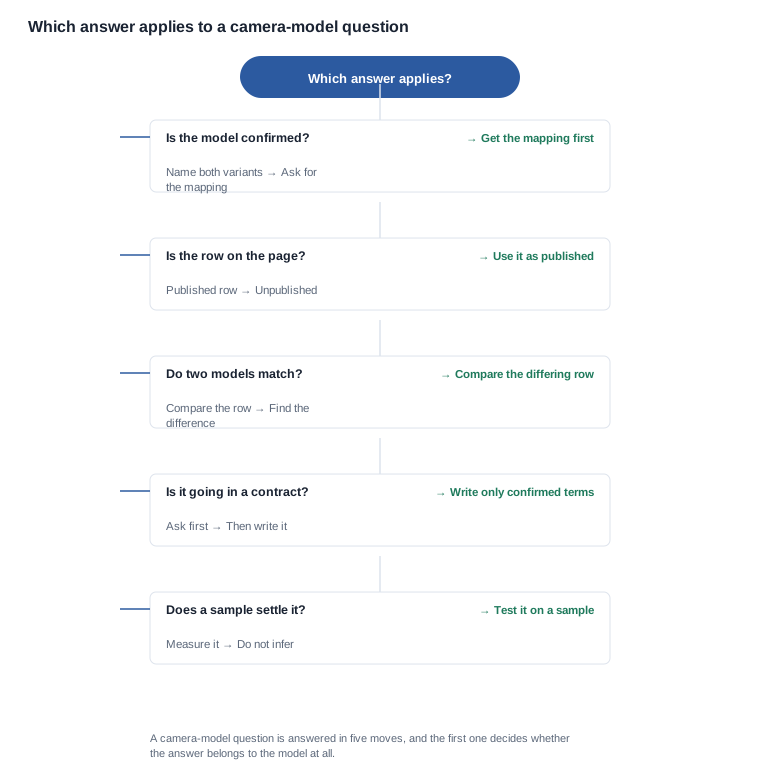
A reply becomes usable in three moves, and each of them can be asked for in a single sentence. First, fix the subject: name the model, name the variant, name the configuration and name the market. A reply that does not state its subject has to be treated as a range summary and cannot be copied into a document.
Second, fix the source: ask which row the figure came from, and ask what it was measured under. A figure with a row behind it can be repeated; a figure with a method behind it can be planned around; a figure with neither can only be used as a conversation.
Third, fix the destination: say where the answer is going. An answer for a catalogue can be published as it stands, an answer for a listing can be published only if the wording adds nothing, and an answer for a contract has to be confirmed in writing by a named person before it is written down at all. How to evaluate a reply against those three tests is set out in the buyer review checklist.
What to do with the answers that arrive
Record each answer with its source and its date, and keep the open items in a list with an owner rather than allowing a partly answered question to disappear into a summary. Then check the answers against each other, because the range is built in groups and the groups disagree: four camera models publish 290 mAh with about seven hours, three of those four publish no charging method, and two of them publish 13 MP rather than 8 MP. A reply that contradicts another reply usually means one of them was written about a different model.
The remaining step is the one that no document replaces. Measure what the catalogue leaves open — the frame weight with the cells fitted, the case on its own, a charge timed from a stated start state, a runtime with the camera running, and the location of the port on both parts — and record the measurement with the sample it came from. How to run that sample stage and what to write down is covered in the limitations analysis for this model, which sets out the same rows as a document request rather than as a test sheet.
The L2 Utral answers in one place
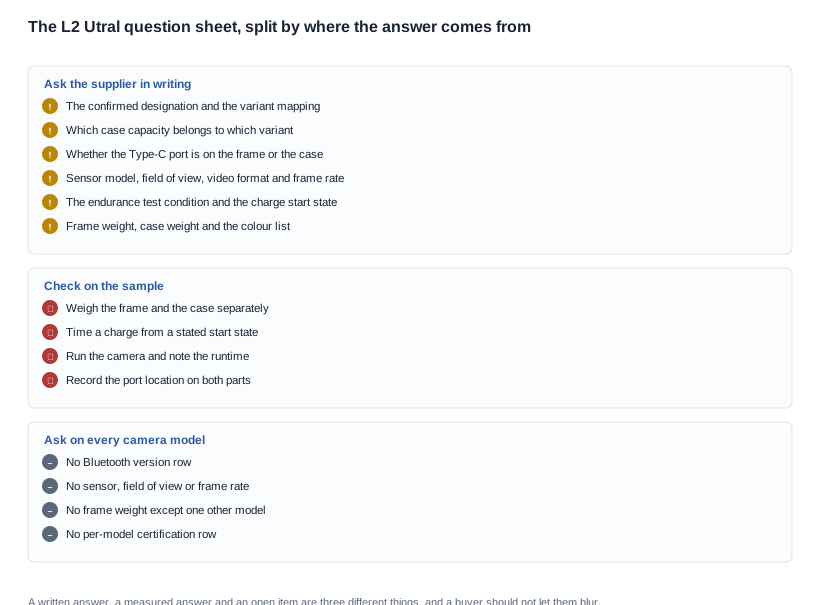
This model is well documented on the rows it covers and silent on the rows that would cost a buyer money if they were assumed rather than obtained. We will publish the 13 MP as a resolution and not as an image quality claim, we will publish the 290 mAh as a cell figure, we will publish the charge time as a ceiling of two hours or less, we will publish the endurance as a rating of about seven hours, and we will publish the two case capacities and the two variant names without matching them to each other. We will not fill the empty rows with values that are typical elsewhere in the range, because a buyer who knows which rows are empty can act on that, and a buyer who does not will meet them in the returns queue.
Send us the target market, the quantity and the configuration in mind, and we will come back with what is published, what is not, and which of the two needs a sample.
Related reading
- Where the L2 Utral sits against the L1 Pro — AI camera glasses
- Reading a rated runtime figure — smart glasses battery life
- What an IP marking does and does not mean — IP ratings and durability


