

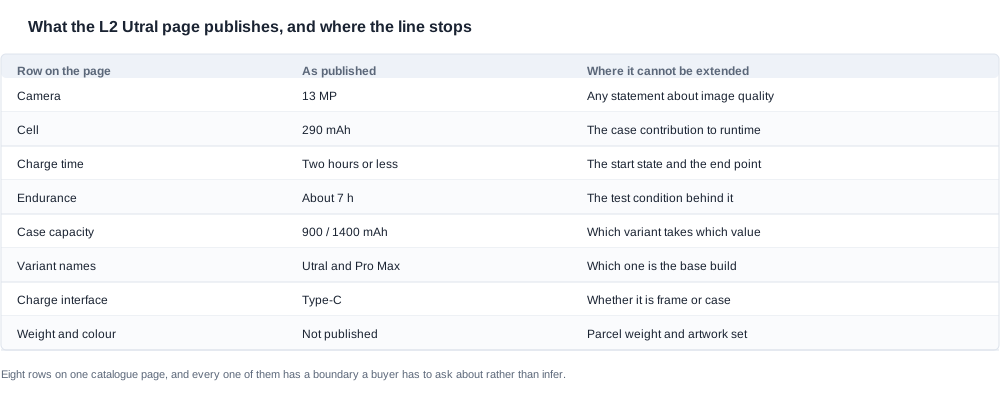
The L2 Utral publishes more rows than most models in the camera range: 13 megapixels, a 290 mAh cell, a charge time of two hours or less, roughly seven hours of endurance, a charging interface named as Type C, a case offered at 900 mAh or 1400 mAh, and two variant names. That is an unusually complete hardware page. It is also a page where three of those rows do not quite close — the two case capacities are not attached to a variant, the two variant names are not attached to a build, and the interface is named without saying where it sits. Those three gaps are the ones that stop a buyer before an order, and they are what this article sets out, together with what the published rows can and cannot carry.
L2 Utral smart glasses limitations: the variant and case gap
Two names, two capacities, and no mapping between them
The catalogue page carries the model name, and then two further names: Utral and Pro Max. The same page gives the case capacity as two values, 900 mAh and 1400 mAh. What the page does not do is say which capacity belongs to which name, or which of the two names is the base build that the other one is derived from. A buyer reading the page can state that two capacities and two names exist. A buyer cannot state the configuration they are ordering.
This matters more here than in most catalogue gaps, because the two capacities are not a cosmetic difference. A 900 mAh case and a 1400 mAh case are different objects with different weights, different dimensions, different freight classes and different shelf prices, and the choice changes what the customer receives in the box. A configuration left ambiguous at the quotation stage becomes a packing problem, a artwork problem and a customer-expectation problem at the delivery stage, and all three are more expensive to fix after a shipment than before one.
How to evaluate this is a short question with a long answer. Ask for the correspondence in writing — which variant name is supplied with which case capacity, and whether the two capacities are alternatives within one variant or a fixed correspondence between the two. Then ask what else separates the builds, because the two names may differ in more than the case. Until that reply exists, the correct statement in a specification is the two published values and the two published names, with the correspondence left open, and any document that shows a single capacity as the model's case without naming the variant it belongs to should be sent back for correction.
The naming question underneath it
The model designation itself has to be identical across the supplier's specification sheet, the product listing, the packaging artwork, the certificate application and the customs paperwork. Where it is not, the friction appears at customs clearance and again on every quality claim, and it is far cheaper to resolve in a message than in a shipment. The variant names add a second layer to the same problem: a case, a carton and a label all have to carry the right one of the two names, and a mis-labelled carton is a stock-writing task rather than a shipping problem.
There is a practical way to close this in a single message. Ask for the designation as it must appear on each of three documents — the specification sheet, the packaging artwork and the declaration of conformity — and require that the reply lists them as written. If the supplier uses an internal code, ask for that code as well and record it beside the commercial name, because a code that only exists inside one system is where the next mix-up comes from. A model designation that is agreed once, in one reply, and then copied everywhere is the cheapest item on this list.
Where this model sits among the camera models
For context on what the camera range publishes and what it does not, the pixel row splits into eight 8-megapixel models and three 13-megapixel models, of which this is one. The case row is published for only five of the eleven camera models: three at 1400 mAh, one at 1200 mAh for a foldable case, one at 900 or 1400 mAh, and one whose case is mentioned but whose capacity is not published. That last case is worth noting, because it shows the catalogue publishing a case without publishing its size — which is precisely the kind of partial row a buyer should be alert to in any model, not only in this one.

The camera rows that are published, and the imaging row that is not
Thirteen megapixels is a resolution, not a quality claim
The camera row for this model reads 13 MP, and that is the whole of the imaging information on the page. There is no sensor model, no field of view, no video format, no frame rate, no stabilisation behaviour, no low-light figure and no statement about where the images are stored. Nothing about the imaging chain is published, and the gap is wider here than on the 8-megapixel models, because the whole commercial argument for a 13-megapixel row rests on image quality rather than on arithmetic.
The reason is structural. A megapixel count is an input to an imaging chain, not an output of it: the same pixel count produces a very different result depending on the size of the sensor, the aperture and the lens, and the field of view decides whether first-person capture works at all in a given deployment. What to ask is therefore not a better resolution but the four rows that make the number meaningful — the sensor model, the field of view, the video format and the frame rate — and a fifth that decides whether the recording stops silently: where the files go, how much is stored, and what happens when the storage fills.
The camera and imaging page sets out that position, and the published specification list for this model is the honest baseline for what can be repeated on a listing today.
What may be written, and what may not
A buyer should be able to state three things from this page without qualification: the camera row reads 13 megapixels, the platform is a camera platform rather than an audio platform, and the resolution sits in the higher of the two published pixel tiers in this range. What cannot be stated is any comparison of image quality against another model, any claim about first-person video quality, and any statement about low-light behaviour. A comparison against the 8-megapixel models is the claim that a written specification is most likely to make by accident, because the two numbers sit in the same table and invite a comparison that the documentation does not support.
How to evaluate a received document is simple: read the camera row, and if a second sentence follows it that describes the picture itself, treat the second sentence as unverified regardless of how plausible it sounds. The how to compare battery life method applies the same discipline to the runtime row, and the red flag is identical in both cases — a specification that has one number and three adjectives around it.
The charging interface, the case, and what neither of them states
The interface is named, and its location is not
The feature line on this page names a Type C charging interface. That is more than most camera models publish, since several of them carry no charging-method row at all. What the page does not state is where the interface sits: on the frame, on the case, or on both. It also does not state whether the case is charged over the same interface, whether the case charges the frame over a contact or over a cable, or what the interface on the case is called.
For a buyer this is the difference between a product that needs a cable in the box and a product that does not, and between a carton that carries an accessory and a carton that does not. It also decides the customer experience after purchase: a frame that charges over a common interface can be used on day one with a cable the customer already owns, while a product that depends on a case supplied in the box cannot be used at all until that case is found. None of that can be answered from the page, so the criteria for the answer are simple and worth stating in the request: which part carries the interface, whether the case is a power source or a storage and charging cradle, and what a customer needs in the box to charge the product.
The two capacities and what the case still has to answer
The case row publishes two capacities. The rest of the case is unpublished: its own weight, its dimensions, its charge time, its interface, whether it carries a cell of its own or simply holds one, and whether the frame charges from the case or the case charges from the frame. The charging case options analysis covers the commercial mechanics of a two-capacity choice, and both of those unresolved rows are exactly what the two-capacity choice turns on.
A case capacity is also a freight and a packaging fact rather than a feature fact, which is why the weight and dimension rows belong in the same request as the correspondence question. A 1400 mAh case and a 900 mAh case produce two different cartons, two different gross weights and two different freight classes, and a buyer who plans the shipment on the assumption that both configurations travel identically will discover the difference at the pallet. The cost of getting it wrong falls on the total landed cost of the unit rather than on the unit itself, which is why the question has to be answered before the quotation is accepted rather than after the first shipment.
Whether the case ships, and in which configuration
One more question sits behind the other two and is asked more often than either: what is in the box, by configuration. A model that publishes a case capacity is usually assumed to ship the case, and that assumption is worth checking, because the catalogue rows describe properties of the product rather than the contents of a carton. What to ask for is a box contents list per variant — frame, case, cable, adaptor, paperwork — and confirmation of whether the same list applies to both capacities. A buyer who wants to compare this platform against another should compare the box contents rather than the case capacity, because a case that is ordered separately changes the purchase entirely. The model readiness overview sets out how a documentation status is normally assessed before a range is committed to.
The rows this page leaves open
Weight and dimensions
No weight and no dimension is published for this model. The only weight figure in the catalogue belongs to a different model in the same range, on a different cell and with a different case, so it cannot stand in as a proxy. The gap is more consequential here than the numbers suggest, because this frame carries a 290 mAh cell and a 13-megapixel camera module, and the case adds a second and third object to the parcel. For a brand that publishes a shipping weight on its listing, or for a distributor that plans carton dimensions, this is a row with a direct commercial cost. The criteria for closing it are the state as well as the number: the frame with cells fitted, the frame without cells, the case empty and the case with its cell, each weighed separately, so that a listing weight and a freight weight can both be derived from the same set of measurements.
Colour and configuration artwork
No colour list is published for this model. For a buyer with a merchandising plan that is not a minor omission: a new colourway is a moulding or print decision, a minimum quantity, an artwork revision and a lead time rather than a preference, and the number of colourways also multiplies the number of packaging SKUs that a case choice has already created. The question to ask is which colourways exist for each of the two case capacities, whether the frame colour is shared across both, and whether the case is colour-matched to the frame. A supplier that answers this well has a production plan; a supplier that answers it vaguely has a catalogue.
The runtime condition behind about seven hours
The endurance row reads about seven hours, with no stated condition. On a camera platform the camera is the dominant load, so a rating measured with the camera running and one measured with it idle are different products, and the difference between them decides whether a deployment works or returns. The two values do not settle it either: a case in the box can extend the usable day only if the frame can be charged from it, and whether it can is one of the open questions above.
What to ask is the test condition, the volume and recording state used to produce the rating, and the charge start state behind the two-hour ceiling. The charge time is published as an upper bound on every model in the range, and the bound only becomes useful in a plan once the state it is measured from is known. A buyer who wants to assess this properly should treat the runtime row as a rating and nothing more until the condition arrives in writing, and should record the reply with the same care as the case correspondence, because both end up in a specification annex that somebody else will rely on later.
Documents that name this model
The catalogue carries an export certification page at company level whose content is presented as images, and it carries no per-model certification row. That means a buyer cannot point at a published document for this model, and has to assemble the file per market instead: the conformity regime the model is built for, the certificate numbers that will appear on the declaration, the supporting test reports, the signatory, and the labelling and packaging instructions that follow. The certification status for the camera range sets out the route, and the export documentation checklist covers the paper that travels with the goods into a distributor's warehouse.

What the published rows do support
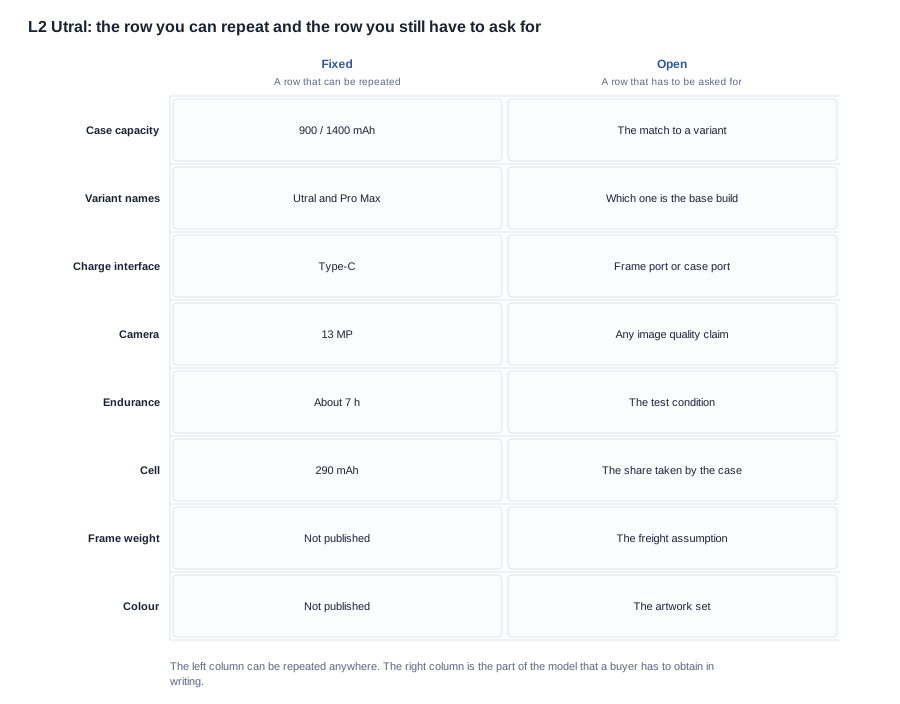
It is worth stating plainly what this page does give a buyer, because a limitations list that only counts gaps misrepresents the model. The page publishes eight substantive rows: the camera row, the cell, the charge time, the endurance figure, the case capacity, two variant names and the charge interface. The three other camera models that share this cell figure and this endurance figure publish five rows each — camera, cell, charge time, endurance and one case capacity — and none of the three names a charging method. This model publishes two case capacities instead of one, and it is the only camera page in the range that carries a variant-name line. That is a documented platform rather than an undocumented one, and for a buyer doing due diligence the difference between a short page and a missing page is the difference between a question and a rebuild.
Two of those rows are also commercially load-bearing in a way the page does not spell out. The interface row means this model can be charged without a proprietary accessory, which removes an accessory from the box and from the accessory family, and for a buyer building a channel that is a direct reduction in the number of things that have to be stocked. The case row, with two capacities, gives a brand a choice of a smaller parcel or a longer day, and a way to serve two different customers from one platform. The value analysis for this model sets out which cost elements the published rows actually touch, and the charging options analysis sets out the accessory arithmetic on the other side of the range.
None of this makes the gaps disappear, and it is worth being precise about the relationship between the two. The published rows describe the product; the gaps are all about the programme around it — which build, which case, which port, which market, which parcel, which file. That is why the same page can be a strong basis for a product listing and an insufficient basis for a purchase order, and why the closing list below is a document list rather than a product list.
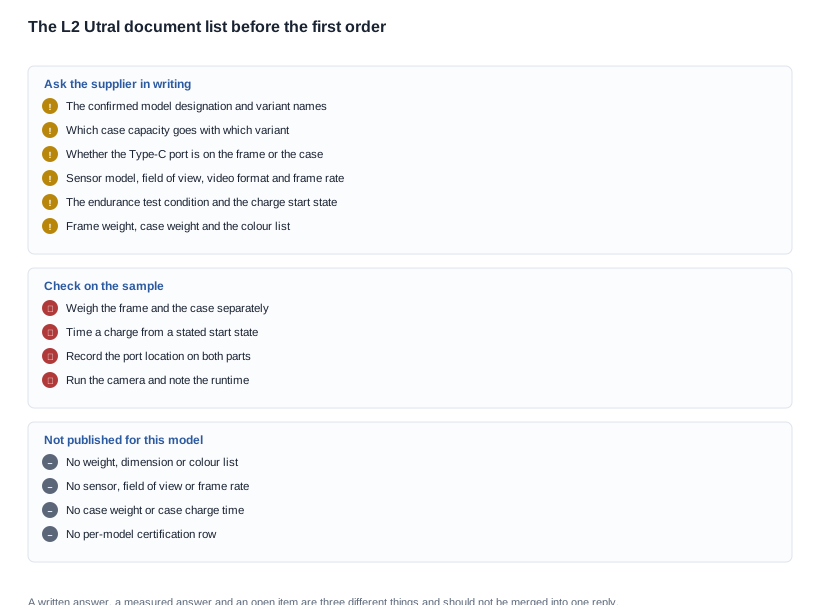
The document list to close before the first order
Seven items, and what each one unblocks
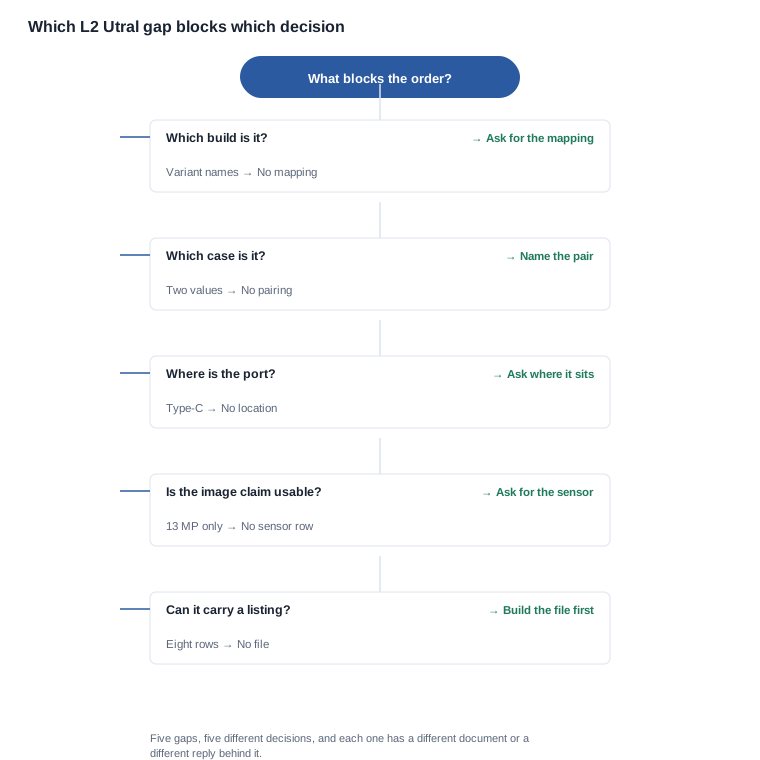
The gaps on this page resolve into a short list, and each item unblocks a different decision. This is the order in which to ask for them, because the first two change the configuration and everything downstream depends on it.
- The confirmed model designation and the two variant names as they must appear on the specification sheet, the packaging artwork and the declaration of conformity. This unblocks the artwork, the certificate application and the customs paperwork at once.
- The correspondence between the two case capacities and the two variant names, and whether the capacities are alternatives within one variant or a fixed assignment. This unblocks the box contents, the carton specification and the freight calculation.
- Whether the Type-C interface is on the frame, on the case, or on both, and what a customer needs in the box to charge the product. This unblocks the box contents and the day-one usability claim.
- The camera rows that make the resolution meaningful — sensor model, field of view, video format, frame rate and the storage arrangement. This unblocks any image quality statement and the first-person capture use case.
- The frame weight and the case weight, each measured in a stated state, plus the colour list for each capacity. This unblocks the listing weight, the carton, the artwork set and the freight class.
- The endurance test condition and the charge start state behind the published figures. This unblocks the duty cycle, the support topics and the return pattern.
- The conformity file that names this model — regime, certificate numbers, test reports, signatory, labelling and packaging instructions. This unblocks the market entry, the distributor pack and the compliance file.
How to run the request
A single message should carry all seven, because a buyer who sends them one at a time will receive them one at a time and will assemble a specification from partial replies. The message needs four things: the model written as it must appear, the market, the quantity, and the configuration being quoted. It should ask for the answers in a form that can be attached to the purchase file — a table rather than a paragraph, with the row names matching the rows in the catalogue so that the two can be compared side by side.
The second rule is about what happens to the reply. Record each answer with its source — catalogue, measured or quoted — and keep the open items in a list with an owner and a date, rather than allowing a partially answered item to disappear into a summary. The buyer review checklist turns this into a review sheet that can be used at the sample stage, and the best-for analysis for this model sets out how the configuration choice is made once the correspondence is known. The third rule is the one that gets skipped: if an answer arrives that contradicts a published row, treat the contradiction as the finding, and put it in front of the supplier rather than choosing the more convenient of the two.
How we state the figures this model does support
This is a well-documented model whose documentation still does not support a product page written from the catalogue alone, and whose configuration has to be settled before anything else is ordered. We will publish the 13 MP as a resolution and not as an image quality claim, we will publish the roughly seven hours as a rating, we will publish the two case capacities and the two variant names without matching them, and we will not quote a weight, a colour, a case interface, a certificate number or a sensor model that the source does not contain. We will not present a case capacity as an upgrade or a range as a ladder, because neither is a published fact.
Send us the target market, the volume and the configuration in mind, and we will tell you which of the seven items are answered, which remain open, and which of the published rows can be repeated as they stand.
Related reading
- The data published for this model — L2 Utral smart glasses specifications and features
- The pre-order checklist — L2 Utral buyer review checklist
- The accessory decision — AI camera glasses charging case options


