

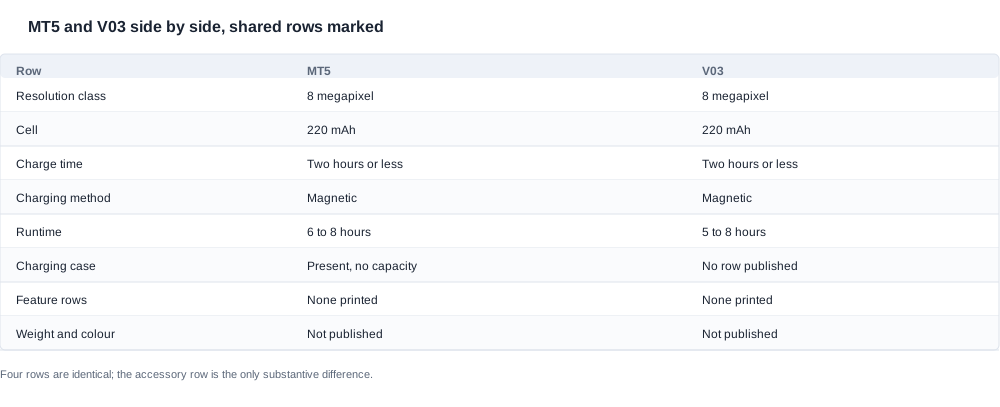
MT5 smart glasses vs V03 spec comparison comes down to a single substantive row: the charging case. Everything else on the two pages is identical. Both models are published in the eight-megapixel resolution class, both carry a 220 mAh cell, both publish a charge time of two hours or less, and both publish magnetic charging. The runtime rows differ in shape rather than in kind. And the case row differs in a way that is genuinely subtle, because on one model the case is documented as present with no capacity stated, while on the other there is no case row at all.
That distinction between a documented accessory with a blank number and an undocumented accessory is the entire useful content of this comparison, and it is worth more to a buyer than any performance difference the catalogue does not publish.
MT5 smart glasses vs V03 spec comparison: the shared rows
Four rows are identical, and they carry most of the weight of the comparison.
Resolution class. Both are eight-megapixel camera models, published alongside the MT5 and the KY06, the MT6 and the CY05, and the CY03 and the V03 Pro, and the V06. Neither publishes a sensor model, a field of view, a frame rate or a video format, so neither supports an imaging claim beyond the resolution class. The thirteen-megapixel class in this catalogue is the L1 Pro and the S7, and the L2 Utral, and neither model on this page is in it.
Cell. Both publish 220 mAh, the smallest cell in the camera group and a value shared with the V03 Pro. Any argument about small cells, lightweight parcels or freight class applies equally to both models and therefore distinguishes nothing between them.
Charge ceiling. Both publish a charge time of two hours or less. This is a ceiling, not a measurement: no starting state of charge and no completion criterion accompany it, and it should be written as "two hours or less" or "at or under two hours" rather than as "under two hours", which is a different assertion.
Charging method. Both publish magnetic charging. That means both expect an accessory in the box — a case, a pad, or both — because a magnetically charging frame cannot be replenished from a wall socket on its own. The interesting part is what each model does with that expectation in its documentation.
Both models also share every gap. Neither publishes a weight, a colourway, a descriptive feature line, a Bluetooth version or a per-model certification row. The Bluetooth absence is true of all eleven camera models in this catalogue and false of every audio model. The certification absence is true of the whole catalogue.
When four of the significant rows are identical, the comparison stops being a hardware question. It becomes a question about what each documentation file chose to record, which is a different kind of question and a more tractable one.

One row differs, and it is an accessory row
The MT5 charging-case row. The model is documented as shipping with a charging case, and the capacity of that case is not published. The charging method row reads magnetic. So the documentation establishes two things: an accessory is present, and its size is not stated.
The V03 charging-case row. There is no charging-case row on the page at all. The charging method row reads magnetic. So the documentation establishes one thing: an accessory is expected, and nothing about whether one is included.
Both models therefore expect an accessory, neither model publishes an accessory capacity, and the difference between them is whether the documentation asserts that a case is in the box. That is a smaller difference than it first appears, and it points the same way as the rest of this comparison: the MT5's documentation is marginally more informative, and marginally more committed.
The practical consequences separate cleanly. For the MT5, the in-box statement is known and only the number is missing, so one question closes the item. For the V03, both the existence and the size of the case are open, so the same question has to establish the existence first.

Why "no case row" is not the same as "no case"
This is the distinction that matters most in this comparison, and it is the one most often collapsed.
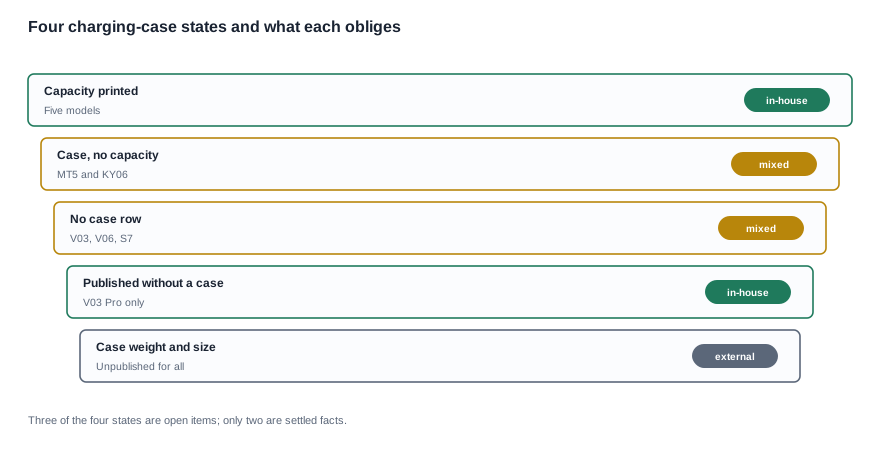
Across the eleven camera models, the charging-case situation has three states:
- Capacity printed. Five models: the CY03 and the L1 Pro, and the CY05 — each at 1400 mAh, the L2 Utral at 900 and 1400 mAh in a single row, and the MT6 at 1200 mAh in a folding case.
- Case documented, capacity not stated. Two models: the MT5 and the KY06.
- No charging-case row published. Four models: the V06 and the V03, and the V03 Pro and the S7.
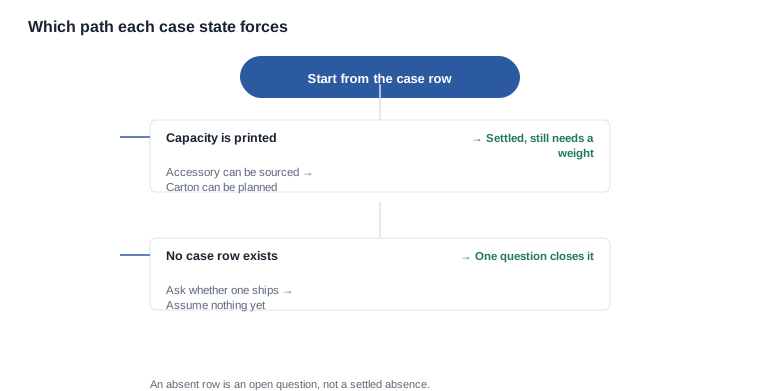
The three states are not interchangeable, and the difference between state two and state three is the difference between an open question and a blank cell. Both of those have to be closed with a written supplier answer before the specification is frozen.
State four — the V03 Pro — is the only model where the documentation makes an outright statement that there is no case. That is a fact a buyer can plan against: the carton does not contain an accessory, the accessory question is closed, and the in-box copy is complete.
State three — the V06 and the S7, and the V03 — means the page does not address the case at all. It does not mean the product ships without one, and it does not mean it ships with one. It means the question has not been asked in print. Closing it costs one email, and the answer is probably the same as the MT5's, but it has to be established rather than assumed.
State two — the MT5 and the KY06 — means the documentation asserts the accessory and leaves its size open. The in-box copy can be written; the accessory cannot be sourced, weighed or quoted until the number arrives.
The error this prevents is expensive in both directions. Treating state three as state four produces a product page that promises no accessory where one may be present, and a carton that is too small. Treating state two as state three produces a product page that declines to mention an accessory the documentation says is present. Both errors are invisible in review, because the two pages look superficially similar.
The runtime band is the only other difference
The remaining difference is the runtime row, and it is a difference in shape rather than in kind.
The MT5 publishes six to eight hours. The V03 publishes five to eight hours. Both are ranges, both carry no test condition, and neither can be ranked against the other — a band and a band are not comparable unless the protocol that produced them is the same, and no protocol is published for either model.
The upper bounds match at eight hours. The lower bounds do not. What that pattern usually indicates is that the lower end of a range is where conditions start to bite and the upper end is where they do not, which is exactly the part a buyer most needs characterised. Neither model tells you which condition moves the figure from eight down to five or six, so neither tells you what happens to a customer who records continuously rather than intermittently.
A one-line label caution applies here. On several camera pages in this catalogue, including both of these, a duration label is used beside the runtime figure that the same catalogue uses for charge time elsewhere. Both pages also carry a separate charge-time row with the two-hour-or-less ceiling, which is what confirms that six-to-eight and five-to-eight are the rated runtimes. Anyone transcribing these pages by label alone has moved this number before.
That is also why the comparison cannot be used to claim that one model outlasts the other. What can honestly be said is narrower and still useful: both models publish wide bands, the bands share an upper bound, the lower bounds differ, and the condition behind the lower bound is unpublished on both.
How to use this comparison in a shortlist
Because four of the significant rows are shared, the practical value of this comparison is not in choosing between the models. It is in identifying how many distinct products a range is really buying, and in closing two accessory questions that both models have open.
Five questions, asked in one message covering both models, do that. Ordered by how much each answer changes the outcome:
- Does the V03 ship with a charging case, and what is its capacity if it does? This single question moves the V03 from state three to either state one or state four, and either answer is useful.
- What is the MT5's case capacity, with a unit? Moves the MT5 from state two to state one.
- Does the case recharge the frame or hold a spare cell? Unpublished for every case in this catalogue, and it determines whether an endurance claim is available at all.
- What is the packed unit weight of each model as it ships, on a calibrated scale? Neither model publishes a frame weight and the only published weight anywhere in this catalogue belongs to a different model, so this has to be measured. Asking for both in one request keeps the comparison fair.
- What is the runtime test condition for each model? Camera state, radio state, battery endpoints and sample size. The lower bounds differ and the lower bounds are the part a customer will discover first.
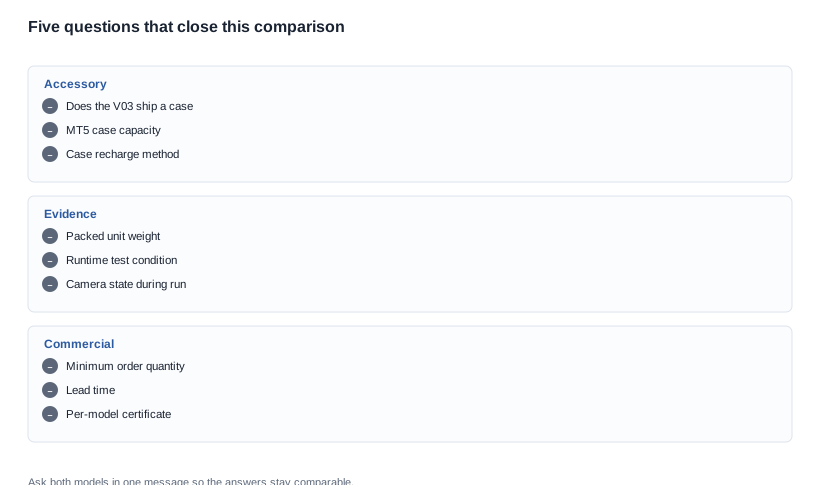
Add the commercial set to the same message, because none of it is published and all of it belongs in the same document as the specification: minimum order quantity, lead time, sample policy, warranty terms, payment terms and the quality control regime behind incoming inspection. If a factory is in the supply chain rather than a trading company, asking which operations are in-house is a due diligence question that costs nothing and determines who absorbs a defect claim later.
On compliance, the position is identical for both models. The catalogue carries a company-level export certification page holding ten patent certificates — eight appearance-design patents and two utility-model patents — and no per-model certification row anywhere, and the catalogue text contains no reference to CE, FCC or RoHS. For European Union buyers the relevant buyer-side instrument for radio equipment is the Radio Equipment Directive (EU) 2014/53/EU; the electromagnetic compatibility directive, (EU) 2014/32/EU, is a separate requirement. Ask for the scope that applies to the model in your purchase order and check that the model designation on any document matches the order.
What to do with an answer that comes back weak
Responses arrive in four shapes and only one closes an item. A closed answer carries a number, a unit, a condition and a document reference. A partial answer carries a number and a unit without a condition, which can still be written into a specification if the assumption is stated on its face. A referred answer points at a listing or a neighbouring model and resolves nothing, because it cannot be traced back to the model being bought. A restated answer repeats the question back, and the remedy is to ask again with the question narrowed to one attribute.
Three weak forms are especially likely on this page, and each should be treated as still open. The case capacity tends to arrive as "around" a figure rather than as a figure. The case behaviour tends to arrive as a description of the accessory rather than an answer about the frame. The runtime protocol tends to omit the camera state, which makes it a description of a different product — on a camera model that omission invalidates the number.
A fourth weak form deserves separate attention because it is easy to miss: an answer about the case that is about the wrong case. Shared platforms make it routine for a supplier to attach the file belonging to a neighbouring model, and a case specification is no different from a certificate in that respect. The check is the same and takes seconds — read the model designation on whatever arrives and confirm it matches the model in the purchase order. Where a supplier supplies cases for several models on one platform, ask which of their models this figure applies to rather than assuming it applies to the one you are buying.
The freight consequence of an accessory you cannot weigh
Because the two models differ only on the accessory row, the freight comparison between them is worth stating explicitly, since it is the practical reason the comparison is worth running at all.
Both frames carry the same published cell, so they contribute the same published mass to the parcel. The difference in parcel weight therefore comes entirely from the accessory — and the accessory is exactly what the documentation does not describe on either model. One of them has an accessory whose size is unknown; the other has an accessory whose existence is unknown. Neither can be weighed from the catalogue, so neither can be modelled, and a comparison of delivered cost between them cannot be completed today.
That is worth stating plainly to anyone expecting this article to answer a costing question. It cannot, and the reason is structural rather than editorial. The remedy is the same in both cases and takes one request: a weighed sample, with whatever ships in the carton, on a calibrated scale, with the result supplied in writing. Once that number exists for both models, the freight comparison completes itself, because every other input to it is already published.
Two related points belong in the same place. The first is classification: a second lithium cell in the unit affects transport documentation regardless of its capacity, so the accessory question is a compliance question as well as a freight question, and it should be raised with whoever handles your shipment paperwork rather than only with your buyer. The second is packaging: no carton artwork should be released while a component that ships inside it is unsized, because the correction after release is a reprint rather than a correction.
What a range decision looks like with these two models together
If the intention is to carry both models rather than to choose between them, four consequences follow, and they are worth planning rather than discovering.
The platform count does not double. Both models sit on the same cell tier, so carrying both halves rather than doubles the number of hardware platforms to qualify. That reduces inspection routines, spare part sets and quality control procedures.
The listing count does double. Two products sharing every visible specification except the box will require explanation on every page that carries them, and the explanation has to be written rather than inferred by the shopper.
The accessory strategy may unify. If both models end up with the same case, sourcing, packaging and spare parts can be consolidated across both. If they end up with different cases, the consolidation benefit disappears and the range carries two accessory regimes. This is not knowable until both questions are answered.
The documentation burden stays flat. Both models are thin in the same places — no weight, no dimensions, no Bluetooth version, no per-model certification row. A range listing both inherits that thinness uniformly, which at least means one set of open items rather than two different sets.
The trade-off to weigh is between operational efficiency and commercial clarity, and that weighing is a buyer decision rather than a catalogue one. What the catalogue supports is a clear statement of which rows are shared, which differ, and which are open on each side — and that statement is worth more than a page of similarities, because it tells you exactly which questions to ask.
One closing caution for anyone publishing this comparison. The most quotable line in it is also the easiest to misapply: two models sharing four significant rows is a statement about two catalogue entries, not a statement that the products are interchangeable. Documentation can be identical while two products differ in ways a catalogue does not record, and a page that presents shared rows as evidence of equivalence invites exactly the challenge it cannot answer. Publish the shared rows as shared, publish the differing row as differing, and publish the open items as open — that version is shorter, and it is the only one that survives a question from someone who has read both datasheets.
The trade-offs worth negotiating are narrow. A supplier who will not publish a case capacity may still commit to one contractually, and a contractual commitment is worth more for planning than a published figure because it carries a remedy. A supplier who cannot commit to a packed unit weight can usually commit to a tolerance band. A supplier with no runtime protocol can usually run one on sample units and supply the result. Each is a smaller ask than a public specification change, and each closes the same gap for the same buyer.
What we will publish for this pair is every row exactly as it appears, including the four shared rows, the two runtime bands, the two magnetic charging rows and the two different case states. What we will not publish is an endurance ranking, an imaging claim, a weight, a case capacity, a certificate number or a price. The published MT5 specification list and the V03 limitations analysis are the two honest baselines, and the value of this comparison is that it isolates a single row on which the two documentation files disagree — a small, checkable difference that is worth more to a buyer than a long list of similarities.


