
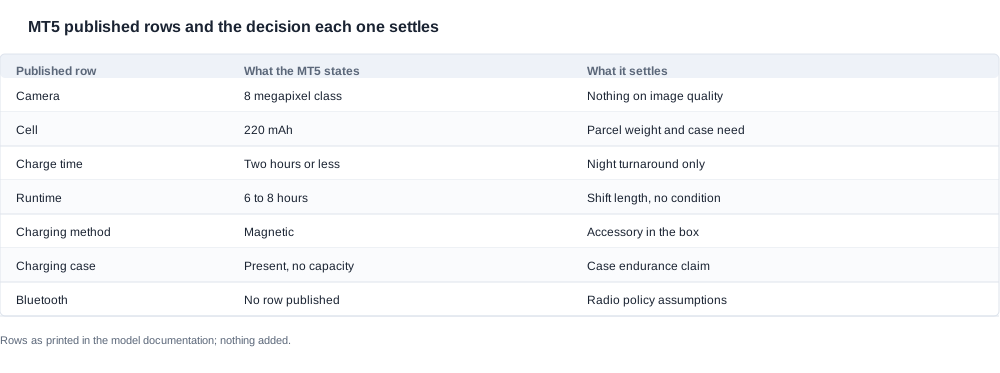
MT5 smart glasses specifications and features are short enough to read in one minute, and one of the rows in that minute is deliberately blank. The MT5 is published with a 220 mAh cell, an eight-megapixel resolution class, a charge time of two hours or less, a rated runtime of six to eight hours, magnetic charging, and a charging case whose capacity is not stated anywhere in the documentation. For a buyer writing a quotation, that blank cell is the whole planning problem: the case is the accessory that makes a small battery workable, and you cannot size it, cost it or weigh it from the published sheet.
What follows is a row-by-row reading of the MT5's published data, followed by the questions that close the gaps, the order in which to ask them, and the boundary between what is documented and what has to become a supplier commitment.
MT5 smart glasses specifications and features: the published rows, row by row
The MT5's page carries the standard camera-model rows and no feature rows of its own. That distinction matters when you compare pages: several models in this camera group carry descriptive lines about frames, lenses or water resistance, and the MT5's page carries none of those. What it does carry is enough to establish the product's class, and not enough to describe its performance.
The camera row is a resolution class, not a quality claim. The MT5 sits in the eight-megapixel group, alongside the V03 and the MT6, the V06 and the V03 Pro, and the CY03 and the KY06, and the CY05. No sensor model, no field of view, no frame rate, no video format and no low-light behaviour are published for it. That is normal for a catalogue of this type, but it means the figure cannot be carried across to a product page as anything stronger than a resolution class. If a channel wants an imaging claim, that claim has to come from a supplier test report, and the test method has to travel with it.
The cell row reads 220 mAh. This is the smallest published cell in the camera group, shared with the V03 and the V03 Pro. A small cell is a favourable number for freight and an unfavourable one for any product story built around endurance.
The charge-time row is a ceiling, not a measurement. The documentation states a charge time of two hours or less. Twenty-six of the twenty-eight models in the catalogue are published on that same ceiling; only the D17 and the ZH12 are published at about one hour. Write it as "two hours or less" or "at or under two hours". Do not write "under two hours", because that is a different assertion, and do not treat the number as a measured value because there is no starting state of charge and no completion criterion published with it.
The runtime row is a range, not a point. Six to eight hours. In a catalogue where several sibling models publish a single figure, a range usually means more than one condition was measured. It also means the two ends of the range came from somewhere, and that somewhere is not described.
The charging method row reads magnetic. That is published, and it tells you an accessory or a pad is expected in the box, because a magnetically charging frame cannot be topped up from a wall socket alone.
The charging-case row exists and carries no number. The MT5 is documented as shipping with a case. The capacity of that case is not published, and there is no second capacity offered against it.
There is no Bluetooth row. None of the eleven camera models publishes a Bluetooth version, the MT5 included. A buyer who needs a radio version for a device-management policy has to request it in writing; the audio models in this catalogue do publish theirs, so the gap is specific to the camera group rather than a house style.
One label warning applies before any of those rows is quoted. On several camera pages, including this one, the printed label beside the six-to-eight-hour figure is a duration label that the catalogue also uses for charge time elsewhere in the document. On the MT5 page there is a separate charge-time row carrying the two-hour-or-less ceiling, which is what confirms that the six-to-eight-hour figure is the rated runtime and not a second charge-time statement. Anyone transcribing these pages by label alone has moved this number before and will move it again.
Where the 220 mAh cell sits against the other camera models
Structural grouping by cell value is legitimate, and it is worth doing because it tells you how many platforms a range has to manage. It is not a price tier, and no price is published for any model in this catalogue, so the grouping should never be presented as one.
The camera group divides into four published cell values: 220 mAh for the V03 and the V03 Pro, and the MT5; 260 mAh for the KY06 and the V06, and the S7; 265 mAh for the MT6 alone; and 290 mAh for the L1 Pro and the CY03, and the L2 Utral and the CY05. Four cell values across eleven models means four platform tiers for a procurement team to qualify, four endurance stories to write, and four sets of accessory logic to source.
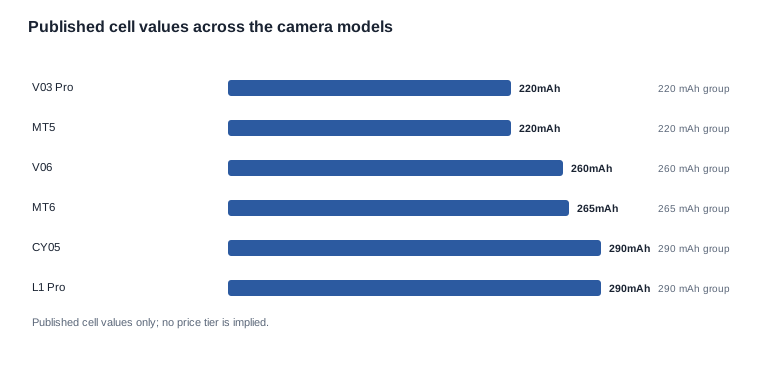
The MT5's position inside the 220 mAh group is what makes it interesting rather than merely cheap. The V03 and the V03 Pro share the cell and are published with magnetic charging and no case; the MT5 shares the cell and is published with a case. A buyer who has already qualified the V03 platform gains a second carton configuration from the same cell tier, which is a packaging and listing decision rather than a hardware decision. The published MT5 specification sheet is the closest published baseline for that comparison.
What the small cell does not settle is the parcel. A smaller cell reduces the frame's contribution to packed unit weight, but the case adds a second lithium cell back into the box, and the MT5's case capacity is exactly the number that would let you model the accessory weight. Until it is published, the freight class for an MT5 unit is an assumption rather than a calculation. The shipping weight breakdown covers how that arithmetic runs once a packed unit has actually been weighed on a calibrated scale, which is the only figure worth accepting.
The six-to-eight-hour range is a wider disclosure than a point
Endurance is where camera catalogues get compared loosely, and the MT5 is a good example of why. Across the eleven camera models, runtime is published three different ways: five to eight hours for the V03 Pro and the S7, and the V06 and the V03; six to eight hours for the KY06 and the MT5; and about seven hours for the CY03 and the CY05, and the L2 Utral and the MT6, and the L1 Pro.
Three shapes, one catalogue, no protocol published for any of them. That does not make any of the figures wrong. It means none of them can be ranked against another, because a five-to-eight-hour range measured with the camera idle and a five-to-eight-hour range measured with the camera recording are the same printed number attached to two different products.
For the MT5 specifically, the honest position is that the range is wider than the point figures around it and that the width is a disclosure about the supplier's testing rather than a statement about the hardware. A buyer who needs a defensible endurance claim should ask three things in writing: whether the camera was recording during the measurement, what the audio and Bluetooth states were, and what the starting and ending battery state was. Then ask the same three questions of any other supplier in the same words, because an answer that arrives only after a comparison has been built around the number is not an answer that can be relied on.
What the range cannot do is support a shift-length claim on its own. Six hours and eight hours are not the same operating window, and neither end of the range is stated as a guaranteed floor. The AI camera glasses battery comparison sets the full grid out, and the method for reading it is covered in the battery life comparison method.
A case that is documented but not sized
The charging-case situation across the eleven camera models falls into four states, and conflating them is the most common error made when this group is written up.
Five models publish a case capacity: the CY03 and the L1 Pro, and the CY05 — each at 1400 mAh, the L2 Utral at 900 and 1400 mAh in a single row, and the MT6 at 1200 mAh in a folding case. Two models are published with a case and no capacity, which is where the MT5 sits alongside the KY06. And four models — the S7 and the V03, and the V06 and the V03 Pro — carry no charging-case row at all, which is an absence of documentation rather than an absence of a case, and the case position for those four has to come back from the supplier in writing before a kit is planned.
Those last two states are routinely collapsed into each other in buying conversations, and the collapse is expensive. "No case" and "case of unknown size" lead to different quotations. The first is a product with a smaller carton and no accessory line. The second is a product whose carton cannot be sized, whose accessory cannot be quoted, and whose in-box experience cannot be described honestly.
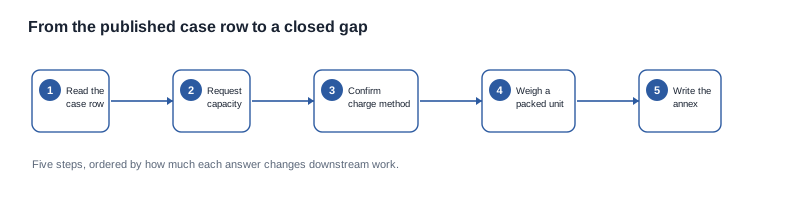
Six questions close this particular gap, and all six belong in the specification annex rather than in an email:
- What is the case capacity for the MT5, stated in the same units and format used for the other models?
- Does the case charge the frame, or does it hold a second cell that the customer swaps in?
- What is the case charge time, and is it published as a ceiling or as a measured value?
- What is the case weight and what are its external dimensions, for freight and for retail shelf planning?
- Is a second case capacity available for this model, as the L2 Utral publishes two?
- Does the case carry any regulatory documentation of its own, given that it ships as a separate lithium cell?
The second question changes the product more than any of the others. A case that recharges the frame extends the product's usable day; a case that only holds a spare cell requires the customer to open the temple and swap cells, which is a different instruction, a different accessory and a different customer expectation. Both are legitimate designs. Only one of them can be called a case-based endurance story, and the published row does not say which this is.
The MT6 value analysis covers the neighbouring model whose case capacity is published, which is the closest available reference for how a case changes a product's positioning once the number exists.
Verification sequence before an MT5 sample order
A sample order on the MT5 is cheap relative to the questions that should be answered before it. The sequence below is ordered by how much each answer changes downstream work, not by how quickly it arrives.
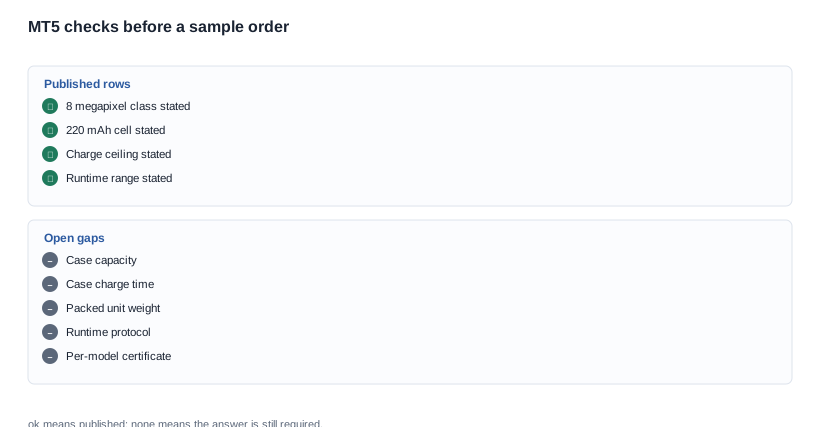
The published rows, which need confirming rather than discovering. The eight-megapixel resolution class, the 220 mAh cell, the two-hour-or-less ceiling, the six-to-eight-hour range, magnetic charging, and the presence of a case. Confirm these against the supplier's current datasheet rather than against a distributor listing, because listings in this category routinely carry rows that the source does not contain.
The gaps, which need answers before anything is written on a product page. Case capacity. Case charge time. Case weight and dimensions. Packed unit weight with the case in the carton. Runtime test protocol. Bluetooth version. Camera sensor model, field of view and video format, if the channel intends to publish any imaging claim at all.
The compliance material, which is entirely absent from the catalogue text. The documentation carries a company-level export certification page whose content is images rather than text, holding ten patent certificates — eight appearance-design patents and two utility-model patents. There is no per-model certification row anywhere, and the catalogue text contains no reference to CE, FCC or RoHS. Nothing in that page can be transferred to a claim about the MT5's own compliance scope. A buyer who needs the radio and safety conformity position for this model must request it as written material, model by model, with certificate numbers that can be verified against the issuing body. The relevant buyer-side reference for radio equipment in the European Union is the Radio Equipment Directive (EU) 2014/53/EU; the electromagnetic compatibility directive is a separate instrument, (EU) 2014/32/EU, and the two are routinely confused in category documentation.
The commercial material, which belongs in the quotation. Minimum order quantity, lead time, sample policy, warranty terms, defect replacement thresholds and the quality control regime behind incoming inspection. None of these appear in a specification catalogue, and all of them belong in the same conversation as the specification annex so that the two do not drift apart.
The MT5 against the L1 Pro comparison covers the power and charging rows of this model against the largest published cell and case in the group, which is the most useful reference point for a buyer who intends to build a range rather than a single line.
The boundary between published rows and supplier commitments
The MT5 is documented, not specified. That distinction is the practical summary of this model, and it decides how the specification sheet may be used.
Documented means the rows listed above are in the catalogue and may be repeated as catalogue content. It does not mean they are contract terms, because a catalogue row carries no test method, no tolerance and no guarantee attached to it. We will publish the eight-megapixel resolution class, the 220 mAh cell, the two-hour-or-less ceiling, the six-to-eight-hour range and the magnetic charging method exactly as they appear, and we will not extend any of them into an imaging claim, an endurance guarantee or a charge-time claim that the source does not support.
Everything else on this model — the case capacity, the case weight, the packed unit weight, the runtime conditions, the camera detail, the radio version and the whole compliance scope — is a supplier commitment, and a supplier commitment only exists in writing. Each of those items converts a gap into either a number you can plan with or a limit you can disclose. Neither outcome is a loss; what is a loss is discovering the gap after the master carton has been printed.
How to evaluate a reply, and what to ask when the test condition is missing
A specification request produces three kinds of response, and only one of them is useful. The useful answer carries a number, a unit, a test condition and a document reference. The second kind carries a number and a unit without either, which is better than silence but not yet a specification. The third kind is a restatement of the question, and it is more common than a buyer expects.
The criteria for judging which kind you received are short enough to apply to any supplier. For every row on the request list, ask: what exactly is measured, under what condition, by what method, with what tolerance, and where is the evidence. If the answer names a test report, ask for the report and check that the model designation on it matches the model you are buying. A technical file built for a neighbouring model is the single most common cause of a compliance dispute in this category, and it is entirely preventable by checking one line on the cover page.
Before you commit to a bulk order, the total cost of an unanswered gap is worth writing down explicitly, because gaps rarely cost what they appear to cost. A missing case capacity does not cost one number; it costs the accessory quotation, the carton dimensions, the freight class, the retail shelf allocation, the in-box experience the channel will describe, and the after-sales handling when a customer asks what came in the box. Adding those up is the only way to decide whether a given gap justifies chasing it before the first shipment or whether it can be closed during the second production run.
There are also trade-offs to negotiate deliberately rather than absorb. A supplier who will not publish a case capacity may still commit to one in the contract, and a contractual commitment is worth more than a published figure for planning purposes because it carries a remedy. A supplier who cannot commit to a packed unit weight can usually commit to a tolerance band. A supplier who has no test protocol for runtime can commit to running one on your sample units and supplying the result. Each of these is a smaller ask than a public specification change, and each closes the same gap.
The questions that separate a shortlist from a guess
Which model to put on a shortlist is decided by the gaps you can live with, not by the gaps you have already filled in. For the MT5, three answers decide that question.
If the case capacity comes back with a number and a clear statement of whether the case recharges the frame or only holds a spare cell, this model becomes straightforward to specify. If it comes back with a number but no method, the specification can still be written with a stated assumption, which is an acceptable outcome for most channels. If it does not come back at all, the channel must either source the case as a separate line or write the product without any in-box endurance claim, and both of those are bigger commercial decisions than the choice of camera model itself.
The same logic applies to the compliance material. A per-model declaration with verifiable references closes the question for a distributor. A company-level statement does not, and no amount of repetition in the specification annex will convert one into the other.
So the usable version of the MT5's sheet is short: a documented platform position, a documented cell tier, a documented case presence, and a documented list of what is not yet known. That list is the specification request. Send it with the sample order, in the same document as the purchase order, and the MT5 becomes a normal line in a range rather than a question mark in one.


