

An ODM development case review is a review of a programme that has already run, and its value is entirely in whether the findings reach the next programme. A review that documents what happened without changing what will happen next is a record, not a review.
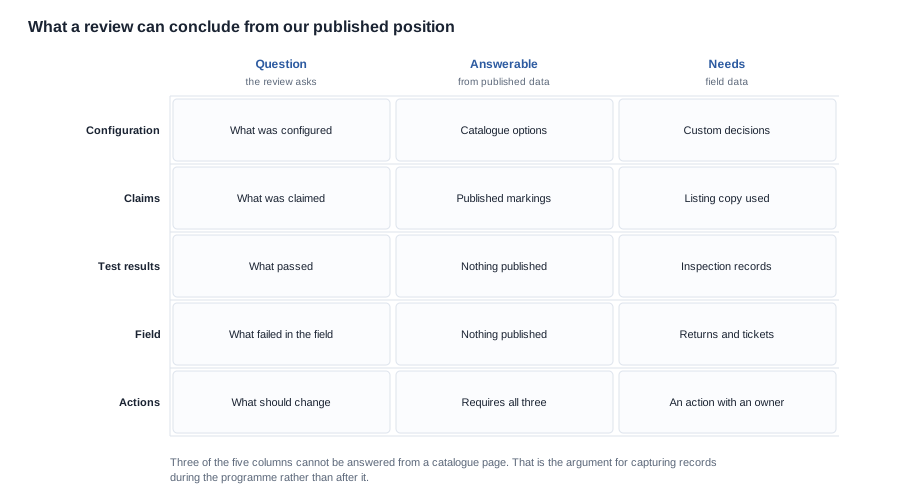
The complication in this category is that a programme's outcome is hard to attribute, because so many of the published rows are thin and so many of the decisions that mattered were undocumented. Our published position across the range is what a review works from: the configuration space, the published colour options on two models, the IP54 markings on the V06 and the S7 with no report number, the claimed certifications with the certificate numbers awaiting confirmation, and the rows that are Not published everywhere.
So odm development case review is best understood as a review structure designed to make the next programme better rather than to grade the last one — and the difference is not semantic. A structure that grades produces a number, and a number gets compared across programmes that are not comparable. A structure that improves produces actions, and actions have owners.
The timing matters as much as the structure. A review conducted while the people who made the decisions are still available can recover the reasoning behind those decisions. The same review conducted a year later recovers only the decisions themselves, and the reasoning is what a review is actually after.
There is a practical consequence that follows from this and that is worth planning around. The people who know why a decision was made are the same people who are moving on to the next programme, and the schedule for a review almost always collides with their handover. A review booked two weeks before somebody leaves will produce facts; a review booked two months after they have gone will produce guesses presented with the same confidence. If the reasoning matters — and in this category it usually does — the review has to happen while the room is intact.
That constraint also determines who should be in it. A review attended only by the programme's sponsor produces a summary. A review attended by the people who did the work, with the sponsor present to own the actions, produces findings. The sponsor's role is not to contribute content but to commit resources to whatever the findings require, which is why their absence turns a review into a document.
ODM development: what a case review is actually for
A case review has three possible purposes, and mixing them is the most common reason a review fails to be useful.
Closing the programme. This is the administrative purpose: confirming what was delivered, settling what is still open, and releasing the people involved. It is legitimate and it is not what produces value for the next programme.
Settling a specific question. Somebody needs to know whether a particular decision was correct, or whether a failure was avoidable. This produces a narrow but real result, provided the question is written down at the start rather than emerging from the discussion.
Improving the next programme. This is the purpose that justifies the effort, and it requires naming the next programme at the start. A review whose findings have nowhere to go will produce a document, because a document is what a review produces when nobody has committed to acting on it.
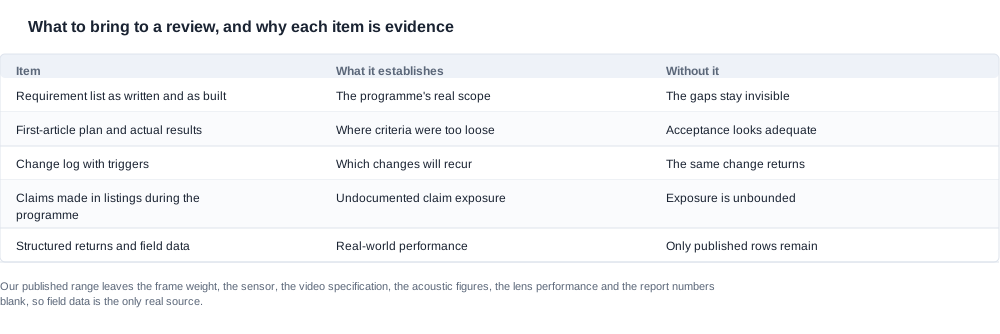
Of the three, the third is the only one that changes anything, and it is the one most often left implicit. The decision to name the next programme at the start is the single structural element that separates a review from a post-mortem, and it costs nothing to add.
It is worth being concrete about what naming the next programme changes in practice. Without it, a finding becomes a note in a document. With it, a finding becomes a line in somebody's specification, checked against at the next design freeze. The mechanism is unglamorous and it is the only reliable one: the findings are entered into the requirement list for a programme that is already scheduled, and a requirement that is not entered has not been accepted by anybody.
That is also why a review should produce actions with owners rather than a list of recommendations. A recommendation is addressed to nobody and expires when the meeting ends. An action has a name against it and a date by which it has to be done or explicitly declined, which is a very different amount of accountability for a very small amount of extra work.
There is a fourth purpose that appears only in some organisations and is worth naming because it produces the best material: identifying which requirements should become standard rather than bespoke. A review that discovers two programmes in a row specified the same acceptance criterion separately has found something more valuable than a schedule explanation, because the criterion is now a candidate for the catalogue rather than for the next negotiation.

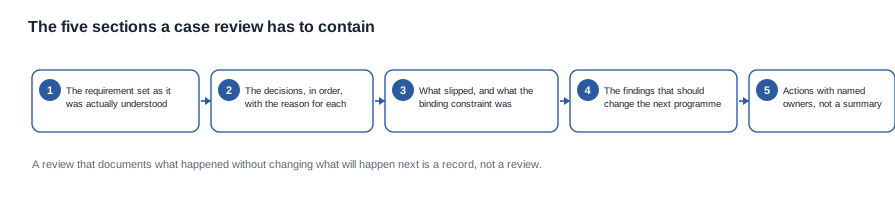
The five sections a review has to contain
1. The requirement set as it was actually understood. Not the signed specification — the requirement list as it stood when the programme started, including the items nobody wrote down. The gap between the two is the programme's real scope, and it is the most useful thing a review can establish.
2. The decisions, in order, with the reason each was taken. A programme is a sequence of decisions, and the ones that turned out to matter are rarely the ones that seemed important at the time. Recording them retrospectively is possible if the review is done while the people are still there.
3. What slipped, and what the constraint was. In this category the usual constraints are a laboratory queue, a tooling lead time, an artwork approval cycle and a component substitution. A review that names the constraint for each slip is worth more than one that lists the slips, because the constraint is the part that generalises and the slip is not.
4. The findings that should change the next programme. The design changes, the specification rows that should have been required, the acceptance criteria that should have existed. This is the section that makes the review a review.
5. What we would do differently, and who owns each action. Actions with owners and dates, or the review produces a document rather than an outcome.
The order of those sections is deliberate and it is not chronological. Sections one and two reconstruct what the programme was; section three explains what happened; section four converts that explanation into requirements; section five converts requirements into work. A review that runs them in programme order ends with a description of what happened, which is the outcome the whole structure exists to avoid.
Section three is where the discipline is hardest, because naming a constraint requires admitting that somebody's date was wrong. The technique that works is to ask what the team believed at the time, and to record the belief alongside the fact. A team that believed a date was firm and was wrong has a communication finding; a team that knew the date was soft and said nothing has a different one. Both are actionable, and neither is actionable without the distinction.
There is a version of section three that is even more useful and considerably harder to produce, which is the constraint that was never visible at all. Most reviews record the constraints the team already knew about — the laboratory queue they were tracking, the tooling lead time they had been quoted. The more valuable finding is the dependency nobody had identified until it bound, and identifying it usually requires somebody to say what they assumed rather than what they knew.
That is why the review should ask the question before the session rather than during it: send participants the list of slips in advance and ask each to name the constraint they believed at the time. The difference between the answers and the team's shared recollection is frequently the most valuable content of the whole review, and it is far easier to obtain in writing before anybody has agreed on a shared account.
Section four is where the review either earns its cost or does not, and the test is simple: every finding should be convertible into a line in a specification or a checklist. A finding that cannot be converted is probably a true observation with no home, and those are worth recording separately from the findings rather than forcing them into a requirement they do not fit.
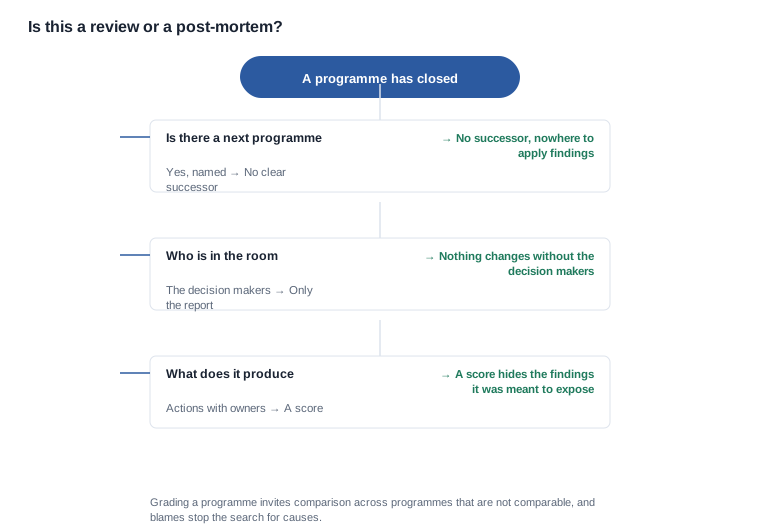
What to bring, and what each item proves
1. The requirement list as it was, and as it became. The divergence is the programme's real scope. Where the two documents exist, the divergence is easy to see. Where the requirement list was never written down, the absence is itself the finding and should be recorded as one rather than reconstructed after the fact from memory.
2. The first-article inspection plan and the actual results. The gap between the criteria and the outcomes is where the acceptance criteria were too loose. This is the most useful single document pair in a review, because it converts a general statement about quality into a specific statement about which criteria did not do their job.
3. The change log. Every change and its trigger, because a change with no trigger is a change that will recur. A change log without triggers is really just a list of dates, and it will not support any conclusion about whether change control worked.
4. The claims made in the listings during the programme's life, and the documentation behind each one. This is the section with the most uncomfortable content and the most value. Listings outlive the people who approved them, so a claim made in month four may still be live long after the programme has closed and the evidence for it has lapsed.
5. The returns and the field data, structured rather than anecdotal. This is the only source of information about real-world performance, because the published rows in this range are thin and the field is where the truth is.
A sixth document completes the set and is frequently missing: the quotation and the purchase order as they actually stood. Comparing the quoted configuration against the delivered one is the fastest way to find requirements that changed informally, and it does so without asking anybody to remember anything.
That comparison is worth doing in detail rather than as a single glance, because the informal changes are the interesting ones. A cell configuration that moved, a case capacity that was substituted, a firmware build that shipped later than the one described — each of these is a small discrepancy that appears nowhere in the change log and that a subsequent programme will assume never happened. The quotation and the purchase order are the two documents that were written down at a specific moment, which makes them unusually reliable evidence of intent.
A seventh item is worth adding where field data exists: a sample of the support tickets or returns that were closed without a recorded cause. Those are the failures that never reached the review in the first place, and they are usually more numerous than the ones that did. Their value is not in the individual tickets but in the pattern — a cluster of unreported failures in one configuration tells you more than a page of post-mortem.

What a review must not do
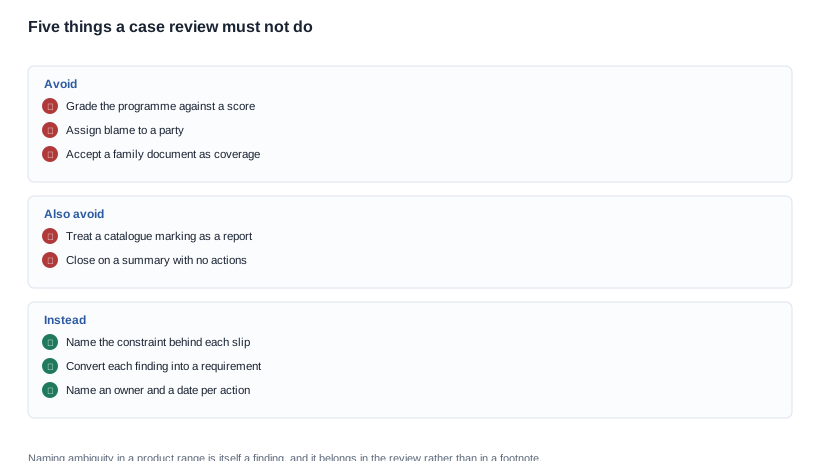
1. Grade the programme. A score invites comparison across programmes that are not comparable and hides the findings.
2. Blame the supplier or the buyer. The findings are usually about a requirement that was never specified, and a review that finds a person to blame stops asking what caused it.
3. Accept a family-level document as coverage. Our own catalogue carries one entry listed as "L2 Utral" with a note about the spelling and a further "Utral Pro Max" designation whose meaning is not published, and the light-responsive and bone conduction entries have no designation at all — the naming ambiguity in a review is a finding.
4. Treat a catalogue marking as a test report. The sport tier's IP54 marking has no test report number published, and calling it a report would put a false claim into the next programme's file.
5. Close on a summary. A review without actions is a description of what happened.
There is a sixth prohibition that is less obvious and arguably the most damaging: do not let the review produce a document that will be used as evidence later. A review frequently contains admissions — that a figure was assumed, that a marking was unverified, that a claim was made without a document — which are entirely appropriate in a review and entirely unsuitable in a file that somebody will later rely on. Reviews are internal documents. Treating them as records changes what people are willing to say in them, and the review gets worse because the candour that makes it useful has been priced out.

Asking the right five questions at the start
- What is the purpose of this review? To close the programme, to improve the next one, or to settle a specific question. Everything else depends on the answer, and the most common reason a review produces nothing is that nobody agreed on the purpose.
- Who is in the room, and does it include the people who made the decisions. A review without the decision makers can reconstruct events but not reasoning.
- What data is available — the requirement list, the first-article record, the change log, the returns, the quotation. Answering this honestly sometimes reveals that the review cannot be done usefully, which is a better outcome than running it anyway.
- Which programme is the next one, and will these findings reach it. Naming the programme is what turns findings into requirements.
- What will the review produce that somebody will act on? A document with a named owner and a date attached, or nothing useful.
The fifth question is the one that reveals whether a review is worth the time. If the answer is a report, the review is a paperwork exercise and should be scheduled as one. If the answer is a changed specification, the review is worth doing properly.
There is a sixth question that is useful when a programme has gone badly: ask what the team would do differently if they were starting again with the same information. It is a productive question because it removes blame — the team had the same information — while still producing the specific actions that the review exists to generate.
A seventh question decides how the review is recorded, and it should be asked before the session rather than during it: who is allowed to read the output, and where does it go afterwards. A review contains admissions that are appropriate internally and unsuitable in a technical file, as noted above, and the answer determines whether people will be candid. Recording that the output is an internal working document, and naming who receives it, is a two-minute step that materially changes the quality of what gets said.
There is also a question about frequency that most organisations settle by default rather than by decision. A review after every programme produces a lot of material and diminishing returns, because programmes in the same category repeat the same lessons. A review after every three programmes produces less material and more generalisation. The right answer depends on how much the next programme resembles the last one, and the question to ask is whether the findings would change anything if they arrived two programmes late.
Being direct about our published gaps as review input
We will say plainly that a case review should produce a list of actions with owners rather than a score, and that the honest starting point in this category is the published gaps — the frame weight except for one model at 158 g, the sensor, the field of view, the video specification, the microphone figures, the lens performance, the seal material, the test report numbers and the certificate numbers.
We will not fill those gaps with typical values, and we will not present a catalogue marking as a test report. In a review context this has a specific consequence: a finding that rests on an assumed figure cannot be resolved by asking us for the figure, so it has to be resolved by writing the criterion and running the measurement. That is more work than a phone call and it is the only version of the answer that will still be true in a technical file next year.
The same rule applies to our own past decisions, not only to the current catalogue. Where a programme we supplied relied on a figure that we did not hold at the time and have not published since, that is a review finding about both parties, and the useful action is the same in both cases: write the criterion, define the method, and run the measurement on a defined sample. Reviews are much better at producing that action when they are permitted to record that the figure was assumed rather than agreed.
If you tell us what the review is for and which programme follows it, we will tell you what data will need to have been captured for the review to be worth anything — and which parts of that data will have to come from the field rather than from us.
The stage structure the review examines is set out in ODM development, the documentation the review should have been able to read is in development process documentation, and the production stage that most reviews are trying to explain is covered in development process mass production.
One closing point about reviews that produce nothing. The failure is rarely that the review was badly conducted; it is that it was conducted without a successor programme, without an owner for the actions, or without permission to be candid. Any one of those three omissions is enough, and all three are visible at the moment the review is scheduled rather than at the moment it closes. Scheduling a review with the successor named and the candour agreed in advance is most of the work.
There is one more question that separates a review that works from one that does not, and it is asked at the end rather than the beginning: what will we do differently on the next programme, in one sentence each? Asking for one sentence forces a priority. A review that ends with five equal findings has produced a list; a review that ends with one sentence per participant has produced a decision, and the decision is what the next programme needs.
Related reading
- ODM development
- Engineering customisation case review
- Development process documentation
- Mass production stage
Tell us what the review is for and which programme follows it.


