

An ODM development checklist is a document about stopping, not about starting, and that is its most useful property. It is the set of points at which a programme can be halted for a defensible reason, each with a condition and a document behind it. This checklist sets out thirteen gates across three phases, what has to be true at each one, and which document closes it — because a checklist that only records progress is a schedule, and a schedule is not a control.
Our published position gives the checklist its substance, because the published gaps sit exactly where the stopping points are. The sensor model, the field of view, the video specification, the microphone figures, the lens performance, the ingress report numbers, the seal material and the frame weight are Not published for nearly every model in the range. Our catalogue publishes no CE, FCC or RoHS text and no per-model certification row across the adult models, publishes no certificate number at all, and nothing has been published to us about where the children's models stand. Those are not tidiness problems. They are gate conditions.
odm development checklist: what a stop point has to contain
A gate is only a gate if it can refuse. That sounds obvious and it is the point most often missed, because a long list of milestones produces a feeling of control while providing none. Four properties separate a real gate from a row in a status report, and all four have to be present together.
A condition, not a task. "Requirements gathered" is a task. "Every requirement line is in one of three buckets, with a named owner against each" is a condition. Tasks are completed by effort and conditions are satisfied or not satisfied by evidence. The distinction matters because the failure mode of a task-based checklist is that a task marked done becomes permanent, while the condition behind it quietly stopped being true three weeks later.
A document. The gate closes when a named artefact exists, is referenced in the programme file, and can be produced by someone who was not in the room. If the evidence lives in a mail thread, the gate is closed in the sense that everyone agrees to remember it, which is a different and much weaker property.
A name on both sides. The buyer's engineer and the supplier's project lead. Not a team, not a department. A gate owned by a department is owned by whoever happens to be in the room on the day the question surfaces, and the question surfaces at the worst possible moment, which is when the line is running.
A reopen procedure. The written statement of what constitutes a change, and what happens to the programme when one is approved. Without it, every reopened gate is an argument about fairness rather than about the condition, and the programme stops while the argument runs.

The reason to build the list this way is that gates let two sides disagree productively. A buyer who wants to change the firmware can point at gate 4 and say the acceptance criteria for firmware behaviour were never written, so the change cannot be assessed. A supplier who wants to close a row can point at the same gate and say the criteria exist, here is the reference, so the change is a new item. Both positions are checkable. Without written criteria the discussion becomes a matter of who trusts whom, which is the least efficient instrument available in a programme that will run for months.

The five gates that decide whether a quotation is even possible
Five gates sit before a quotation is issued, and a programme that fails any of them produces a number that looks like a price and behaves like an estimate. The commercial risk is not losing money on the quote. It is signing a purchase order against a number that was never a number.
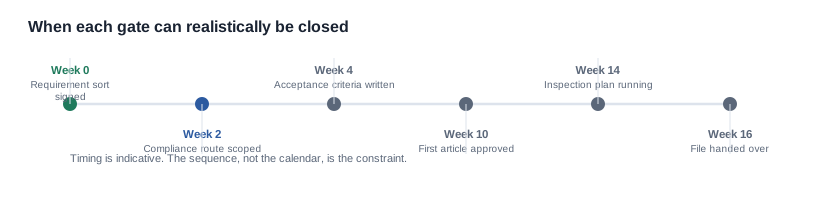
Gate 1 — the requirement sort is complete. Every requirement sits in one of three buckets: fixed by the platform, negotiable within a stated range, or genuinely open with a cost and a lead time attached. Each bucket has a named owner. An unsorted requirement is the single most common cause of a quote that changes by fifteen per cent after signature, and it is also the most common cause of a supplier quietly building something nobody wanted.
Gate 2 — the configuration is specified at part level. The cell, the charging interface, the resolution tier, the case capacity, the colour, the firmware version, the supplier of the named component where it matters. Part level rather than model name, because documents work at part level and so does a production line. A model name carries more variation than a part number, and every requirement expressed at model level has to be re-interpreted before it can be built.
Gate 3 — the compliance route is established per market. For each destination, which certificate exists, on which model list, whether the requirement is new, an extension of something already held, or already in place. This is the gate with the longest lead time attached, because certification does not compress. Our own position is that specific model and certificate numbers await confirmation, which means the honest answer to the buyer's question is that the route needs scoping before the quote can carry it.
Gate 4 — acceptance criteria are written for every row that is Not published. This is the gate buyers skip and suppliers quietly appreciate, because written criteria are the only defence against a rejection that is argued rather than measured. The frame weight, the camera specification, the acoustic performance, the lens performance, the ingress evidence — these are criteria the buyer writes, and the pre-production phase is the cheapest moment to write them. Criteria written after the first article arrives are criteria written under pressure.
Gate 5 — the change control procedure is in place. A named authoriser on each side, a written list of what constitutes a change, and a review that produces a written outcome rather than a verbal agreement. Changes are not a failure of the programme. Unmanaged changes are.
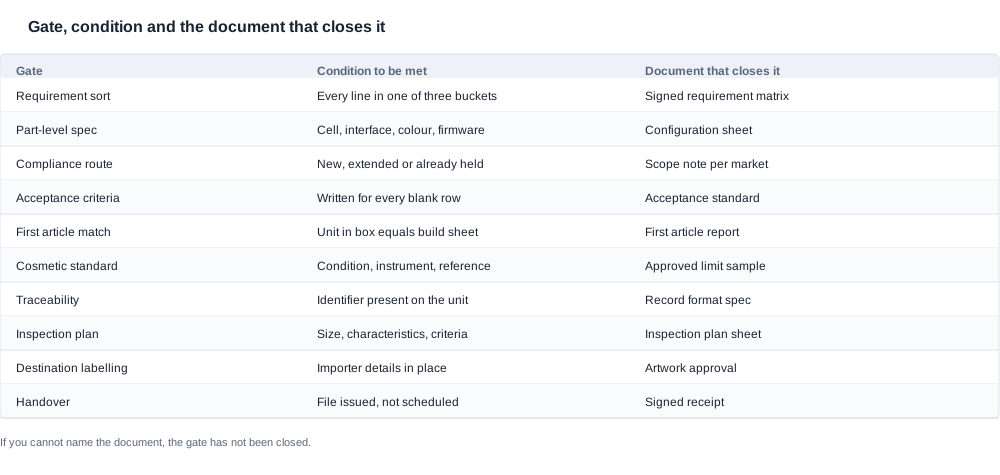
Four gates then sit between the purchase order and the first article, and they are where most programmes first produce a document they do not have.
Gate 6 — the first article is the production configuration. The cell, the colour, the firmware, the case. A sample that differs from the production unit invalidates every evaluation performed on it, and this is not a theoretical concern: evaluation results are quoted in the buyer's own review, in their channel, and sometimes in their retail listing. An evaluation of a non-production unit is a claim that will eventually be checked.
Gate 7 — the cosmetic acceptance standard is written, with a viewing condition, an instrument and a physical reference unit. This is the most frequent first-article rejection and the cheapest to prevent. "No scratches" is not a criterion. "No scratch visible under a 400 lux diffuse source at 300 mm, against reference unit R-3" is a criterion, and the difference between the two sentences is the difference between a technical rejection and a negotiation.
Gate 8 — the traceability record format is agreed and the identifier is physically present on the unit. The lifecycle discussion sets out why this is the single document that makes a claim work in year two, when the original buyer has changed roles and the build sheet is no longer on anybody's desk.
Gate 9 — the compliance model list matches the first article. Not the planned configuration. The unit in the box. The gap between the plan and the article is where model designations drift, and a drifted designation means a certificate that does not cover the goods.

A worked failure: the gate that was closed in a meeting
Consider a programme that went wrong in an entirely ordinary way, with no bad intent anywhere in it, because that is the usual case.
The buyer wanted a particular acoustic signature for a retail demonstration environment. There was no written criterion for acoustic performance, because the published position across the range is that the microphone figures are Not published. The requirement went into the programme file as a sentence in a requirements document, with no number attached. Gate 4 was marked complete because a requirements document existed.
The first article arrived. It was a production configuration, it was built to the part-level specification, and its compliance model list was correct. It simply did not meet an expectation that had never been written down. The supplier's position was that the requirement was not a requirement. The buyer's position was that it was in writing. Both positions were formally correct, which is what made the disagreement so expensive.
The resolution took eleven weeks and cost more than the acoustic component ever would have. The final outcome was a written criterion, which was derived from a measurement taken on a rejected unit. The programme shipped. Nobody involved would describe it as a catastrophe, and it was still the most expensive week in the programme's calendar, because the gate that would have closed it in an afternoon was closed verbally and then reopened twice.
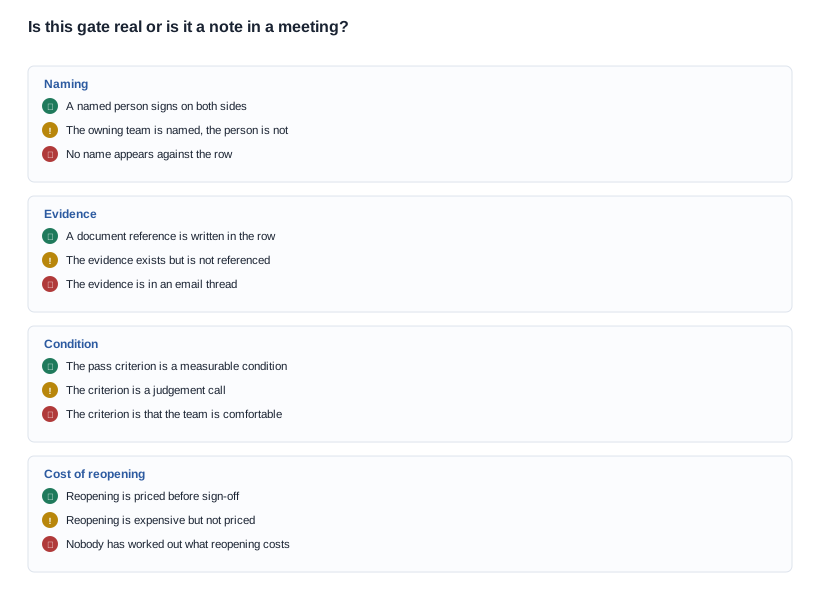
Three things distinguish this from a case where someone did the work badly. First, the failure was structural rather than personal: nobody in the programme had a reason to invent a criterion, because nobody had been asked for one. Second, it was invisible until it was expensive, which is the defining property of a gate that was closed without a document. Third, it was recoverable, which is the only reason it is worth writing down — the programme did not fail permanently, it lost eleven weeks.
The corrective action was not a new supplier and not a new engineer. It was four words added to the checklist: criterion must be measurable. Four words, applied at gate 4, would have moved an eleven-week problem into a one-day conversation about whether the target was achievable at all.
The four questions that turn a checklist into a control
Every gate in the list above is interrogated by the same four questions. Used at every gate, they are what separate a programme with a checklist from a programme with a checklist that is actually applied.
-
What is the document behind this gate, and is it in the programme file right now? Not "will there be one" and not "it is being drafted". Is it there, with a reference, retrievable by someone who was not in the meeting. This question does most of the work, because it converts an assurance into an artefact or exposes the absence of one.
-
Who signs it, and are they available this week? A gate signed by a name that appears on an organisation chart is not owned. Ask for the person, then ask whether they are reachable in the next five working days. If the answer is that the signature needs another week, you have learned something useful about the programme at a cost of five minutes.
-
What is the early warning that this gate will slip? Every gate has a signal that appears before the miss, and asking for it in advance converts a schedule failure into a managed one. For gate 3 the signal is usually a certificate scope question that has been open for two weeks. For gate 7 it is a limit sample that has been requested but not shipped. A supplier who cannot name the early warning for their own gate has not thought about that gate.
-
What happens downstream if it does slip? This is the question that determines whether a slip is a scheduling event or a programme event. If gate 4 slips, the pre-production phase lengthens and the acceptance criteria arrive after the article. If gate 8 slips, the first article ships without an identifier, and every unit built before the fix is untraceable — which cannot be corrected retrospectively. Gates differ enormously in blast radius, and a checklist that does not record the blast radius treats all of them as equally urgent, which guarantees the urgent one loses.
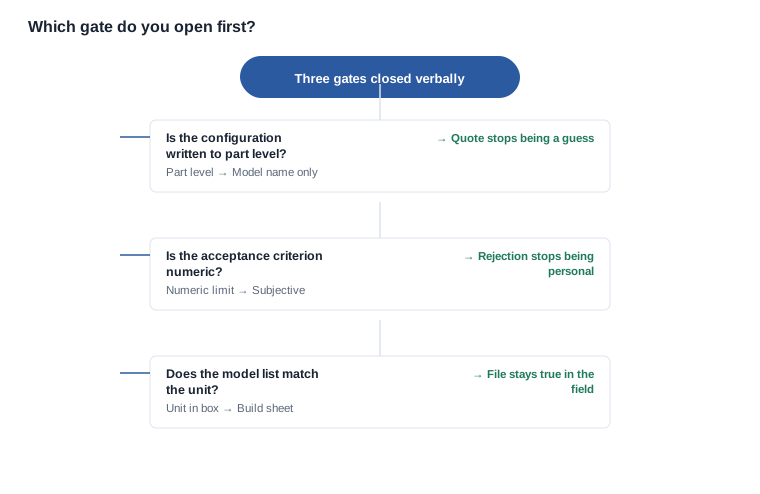
It is worth being concrete about blast radius, because it is the question most programmes answer worst. Take the traceability gate. If it slips, the units already built are not individually recoverable, because the identifier is either moulded, laser-etched or printed, and none of those processes can be applied selectively to a finished batch after the fact. The realistic recovery is a record kept elsewhere that maps serial ranges to build dates, and that record has to have existed before the units shipped. Now take the artwork approval gate. If it slips, the units are finished and correct, the packaging is late, and the recovery is an air shipment of printed material plus the customs delay that follows it. Recoverable, expensive, and entirely avoidable.
The same four questions applied to the requirement sort produce a different answer again. The condition is that every line is bucketed, the document is the signed requirement matrix, the name is the buyer's product owner rather than the procurement lead, and the early warning is a requirement line that has been open for more than a week without an owner. What happens downstream if that gate slips is that the configuration sheet contains an assumption, the assumption becomes a build instruction, and the discovery arrives at first article — which is the most expensive place in the programme to discover anything.
There is a second-order point that experienced buyers use and inexperienced buyers rarely do. Ask the same four questions about a gate you expect to pass easily. The purpose is not suspicion; it is calibration. A supplier who answers gate 5 in four seconds and gate 8 in four minutes has told you something about how much of the programme is genuinely under control, and the answer is frequently that the easy gates are easy because nobody has examined them yet. Cheap gates are where assumptions accumulate, because they cost nothing to carry and everything to correct.
Four things belong in an ODM checklist, and four things must never appear in one.
Progress statements must never appear, because a checklist records whether a condition is met, not whether a task was finished. A score must never appear, because a score invites comparison between programmes that are not comparable, and a buyer who has scored two suppliers on a five-point scale has stopped evaluating them. A gate with no document must never appear, because it is a discussion, and discussions are reopened whenever the commercial position moves. A gate owned by nobody must never appear at all, because an unowned gate is not a gate — it is a hope with a row number.
The remaining four gates, before shipment, close the programme rather than qualify it.
Gate 10 — the documentation set is complete per configuration, and the handover has happened rather than being scheduled. "Scheduled" is the word that kills this gate. A file that has been promised for week sixteen and issued in week twenty-two is a file that arrives after the buyer's compliance team has already filled the gap with an assumption.
Gate 11 — the inspection plan is running, with a sample size, a list of characteristics and the criteria for each one. An inspection with a sample size and no criteria produces a number that cannot be defended at the point of dispute.
Gate 12 — the labelling and the instructions are correct for the destination market, including the importer's details and the plug standard. This is a gate rather than a detail because the label is the only part of the product a customs authority reads in detail, and a programme that has been managed carefully for six months can be stopped at the border in twenty minutes.
Gate 13 — the packaging and the artwork have been approved against a physical sample, in the final finish and with the final print process. Artwork approval on screen is not artwork approval, because the same artwork renders differently on coated and uncoated board, and the difference is visible at retail under the exact lighting where the product is being sold.
What our published position allows us to close
We will work to a checklist of this kind for a specific programme, and we will mark every item we cannot evidence as Not published rather than as satisfied. A checklist showing everything green while half the rows are empty is worse than no checklist, because it converts an open item into a false assurance and moves the discovery to a point where it is expensive.
In practice that means the rows we can close quickly are the structural ones. The part-level configuration sheet, the change control procedure, the acceptance standard format, the traceability record format, the inspection plan structure and the artwork approval route are all things we can produce as documents for a named programme. The rows that need a measurement or a third party are the physical ones: the frame weight, the sensor, the field of view, the video and microphone specifications, the lens performance and the ingress evidence. Our published position is that those remain Not published for nearly every model in the range, and the certification position is incomplete for the children's tier.
A Not published row is not a refusal, and treating it as one wastes the negotiation. It is a statement that the evidence does not exist in a form we can hand over today, and that form is usually one of three. The specification exists on paper at the component supplier and can be requested, with a lead time attached. The specification exists as a test report from a specific lab against a specific sample, in which case the number describes a sample and not your production units unless the production units are the sample. Or the specification has never been measured at all, in which case the honest first step is to agree a measurement method and pay for the measurement, because it will be needed again for the next programme and it is not a one-off cost.
That third case is the one buyers most often skip, and it is the one that produces the eleven-week problem described above. A row that has never been measured cannot be closed by asking twice. It can be closed by writing down the measurement method, the instrument, the condition and the tolerance, then commissioning the measurement once, for a defined configuration, and recording the result as a programme document that a future order can reference. That is not a workaround. For a product category where several core specifications are genuinely unmeasured, it is the normal path, and it is much cheaper than rediscovering the method in every programme separately.
The contract consequence follows directly. Each Not published row should be assigned to one of three buckets in the agreement itself: rows the supplier closes before shipment, rows the buyer closes by commissioning a measurement, and rows where the risk is accepted explicitly by both sides with a named consequence. A row that belongs to no bucket is a dispute scheduled for the delivery date, and the delivery date is the worst possible moment to discover that nobody owned the frame weight tolerance.
That is a more useful answer than a confident one we could not evidence, and it changes the shape of the negotiation. A buyer who receives a gate list with half the rows marked Not published knows exactly which items to price, which to schedule, and which to treat as supplier risk in the contract. A buyer who receives a fully green list learns all of that at the point of dispute instead.
If you send us the configuration, the destination markets and the volume, we will return this checklist with our rows marked against your programme — closed, Not published, or dependent on a third party, with the reason written next to each one.
Related reading
- ODM development
- Engineering customisation checklist
- OEM requirements checklist
- Development process stage by stage
Send the configuration, the markets and the volume and we will return the checklist with our rows marked.


