

The distance between a validated development and a mass production order is shorter than buyers expect and more conditional than they assume. Almost nothing about it is technical. It is a sequence of gates, each of which has to be closed by a named person rather than assumed closed because nobody objected.
That is the whole argument of this article, and it is worth stating more bluntly than is usual: the reason programmes stall between validation and production is almost never a technical problem. It is that a gate was closed by a conversation, a gate was closed by a document that did not name the right version, or a gate was closed by silence because the person who cared was somewhere else.
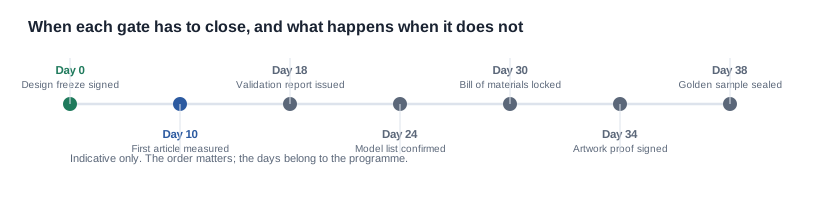
The practical consequence for a buyer planning a release is that the gates have to be scheduled, not just listed. Each one needs a named signer, an artefact and a date, and the dates have to run backwards from the shipment rather than forwards from today. Programmes that treat the gate list as a checklist discover the dates too late; programmes that treat it as a schedule find that three of the seven gates sit on the critical path and the rest do not.
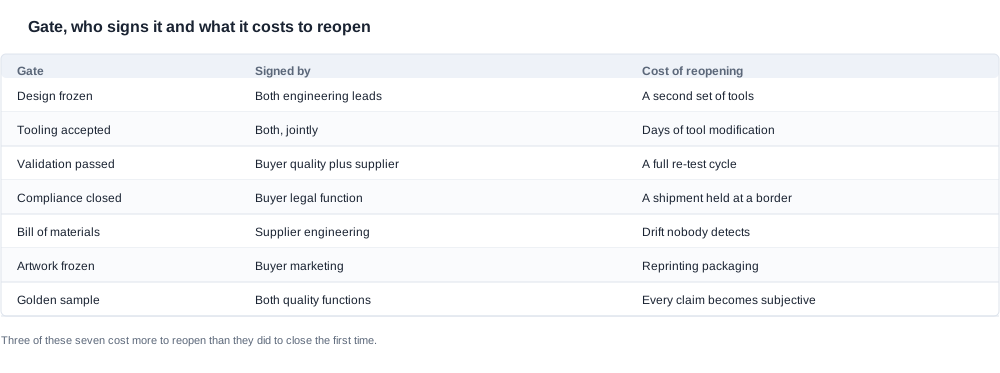
So odm development mass production is best treated as a gating exercise, and each gate below names who actually signs it and what it costs to reopen.

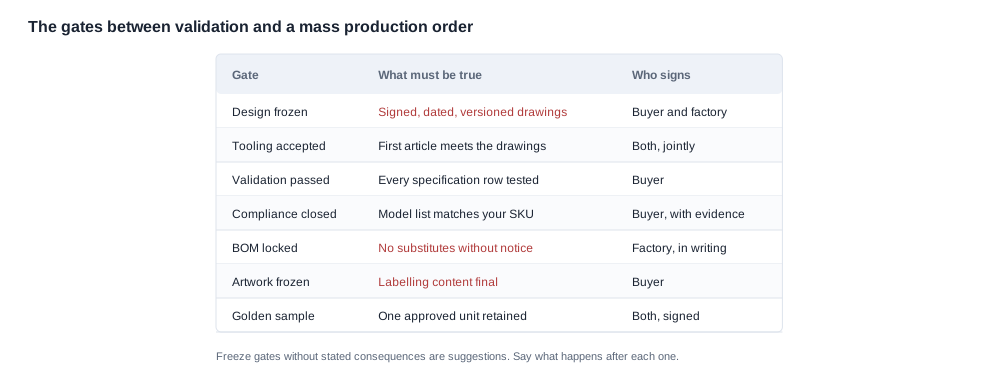
odm development mass production: the seven gates and who signs each
Gate one: design frozen. Signed, dated, versioned drawings with no open items, signed by both parties. This is the gate most often mishandled, because a verbal approval given while somebody is looking at a rendering means different things to the two parties and neither knows what the other intended. Signed, dated and versioned means what it says, and it is the only thing standing between a drawing revision and a second set of moulds.
Gate two: tooling accepted. The first article meets the drawings, measured against them rather than assessed in isolation. Both parties sign, jointly, because this is the point where a design that was reasonable on paper is tested against whether it can actually be made. A first article that fails usually fails on moulding tolerance or on something the drawing did not specify, and tool modification here costs days while the same problem found after production costs a shipment.
Gate three: validation passed. Every row of the specification tested against criteria agreed in advance — not every feature, every row. Passing validation should produce a signed report listing each row, the criterion, the measured result and a pass or fail. Failures are as valuable as passes here: a validation that found nothing usually means the criteria were too loose rather than that the product was excellent.
Gate four: compliance closed. The model list on each document matches the designation being bought, for each market. This is the gate most often treated as administrative and most often the one that stops a shipment. A family-level report that does not name your configuration is a real finding, and it is visible on the header of a document before any money moves.
Gate five: bill of materials locked. No component substitutions without prior written notice. This is the gate that protects the buyer from the failure mode nobody detects until customers report it: a component supplier changes between lots, nobody on the project notices, and the product's behaviour drifts. Microphone and acoustic performance are the most sensitive to this, which is exactly why the retained sample exists.
Gate six: artwork frozen. Labelling content final — manufacturer identity, warnings, battery marking, and any language requirements for the destination market. This is one of the few places where a late change is genuinely expensive rather than merely inconvenient, because changing labelling content means reprinting packaging. Freeze it with a signed proof.
Gate seven: the golden sample retained. One unit from the approved build, signed, dated, photographed and kept. Every subsequent delivery is compared against it. Without one, the phrase "not as ordered" has no agreed referent and every quality conversation becomes subjective rather than measurable.

The gates that fail silently
Three of these seven fail quietly, and the quietness is the problem rather than the failure.
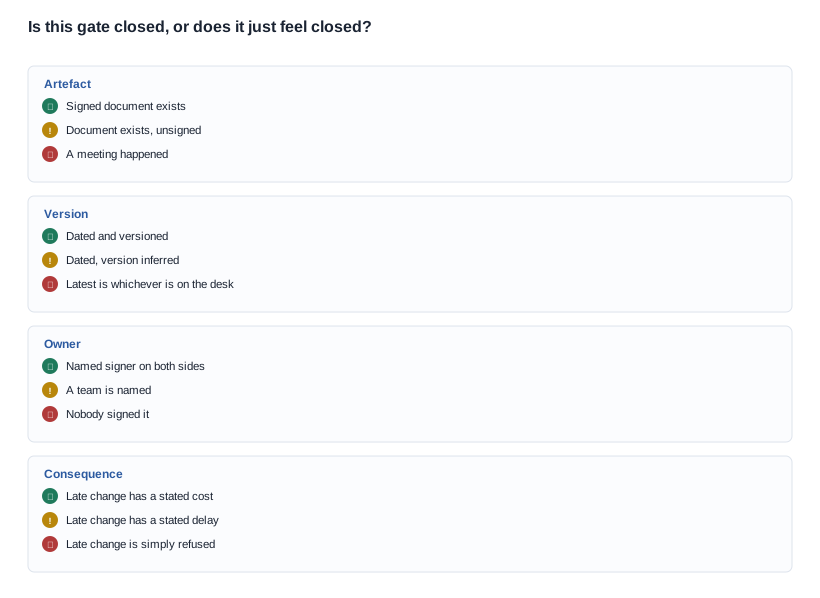
Design freeze fails silently because a rendering was approved in a meeting. Nothing is wrong; two people simply hold different beliefs about what was agreed, and the disagreement surfaces at the point where a drawing revision is requested and someone says the design was frozen. The evidence is a meeting, and the counterparty's evidence is a memory.
Bill of materials lock fails silently because nothing happens at all. The substitution is made for a good reason, usually availability, and communicated to nobody because there is no mechanism requiring communication. Three lots later the acoustic behaviour has drifted and there is no baseline to compare against, which is the specific function the retained sample performs.
Compliance closure fails silently because the certificate number was copied from a previous programme and matches a family rather than a configuration. Nothing looks wrong in the file. The finding appears at customs clearance, and the cost at that point is not the certificate but the demurrage and the relationship with the importer.
The other four fail loudly, which is why they are less dangerous. A first article that does not meet the drawings is obvious on the day. A validation that fails is a report with a red line in it. Artwork that is not final is a printer who will not start. Loud failures are expensive but recoverable; the three silent ones above are the ones that survive into the field.
There is a pattern underneath the three silent failures, and it is worth naming because it is the reason buyers find them surprising. Each of them substitutes an act of communication for an act of confirmation. The design freeze substitutes an approval for a signature. The bill of materials lock substitutes an intention to inform for a required approval. The compliance closure substitutes a plausible certificate reference for a verified one. In each case the parties behaved reasonably and the artefact does not exist, which is why the failure cannot be attributed to anybody and therefore cannot be fixed by asking anybody to be more careful.
The corrective action is the same in all three cases and is worth applying before release rather than after a problem: identify the artefact, name the person who signs it, and put the signature in a place where the next person will look for it. That is a half-hour of work with a disproportionate effect, and it is the difference between a release that is defensible and one that is merely completed.
There is a fourth silent failure that is not in the list because it is not a gate: the assumption that the sample the buyer evaluated is the unit the factory will build. A sample that differs from the production unit in a cell, a colour or a firmware version invalidates every evaluation performed on it, and the divergence is almost always invisible because the differences are small and unremarkable. The design phase covers why that decision belongs much earlier than buyers expect.
What makes a freeze hold: consequences, not requests
A freeze without a consequence is a suggestion, and a suggestion does not change anyone's behaviour. For each gate, state in advance what happens if a change arrives afterwards: who pays, and what it adds to the schedule.
The mechanism is simple and it works immediately. If a drawing revision after the freeze costs a second tool, the requester thinks twice before asking. If a bill of materials substitution requires written approval from a named buyer, the engineer checks whether the alternative is acceptable before proposing it. If a late artwork change means reprinting, the marketing team freezes the content before the print run rather than after it. None of these is an instruction to be more careful; all of them are price signals, and price signals change behaviour far more reliably than requests do.
What to write, specifically, is three lines per gate: who may authorise a change after the freeze, what it costs, and how long it adds. Gates with different consequences get different treatment, and a buyer who applies one rule to all seven will either over-control the cheap gates or under-control the expensive ones. The artwork gate is worth a full repackage. The design gate is worth a second tool. The golden sample gate is not really reversible at all, which is why it should be closed last and sealed.
The test for whether a consequence is written well is whether it can be applied without a conversation. "Changes after the design freeze require a second tool, which the requesting party pays for" can be applied. "Changes after the design freeze should be avoided where possible" cannot, because there is no event that triggers it and nobody can determine whether it has been honoured. The second form is much more common in contracts and programme notes than the first, and it is worth converting one clause at a time as the programme runs rather than waiting to redraft everything.
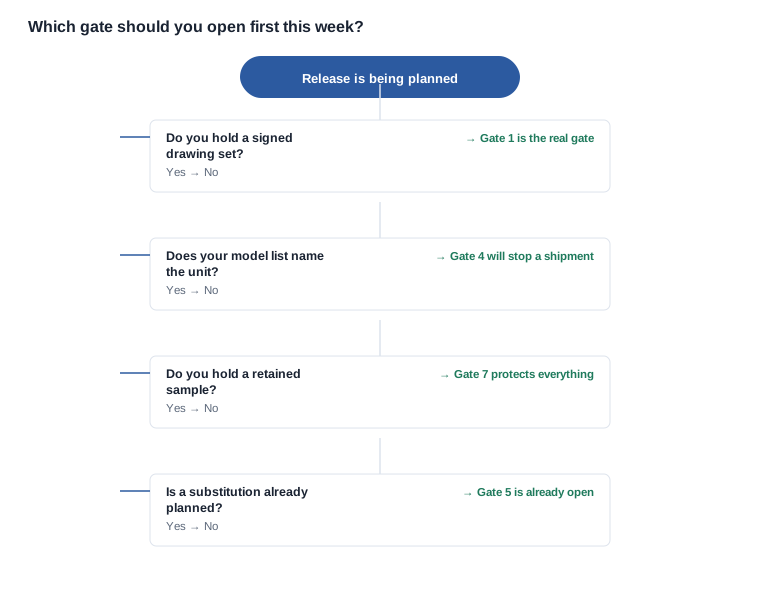
There is one further element that costs nothing and changes more than expected: a named person on each side who may refuse a change without escalating. Without one, every late change becomes a negotiation between organisations rather than a decision between engineers, and whoever is best placed to judge the impact is whoever cannot commit to it.
That element is worth more than it appears, because it changes the position of the engineer who spots the problem. An engineer who knows a change will need escalation cannot raise it casually, so it is raised late — after the tool is cut, after the artwork is at the printer, after the substitution has been made. An engineer who can refuse a change on the spot raises it immediately, when it costs a conversation. The whole mechanism rests on giving the person closest to the work the authority to act on it, and the authority is what changes the timing.

What a golden sample is for, and what it costs to keep
The retained sample is the cheapest of the seven gates and the one buyers most often drop, usually because it seems administrative until the first claim arrives and everyone discovers what "not as ordered" means without one.
It does four things. It gives every subsequent quality conversation a shared referent rather than an argument about standards. It makes drift visible — a component change, a process adjustment, a material lot variation — because a comparison is possible. It supports the acoustic and camera characteristics that no published specification describes, which in our range is most of them. And it lets a buyer's own team evaluate a later production unit without a new programme.
What it costs is storage, a labelling convention that survives handling, and a rule about who may inspect it. The rule matters most: a retained sample that gets used for destructive testing is no longer a retained sample, and a programme that discovers this during a claim has already lost the evidence. Two units, one retained and one available for test, removes the ambiguity for very little money.
There is a second thing the retained sample does that is easy to miss, and it matters more than the claim use case. It gives the buyer's own team a way to evaluate a later production unit without opening a new programme. Teams that receive a sample from a repeat order can compare it against the retained unit themselves, in their own facility, under their own conditions. Teams without one raise a question with the supplier and wait. The first arrangement takes an hour; the second takes a fortnight and produces a less specific answer.
What to ask about the retained sample, before release, is three things: how many units, how they are identified, and who may open the box. A programme that answers all three has done the gate. A programme that says one unit and does not say how it is marked has deferred the decision, and the decision will be made by whoever first needs to look inside.
There is also a question about the relationship between the retained sample and the acceptance criteria, and it connects back to gate three. If the criteria were written loosely enough that almost anything passes, the retained sample becomes the real standard — which is workable but accidental, and it means the standard is whatever that one unit happens to be. It is better to have criteria and a sample than either alone, because criteria tell you what you are looking for and the sample tells you what you got.

Who signs, and why the buyer needs its own signature on each
The gate list above names a signer on each side for a reason that is easy to understate. In most programmes the buyer's signature is collected once, by a person whose job is programmes, and the people whose jobs depend on the outcome — quality, legal, marketing — are asked to approve informally. The gates then close on paper and reopen in practice.
The fix is unglamorous: the buyer needs a named signer per gate, and that person needs the authority to say no without escalating. A quality engineer who cannot reject a first article is not signing it, and the signature on the document is a formality that protects nobody.
It is worth mapping the seven gates to the buyer's own functions before release, because the mapping exposes gaps. Design and tooling belong to engineering. Validation belongs to quality. Compliance belongs to legal or regulatory. Bill of materials belongs to engineering with quality informed. Artwork belongs to marketing with legal reviewing the claims. The retained sample belongs to quality. Where a function has no signer assigned, that gate will be closed by whoever is nearest, which is how gate five in particular ends up closed by nobody.
The supplier's side works the same way, with one difference that buyers should ask about: whether the supplier's signer for the compliance gate is the person who can obtain the missing documentation, or the person who reports on it. The distinction determines whether the gate will close in two weeks or in two months, and it costs one question to establish in week one.
The same question applies to the bill of materials gate on the supplier's side, and it matters because that gate is usually signed by a purchasing or supply chain function rather than an engineering one. A purchasing function will honour a rule about written approval because it is a rule about paperwork. An engineering function will honour it because it is a rule about the product. Both can sign the gate, but only the second will notice a substitution before it is made rather than after, and the difference between noticing and not noticing is the difference between a notification and a drift.
Before you commit to a release date, the practical test is whether every one of the seven gates has a name against it on the buyer's side and on the supplier's. Where one does not, that gate will be closed by proximity rather than by decision — by whoever is in the meeting, or by whoever notices first, or by nobody at all. Which of those happens is not a question of process maturity. It is a question of whether anybody was ever asked.
What our published data can close, and what it cannot
Each of these gates should close with an artefact you can hold, and we will not present a gate as closed when its output is a conversation. That includes saying plainly when a gate cannot be closed from our published position.
Several gates close easily because our catalogue publishes what they need. The design gate closes against signed drawings rather than catalogue data. The tooling gate closes against measurement. The artwork gate closes against the destination market requirements. But the validation gate depends on acceptance criteria, and the criteria in several areas cannot be written from what we publish.
Specifically, the frame material composition is Not published, the frame weight is published for a single model across the range — 158 g for the MT6 — and Not published for the rest. The camera sensor model, the field of view and the video specification are Not published. The microphone and acoustic figures are Not published, and no third-party acoustic measurement supports any model in our range. Ingress test report numbers are Not published beyond a single catalogue marking. No certificate numbers are published, with the CE, FCC and RoHS position claimed for the adult models and specific model numbers awaiting confirmation.
Where a row cannot be closed from published data, the row stays open with a named owner and it is not closed by assumption. That is uncomfortable and it is correct, because the alternative is a validation report containing a plausible number that nobody measured — and a plausible number in a validation report is worse than an open row, because it will be relied on by somebody who cannot tell it was invented.
The distinction between an open row and a closed row with a weak criterion is the one that costs money. An open row costs a request, a lead time and sometimes a measurement. A closed row with a weak criterion costs nothing until the day somebody relies on it, and at that point the cost is a claim the buyer cannot defend and a specification the supplier never agreed to. Buyers under pressure to release will accept the weak criterion because it is faster, and the discovery that it was weak usually arrives from a customer rather than from a test.
There is a middle position, and it is worth knowing about it because it is often the correct one: close the row against a stated method and a stated tolerance without a stated number. The row is then closed in the sense that the criterion exists and the measurement is scheduled, and the report says "pending measurement against method M" rather than asserting a value. That is defensible, it is honest, and it is compatible with shipping a small pilot batch rather than a full production run.
What we will do, for a named programme, is state which of the seven gates we can document from our own records, which depend on information we have not been given, and which require a measurement to be commissioned with a method agreed first. The pilot run stage and the documentation stage both come back to the same point: the artefact, not the intention.
Send us the gate list against your programme and we will tell you which ones we can document and which depend on information we have not been given.
Related reading
- ODM development and validation
- The documentation a programme has to produce
- Engineering customisation review process
- The pilot run and what it proves
Send the gate list and I will say which we can document and which we cannot.


