
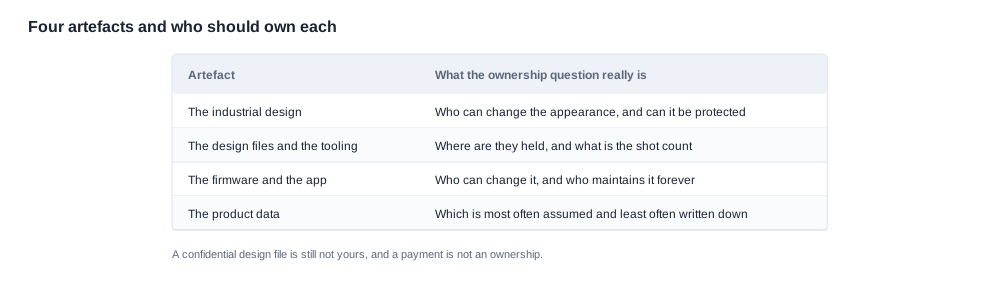
Intellectual property in an ODM programme is a question about who owns which artefact, and the reason it gets muddled is that "the design" is treated as one thing when it is at least four, each with a different owner and a different practical significance. A clause that says the buyer owns the design protects nothing in particular, because it does not say which of the four, in which version, in which format, or held where.
The most consequential distinction in this category is between the shape of the thing and the software in it. A brand that owns the industrial design but not the firmware owns the part of the product that is visible on a shelf and not the part that determines what happens when a customer uses it — which is the part that determines whether the customer's experience still exists in three years if the relationship ends.
Our published position shows what is at stake. The published customisation record is not a single list across our range — the camera tier carries seven recorded items, the audio tier five, the sport tier five and the children's tier two, each set different from the others — so the commercially sensitive material is the design and the software. What a buyer should ask is which of those recorded entries generate an asset that would be owned outright and which generate an asset that would only be licensed. Colour options are published for the V03 Pro in three and for the V06 in four, which means those colourways are ours and are documented; anything else about colour is a custom development. Confidentiality protects material; ownership determines whether you can do anything with it. The non-disclosure agreement is the mechanism for the first, and it does no work at all for the second.
So odm development ip ownership is a question about which of the four artefacts the buyer ends up with, in a form it can actually use.
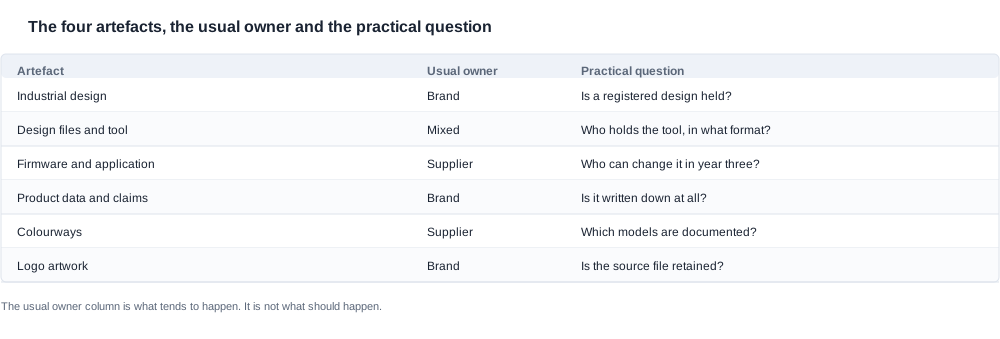
odm development ip ownership: the four artefacts and their owners
1. The industrial design. The frame geometry, the temple profile, the surface finishes. This is the artefact a brand is most likely to want to own outright, and it is also the one that is hardest to protect without a registered design — because a registered design protects appearance rather than construction, which means a competitor can build something that looks different and works the same way, or looks the same way and is not infringing. Registered rights are jurisdictional and are a legal function's matter, not a contractual one.
2. The design files and the tooling. The CAD, the tooling drawings, the moulds. The practical questions are four, and they are all separate: who owns the files, in what format they are held, who owns the tool, and where the tool physically is. A tool held at a supplier with no ownership record is an asset that neither party controls, and the absence of a record is the finding — not the location.
3. The firmware and the application. The source, the build system, the release process and the roadmap. The critical question is not who wrote it but who can change it and who maintains it. A branded application is a permanent obligation rather than a deliverable, and our published position is that the feature details — which models are supported, where the processing runs, whether a subscription applies and where the data is held — are all Not published, which is exactly the material a brand would not want a competitor to hold and cannot easily replace.
4. The product data. The claims, the images, the listings, the field data and the customer information. This is the artefact most often assumed to be owned because the brand paid for the work and least often written down anywhere. It is also the one that matters most if a programme ever ends badly, because the customer relationship does not transfer with the product.
Each of the four has a different failure mode, and mixing them up is what makes ownership clauses vague. The industrial design fails by being protected in principle and unenforceable in practice, because nobody registered anything in any jurisdiction and nobody checked which jurisdictions matter for the buyer's markets. The design files and tooling fail by being handed over in a format that cannot be manufactured from, or by being located at a supplier with no ownership record at all. The firmware and application fail by being assigned in principle and controlled in practice by whoever holds the repository. The product data fails by never being mentioned.
The order of difficulty is worth keeping in mind, because it determines where a buyer should spend negotiating effort. Getting the industrial design right is the easiest of the four and the one with the highest visibility, which makes it the one buyers spend the most time on. Getting the tooling position right is harder and matters more, because the tool is the only one of the four that physically exists and is therefore the only one that can be moved, damaged or lost. Getting the firmware position right is the hardest and is usually deferred to a change request nobody reads. The product data position is the easiest to agree and the one most often left out entirely.
There is a fifth question that belongs in the set even though it is not about an artefact at all: what happens to the ownership position if the supplier's own ownership changes. Corporate ownership can transfer, can be pledged to a lender, or can sit with a group entity that did not sign the contract. A buyer who has taken an assignment from the wrong entity discovers this at the worst possible time, and the answer is to name the entity that owns the artefact rather than the company that happens to be selling.
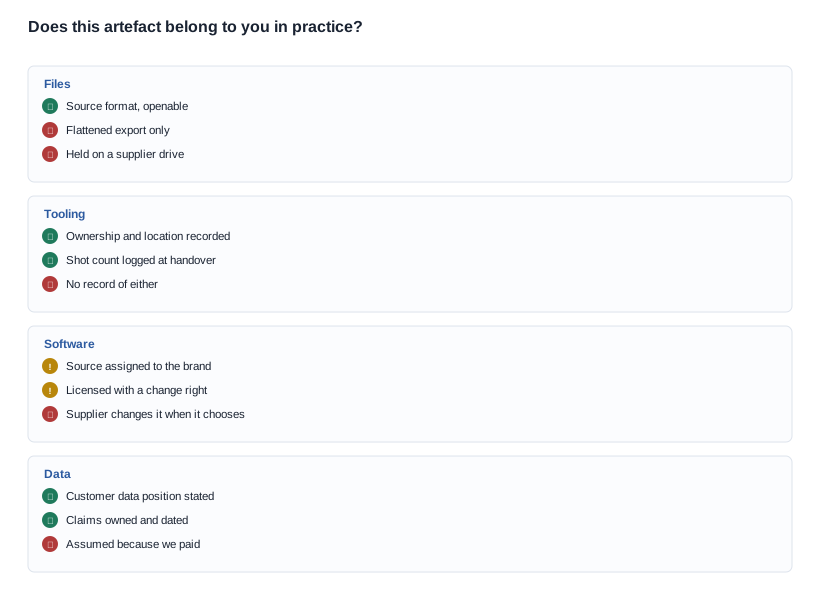
Two further artefacts sit outside these four and are worth naming, because both are routinely assumed into the first two. The logo artwork and the packaging artwork are design files with an owner, a version and a print process, and they are handed over as flattened press-ready files more often than as editable sources. The bill of materials and the test records are neither design nor software, but they carry the most operational value of anything in the programme, and they are usually held by the supplier with no stated position at all.
What to ask when the answer is that it is the platform
"That is the platform" is a reasonable answer to an ownership question and a poor place to end the conversation, because it means the artefact predates the programme and was created for someone else. What matters is not whether that is true but what follows from it, and the follow-up questions are always the same four.
How long has it existed, and has it been used on other products. If the answer is that the industrial design has been on a previous programme for another brand, the buyer's position is much weaker than the buyer's expectation, and knowing that in week one is worth a great deal.
What was changed for this programme specifically, and who owns that change. Customisation for a specific buyer is a much stronger position than the underlying platform, and the difference is usually documented somewhere even when nobody has looked.
Whether an exclusive arrangement is available, and what it would exclude. In this category, exclusivity is frequently available and rarely worth as much as buyers hope, because it usually excludes the supplier from serving the specific competitor rather than preventing that competitor from building something similar on a different platform.
What it would cost to transfer, if transfer is possible at all. Some platform material cannot be assigned because it incorporates third-party technology with its own terms — a licensed chipset, a licensed software stack, a licensed design element — and the honest answer in those cases is a licence with limits rather than an assignment. That is a perfectly workable outcome provided the buyer knows before signing rather than during a dispute.
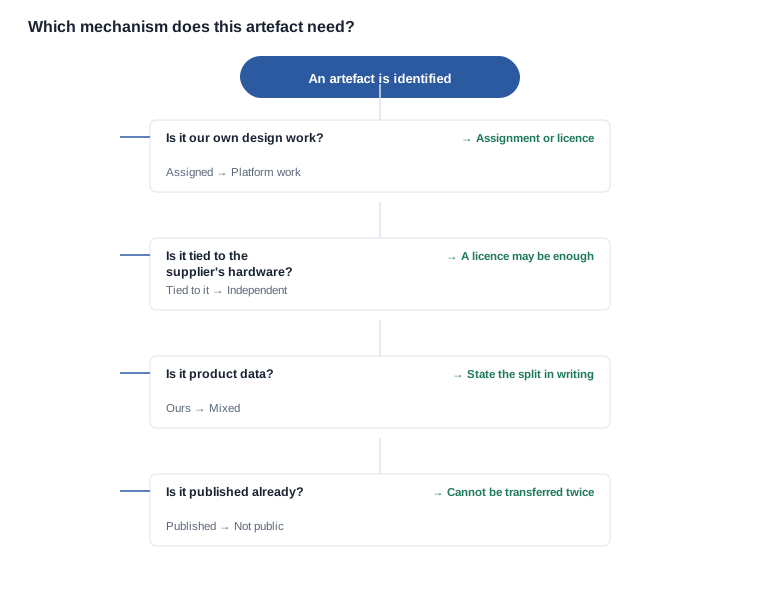
What to ask next, having received that answer, is the one that separates a usable arrangement from an unusable one: what would the brand have to do differently if it wanted to build this product with somebody else. The answer is the actual cost of the ownership arrangement, expressed in work rather than in money, and it is usually a far better basis for negotiating than any percentage of the tooling cost.
How to evaluate the answer itself, before you commit, is straightforward. A supplier who explains what is platform, what is custom, what is licensed and what cannot move is giving you a usable position. A supplier who says everything can be assigned without qualification has either not thought about it or does not intend to be held to it, and in both cases the buyer will find out later.
The five questions to ask before you sign anything
- Who owns the design files, and in what format are they held? A format the buyer cannot open is not ownership. Ask to receive one file before signing, not after the relationship has become difficult, because a supplier who declines to demonstrate the format is telling you something.
- Who owns the tooling, where is it physically held, and what is the maintenance position? A tool with a recorded shot count and condition is an asset. A tool without one is a hope. The maintenance position matters more than the ownership position, because a tool that has not been maintained will need work before it can produce an acceptable part again.
- Who owns the firmware source and the application, and who maintains them? Then ask the second half of the question, which is the half that matters: what happens to the customer experience if the arrangement ends. An arrangement where nobody maintains the application leaves the buyer's customers with an application that stops being updated, and the buyer discovers this at the worst possible moment.
- What registered rights exist, if any, and in which jurisdictions? Including whether a design has been registered, whether a mark has been filed, and whether either is pending. The answer changes nothing commercially on day one and changes everything in a dispute.
- What is the position on the product data, the claims and the customer information? Specifically: who owns the listing content, who owns the customer list, what happens to both on termination, and whether the supplier has any right to use the buyer's product data for anything at all.


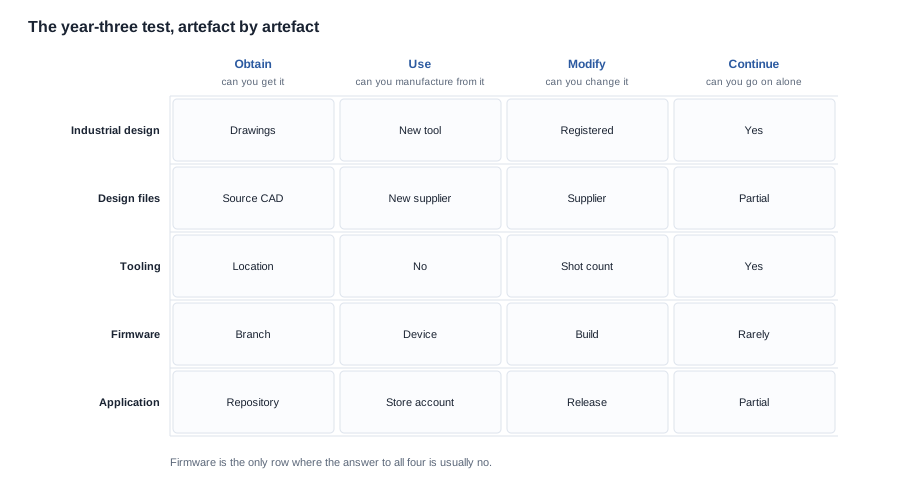
The year-three test: can the brand continue the product?
This is the question that decides whether an arrangement is workable, and it is asked in this form because it is the only version that produces a useful answer. Most ownership conversations happen at signature, when both parties are optimistic and neither has information. The year-three test converts an abstract question into four concrete ones.
Can the brand obtain the design files? In a form that a different manufacturer could use. Not a flattened export, not a printout, not a promise to provide them later.
Can the brand use them to manufacture? Which requires that the files describe the current product, not the product as first designed. Design files drift from the built article, and a handover of the original files rather than the current ones produces a product that differs from the one that was approved.
Can the brand modify them? Which is a different question again, and the one that a registered design or a platform licence may restrict even where ownership does not.
Can the brand continue without the supplier? Which requires all of the above plus the tooling, plus the documentation, plus — hardest of all — the firmware branch and the application.
Two further questions belong in the same set and are asked even less often. Does the brand need exclusivity, and if so from whom — because an exclusive arrangement in a category where a competitor could take the same platform and brand it differently is worth little, while costing the supplier the ability to serve others. And what happens to a design change the brand does not want: if the manufacturer owns the industrial design, the brand's ability to protect its identity is limited to the parts it owns, and its ability to stop a change is close to zero.
The trade-off between breadth and security is the one buyers most often resolve by default. A broad assignment — all artefacts, all versions, all territories — feels strong and can be weaker in practice than a narrow assignment with an audit right, because a broad clause invites the supplier to resist it in negotiation, and a clause resisted at signature is a clause that will be interpreted narrowly at the point of dispute. A narrow, specific assignment with a defined format, a defined location and a stated right to inspect is usually easier to obtain and easier to enforce. That is a trade-off worth knowing about before you spend negotiating capital on the wrong clause.
There is a sequencing point too. Ownership and confidentiality are different mechanisms doing different work, and the confidentiality discussion sets out the four categories of sensitive material. An agreement can perfectly protect a design file the brand does not own, and a brand can perfectly own a design file nobody else is obliged to keep confidential. Buyers routinely conflate the two because the same nouns appear in both documents, and the consequence is that a confidential design file is still not yours.

Five mistakes that look like ownership and are not
1. Assuming the design belongs to the brand because the brand paid for it. Payment is not ownership, and in an ODM the design is frequently the manufacturer's platform modified for the buyer. The honest question is not whether you paid but whether what you paid for was created for you or adapted from something that existed first.
2. Accepting a design file handover that is a flattened export, which cannot be used to manufacture anything and cannot protect anything. A flattened file is a picture of a design, not a design, and receiving one and believing it to be the second is a common and expensive error.
3. Leaving the application in a grey area. If the application is the manufacturer's and carries the brand's name, then the brand's customers are in a relationship with the manufacturer, and the maintenance obligation exists whether or not anyone wrote it down. Grey areas in this category resolve themselves, and they resolve in favour of whoever has the source code.
4. Not recording the tooling's condition at handover, which is the exact point at which the shot count and the maintenance history stop being known. Whatever condition is recorded is the condition that will be argued about.
5. Treating the confidentiality agreement as doing the ownership work. It does not. An agreement can be exemplary, can be enforced, and can leave the brand owning nothing it can use.
A sixth mistake deserves naming because it is the most common of all and the least visible: assuming the ownership position transfers from the programme to the range. The first programme has a contract, a named contact and attention. The fifth model in the range does not, and by then the person who knew the position has moved on. What to ask, in year two, is a single question: which artefact did we assign, which did we licence, and where is the record of each. If nobody can answer in a minute, the position was never written down.
What we can assign, what we licence, and what we cannot transfer
We will put the ownership position for each of the four artefacts in writing, separately from the confidentiality terms, and we will tell you plainly which ones we can assign, which ones are the platform's, and where the practical answer is a licence rather than an assignment.
We will also be direct that our published catalogue — the configurations, the electrical rows, the colour options and the general technology descriptions — is published and cannot be made confidential or transferred twice. The confidential material is the part that is not published: the design files, the firmware, the application, the commercial terms and the certification position.
Three distinctions do most of the work in practice, and it is worth asking about each of them directly. Assignment versus licence: a licence is a permission that can be limited by scope, territory and duration and that ends on a stated date, while an assignment is a change of owner that does not. Platform versus custom: a modification made specifically for a buyer is a far stronger ownership position than an adaptation of something that already existed, and the difference should be priced rather than assumed. Artefact versus process: owning a firmware branch is different from owning the release process, and the second is what determines whether the first is useful.
The practical way to use those three is to ask for a table rather than a clause. Four rows, one per artefact, three columns — what we own, what we licence, what we hold as platform — with a line under each cell describing the limit. It takes an hour to produce, it is the only artefact most buyers will still be able to find in year three, and it makes the negotiation concrete rather than abstract.
There is one thing we will not do, which is worth stating because it is asked for. We will not assign ownership of material that was not created for the buyer and that a third party may itself have claims over, because assigning it would be a statement we could not stand behind. What we can offer in that case is a licence with a stated scope, a stated duration and a stated right to a new supplier for continuity, and we will say clearly which of those three terms we can and cannot meet for a given programme.
That answer is more useful than a yes, and it is worth explaining why to a buyer who expected one. A supplier who assigns everything has either created more than the buyer paid for or is accepting an obligation it cannot perform, and in this category the second is the usual case. Buyers who understand that the honest answer is a structured licence will negotiate the licence terms — scope, duration, continuity — instead of spending months discovering that the assignment clause is narrower than the expectation behind it.
What we would ask a buyer to do, in return, is equally simple: tell us which artefacts the business genuinely needs to own rather than which ones it would prefer to own. That distinction is the whole negotiation. A business that needs to own the tooling position has a clear, achievable ask. A business that wants to own everything has an ask that will be resisted for reasons that are about the platform rather than about the buyer, and resisting it costs the relationship more than conceding it would.
If you tell us which artefacts your business needs to own, we will say which of them we can transfer, which will need a licence, and which we would hold as platform. The protection discussion covers the registered-rights side, which is a different mechanism from contractual ownership and is worth planning before the first tooling release rather than after a dispute.
Related reading
- OEM intellectual property protection
- ODM development confidentiality
- Can you sign an NDA
- ODM development
Tell us which artefacts you need to own and we will say which we can transfer.


