
NRE and tooling are the two costs a buyer is least prepared to see, and they arrive at the same moment, which is usually the moment a programme's economics change. The reason is that both are one-off costs that a unit-price-focused buyer has not modelled, and because they are usually quoted as a lump rather than as a line that can be examined and amortised across a volume.
The distinction between them matters more than the total. NRE is the engineering work that makes the product exist in a particular configuration; tooling is the physical means of making the physical part. They behave differently in almost every way a buyer cares about — when the cash moves, how negotiable they are, what causes them to change, and what happens if the programme goes wrong — and a buyer who treats them as one number will negotiate the wrong one hard and accept the other.
So odm development nre and tooling is best understood as two separate commitments with two separate lives, and this article sets out what belongs in each, what a buyer should ask to see in a quotation, and where the line is most often drawn incorrectly.
odm development nre and tooling: the two commitments and how they behave differently
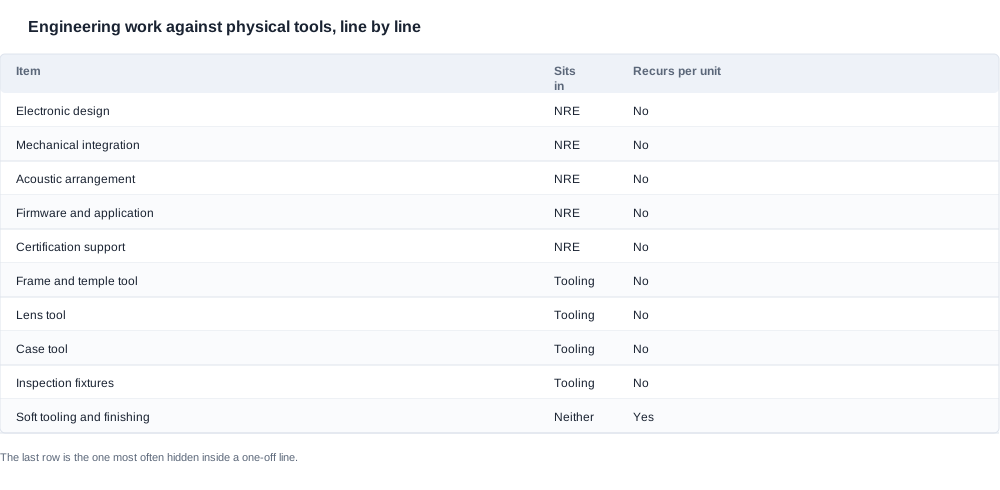
NRE is spent before anything exists. Tooling is spent to make something exist. That single sentence explains most of the practical differences, and it is worth following through because the differences determine what a buyer can do.
Cash timing differs. NRE is generally payable across the development phases, in instalments tied to milestones, which means a buyer funds work before seeing anything. Tooling is generally payable around the release, in a deposit and a balance, which means the cash lands later and in a larger single event.
Negotiability differs, and this is the one buyers most often get wrong. The unit price is the most negotiable figure in the programme because it depends on volume, on term and on the commercial relationship. NRE is more negotiable than most buyers assume, because its scope is a judgement rather than a measurement — a different decomposition of the same engineering can produce a different total. Tooling is the least negotiable of the three, because a tool is a physical object made to a specific drawing and its cost is driven by the geometry rather than by the relationship.
What causes them to change differs, and this is where the risk sits. NRE changes when the requirement changes. Tooling changes when the drawing changes. Those are not the same trigger, and a programme that freezes the specification but leaves the drawing open has not closed the tooling exposure — it has only moved it from one document to another.
There is a fifth difference that is easy to miss because it only appears when something goes wrong. NRE, once spent, is gone; tooling, once made, is a physical asset that persists. That asymmetry means the recovery options after a problem are not symmetric either. A programme that needs to change its engineering can sometimes absorb the cost by extending a phase, because engineering time is the one input that can be bought in quantity. A programme that needs a different tool cannot do that at all, because tool shops work in sequences and inserting a tool into a full queue moves everything behind it. Any assessment of how quickly a programme can recover from a mistake has to weight those two inputs very differently, and most buyers weight them the same way.
The practical consequence is a rule that is easy to state and easy to follow: protect the drawing with more care than you protect the specification, even though the specification feels more important. The specification can be changed for money. The drawing cannot be changed for anything once the tool is cut, and the only moment when changing it is cheap is before anyone has committed a tool shop slot.

What counts as NRE, line by line
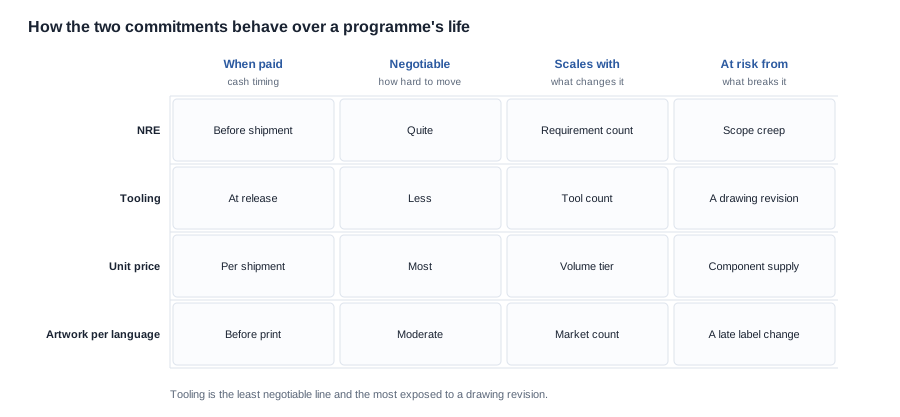
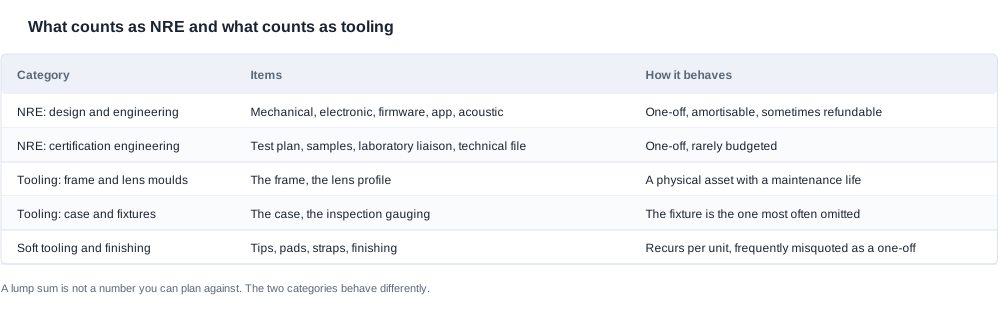
Design and engineering. Electronic design, mechanical integration, the acoustic arrangement where there is one, and the firmware and application work. In our range the acoustic and optical arrangements are the expensive part of the design, because a camera module inside a temple, a bone conduction transducer with a 35 dB gain, and an electrochromic lens each change the mechanical design rather than simply adding a part.
The tooling engineering. Tool design, trial shots, corrections and validation runs. This is frequently quoted inside the tooling figure rather than as NRE, and it is worth separating out for a specific reason: the first article's quality depends on it, and the cost of a badly prepared tool is effectively paid twice — once in the tool correction and once in the production output that has to be reworked.
The certification engineering. Test plan, sample preparation, liaison with the laboratory, and the technical file. This is NRE in the sense that it is one-off work, and it is the part most often not budgeted at all. Our published position is that no CE, FCC or RoHS text appears for the adult models, that no certificate number exists for us to quote, and that we hold no published certification position for the children's models either, so the scope of this work is not something a buyer can assume is small.
The documentation and artwork. Manual, packaging, labelling per market and translations. The per-language artwork is a recurring cost even though the artwork file is a one-off, which is one of the places where the one-off line quietly contains something that returns every year.
Two items sit on the boundary and are worth deciding explicitly rather than by convention. The first article is arguably NRE and arguably production, and the answer changes how it is approved — as a development deliverable or as a production unit. Calibration is arguably recurring and is frequently bundled into a one-off. Both are small individually and both become disputes when a buyer's forecast turns out to be different from the supplier's assumption.
The way to settle a boundary item is to ask what happens to it when the programme stops. If it stops being needed entirely, it was one-off. If it recurs at the next order, it was recurring regardless of how the first one was billed. That single question resolves most of the ambiguities in a single afternoon, and it produces a list that both sides can sign because it is derived from the programme's own behaviour rather than from a convention.
What counts as tooling, and which tools a programme actually needs
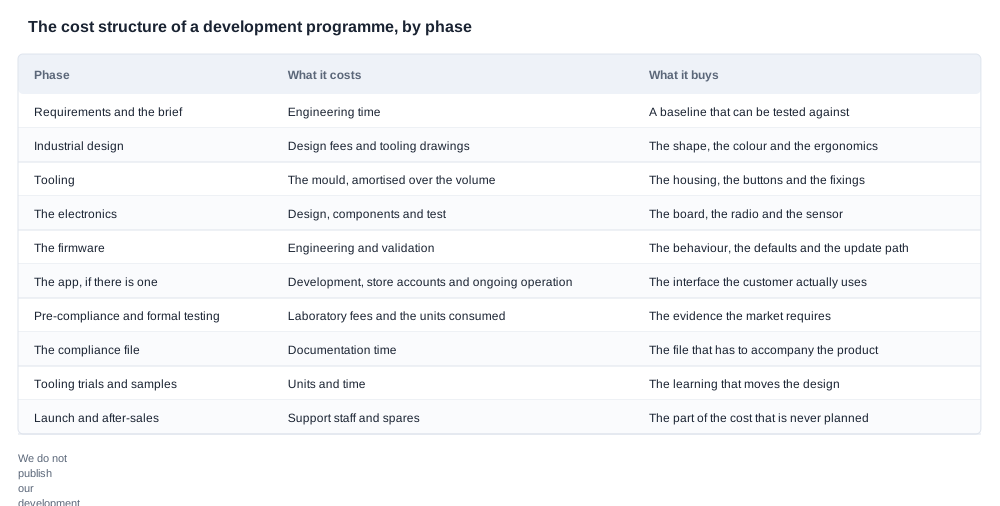
The frame and temple moulds. The largest item. Whether a new mould is needed depends on whether the programme uses a published frame geometry or changes the cross-section, and the battery decision is what changes it — a temple carrying a cell, a protection circuit and a board needs a different section from an optical temple.
The lens tooling, where the lens profile is specific to the buyer's frame.
The case tooling, where a charging case is part of the product. Our range publishes case capacities at 900 mAh, 1200 mAh and 1400 mAh, which are separate moulded components with their own tools — a case capacity change is therefore a tooling question and not only a configuration question.
The soft tooling and finishing. Silicone tips, pads and straps, plus finishing processes. These recur per unit and are frequently bundled into a one-off line by mistake, which is the single most common itemisation error we see.
The fixtures. The gauging required by the first-article inspection plan. Rarely quoted as tooling, and frequently discovered to be missing at the pre-production stage, when the inspection cannot be performed as designed.
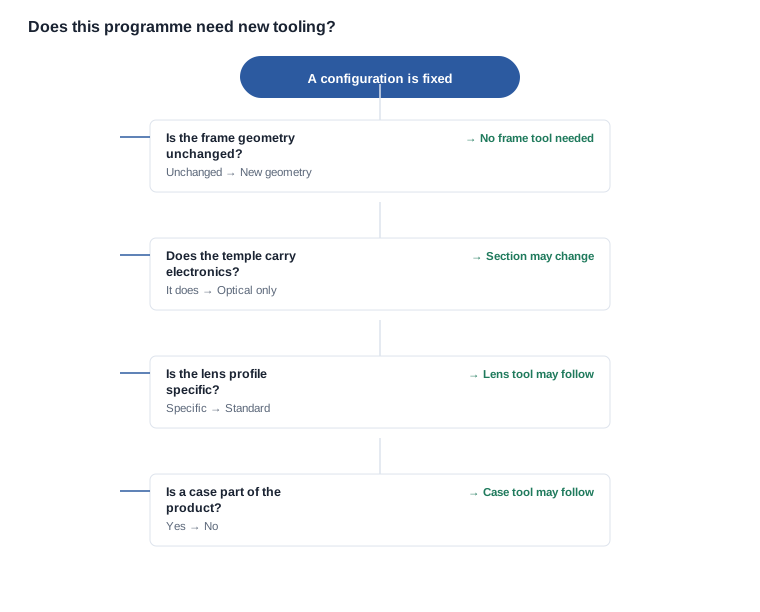
The sequence in that decision tree is worth following in order, because the questions are ordered by cost. If the frame geometry is unchanged, the rest of the questions may still matter but the largest tool is off the table. If the geometry has changed, the temple cross-section usually has to change with it, and if the temple carries electronics it changes substantially. Only after those two are answered do the lens and the case become relevant. Buyers frequently work backwards from the case because it is the visible retail object, and end up paying for a frame tool they did not need.

The four questions that turn a lump sum into a plan
- What is the tooling line made of? Broken into the frame, the lens, the case and the fixtures, it is comparable between suppliers. As one number, it is not comparable with anything, and it cannot be checked against a second quotation for the same configuration.
- Is the NRE refundable or amortised? Some programmes credit it against the unit price at a stated volume and others do not. The difference changes the effective cost of the first order substantially, and it is the difference between a one-off and a per-unit charge that stops at a threshold.
- What is the amortisation volume? If a fixed NRE is spread over 500 units, the first order carries a far higher effective unit cost than the five-thousandth. A buyer who has not modelled this will be surprised by the price of the first order and may conclude that the supplier has mispriced it, when in fact both numbers are correct for different volumes.
- What is the tooling maintenance position? Tools wear, and a programme that has not agreed who pays for maintenance will have that conversation at the worst possible moment. A tool with a recorded shot count and a maintenance history is an asset; a tool without either is a liability that nobody has valued.
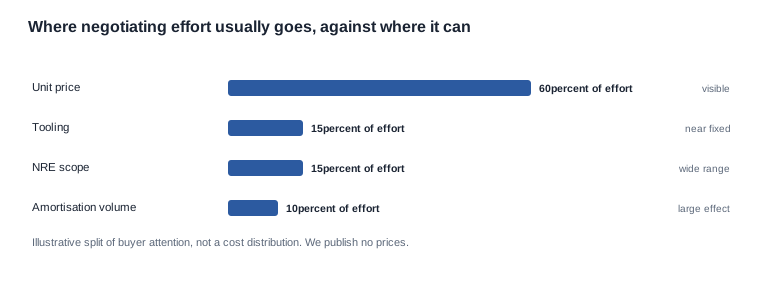
Those four questions also determine how to spend negotiating effort, which is the part the chart above is about. The unit price attracts most of the attention because it is the most visible and the most quotable, and it is genuinely the most negotiable of the three. But the amortisation volume and the NRE scope have a larger effect on the total than a few points of unit price, and both are settled by a question rather than by pressure.
Four mistakes account for most of the bad positions. Negotiating the unit price hard and accepting the tooling charge, when the one-off is frequently larger than the unit price. Accepting a one-off that contains recurring costs — soft tooling, finishing, per-language artwork and calibration — which are the items that quietly become the margin. Not separating the first article from the production run, so a design change made after it is the most expensive change available. And treating the tooling as the supplier's problem, which is what happens when nobody asks who owns the tool and where it is held. The tooling requirements page covers that position in more detail.

There is a fifth mistake that is easier to miss, because it looks like prudence: deferring the tooling decision to the sample stage to keep the first order small. A programme that has not decided whether a new tool is needed will find out at the moment when changing the answer is most expensive, and the outcome is usually that the smaller option was not actually available. The tooling question belongs in the design phase, where it costs a conversation, rather than in the pre-production phase, where it costs a schedule.

Why the one-off and the unit cost diverge
There is a structural reason the two numbers look the way they do, and understanding it removes most of the surprises buyers describe. A one-off cost is not divided by anything unless somebody divides it. The division happens when someone chooses a volume to amortise over, and that choice is made for convenience rather than derived from the programme — which is why the effective unit cost of a first order is usually much higher than the number a buyer had in mind when the total was approved.
The second reason is that the two numbers move in opposite directions under pressure. If the specification grows, the engineering grows and the unit price stays roughly where it was. If the volume grows, the amortised part falls sharply while the unit price falls slowly. The result is a programme whose total cost is dominated by one-offs for its first year and by unit cost for its third, and a business case built on the year-one number will look wrong in year three even though nothing has gone badly.
What follows is practical rather than theoretical. Model the programme at three volumes rather than one — the first order, a plausible twelve-month figure, and a figure you would be pleased to reach — and do the arithmetic for each rather than applying a single amortisation. The programme that looks acceptable at the first volume and unacceptable at the twelve-month figure is telling you something real about the volume assumption, and that is far cheaper to discover on paper.
There is a second modelling habit worth forming: separate the part of the one-off that is genuinely one-off from the part that stops when you stop paying for it. Trial shots, calibration and initial artwork are one-off. Maintenance, finishing, per-language artwork updates and ongoing certification are not, and they belong in a different year of the plan. Buyers who put all of it in year one have not miscalculated; they have answered a question nobody asked, which is why the plan gets rebuilt in year two and the rebuild is attributed to the supplier.
Neither of these habits requires a price from anyone. Both of them require knowing which lines are which, and that is exactly what a properly itemised quotation provides.
There is a third modelling habit, and it is the least common. Write down what the programme would need to do differently if the volume turns out to be half of what was assumed — not the figure, but the action. A programme with a tool designed for a particular geometry and a bill of materials arranged around a particular order quantity has a fairly small set of answers at half volume, and identifying them before the order is far cheaper than discovering that the answer is "reorder at a different price", which changes the buyer's business rather than its plan.
The same exercise works in reverse. Write down what the programme would need to do if a component became unavailable six months in. Most programmes have an answer that involves substituting and re-validating, and a few have no answer at all. The ones with no answer are the programmes where a single supply interruption becomes a supply problem, and identifying them is a paperwork exercise rather than an engineering one.
The fourth of those questions is the one answered least often, and it is the one whose answer matters most once the programme is behind you. A tool is a physical asset that outlives the programme that paid for it, and the buyer's position in it is settled by what was written down rather than by how the relationship felt at the time.
Four specifics separate a supplier you can plan around from one you have to negotiate with after the fact:
- Who owns the tool, and whether that includes the artwork, the CAD data, the fixture drawings and the process sheets, or only the steel. These are different assets with different values, and a supplier who answers only the first half has answered half the question.
- What happens to the tool if the programme is discontinued — whether it is scrapped, sold, or stored on your behalf, and who carries storage, maintenance and insurance in the meantime.
- Who pays when the tool reaches its working life. A mould that has run its shot count is not the supplier's problem, and a buyer who assumes it is finds the cost inside a revised quotation rather than inside a conversation.
- What a later change to the geometry costs. A modification to an existing tool and a second tool are different orders of work, and the difference between them is only visible if the quotation treats them as different lines.
The last one surprises buyers most, because a programme usually starts on one configuration and adds a variant later. The test is simple: ask what changes in the tool if only the specification changes, then ask what changes if the geometry changes. A supplier who answers the first confidently and the second vaguely is telling you the second is an assumption, and assumptions at that point in a programme are usually the expensive ones.
Put all four in writing in the request for quotation rather than in the acknowledgement. They are ordinary to ask and awkward to raise a year later, and that asymmetry is the whole point: a buyer who asks at the start is negotiating from a position where the supplier has already answered, while a buyer who asks afterwards is negotiating against an answer that has to be invented on the spot.
What we will itemise, and what we will not publish
We will itemise NRE and tooling separately from the unit price, because a lump sum is not a number you can plan against, and because the two behave differently in a negotiation. The itemisation will show the engineering broken down by workstream — mechanical, electronic, firmware, application, acoustic and certification support — the tools broken down by component — frame, lens, case and fixtures — the one-off against recurring split stated explicitly, and the amortisation volume with any refund or credit terms.
We will also tell you before the quotation whether a programme needs new tooling or can use an existing platform mould, and we will state where the tools are held, who owns them, and what the maintenance position is. That is a question buyers should ask of every supplier, and the answer is more informative than the figure itself: a supplier who can answer it has a tool register, and a supplier who cannot has tools somewhere they cannot find.
Minimum order quantities, production lead times and unit prices are Not published on this site and are confirmed per enquiry, because each depends on configuration, quantity, tooling and the current schedule. What we will do is show you the breakdown behind a figure for a specific programme, including which lines are structural and which are negotiated at the next order. The cost breakdown sets out the full structure those lines sit in, and frame material cost factors covers the material choices that drive several of them.
If you send the configuration, the branding requirement and the volume, we will tell you which tools are involved and what the NRE covers.
Related reading
- ODM development
- The standard OEM tooling requirements
- Frame materials cost factors
- ODM design phase and its decisions
Send the configuration, the branding requirement and the volume, and we will tell you which tools are involved.


