

OEM ready platforms are usually discussed as if the question were whether a supplier can put a logo on a product. It is a narrower question than it sounds, and answering it well is worth more to a brand than any single cosmetic change. The question is whether a supplier can produce, repeat and document a specific set of brand rules — artwork, colour, packaging, labelling, model naming — to the same standard across repeat bulk orders. This piece works through what a brand guideline has to contain to be usable downstream, where this catalogue's published information constrains a guideline and where it is silent, how to convert guideline language into acceptance criteria you can actually inspect, and in what order to settle the work relative to a sample order and a bulk order.
OEM ready platforms and the brand guideline question nobody asks early enough
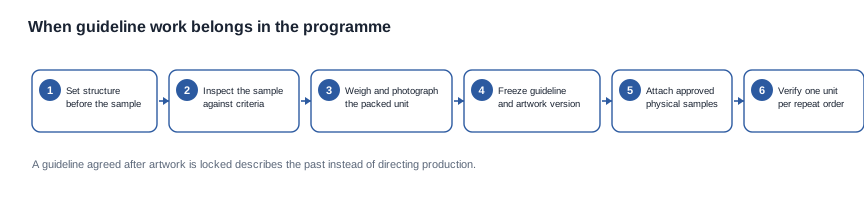
Most brand guideline disputes are not aesthetic disagreements. They are timing failures. A guideline is agreed after the artwork is finalised, or after the first packaging dielines are locked, or after a first bulk order has already shipped. At that point the guideline is no longer a document that directs production — it is a document that describes what already happened, which is a completely different and much less useful artefact.
The second timing failure is scope. A guideline that covers only the logo and the box colour will pass review and then fail at the point where a retailer asks for a specific label format, or where a market requires a particular set of declarations on the packaging, or where a second channel requires a different variant name printed on the carton. Each of those is a brand rule, and none of them was in scope.
The third is repeatability. A guideline that works for one production run is not evidence of capability; it is evidence of one successful outcome. What a brand needs to know is whether the supplier can hit the same standard on the third, fifth and tenth order, and the only way to establish that is to write the rules at a level of detail that leaves no room for interpretation.
This matters more for this product category than for most, because the range is wide and structurally uneven. The catalogue spans camera models, audio models, sport models, children models, an AR model, a bone-conduction model and a photochromic model, with published differences in colour options, variant naming, case configurations, ingress protection and weight disclosure. A guideline written for one of those groups will not transfer cleanly to another, and the transfer is where brand inconsistency usually enters a range.

What a brand guideline has to contain to be usable downstream
A guideline becomes usable when a person who was not in the room can make a correct decision from it alone. That test eliminates a surprising amount of what gets filed under "brand guidelines", because plenty of brand documents fail it.
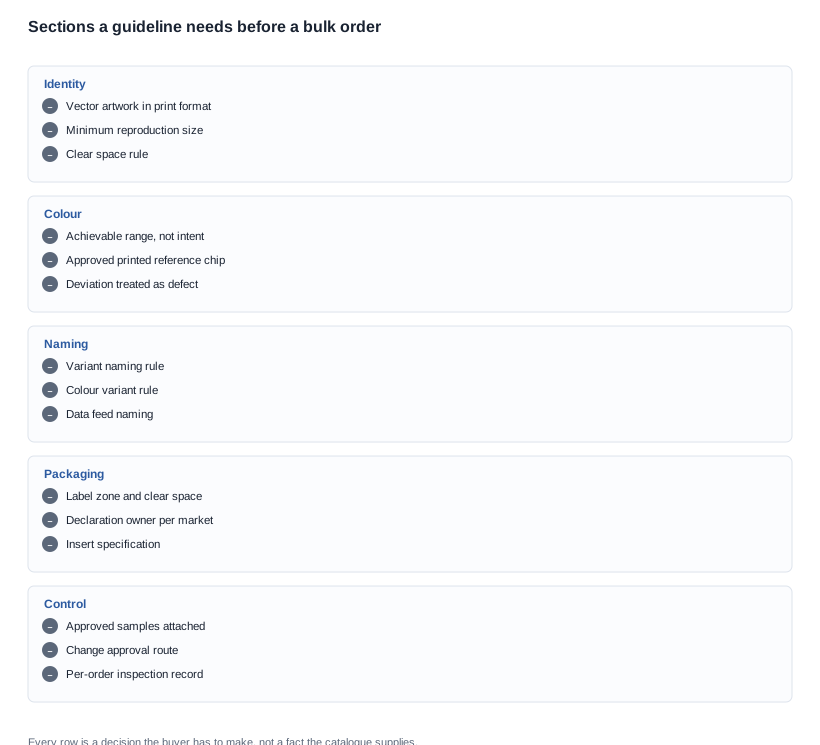
Identity assets, in production format. Not a logo on a slide. Vector artwork, the specific file formats the factory's printing and laser processes can consume, minimum reproduction sizes, and the clear-space and background rules that decide whether a small instance is acceptable. Ask which formats the production line actually accepts, because a supplier who answers with a list of formats they have heard of rather than the ones their equipment reads will find out at pre-production.
Colour, stated as achievable rather than aspirational. This is the most common failure in private-label hardware. Brand colours live in a design system calibrated to displays; the production line works in whatever the substrate, the process and the batch allow. A guideline should state the achievable range, show an approved sample under the relevant lighting, and define how a deviation is handled. Ask for the process used on each surface — injection moulding, pad printing, silk screen, laser engraving — because identical colour intent lands very differently across them.
Model and variant naming. The naming rule has to cover how a model designation appears on the device, on the carton, in the product data feed and on any regulatory or market document, and what happens when a second colour or a second capacity exists. This catalogue illustrates the problem: one camera model page carries two variant names and two case capacities without stating which name corresponds to which capacity, while another carries three colour options and a third carries four. A brand that inherits a product with an unresolved naming relationship will pass that ambiguity straight through to its own data.
Packaging structure and labelling zones. Where a label sits, how much clear space it needs, which information must be legible and at what size, and which areas of the carton are structural. For cross-border channels this usually expands to include the declarations each destination market expects on the outer package, and the guideline should say who supplies that content and who verifies it.
The change-control rule. Who can approve a deviation, in what form, and how it is recorded. Without this, the guideline decays within two production runs as each new request is handled informally.
The structure of the document is secondary to the test it has to pass. A short guideline that lets an unseen decision-maker act correctly beats a long one that does not.
Where this catalogue constrains a guideline and where it is silent
It is worth being precise about what a supplier's published documentation can and cannot settle, because a guideline discussion often runs on assumptions that the product pages do not support.
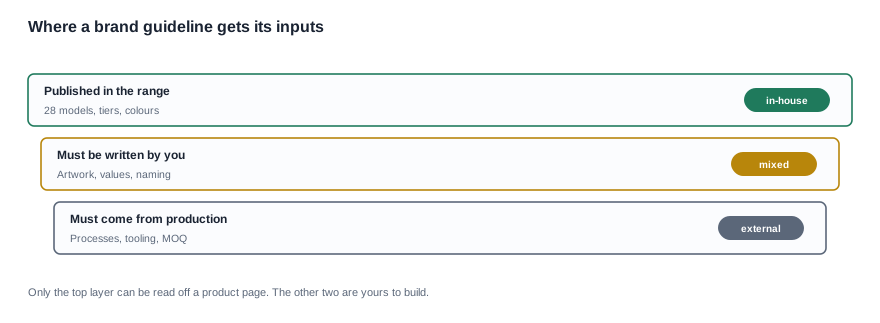
What the catalogue does publish includes a real amount of structural information that a brand guideline can lean on. Twenty-eight models are described. Eleven of them carry a camera, and among those the resolution class is published as either eight or thirteen megapixel — eight models in the lower class and three in the higher. Eight models are audio models, three are sport models, and the children models carry their own feature rows. Two models publish ingress protection. Two camera models publish colour options. One camera model publishes two variant names alongside two case capacities. One model publishes a weight, and it is the only published weight in the range, covering the eyewear body and excluding the foldable case. One export certification page at company level carries ten patent certificates — eight of them covering appearance designs, two covering utility models.
What it does not publish is most of what a brand guideline needs. There are no logo placement files, no artwork templates, no colour values, no packaging dielines, no label artwork, no print process specifications, no material declarations, no carton dimensions, no minimum order quantities for custom artwork, no tooling charges, no sample fees, no lead times and no warranty terms. There is also no per-model certification row anywhere, and the catalogue text names none of CE, FCC or RoHS.
That last point has a direct consequence for guideline scope. If your brand guideline includes a compliance section, it cannot be written from the catalogue, and a company-level page of patent certificates does not answer a per-model conformity question. The guideline has to name the person or entity that supplies each conformity file and the date by which it is required. On a range-wide level, the documentation discipline is treated in the export documentation note, and the model-selection side is in which models are ready.
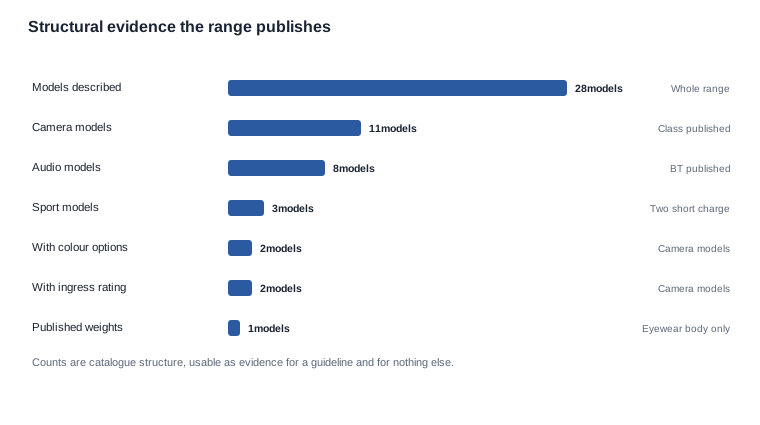
Read that published structure as scope rather than as specification. It tells you how wide the range is and where its variability sits, which is exactly what a guideline has to absorb — but it does not tell you what any of those models can be customised to. The eleven camera models, the eight audio models and the three sport models are separate guideline problems rather than one problem with twenty-eight entries, because the differences between them appear in different rows and in different combinations.
Two consequences follow, and both are worth writing into the guideline rather than leaving to judgement.
First, a guideline that states a single colour rule has to state what it means for the two camera models that publish colour options and for the camera models that do not. The distinction that matters is between "this page publishes three colour options" and "this page publishes no colour information". The second is not a statement that a single colour exists, and a guideline written as though it were will produce a range that varies in ways nobody designed. Ask the supplier what the default finish is for any model without a published colour row, and get the answer in writing, because otherwise the default is chosen at the production line.
Second, a guideline that asserts a product weight has to state its scope. The one published weight in this range explicitly covers the eyewear body and excludes the foldable case, so a brand that inherits that figure without its scope will contradict its own packaging documentation the first time somebody weighs a packed unit. This is a small correction to make in a document and an awkward one to make in a market listing that has already shipped.
A third consequence is about evidence rather than content. Counts are the most useful thing a supplier's product documentation can give you, because they let you scope the work before you scope anything else: eleven camera models means eleven naming decisions, two models with published colour options means two colour rule applications, one model with two variant names means one naming ambiguity to resolve in your own data model. If a supplier cannot produce counts like these, that is a signal about the documentation you will be working from later — not about the product.
Turning guideline questions into a written request
The most common failure mode is not a missing guideline; it is an unanswered request, or one answered in a form nobody can act on. The structure of the request matters as much as the guideline.
Group the questions by the party who can answer them, because that determines the deadline and the cost of chasing. Identity assets, colour ranges, print processes and minimum reproduction sizes are one group, and they should go to whoever owns production engineering. Naming rules, variant logic and data-feed naming are another, and they belong with the person who owns the product data. Compliance files and declaration ownership are a third, and they carry the longest lead time of anything in the guideline, so they should be requested first even though they are approved last.
For each item, ask for the answer in a form that can be attached to a document: artwork as a file with a version reference, colour as a physical chip produced by the production process rather than as a screen value, minimum sizes as measurements in millimetres per surface, and compliance as a document with an issuing body and a date. An answer that cannot be attached cannot be signed off, and an answer that cannot be signed off will be re-opened during the first production run.
Set one date for the whole request rather than a date per item. Partially answered guideline requests are the normal state of any first round, and a per-item deadline turns the follow-up into a spreadsheet exercise instead of a single escalation. Record the gaps explicitly rather than letting the guideline be drafted from whatever came back, because a guideline drafted from partial answers will read as complete and will be approved by someone who assumes the rest was standard.

Turning a guideline into acceptance criteria for artwork and packaging
A guideline that cannot be inspected is a wish. The conversion step is to rewrite every visual rule as a check somebody can perform with a tape measure, a sample chip or a ruler in front of them.
Take clear space around the logo. Instead of "generous clear space", specify a minimum expressed in millimetres on the largest and smallest surfaces the brand will use. Take the reproduction size. Instead of "the logo should be clearly visible", specify the minimum height in millimetres on device and on carton separately, because the two surfaces have different constraints and a single number will be wrong on one of them. Take colour. Instead of "brand navy", define the acceptable range as a printed reference chip produced under the actual production process, and state that a deviation beyond an agreed tolerance is a defect rather than a variation.
The same logic applies to information content. Any text that must appear on a surface — model designation, variant, declarations, handling marks — needs a specified position, a minimum size, a language set, and an owner who supplies the content. If the guideline does not say who supplies it, the supplier will invent it, and the invented version will be on your product.
Two failure modes are worth naming because both are expensive. The first is a guideline that specifies the artwork but not the substrate, so the same file lands on a matte and a gloss surface and produces two visibly different results. The second is a guideline that specifies the carton but not the insert, so the retail-ready unit depends on an uncontrolled layer between the product and the customer. Packaging decisions across options in this category are discussed in the packaging design options note, and the depth question — what can and cannot be changed on an existing model — is covered separately in the guide to how deep customisation goes.

Model-level evidence a guideline has to cover before sign-off
Before a guideline is signed, it has to be tested against the models you actually intend to order, because the range is structurally uneven and a guideline tested on one model will not transfer.
Test it against a camera model with published colour options, and check whether the guideline's colour rule has a defined answer for each published colour. Test it against a camera model with no published colour row, and establish what you are actually ordering — because the absence of a colour row is an absence of information, not a statement that only one colour exists, and the guideline needs a defined colour for that model either way. Test it against the model whose page carries two variant names and two case capacities, and write the naming rule that resolves the ambiguity for your channel, rather than inheriting it.
Test it against the weight question. The range publishes one weight, and it is explicitly the weight of the eyewear body excluding the foldable case, which means a guideline that asserts a product weight has to state its scope or it will be contradicted the first time someone weighs the packed unit. The weight comparison across audio models note covers the parallel problem on the audio side, and audio glasses customisation options covers the category-specific version of the same question.
Then test the guideline against a destination market. Ask which declarations that market expects on the outer package, where they must sit, and whether the brand or the supplier is the declared party. This is the part of a guideline most often discovered to be missing after the artwork is approved, which is exactly the failure mode this piece opened with.
Sequencing: what to settle before the sample, before the bulk order
The order in which this work happens determines whether it costs a week or a quarter.
Before the sample order, settle the guideline's structure rather than its detail: the asset formats, the print processes available per surface, the naming rule, and the compliance owner. A sample order is the cheapest moment to discover that the factory's laser process cannot hold your minimum logo size, because nothing has been tooled yet. The sampling discipline itself is covered in sample before bulk.
At the sample, inspect against the criteria rather than against taste. Measure the reproduction size, check clear space with a ruler, compare the colour against the reference chip under the same lighting the end user will have, and photograph every surface for the record. This is also the point to weigh the packed unit, because that is the moment a sample is available and a scale is cheap.
Before the bulk order, freeze the guideline and get it signed by both sides, with the change-control rule attached. Freeze artwork files with a version reference, and attach the approved samples to the document so that "the approved colour" resolves to a physical object rather than a description. The documentation discipline for the wider process is in development process documentation.
Through the repeat orders, verify rather than assume. Take one unit from each subsequent order against the frozen guideline, keep the results, and treat drift as a defect. Repeatability is the property a brand actually buys, and it is only demonstrated across runs.
Two commercial items belong in the same conversation because they are decided at the same time and are frequently confused with each other: how price tiers are structured across volumes, and how the relationship itself is set up. Neither is published here, so both belong on the list of questions to ask rather than on the list of things a supplier page should have told you. They are treated separately in pricing tiers, in partnering with a factory, and in the consistency controls in quality consistency.
The summary position is straightforward. A brand guideline is a control document, and its value is measured by how few decisions remain ambiguous after it is signed. Nothing in this catalogue's published material substitutes for that document, and the fastest way to build it is to decide which decisions must not be left open, in what order they bind the production process, and who is accountable for each one.
Related reading
- Model readiness across the range — OEM ready platforms which models are ready
- Customisation scope — OEM ready platforms customization depth
- Programme controls — OEM ready platforms quality consistency
Tell us the models you intend to order, the surfaces your artwork has to appear on and the markets you ship to, and we will tell you which parts of a brand guideline have to be settled before a sample order and which parts can wait until the first bulk order.


