

No unit price, order quantity, lead time or production capacity is published for any model in this catalogue. That single fact determines what this piece can be, and it is worth stating before anything else: a price tier structure cannot be read off a catalogue, because a catalogue publishes specifications and a price tier is a commercial term. What a catalogue can do is separate the range into groups that are genuinely different from each other, and a tier structure built on those groups is a specification ladder rather than a price ladder, and the difference matters because only one of the two is something you can publish and the other is something you have to quote.
The practical consequence is a division of labour. Five published rows can separate a range: the pixel tier, the cell capacity, the case configuration, the colour options and the ingress marking. Four commercial terms set the price, and all four are quoted per programme. A plan that keeps those two groups in separate columns is a plan that can be drawn today; a plan that lets a specification row drift into a price signal is a plan that will produce a number nobody quoted.
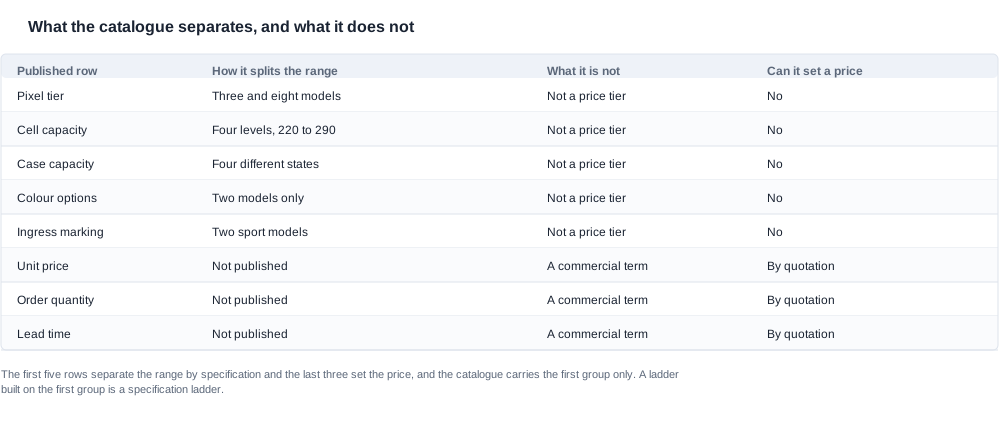
What the catalogue separates, and what it does not
The table below sets the published rows against the commercial terms, and the fourth column is the one that does the work.
| Published row | How it splits the range | What it is not | Can it set a price |
|---|---|---|---|
| Pixel tier | Three and eight models | Not a price tier | No |
| Cell capacity | Four levels, 220 to 290 | Not a price tier | No |
| Case capacity | Four different states | Not a price tier | No |
| Colour options | Two models only | Not a price tier | No |
| Ingress marking | Two sport models | Not a price tier | No |
| Unit price | Not published | A commercial term | By quotation |
| Order quantity | Not published | A commercial term | By quotation |
| Lead time | Not published | A commercial term | By quotation |
Read as a specification ladder, the published rows work well. The pixel tier is the cleanest: the camera range divides into three models at thirteen megapixels and eight at eight, which is a real and repeatable division rather than a judgement. The cell capacity divides the camera range into four levels, and it is worth being precise about the number because the published set is not what people assume. Two hundred and ninety milliamp hours is carried by four models, two hundred and sixty by three, two hundred and sixty five by one, and two hundred and twenty by three. The case configuration divides into four states, which is the most fragmented of the published rows: three models publish one thousand four hundred milliamp hours, one publishes one thousand two hundred with a note that the case folds, one publishes two capacities where the second is nine hundred, two name a charging case without publishing a capacity, and four publish no case row at all. The colour options and the ingress marking are narrow rows, published on two models each.
None of that is a price. What it is, is a set of groups that a buyer can explain to a customer and that a channel can stock as separate lines. That is genuinely useful, and it is a different thing from a price ladder.
The commercial terms in the lower half of the table are the ones that actually set the price, and the documentation is empty for every one of them. That is not an evasion. A unit price is a function of a configuration, a quantity, a market and a moment in time, and any of those four changing moves it, which is why a published figure would be wrong for most of the orders it was read for.
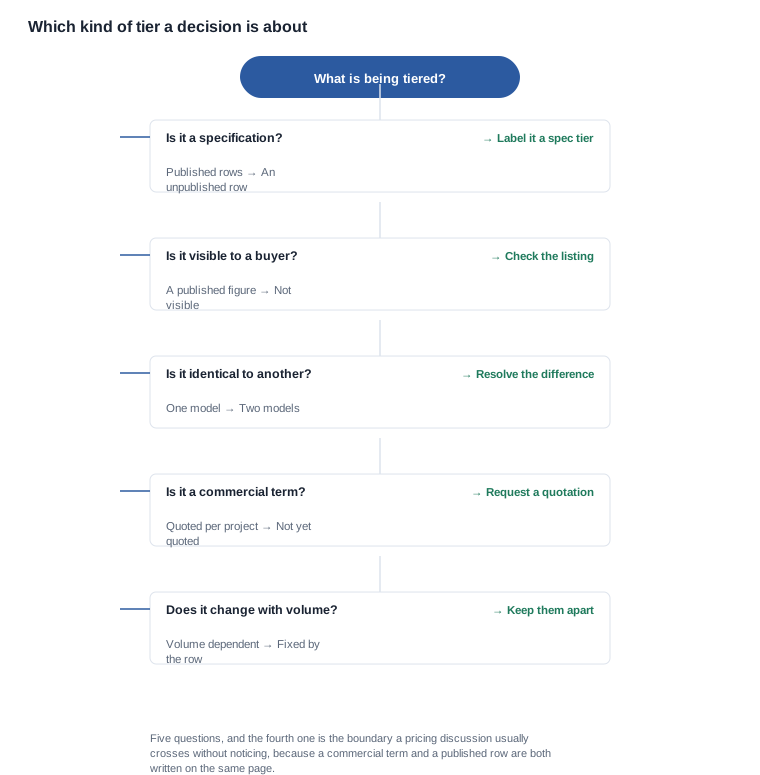

The unpublished drivers, and why their order is not fixed
Four commercial terms have to be established per programme, and the order in which they are negotiated is a choice rather than a rule.
The first is the unit price, and the first question about it is what it assumes. A unit price quoted without the quantity it applies to is not yet a price, because the same unit at a different quantity is a different commercial arrangement. So the quantity is not a footnote to the price, it is part of it, and a price discussion that establishes one and leaves the other open has not established either.
The second is the order quantity itself, which for most product lines in this category is the single largest determinant of the effective unit price. It is also the term most often left vague in early conversations, and it is the one that a buyer should pin down in writing even if everything else is still open, because it is the parameter every other number is quoted against.
The third is the lead time, and its role is different from the other two. The lead time does not usually move the price; it determines whether a tier can be held in stock at all, and a tier that cannot be reordered in time is effectively unavailable to a channel that moves quickly, whatever the number attached to it. The fourth is the setup items, which are the costs that appear once rather than per unit, and the reason they are named separately is that they are the costs most often left out of an initial discussion and most often discovered at the point where they cannot be avoided. The two that recur per programme are the packaging and the insert, because they vary by destination market and are rarely quoted as a separate line.
There is one more term that does not set a price but determines whether a price is usable, and it belongs in the same conversation, earlier than the price itself. The certification position of a model, which in a supplier's document set comes in three states: a claim still awaiting certificate numbers for the model, a claim plus a marking with no test report number behind it, and no position provided at all. A model in the third state cannot be listed in some channels at any number, which makes its price irrelevant rather than high.
It is worth being precise about what the published rows do and do not give a buyer who is trying to build a range, because the temptation to treat them as more than they are is strong. They give a range its shape. They do not give it its value. The pixel tier tells a buyer that a range can be two steps or three steps rather than one, and that is a real decision about how many stock lines to carry, how many artworks to produce and how many listings to maintain. The case configuration tells a buyer which models can share a carton and which cannot, and that determines the packaging count. The cell capacity tells a buyer which models a customer might compare as equals, which is a warning rather than an opportunity. None of these is a position on what a customer will pay, and a range plan that has read them as one will produce a price ladder that no quotation supports.
The distinction that keeps this honest is between a specification tier and a price tier, and the two behave differently in every way that matters operationally. A specification tier is fixed by the catalogue, is knowable before any commercial conversation, and is the same for every buyer in every market. A price tier is per programme, moves with quantity, moves with configuration, moves with the market, and has a validity date that nobody writes down. The failure mode of mixing them is not a wrong number on a page, it is a number that appears in a plan, gets repeated in a conversation, and reaches a customer as a claim about value, when in fact it was a reading of a specification sheet. The safeguard is procedural rather than clever: the tier structure and the quotation live in different documents, and a tier structure that has no quotation attached says so.
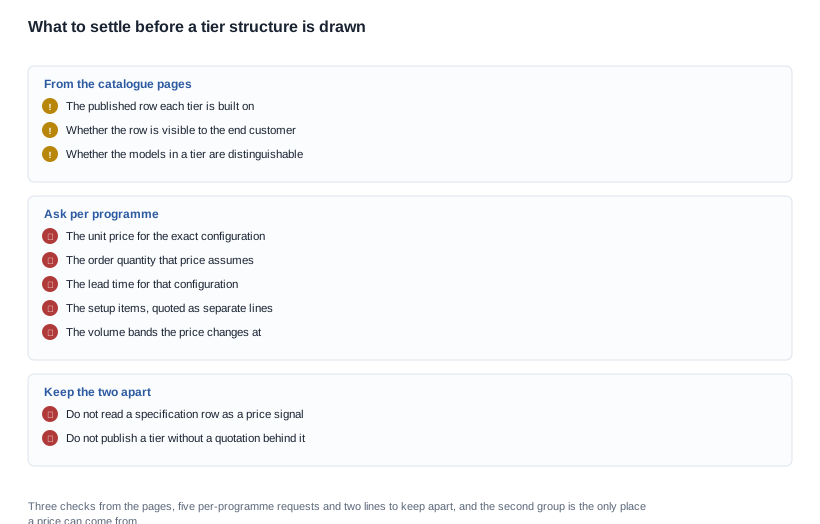

How to build an OEM ready platforms tier ladder that holds
The criteria for a tier structure that survives a customer question are these four.
- Build it on a row the customer can see. The pixel tier is visible in a listing. The cell capacity is not something a shopper evaluates. The case configuration is invisible to them and visible to you.
- Keep the two groups in separate columns. A published row and a quoted term belong to different columns, different conversations and different moments, and a tier structure that merges them produces a number that looks quoted and is not.
- Do not put two indistinguishable models in the same tier. Three pairs in this catalogue publish identical specification rows and no stated difference: a pair of eight megapixel camera models that share a cell, a charge limit, an endurance figure and a case capacity; a pair of audio models that share a radio version, a cell configuration, a charge limit, an endurance figure and a charge method; and a pair of children's models that share a cell, a charge limit, an endurance figure and a charge method, with the record noting that the difference between the two is to be confirmed. There is no published axis to separate any of them, and a tier structure that puts two of them in one tier gives a customer a reason to compare two listings and conclude they are the same product.
- Name the open terms before the tiers are drawn, not after. A tier structure that has four published groups and three unanswered commercial questions is a usable draft, and a tier structure that has four groups and an implied price behind each of them is a claim nobody made.
Those three pairs deserve a closer look, because each one fails in a different way and the failures are not equivalent. The camera pair is a pair of models that a buyer can tell apart by their catalogue pages in one respect only, and that respect is the fact that they are two pages rather than one. Everything else about them is the same: the same pixel tier, the same cell, the same charge limit, the same endurance figure and the same case capacity. The audio pair is the same situation on a smaller set of rows, with the added complication that the radio version and the cell configuration are both shared, so nothing in the published data distinguishes them at all. And the children's pair is the one where the record itself flags the situation, noting that the parameters are entirely the same and that the difference is to be confirmed, and where the certification position for the whole category is recorded as entirely not provided. That third case is the most consequential for a tier structure, because the two models are not merely indistinguishable on paper, they are indistinguishable in the record's own judgement, and the category they sit in has no compliance position either.
What a buyer should do with each of the three is the same in form and different in substance. For the camera pair and the audio pair, the question to ask is what the two pages are for, and the answer is a written one, because if the supplier is maintaining two pages that publish identical rows then there is a reason and it is not a published one. For the children's pair, the question is whether the two models are two products at all, and it is a question to settle before the category appears in a tier ladder, because a tier ladder that lists two children's models and cannot say what separates them is also a claim about the category's readiness, and the record says the category has no certification position at all.
The general rule that falls out of this is worth stating on its own, because it is the rule that keeps a tier structure honest. A tier structure is a set of distinctions that a customer is expected to understand. Each distinction has to come from a published row, otherwise the customer is being asked to distinguish two products on something only the buyer can see, and the first time they compare the two listings the structure collapses. Where the record publishes no distinction, the honest structure is one tier, not two, and the commercial question moves to which of the two the channel actually stocks.
The trade-off worth naming is between a wide ladder and a narrow one. A ladder built only on the pixel tier has two rungs and every customer can tell them apart, which makes it easy to explain and hard to differentiate. A ladder built on the published rows rather than on the customer-visible ones has more rungs, and the ones the customer cannot see are the ones that generate the confusion, because the buyer is quietly doing the comparing and the customer is quietly noticing that two products look the same. A ladder that separates models on a row the customer cannot evaluate and cannot see is a ladder whose separations are real and whose explanation is not, and that is the point at which returns begin.
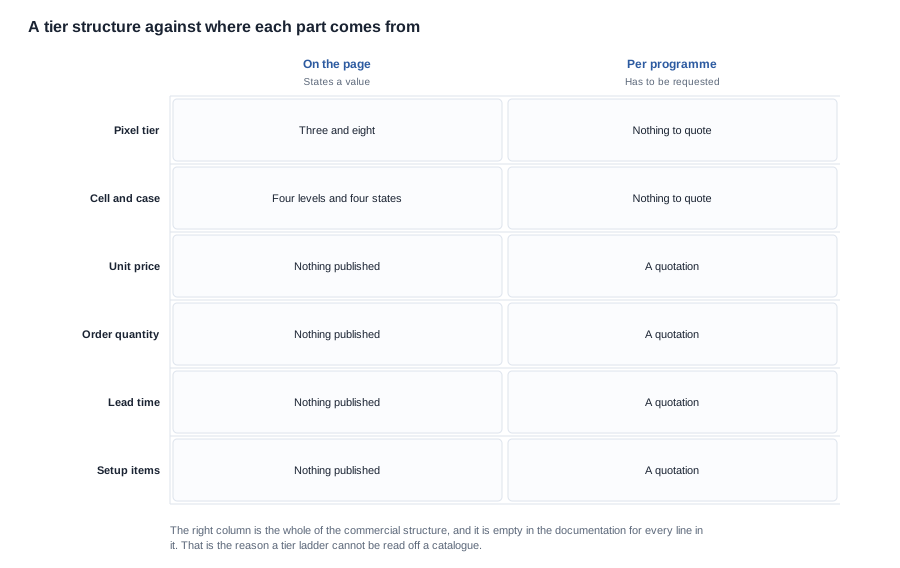

What a tier discussion can and cannot conclude
We will not publish a price tier we have not quoted, and we will not print an order quantity or a lead time we have not been given for a specific configuration. What we can do is tell you which published rows will let you separate stock lines and which decisions rest entirely on terms negotiated per programme, and that distinction is worth more than a number you cannot use.
We will not read a pixel tier as a price signal, and we will not describe a cell capacity difference as though it were a difference in value. We will not put two models with identical published rows into a tier ladder without first saying that the record does not distinguish them. And we will not present a quoted configuration as though it described the model, because the unit price, the order quantity and the lead time all attach to a configuration and a quantity, not to a model name. What we will say is which published rows separate the range, which models the record cannot tell apart, and which terms have to be quoted before any of it becomes a number a customer sees. A tier structure that a customer can read is built on the published rows and states them as specifications, and the commercial structure is a second document that happens to attach to the same groups. Keeping them in two documents is what allows the second one to change without the first one becoming wrong, and that is the property that matters when a range is launched, extended, or repriced in a market that moved while the ladder was being drawn. It is a small discipline, and it is the whole of the difference.
What the record does support is a plan that can be drawn today and completed later. The published rows give the groups, the rungs and the artwork and carton implications, and all of that is knowable before a single commercial term exists. The commercial terms then attach to those groups one at a time, and a buyer who has already separated the two can put each quotation where it belongs. A buyer who has not separated them will find a specification row doing the work of a quotation, and will discover the difference at the point where the first order is placed rather than at the point where the plan was written.
There is a question that comes up at the end of every such conversation and deserves a straight answer, which is how many rungs the range should have. The catalogue can tell a buyer what separations are available, and it can tell a buyer how many of them a customer can actually see, which is not many: on the camera range, the pixel tier is the only published row a shopper can evaluate, and every other separation is either internal or, in the case of the case configuration, invisible to the customer and relevant only to freight. So a two-rung ladder built on the pixel tier is explainable, and a six-rung ladder built on every published row is not, and the difference between them is the number of stock lines, the number of artworks and the number of comparisons a customer makes in a listing page. The choice between them is a commercial one that the catalogue cannot inform, because it depends on how the channel's customers make decisions and how much the range has to be differentiated in a crowded category. What the catalogue does settle is the floor: a rung that cannot be explained to a customer is a rung that has to be justified by something other than the published row, and the record does not contain that something for any model.
The OEM ready platforms range is where the model set starts, the smart glasses wholesale page covers the terms that determine an effective unit price, and the OEM ready platforms inventory planning piece covers what a tier structure does to the stock you have to hold.
Tell us the target market, quantity and required configuration, and we will tell you which published rows can separate the range, which models the record cannot distinguish, and which terms we would need to quote.


