

OEM ready platforms fail at inventory planning in three predictable places: a reorder timing that quietly assumes the model will still be available, a safety stock sized against a lead time nobody quoted in writing, and cash locked into colourways that will not move in your channel. None of those are solved by a better spreadsheet, and all three are solved by deciding what has to be known before the first purchase order is raised. Inventory planning on an OEM-ready platform is not a forecasting exercise; it is a sequencing exercise, and the sequence matters more than the arithmetic.
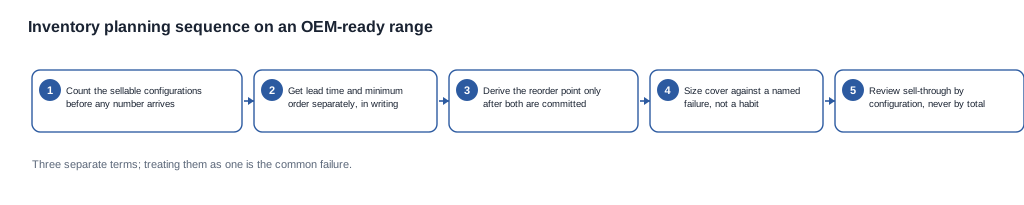
OEM ready platforms turn three unknowns into one reorder decision
Most inventory problems on a private-label programme come from a single number treated as if it were three. A buyer takes a lead time from a conversation, applies it to a minimum order quantity they assume is a round figure, and derives a reorder point — and then discovers that none of the three inputs was ever committed by anyone.
The three numbers are separate and must arrive separately, in writing, per model and per configuration. They are the reorder point, the lead time measured from purchase order to arrival, and the minimum order quantity. Treating them as one figure is what produces the classic failure: a comfortable-looking plan that has a single point of failure at the moment the factory is busiest.
The three numbers, kept apart
The reorder point. This is not the lead time and it is not the minimum order quantity. It is the level of stock at which you place the next order so the goods land before the shelf empties. It depends on demand variability, and you cannot supply real variability until you have sold something — which is why the first reorder cycle is always a guess and the second one is the first opportunity to correct it.
The lead time. Measured end to end, from the moment the purchase order is accepted to the moment the cartons are received and checked in. It contains production, preparation, transport, customs and receiving, and it varies by lane and by season. Production time alone is a smaller number and a misleading one, because most of the variance buyers complain about sits outside the factory.
The minimum order quantity. Not published on this platform, and the reason it is not published is that it is a commercial term rather than a technical one. It also varies by configuration rather than by model, which is the part most quotations do not make explicit. Get it in writing per model and per configuration, because a range-wide figure is the number you will be given first and it will be wrong on the model you actually chose.
What this catalogue lets you fix before the first order
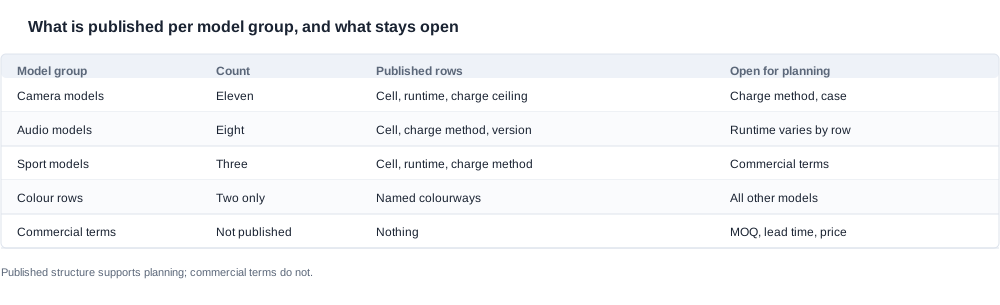
There is real planning value in the fact that the range structure is published even where commercial terms are not. The range holds twenty-eight models across audio, camera, sport, children's and other groups. Eight audio models publish a Bluetooth version and a cell configuration. Eleven camera models publish a resolution class, a cell figure, a runtime figure and a charge-time ceiling, but no Bluetooth version at all. Two camera models — the V03 Pro and the V06 — publish colour rows; the rest do not.
That distribution tells you something a buyer can act on: the models with the most published detail are the easiest to plan against, and the models with the least are the ones where a commercial term is most likely to be quoted loosely. A model that publishes nothing about its charging method or its case capacity is a model whose configuration you should pin down in the first purchase order rather than the third.

Counting sellable configurations before any number arrives
The platform fixes the hardware and the firmware baseline. What it does not fix is the part that consumes your cash: the combination of colourway, packaging language and destination market that each unit is built for. That combination is what a planner actually manages, and it is invisible in the model count.
So begin with an exercise that requires no supplier data at all: write down how many distinct sellable configurations you intend to launch with, before you have any numbers. Three is a normal answer. Twelve is a common accident, and it is usually an accident rather than a decision — it happens when a range presentation gets copied into a purchase order without anyone subtracting the combinations that will not sell.
Why the configuration count multiplies faster than the model count
Every additional variable multiplies the others. Three models with two colourways and two packaging languages is twelve sellable configurations, not six. Each one carries its own artwork, its own minimum order quantity, its own slow-moving risk and its own reorder point, and each one divides your forecast accuracy.
The published range structure helps you see where the multiplication is worst. Colourways are published for only two camera models, so those two can be planned precisely. For every other model the colour list is something you obtain from the supplier, and it is exactly the variable that multiplies. Ask for the colour list early, ask whether it is stable or still growing, and ask what happens to existing artwork if a colourway is withdrawn.
The derived-versus-published discipline
A related habit saves a lot of argument later. Write capacities the way the catalogue publishes them — 55mAh*2, 90mAh*2, 70mAh*2 — and keep any total you compute for your own freight or storage assessment clearly labelled as your own arithmetic. A total that appears in a planning document without that label tends to be read later as a published figure, and it will be quoted back to you.
Safety stock sized against a failure you can name
Safety stock is not a percentage of anything. It is a decision about which specific failure you are willing to absorb and which you have decided to tolerate. A buyer who adds a month of cover without naming the failure is not managing risk; they are deferring the question.
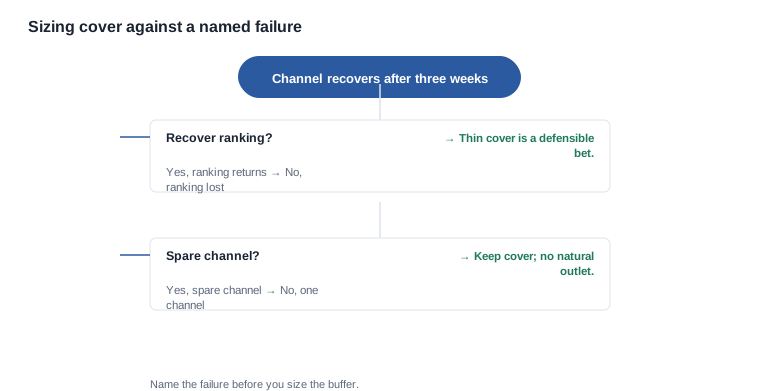
Two questions actually determine the size, and neither of them is about demand. First: how long does the product take to sell through one order quantity in this channel? Second: if you are out of stock for three weeks, does the channel recover — or does the ranking not come back? The second question is uncomfortable, and it is the one that decides whether a thin safety stock is a reasonable bet or an expensive one.
Cost of cover, priced honestly
Cover has three costs, and the first is the only one most plans count. The capital tied up in stock is the obvious one. The shelf space and the handling cost are the second. The third is the obsolescence risk — the risk that the configuration sitting in your warehouse is the one your channel has moved away from by the time you would have used it.
This is where the private-label exposure concentrates. A configuration built for your brand is not interchangeable with a configuration built for another buyer, so slow stock on a private-label programme does not have a natural outlet. That asymmetry is a planning input, not a commercial complaint, and it should change how much cover you take on a configuration whose demand you have not yet observed.
Making the lead time question answerable
You cannot size cover against a lead time that is a guess. Make the question specific: state the model, the configuration, the destination market and the shipping mode, and ask for the number in writing, broken into production and delivery. If a supplier declines to break it down, that is itself a planning input — it means your effective lead time has more variance than you can model, so your cover must be larger.
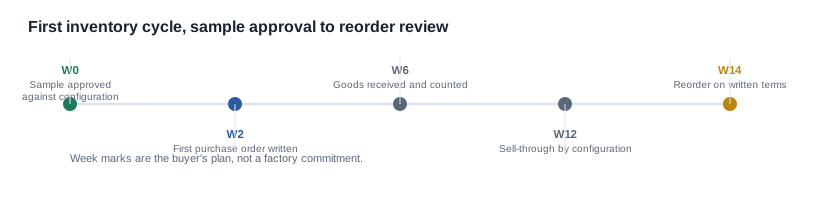
The lead-time arithmetic itself is worth being careful about, because two of the most common planner errors are averaging across seasons and ignoring that the number restarts when a configuration changes.

A slow-moving configuration is a range design error
Slow-moving stock is created by configuration, not by demand. Four colourways launched at once will reliably produce two that underperform, and the cost is not only the units — it is the capital that could have funded the reorder, and the management attention that keeps going into trying to clear them.
Two disciplines reduce it reliably. Launch fewer configurations than you think you need, and be honest about which of them exist for the channel and which exist for the range. That second distinction matters more than it sounds, because a range-only configuration is a marketing asset with a very different demand profile from a channel configuration, and pricing them identically wastes one of them.
The reorder review has to be by configuration
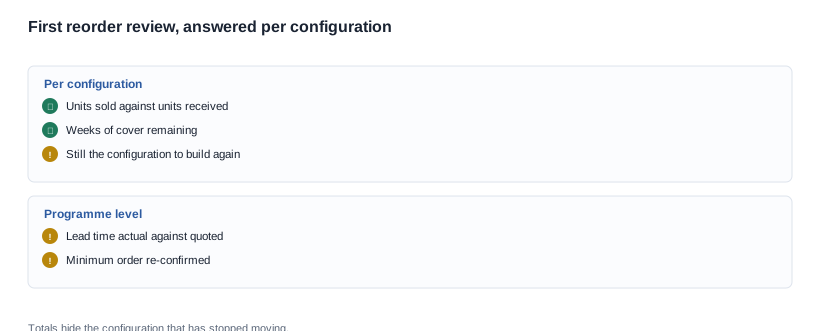
The forecast you started with was a guess. After the first reorder cycle it is history, and history is the only useful input to the second decision. Review actual sell-through by configuration, not by total. Totals hide precisely the problem you need to fix: a total can look healthy while one configuration has been dead for eight weeks.
Record three things per configuration: units sold against units received, weeks of cover remaining, and whether the configuration is still the one you would build again. That last question is the one that produces decisions, because it separates a configuration that underperformed from a configuration that was wrong.

Negotiating the three open terms without inventing them
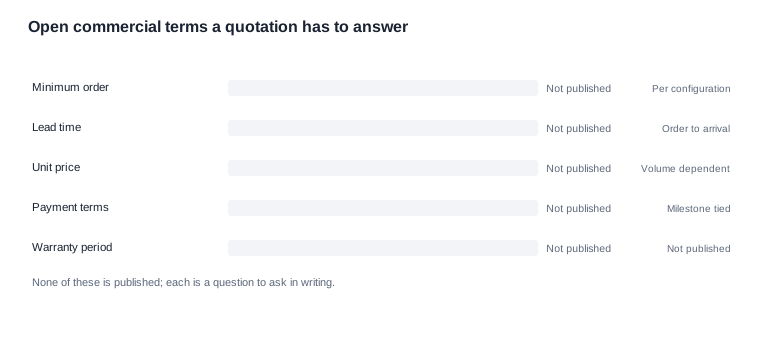
Minimum order quantity, lead time and unit price are unpublished on this platform, and a planning model still needs them. The correct response is not to assume them and it is not to abandon the plan — it is to convert each one into a question whose answer is quotable, and to structure the negotiation so that an answer has to be given.
That conversion is straightforward once you separate what a supplier can commit to from what you have been discussing loosely. What a supplier can commit to is a minimum order quantity per configuration, a lead time measured from an accepted purchase order to a stated destination, and a unit price at a stated volume and configuration. What is usually being discussed loosely is a range of quantities, a production duration, and a unit price at some unspecified volume. The first set can go into a contract. The second set cannot.
Turning the lead time question into a quotable one
A weak request sounds like: how long does production take. A strong request sounds like: for this model, at this configuration and quantity, on this destination lane and shipping mode, state the number of days from purchase order acceptance to arrival at the named port or warehouse, and state whether that number includes customs clearance.
The difference matters because the second question is answerable and the first is not. Production time is a factory variable that varies with the queue; arrival time is a buyer variable that also includes transport, customs and receiving. A buyer planning a reorder cycle needs the second number, and a supplier quoting only the first has not answered the question that was asked.
Three sub-questions make the number usable. Is the quoted duration fixed for a configuration, or does it restart when the configuration changes? Is there a peak-season component, and how is it identified? What is the notice period required to change a delivery date once the purchase order is accepted? Each of these is a question to ask in writing before you order, and each of them changes the safety stock decision that follows.
Turning the minimum order question into a quotable one
The minimum order quantity question is where configuration discipline pays off. Ask for the minimum per model, then ask whether it changes per colourway, per packaging language and per destination market. On a platform where only two models publish colour rows and the rest are open, that question is not academic: a supplier who applies one minimum across the range will tell you so, and a supplier who applies a higher minimum per configuration will tell you that too.
Two clauses belong in the agreement. The first ties the minimum to the configuration written on the order, so a later order cannot be rejected against a range-wide figure you were never shown. The second sets what happens when you want to add a colourway after the first shipment — whether it can ride on the next order or requires a separate production run.
Using the sample order to buy information, not samples
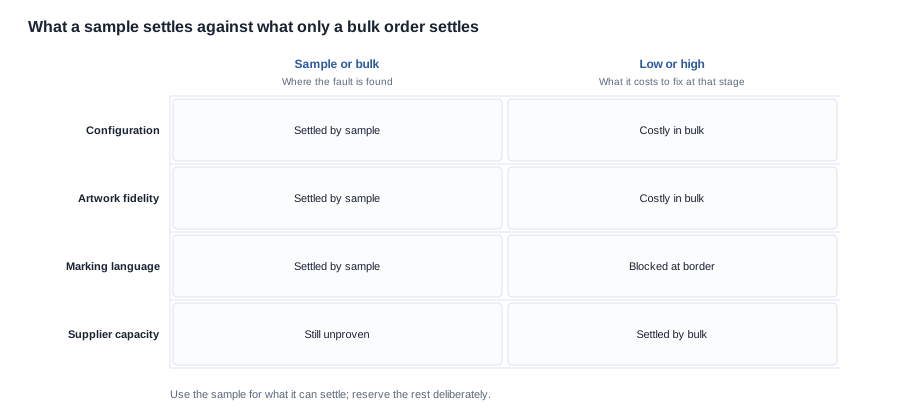
A sample order is often treated as a formality before the real order, and that is the expensive way to use it. The higher-value use is as a due diligence instrument: it lets you verify the configuration, the artwork, the packaging structure and the marking against a real unit, and it establishes the first reference point against which you can measure whether the bulk order matches the sample.
The trade-off is explicit. A sample carries sample cost, sample lead time and a delay to your launch. The return on it is that several expensive categories of defect are caught before they are multiplied across a production quantity. How to evaluate the return is straightforward: list what a sample can reveal — configuration accuracy, artwork fidelity, packaging structure, marking language, accessory completeness — and compare that list against what you would discover only after a bulk shipment arrives. Anything that would be expensive to fix late belongs in the sample criteria.
The payment terms trade-off
Payment terms affect the same cash cycle as the minimum order, and they are worth negotiating alongside it rather than after it. The trade-off is straightforward: a larger deposit protects the supplier and therefore usually buys a better unit price, while longer terms protect your cash position and usually cost more per unit. Neither is inherently correct, and the answer depends on how much working capital the programme can carry through the production cycle.
What should not be negotiable is that the payment milestones are written against events rather than against dates alone. A deposit, a milestone payment against approved artwork, a balance against shipment readiness and any retention or inspection condition are all ordinary commercial terms that belong in the contract. Ask what each milestone is tied to, and make sure the artwork approval milestone is one of them — that single clause is what prevents a production slot being consumed on artwork you had not finished.
A due diligence question set worth sending before you commit
If you only have room for one message before signing, send these as a list rather than a paragraph, and ask for written answers:
- The minimum order quantity for the named model, named configuration and named quantity.
- Whether that minimum changes per colourway, per packaging language and per destination market.
- The lead time in days from accepted purchase order to arrival, including customs, on the named lane and shipping mode.
- Whether the quoted duration is fixed or subject to a peak-season component, and how that component is identified.
- The unit price at the stated volume and configuration, and what changes it.
- The payment milestones and the event each one is tied to.
- The artwork approval deadline that must be met to hold the production slot.
- The defect remedy: what is replaced, at whose cost, and within what period after arrival.
- The warranty period and what it covers, expressed as a contract term rather than an expectation.
- The certification and compliance scope for the specific model, with the documents that evidence it.
None of these ten answers is published, and all ten are ordinary. A supplier who answers all ten in writing is giving you a plan you can build against. A supplier who answers three is telling you that the remaining seven are the risk you will carry.
What the planning cycle must produce for the factory
Planning is only finished when it can be turned into a purchase order without a conversation. That means the configuration definition has to be specific enough to write onto an order: the model designation as the supplier publishes it, the colourway, the packaging language and destination, the quantity, the required delivery date and the shipment mode.
The model designation deserves a specific warning because the range contains genuine naming ambiguity. The L2 Utral's page carries two names printed side by side, Utral and Pro Max, and a case row reading 900/1400mAh without stating which capacity belongs to which name. A purchase order that resolves that ambiguity by guessing will produce a configuration nobody downstream can document.
The terms we will not invent
Minimum order quantity, lead time, production capacity, unit price and warranty terms are not published on this platform, and we will not estimate them in a way that later reads as a commitment. They are per configuration and per volume, they change with the mix, and they belong in a written quotation against a stated configuration. A planning model built on assumed figures will produce a plan that looks rigorous and collapses at the first quotation — which is a worse outcome than a plan built on three open questions.
What we will do is tell you which questions decide which number, so that your negotiation starts from the structure rather than from a guess. The commercial terms behind a private-label order are covered in the minimum order quantity piece; the freight and carton decisions that affect your cash cycle are in the logistics planning piece; and the way to reduce the risk carried by a first order is in the sample before bulk piece.
The honest position is that inventory planning survives when the unknowns are named and tracked rather than smoothed away. Three unknown terms on this platform, tracked explicitly, will not break a plan. Three assumed terms, embedded in a forecast, will.
Related reading
- The commercial terms behind this plan — minimum order quantity for private label
- Freight and carton planning that affects your cash cycle — logistics planning for a multi-part box
- Reducing the risk carried by a first order — sample before bulk
- Naming that has to be fixed before a purchase order — logo and packaging in real detail


