

The questions buyers ask about an open-ear audio product fall into three groups, and saying which is which is worth more than answering them one at a time. Some questions are about the hardware and the catalogue closes them. Some are about the acoustics and the catalogue closes none of them. The rest are about how the product behaves beside a phone, and the catalogue closes the least useful one. A confident answer in the middle group is the failure this article is built to prevent, because it arrives as a number nobody in the supply chain can actually stand behind. The page is written for the buyer assembling a product around an open-ear platform, and it is organised so that you can see which of your own open questions are cheap to close and which are programme-sized.
Open ear audio glasses: eight models, four splits
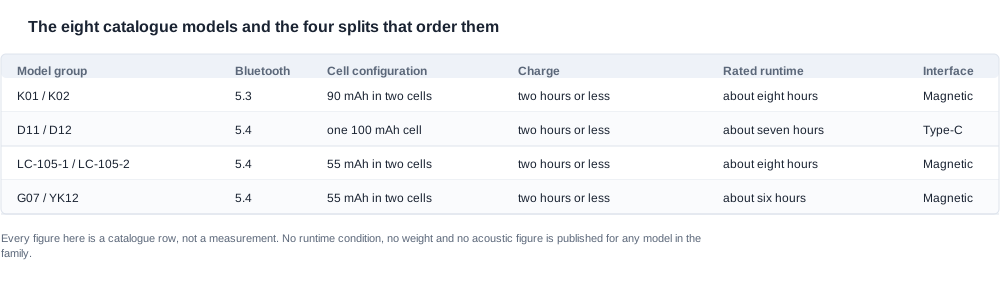
Our Bluetooth audio tier publishes eight models: the LC-105-1 and the K01, the LC-105-2 and the G07, the K02 and the YK12, and the D12 and the D11. Eight models sounds like a wide range and behaves like a narrow one, because the electrical rows are deliberately similar. What separates them is four splits, and once you have the four splits in your head the range becomes small enough to reason about rather than merely compare.
The four splits that organise the whole family
The radio split. Bluetooth 5.3 on the K01 and the K02; Bluetooth 5.4 on the G07 and the D11, the LC-105-1 and the LC-105-2, and the YK12 and the D12. This is a protocol generation, nothing more. It tells you the radio in the unit is of a stated vintage, and it tells you nothing about the audio path, the microphone arrangement, the app or the pairing behaviour.
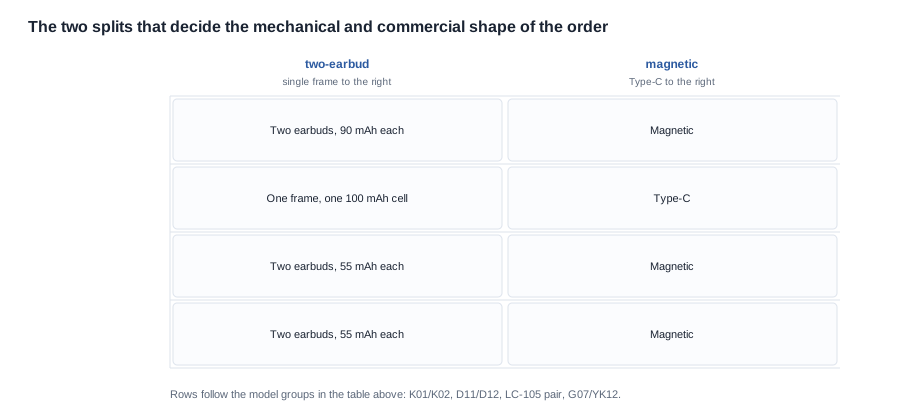
The cell split. Six of the eight carry a doubled cell configuration — 90 mAh in two cells on the K01 and the K02, 55 mAh in two cells on the YK12, the LC-105-2 and the G07, and the LC-105-1. Two carry a single 100 mAh cell — the D11 and the D12. This is the split that gets misread most often, because a buyer sees "90 mAh × 2" and reads it as a capacity figure rather than an architecture statement. It is an architecture statement: the doubled-cell models are the two-earbud form factor, where each earbud carries its own cell and the box contains two devices rather than one.
The interface split. Magnetic charging on the K01 and the K02, the G07 and the LC-105-2, and the LC-105-1 and the YK12. Type-C on the D11 and the D12. This one looks like a user preference and is actually a supply chain decision: a magnetic interface fixes the cradle geometry, the case geometry, the tooling and what has to sit in the box, and it hands the customer a charging routine they did not already own.
The temple split. Six models use a fixed temple. The G07 publishes an ultra-thin and detachable temple as a configuration option, and the YK12 publishes a slim temple together with a surround sound configuration. The temple is not a styling line on the sheet; it is the acoustic chamber and the geometry that determines where the radiators sit relative to the ear.
What each split changes downstream
The radio split changes the certification position and the set of phone behaviours a buyer has to test, because a protocol generation and the implementation behind it are different things. The cell split changes the box contents, the accessory programme, the runtime tier and the number of devices a customer expects to find inside. The interface split changes the packaging bill of materials, the tooling, the cable in the box and the complaint you will receive from a customer who expected a universal charger. The temple split changes the acoustic result, the size of the frame and the shape of the returns.
One structural point is worth stating separately because it gets merged into the wrong category constantly: the eight open-ear audio models carry no camera module, and the AI voice assistant their catalogue pages name is published without a single detail attached to it. The camera module belongs to the AI camera glasses family rather than to these models, and a comparison sheet that places an audio model and a camera model on the same product line is wrong in a way that every number on it inherits.
Shortlisting between a two-earbud architecture and a single frame
The doubled-cell models and the single-cell models are not competing products, and treating them as two entries in a ranked list is the most common structural mistake in a shortlist for this category. They answer different channel questions, and the correct shortlist contains one of them rather than both.
Why these two are not competitors
A two-earbud architecture puts two complete devices in the box. The customer can carry one, both or neither, which matters in a market where a single lost earpiece turns a premium purchase into a returns conversation. It brings a charging obligation with it, and the accessory set for it is larger, and that accessory set has its own minimum order quantity which is usually missing from the cost model in a way that surfaces as a margin problem three months later.
A single-frame architecture puts one device in the box. It is a simpler product to explain, to pack and to ship, and a Type-C interface means the customer can charge it from a power bank they already own. That is a genuine commercial argument in a market where power bank penetration is low and charging anxiety is a purchase objection, and it is not a small one: it moves the accessory line out of the cost model entirely.
The runtime tiers follow the architecture split without lining up neatly against it. The G07 and the YK12 publish about six hours, the D11 and the D12 about seven, and the K01, the K02 and the LC-105 pair about eight. Those are catalogue rows under favourable conditions, and they are not a ranking of architectures. A doubled 55 mAh and a single 100 mAh are close in total charge, and the doubled one splits it across two cells with different management behaviour, so a lower published runtime in the doubled architecture is not evidence that the architecture is worse. It is evidence that the figure was measured on a different workload, if it was measured at all.
The accessory programme deserves its own line in the cost model, because it is the line that quietly decides whether the architecture you picked is affordable at your volume. A magnetic cradle and a two-device case are separate items with their own minimum order quantities, and those minimums rarely match the unit minimum of the product they belong to. A buyer who prices the product and forgets the accessories gets a quotation that cannot be ordered at the volume they intended, and discovers it when the supplier asks how many cradles to quote. This is a packaging and logistics question before it is a commercial one, and it is cheapest to raise in the first request rather than the second.
Four supplier types you will be quoting, and what each one can evidence
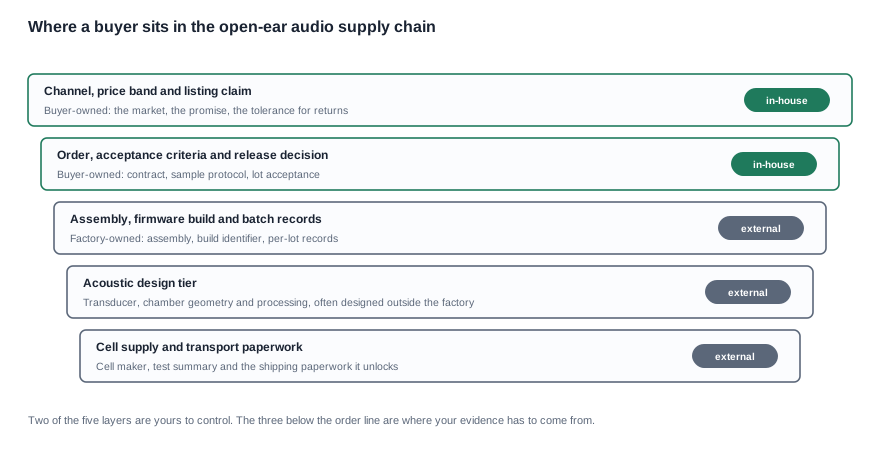
Most buyers in this category end up with three or four quotations that look broadly comparable and are not comparable at all, because the quotations come from businesses with different relationships to the product. Sorting the counterparties by what they can actually evidence is faster than comparing their prices.
An assembly plant takes a design and builds to it. It can evidence per-model production, per-lot records and a retained unit. It will not, in general, be able to answer a question about the acoustic design, because the acoustic design sits above it in the chain. This is the right counterparty for volume and the wrong one to ask about the sound.
A design-led plant owns the acoustic and firmware work as well as the line. It can evidence more, and it charges for the design work, and the design work is normally a one-off that has to be amortised over a committed volume. Ask which volume it is amortised over and what happens to it if the programme is discontinued.
A trading company sells somebody else's model under your name or its own. It can evidence price, minimum order quantity, delivery dates and paperwork. It cannot evidence the acoustic design tier, the firmware build, the per-lot records or the retained unit, because none of those are its to produce.
What a trading company can evidence, and what it cannot
A trading company is not a disqualified counterparty. For a channel that wants a fast launch, a familiar configuration and a low opening commitment, a trading company's terms are often better than a factory's, and the risk profile is manageable if you know which risks you are carrying.
What you are carrying is concentrated in three places. The product specification is not yours to change, because the acoustic design and the firmware are fixed by whoever built it. The acceptance criteria you write may not be enforceable against a party that did not make the goods. And the substitution risk is higher, because a trading company with several factories in rotation has more opportunities to ship a different configuration from the one that was approved.
The three counterparty types above are worth putting into a table of their own, because the question "what can this supplier prove" has a different answer for each of them, and the difference should drive which evidence you demand rather than how hard you press.
An OEM or ODM programme is a fourth arrangement and it behaves differently again, because the design and the manufacturing sit inside one commercial relationship and the buyer inherits a set of decisions rather than a set of options. The advantage is that the acoustic design, the firmware build and the production line are all inside the same agreement, so a change request travels to one place. The cost is that the negotiation starts further back, because you are agreeing a specification rather than accepting one, and the specification is the part that is expensive to change later.
The sorting rule that follows from all four types is simple. Establish what kind of counterparty you are talking to before you decide what to demand, and then demand only what that counterparty can actually produce. Asking an assembly plant to explain its acoustic design produces a vague answer and a suspicion. Asking a trading company for per-lot records produces a promise that will not be honoured. Asking an OEM programme for both produces the actual answer. The question list should differ by counterparty type, and a buyer who sends the same request to all four and treats the four answers as comparable has built the comparison on the wrong basis.

The acoustic gap and the sample programme it forces on you
Seven rows are missing for every model in this family, and they are the rows a buyer most often needs: output level, leakage at a stated distance, microphone count and pickup distance, driver size, frequency response, the negotiated profiles and codecs, and the product weight. Nothing in the published data fills them, and the reason is structural rather than an oversight — there is no published acoustic baseline for the category that a catalogue could quote from.
The seven rows no supplier in this category publishes
Output level without a volume setting is not a measurement, so any figure you are offered should arrive with the volume attached. Leakage needs a distance, an environment and an orientation, and the same product measured at two distances is two different products as far as a customer in a quiet carriage is concerned. Microphone count and pickup distance determine whether the far end of a call can hear anything in a street, and processing cannot substitute for a microphone that is not there. Frequency response measured on a bare driver says nothing about the frame the driver is mounted in. The negotiated profiles determine which audio path the microphone actually takes, and they are a firmware property rather than a hardware one.
On weight, our published position is narrow and we would rather describe it exactly than round it into a convenient sentence. The only product weight published anywhere in our catalogue is the MT6 glasses body at 158 g, which includes the fitted battery and the camera and excludes the folding charging case; that case holds 1200 mAh and its own weight is not published. No bare frame weight is published for any model in the range, including every model in this audio family. A buyer who needs a product weight for a shipping calculation or a comfort specification has to request it per model with the measurement method attached, because it is genuinely not on the shelf.

The practical consequence is a budget line most buyers forget to create. Because the acoustic rows cannot be read from a document, they have to be produced, and producing them costs samples, instruments, time and a written protocol. A buyer who allocates nothing to that programme will either accept a claim they cannot defend or discover the gap at the point where the listing is already live and the artwork is already approved.
Turning a shortlist into a purchase order without losing the thread
A shortlist becomes a purchase order through five documents, and each of them exists to close a specific question that the catalogue leaves open.
The configuration sheet, one per model, quoting the Bluetooth version, the cell and its configuration, the charge time, the charging interface, the rated runtime and the structural feature names exactly as published, with the absent rows still listed as absent. The value of this document is that it makes the supplier's own words the reference point, so a later disagreement is about a document rather than about a memory.
The acoustic request, sent as its own request and covering the seven rows per model with the method attached to each figure. Sending it separately from the commercial request is deliberate. It separates the question about the product from the negotiation about the price, and it gives you a clean read on whether the supplier answers technical questions at all.
The sample protocol, written before the first sample is measured, naming the script, the environment, the pass criterion and the sample size. Two units per candidate is the minimum that tells you anything about consistency, and one sitting with all candidates in the same room is what makes the comparison real rather than a set of separate impressions.
The identity check, which is a single line on a sheet and catches more problems than it has any right to: the model code read off the housing of the unit you received, compared character by character with the model code on the paperwork. In a family where several models share electrical rows, this is the check that catches a substitution, and it should be treated as a stop condition rather than a query.
The acceptance criteria, attached to the purchase order rather than kept in an email thread, with the measurements, their conditions, the sample size and the consequence of a failure written in. In a category where no published standard exists, the contract is the standard, and a lot that fails written criteria is a lot you can refuse.
The order in which these five are produced matters more than the order in which they are filed. The configuration sheet comes first because it establishes which model you are talking about, and every later document is meaningless without it. The acoustic request comes second because it has the longest lead time, since a supplier who has to run a measurement will take longer to answer than one who has to fetch a document. The sample protocol is written before the samples arrive rather than after, because a protocol designed afterwards describes what happened rather than what was required. The identity check happens on arrival of the sample and again on the production lot. The acceptance criteria are assembled last, from the four documents before them, and attached to the order so that they carry contractual weight rather than conversational weight.
One thing not on this list is worth naming because buyers add it by reflex: a price comparison done before the configuration sheet exists. Two quotations for open-ear audio products can differ by a wide margin and still be comparable, but only when they refer to the same model, the same cell configuration, the same interface and the same accessory scope. Until those four are fixed on both sides, the price gap is not information — it is a difference between two different products, and it will be read as a bargain.
What our published position lets a buyer decide
We publish the rows we hold and mark the rest as open, and we would rather show you seven empty fields than seven plausible values that we cannot evidence. The Bluetooth versions, the rated runtimes, the charge times, the cell configurations, the charging interfaces and the structural feature names for these eight models are all published, and the acoustic rows are open on every one of them.
We will not convert a feature name such as surround sound or slim temple into a measured claim, and we will not tell you that one of these products sounds better than another on the strength of the approach it uses. We will not present the MT6 body weight as a frame weight for this family or for any other, and we will not fill a cell column with an arithmetic total and let it stand in for a runtime.
What we can do is take your shortlist and tell you which parts of it our documentation already closes and which parts need a document from a supplier or a measurement on your own units. Send us the models, the quantities, the destination markets and the channel, and we will say which rows exist for you today.
The background is under open-ear audio, the measurement protocol is in how to measure open ear audio, and the range itself is at Bluetooth audio glasses.
Related reading
- The published rows and what they settle — open-ear audio
- The sample protocol — how to measure open ear audio
- Bluetooth audio glasses range
Send us the models, the quantities and the target market, and we will tell you which questions the documentation closes and which need a sample.


