

A template is useful in this category for a specific reason: there is almost nothing published to compare against, so what a buyer needs is not a specification review but a repeatable test. The same protocol run on every sample produces a ranking, and a ranking is what a buying decision actually requires.
What follows is an open ear audio glasses case study template in the form it is actually useful: rows, what to record, and what a pass looks like. It is not a scoring system designed to produce a single number. It is a protocol designed to make one buyer's measurements comparable with another buyer's measurements, and with the next delivery of the same product.
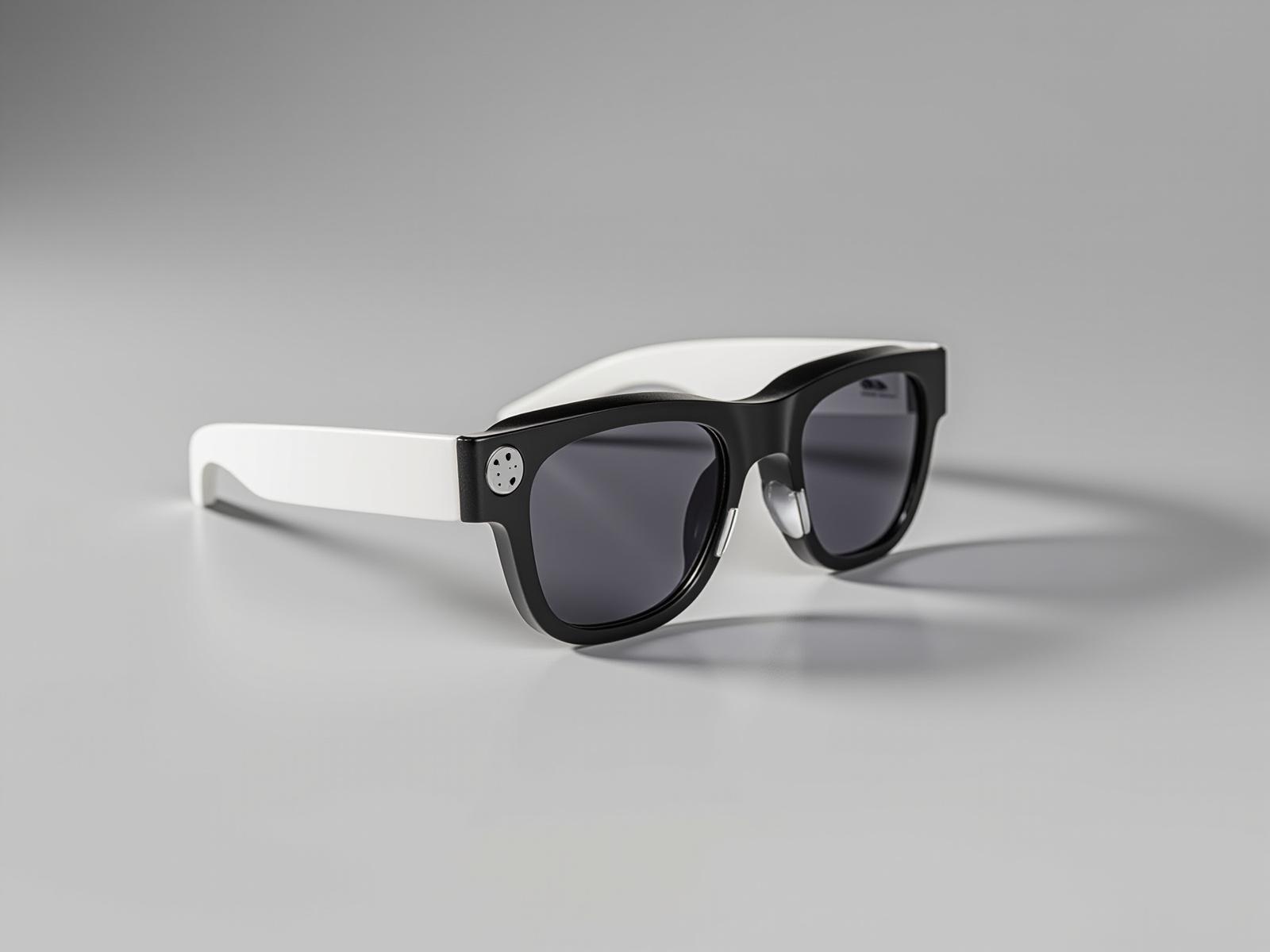
Open ear audio glasses: templates, not a checklist
A checklist asks whether something is present. A template asks what was measured and under what conditions — and in a category where nothing is published, the conditions are the only thing that makes your own measurements comparable to each other.
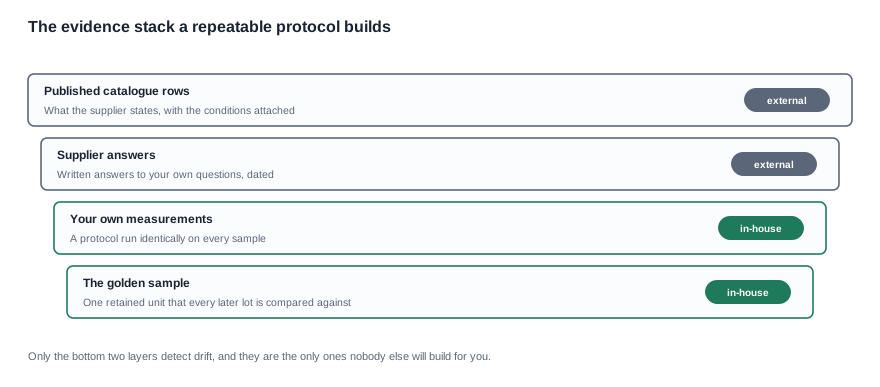
That is the key property: the template does not need to be technically rigorous, it needs to be consistent. Run identically on every sample and every delivery, and it becomes the reference against which drift is visible. A buyer who runs a rigorous protocol on one sample and an informal protocol on the next has two data points and no comparison, which is the same as having none.
The reason the published data is not enough to skip the template is specific to this family. Our catalogue publishes the resolution, the battery configuration, the charge time, the runtime, the Bluetooth version and the charging interface, and it publishes no driver size, no frequency response, no leakage figure and no microphone specification. The published rows describe the electronics. Every decision that distinguishes one open-ear product from another is acoustic, and not one of those is published.
There is a second reason the template earns its cost, and it is the one that shows up in year two. A template is the only artefact that survives a change of supplier, a change of tester and a change of factory. A quotation can be re-issued; a protocol cannot, unless somebody writes it down. A buyer who has a template in the file can evaluate a second factory's samples in the first week, and compare them directly against the first factory's units, which is not possible with a spreadsheet of prices.
What the template gives the purchase order
A template that stays in a folder is a hobby. A template that ends up in the purchase order is the thing that makes the whole exercise worth the afternoon it took. The conversion is mechanical, and it is worth doing row by row rather than in a general paragraph.
Each measured row becomes either a criterion or an observation. A row where the measured result is comfortably good and the margin is obvious becomes a criterion, expressed as a threshold with a method attached: leakage at a stated distance and level must not exceed a figure; a unit must be within a stated weight range; a call must be scored intelligible at the far end in a stated environment. A row where the result is marginal, or where the result varies a lot between units, becomes an observation with a stated trend, and the trend is what you watch across deliveries rather than a number you enforce on receipt.
The difference matters, because a criterion that fails a good production lot costs a re-inspection and a rejected batch, while an observation that fails costs a conversation. Setting ten thresholds on ten marginal rows produces a supply relationship that spends most of its time arguing.
The rows that stayed open are the third category, and they belong in the purchase order as a statement rather than as a threshold. A clause that says the supplier will supply the leakage method, the fixture description and the sampling plan within an agreed period, and will notify the buyer of any change to the acoustic path, the signal chain or the firmware, converts a gap into a dated obligation. Our catalogue publishes no acoustic measurement for any model in this family, and a supplier who holds the measurement has something the buyer needs; a supplier who has neither has a platform nobody has characterised.
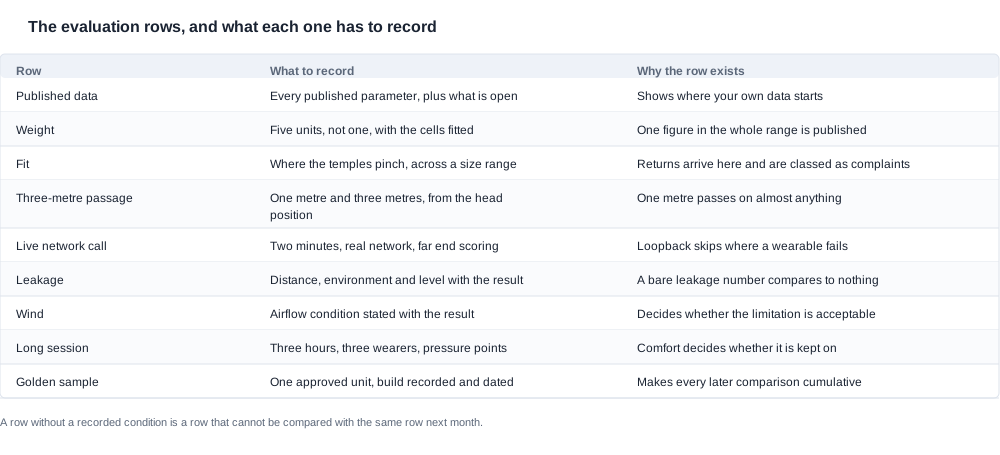
The template rows, and what each one has to record
Nine rows, and every one of them has a reason for being in the sheet rather than in a conversation.
Published data check. Record every published parameter, and mark each unpublished row as open with a named owner. Anything not in the published list stays open rather than being filled with a plausible value. This row is the boundary of the whole exercise: it tells you at a glance which of the results below you are comparing against a specification and which you are comparing against another measurement.
Weight. Five units, not one. Our catalogue publishes a single weight figure in the whole range — 158 g for the MT6, and that is a camera model — and nothing for the audio models, so this row will start empty on almost every SKU. The reason for five units is that a single unit measures one unit, and the question a buyer actually has is what a production unit will weigh.
Fit. A number of wearers drawn from your market's typical head sizes, recording where the temples pinch. Fit complaints are never classified as defects, because each individual return is a normal complaint, so the return rate is where this shows up rather than the defect rate. The recording should be a drawing rather than a description — temple pressure maps, a note of the head size, a note of the temple length — because "it pinched" is a memory and a marked pressure point is a measurement that a second tester can check.
Three-metre test. A fixed passage played at one metre and then three, recorded from where the wearer's head would be.
Real-network call. Two minutes, live network, conversational distance, with the far end scoring intelligibility.
Leakage. The distance, the environment and the playback level recorded alongside the result. A leakage figure without those three is not comparable with another leakage figure, and none is published for our models.
Wind. Air across the front of the glasses, with the airflow condition stated, recorded as a pass or as a documented limitation depending on whether the product will be used outdoors.
Long session. Three hours, three wearers, recording pressure points. Battery figures describe how long the electronics run; comfort determines whether anyone keeps wearing the thing.
Golden sample. One approved unit retained, with its firmware version recorded and dated.
The three-metre passage, and why one metre proves nothing
One metre passes on almost anything. Three is the number that separates products, and the reason is that a distance test measures two things at once: how much signal reaches the ear, and how much of it goes somewhere else. A product that survives one metre has a driver that works. A product that survives three metres has a driver and an architecture that keeps the sound going forward rather than around the head.
The passage matters as much as the distance. A news bulletin is the usual choice because the level is even and the content is known, which means two testers on two products are hearing the same thing at the same moment. Music with a heavy bass passage is the wrong choice for a comparison, because the level varies and the test becomes a memory test.
The recording position is the other half of it. Recorded from where the wearer's head would be, not from where the tester happens to be standing, because a metre and a half of parallax is enough to change the answer on a marginal product.
Recording the conditions that make two results comparable
A result without its conditions is not a measurement, it is an anecdote with a number attached. Four conditions have to be written next to every acoustic result, and they are the same four for every row: the playback level, the distance, the environment, and the build or firmware identifier of the unit.
The level needs to be a setting, not a volume percentage, because "60%" means nothing across two different units with two different maximums. If the tester records "the maximum level the wearer would actually use", that is a better condition than a percentage, because it is a condition the customer recognises.
The build identifier is the one that is most often skipped and most often regretted. Two units of the same model can differ, and the first time a reviewer asks why the second delivery measured differently from the first, the build identifier is the only thing that answers it.
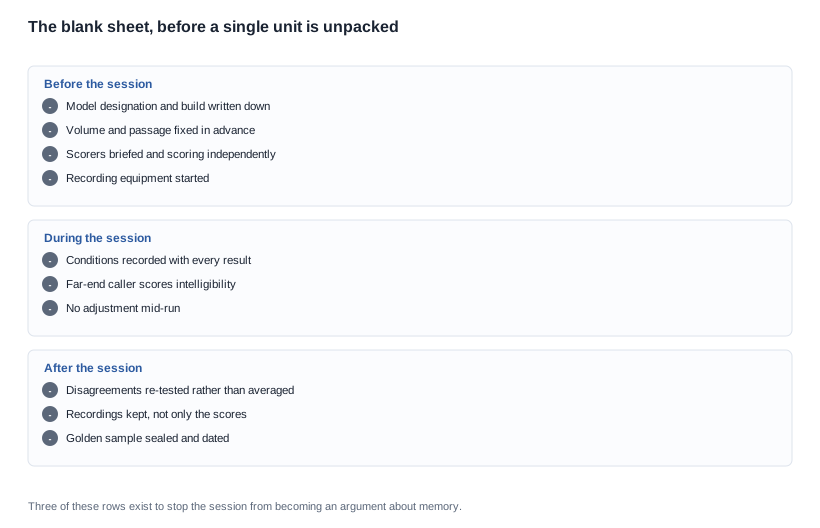

Running a session: order, timing and who scores
The order of a session is not arbitrary, and running it out of order costs you results. A session that starts with the long wear test will produce a comfortable-fit reading from a wearer who has already adjusted to the frame. A session that starts with the call test will produce a call reading from a unit that has not been warmed up. Both of those are real effects and both of them are avoidable.

The sequence that works is: record the build and the unit identifier, set the volume and the passage once, run the one-metre and three-metre passages, place a live call and score at the far end, measure leakage at a stated distance, run the long session and record the pressure points, then seal the golden sample and date it.
The call goes before the long session because the call is the shortest and the most demanding thing to set up, and because a far-end participant who is kept waiting will not be as careful the second time. The long session goes last because it is the one where the wearer's experience accumulates.
The scoring rule that makes a disagreement useful
Score blind, with two people scoring independently. Where they disagree, that row is the one worth re-testing — and it is usually the row that predicts returns.
The reason a disagreement is informative rather than annoying is that the two scorers are responding to different things. One is listening for the product; the other is listening for the problem. A row where they agree tells you the product is unremarkable. A row where they disagree tells you the product has a characteristic that some listeners notice and some do not, which is precisely the profile of a marginal unit — and a marginal unit is what generates a return with no stated cause.
Write the disagreement down rather than averaging it. An averaged score destroys the information, and the information is the reason you ran the test twice.
The other half of the scoring discipline is to keep the recordings, not just the scores. Two scorers can disagree about a recording played back at half speed in a quiet room, and the row can be re-tested in a minute. A remembered impression cannot be re-tested at all.
Running it against more than one supplier
The template earns most of its value when it is used to compare suppliers rather than to characterise one, and comparing needs three extra disciplines that a single-supplier evaluation does not require.
Blind the units. The tester should not know which supplier produced which unit, and the labels should be arbitrary. A tester who knows they are holding the more expensive sample will find more in it, and the sheet will record the expectation rather than the product. This is the single most common way a multi-supplier evaluation is compromised, and it costs nothing to prevent.
One golden sample per platform, not one golden sample per programme. A golden unit only makes sense against the platform it came from. A single golden sample across two suppliers is a measurement of the difference between the two platforms, which is useful, but it is not a drift reference, and using it as one will produce a false drift report on whichever platform differs more from the reference. Keep one approved unit per platform, each recorded and dated, and compare each delivery against its own.
Compare the shape of the result, not only the number. A supplier whose leakage is consistently below a threshold is in a different commercial position from one whose leakage is occasionally below the threshold and occasionally well above it. The second is the one that generates returns, and the mean of its results will look acceptable. This is why the sheet records the individual readings and the spread, and why the golden sample comparison is done on the worst unit in the delivery rather than on the average unit.
The golden sample and the drift it exposes
The golden sample is the row that makes every other row cumulative rather than repeated from scratch. One approved unit is retained, with its firmware version recorded and dated, and every subsequent delivery is compared against it.
This matters because acoustic and microphone performance drift between production lots more often than specification sheets suggest, and the usual cause is a component supplier change that nobody on the project noticed. Nothing in the paperwork changes. The product changes. A buyer with a golden unit sees the difference in one session; a buyer without one sees a slow rise in returns that nobody can attribute.
The golden sample has a lifecycle of its own, and it is worth writing it down. It should be stored in a way that preserves the driver and the battery, kept away from heat and direct sun, and re-tested periodically so that its own condition is known. A golden unit that has drifted is worse than no golden unit, because it will be used to detect drift that is in the golden unit rather than in the delivery.
The comparison against the golden sample should be a row in the ordinary sheet, not a special exercise. That is what makes it cheap: a production delivery is compared against the golden unit on the same protocol, and the result is a signed observation rather than an investigation.
The first production lot is the delivery most likely to be compared, and the comparison most likely to be skipped, because the first lot is usually a rush and the team is usually still resolving the artwork. It is also the lot where a discrepancy is most useful, because a golden unit measured in the pre-production phase and a first lot measured on receipt are two points on the same scale, and the distance between them is the earliest available evidence that a component changed. Schedule that comparison as a named line in the goods-in procedure rather than leaving it to whoever is on the dock.
There is a version of the golden sample that does not work, and it is worth naming because it is a common shortcut. A golden unit that was assembled by hand, or that came from a pre-production batch built with a different component lot, is not a reference for production. It will disagree with the delivery for reasons that have nothing to do with quality, and the first person to report a false drift will be the person who reads the sheet. The golden unit has to come from the production line, and if the only available unit is a sample, then the first production lot has to become the golden unit and the pre-production period simply has no reference at all.
Where an evaluation template tells you the programme is not ready
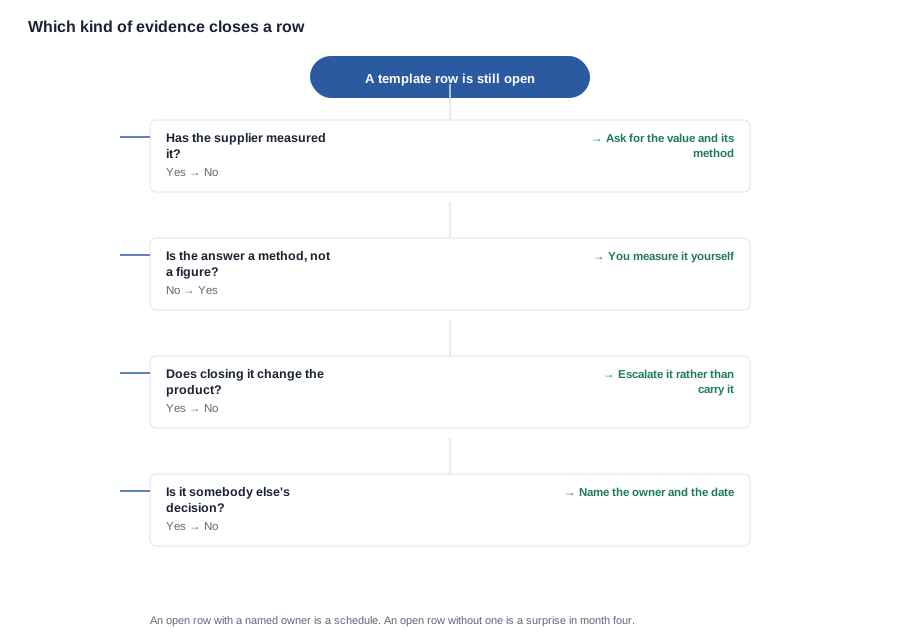
A template also tells you what you do not know, and this is the part that gets skipped because it is uncomfortable. If three rows in the sheet stay open because the manufacturer cannot supply them, that is not a gap in your paperwork — it is a finding about the product's readiness for a controlled programme, and it is better to know it before an order than after.
There are three distinct kinds of open row, and they need different responses:
- Open because the supplier has not measured it. This is the most common and the least serious. A supplier who will measure it in a week has an answer; a supplier who cannot has a platform with no characterisation, and that is a procurement risk rather than a measurement gap.
- Open because the specification does not exist yet. The published row is a method rather than a figure — open-ear acoustic structure, directional audio, intelligent noise reduction are all techniques in our catalogue rather than performance figures. A row like this can only be closed by your own measurement, and it should be closed before the order rather than after.
- Open because the answer is commercially inconvenient. Some rows are open because nobody wants to publish the number. That is a signal about the programme, and it belongs in the same conversation as the price.
The working rule we apply: we publish no acoustic measurement for any model, and a buyer-run evaluation with a consistent protocol is worth more than a datasheet figure whose method nobody has seen. Where you send samples we will run the same protocol with you and report what we measure, including where the result is worse than expected. That honesty is more useful than a supplier comparison, because the comparison is what your customers will experience and it is not in anybody's datasheet.
The technical background is under open-ear audio, the microphone side of the protocol is in noise control, and the same template applied to a supplier's answers rather than to units is in the checklist for procurement teams.
Related reading
Send samples and we will run the same template with you and report results.


