

Open ear audio glasses smart glasses checklist for procurement teams has to start with an unwelcome fact about this category: the published set answers one of the twelve items below, answers part of a second, and leaves the other ten to be established on a sample or in writing. That is not a criticism of the suppliers; it is how the category is documented. It is also why a procurement team in this category needs a checklist rather than a comparison, because the comparison cannot be made from documents.
This is deliberately not a supplier questionnaire. A supplier is selected, samples have been seen, and a quotation is on the table. What sits between that state and a released purchase order is an internal gate, and the gate has a different job from the questionnaire: the questionnaire asks whether a supplier is worth talking to, while the gate asks whether this order, as specified, is safe to place. The gate is run by the buyer's own team, it is scored against evidence the buyer holds, and it produces one of three answers.
Twelve items, each with the criterion that tells you the answer is real.
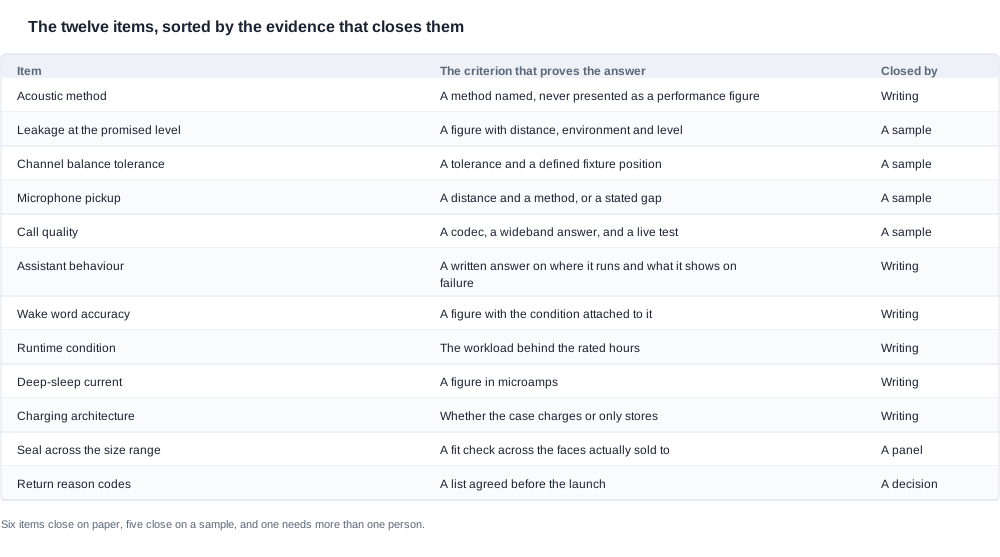
Open ear audio glasses: twelve items before an order can be released
1. The acoustic method. The structure published, and an explicit acknowledgement that the measurement of it is missing. Our catalogue publishes the open-ear structure, the directional audio and the intelligent noise reduction as methods, and no measurements for any of them. Pass criterion: the supplier states the method and does not present it as a performance figure.
2. The leakage at the promised volume. Pass criterion: a figure at a stated volume and a stated distance, or at least a stated test method. This is the number that decides the return rate, and it is the one nobody publishes.
3. The channel balance tolerance. Pass criterion: a tolerance and a fixture position, because a balance error is the failure this category returns most often for and the one that is invisible at launch.
4. The microphone pickup. Pass criterion: a distance and a method, or a stated gap. This is the row that decides whether the assistant and the calls work.
5. The call quality. Pass criterion: a codec, an answer on whether there is a wideband option, and a test. We publish no codec for any model, and call quality is where a buyer discovers a limit late.
6. The assistant behaviour. Where it runs, what happens with no connection, and what the customer sees when it fails. Pass criterion: a written answer, because this is a chain question rather than a hardware one.
7. The wake word and its accuracy. Pass criterion: a figure with a condition. Our catalogue lists an AI voice assistant and publishes no detail about it.
8. The runtime condition. Pass criterion: the workload behind the rated hours. Our catalogue publishes a runtime for every model in the audio family and a test condition for none, so this is where the numbers diverge.
9. The deep-sleep current. Pass criterion: a figure in microamps. It decides the overnight loss and it is publicly benchmarkable, so its absence is conspicuous.
10. The charging architecture. Pass criterion: whether the case is a charger or a dock, and what the customer has to own. A case that stores rather than charges is one of the most common listing errors in this category.
11. The seal across the size range. Pass criterion: a fit check across the faces you sell to, ideally including people who already wear spectacles, because two frames on one face is a common configuration and it changes the seal.
12. The return reason codes. Pass criterion: a list, agreed before the launch, so the field data can be read. A return rate without reason codes tells you nothing about which of the eleven items above is failing.
How these twelve were chosen
The list is not a generic quality checklist with the acoustics removed, and it is worth saying what governs the selection, because a gate that grows without a rule becomes a document nobody trusts.
Three tests decided each item. First: does an open answer to this item change what the product is, what the listing says, or what the channel can be promised? The assistant chain, the call quality, the microphone pickup and the charging architecture all pass this test, because an open answer in any of them is an open question about the product itself.
Second: is the item capable of being closed by somebody other than the buyer? The acoustic method, the runtime condition and the deep-sleep current are supplier questions, and a buyer who cannot answer them has to ask. The fit panel and the return reason codes are internal questions, and a buyer who cannot answer those has to do the work.
Third: will the item still be true in six months? The runtime condition, the deep-sleep current and the return reason codes survive a year. A statement about the current tuning does not, which is why the tuning is not on the list at all — it belongs to a brand decision, not to a release gate.
Items that fail all three tests were left off, which is how the list stayed at twelve rather than growing to thirty.
The one item that needs more than one person
Item 11 is the one that needs more than one person, and it is the one that most often decides the range plan rather than the order.
A fit check across a size range is not something a procurement manager can complete alone and it is not something a sample session can substitute for. It needs several wearers drawn from the faces the channel actually sells to, it needs a recorded note of where the temples load, and — where the channel serves customers who already wear prescription glasses — it needs someone wearing both frames at once, because the two frames interact at the temple and the ear, and the interaction is not visible from a single-frame fit.
The reason it decides the range plan is that the fit result is what determines whether you keep one frame, two, or a size range. A channel that cannot serve a wide range of faces from a single SKU needs a range, and a range is a commercial decision about minimum quantities and stock depth rather than a quality decision about one product. Discovering that after the first order has been placed means discovering it with the stock already bought.

Sorting the twelve by the evidence that closes them
The twelve items are not equal, and treating them as a flat list is what turns a gate into a bureaucracy. They sort into four groups by what closes them, and the groups have different owners and different deadlines.
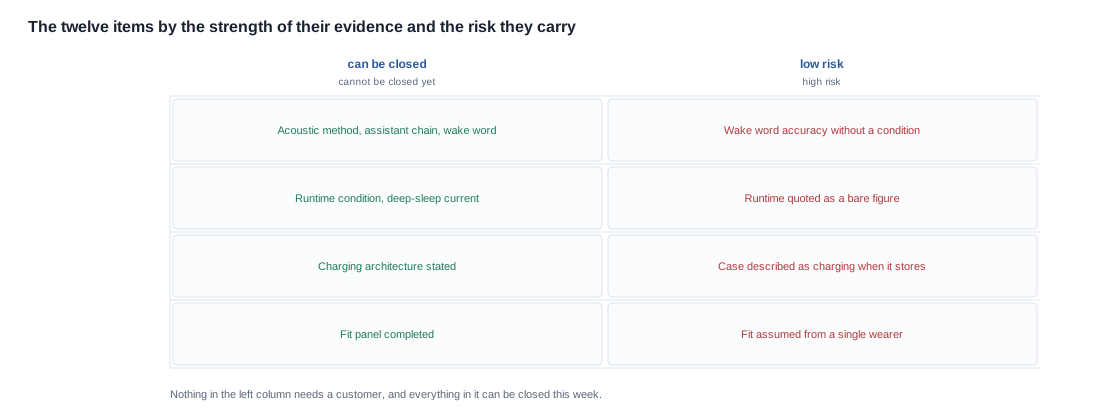
Six close on paper. The acoustic method, the assistant behaviour, the wake word accuracy, the runtime condition, the deep-sleep current and the charging architecture. These are answered in writing, usually within a week, and they are the items a supplier can close without touching a product. They are also the items that decide whether the product is even the right one for the use case — if the assistant chain does not match the customer's expectation, nothing else matters.
Four close on a sample session. The leakage at the promised volume, the channel balance tolerance, the microphone pickup and the call quality. These need the unit in hand, a fixed protocol and a second person for the call. They are best run on a unit from the same production batch as the first order rather than on a marketing unit, because the marketing unit is a unit somebody has been using to make demonstrations.
One needs a panel. The seal across the size range, as described above.
One is a decision. The return reason codes, which nobody measures. They are agreed with the channel before the launch, and they are the item that makes the next programme better.
What to send in writing, in one request
The six written items should go out as one request with a single deadline, not as six emails. There is a practical reason for that, and it is not tidiness: a supplier who receives the runtime condition question and the wake word question separately will answer the first carefully and the second vaguely, and the vague one is usually the one that decides the launch.
The request should state the target configuration, the model designation, the destination markets, and the deadline. It should ask for units on every figure, and it should ask for "not yet measured, and here is the date" as an acceptable answer, because a supplier who is told that a dated no is acceptable will give one instead of a soft sentence.
The reply is then scored into three states, and the three states are the whole of the gate: answered, testable, and open. An item that is testable is not a problem; it has an owner and a session. An item that is open is a problem, and its position depends on which group it came from.


The release gate: what holds an order and what escalates it
The gate produces one of three answers, and the third one is the one that saves programmes.
Release means every item is either answered or testable with a booked session, the fit panel is scheduled or complete, and the return reason codes are agreed. The order can go out.
Hold means the open items are confined to the groups where they can be closed without a customer-facing consequence — the written items that have a date, or the sample items that have a booked session. A hold is a scheduled thing, not a stopped thing, and it should carry the date on which the hold is reviewed.
Escalate means an open item sits in the assistant chain, the microphone pickup, the call quality or the fit, and closing it is not within the buyer's control. Those four decide whether the product works in the customer's hands, and an open item in any of them is a reason to change the product, the claim or the launch date — and all three of those are decisions somebody has to take at a level above the buyer.
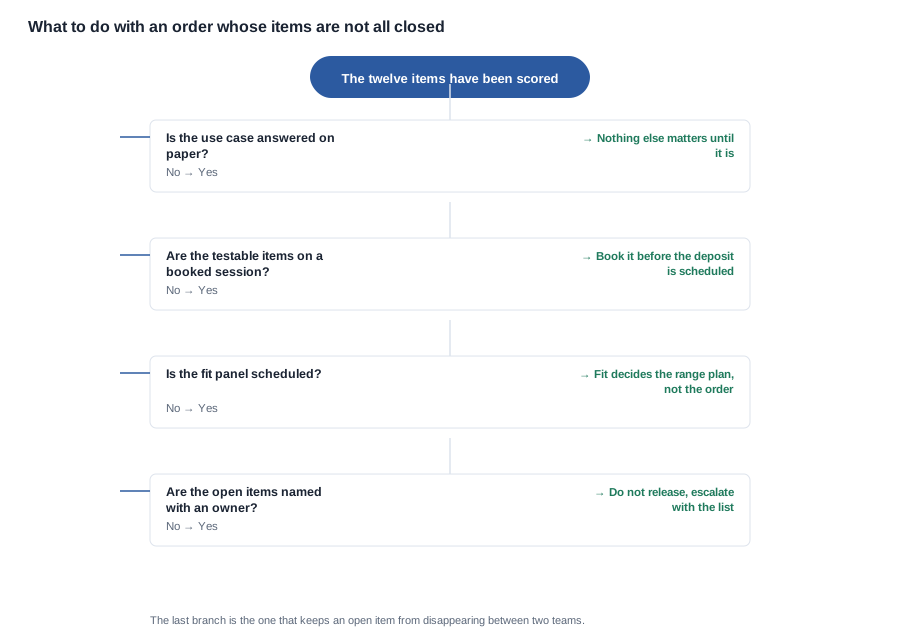
The rule that keeps an open item from disappearing between two teams
Every open item needs a named owner and a date, and the owner has to be a person rather than a function. "Procurement" is not an owner; "the product lead" is. A function owns nothing, and an item owned by a function is an item that is still open when somebody asks about it in six months.
The rule that follows is simple and it is worth writing into the procedure: an open item is not closed by a supplier promising a date, and it is not closed by a good-enough estimate. It is closed by a document or a measurement, and it stays visible on the gate until one of those two arrives. The purpose of the escalation answer is to make sure that an item which is genuinely stuck gets escalated rather than quietly carried into a production lot.
The distinction between a hold and an escalation is usually a question about who is affected. A hold is an item that delays a decision without changing it. An escalation is an item that changes what the product or the claim will be. The buyer can hold; only the business can escalate.
Running the fit panel and agreeing the return reason codes
The fit panel is the item with the longest lead time of the twelve, because it needs wearers to be available over several days, and it is therefore the item to schedule first even though it is scored eleventh. A panel that is booked after the purchase order has been released has already cost the buyer the flexibility it was supposed to provide.
The panel needs three things written down before the first wearer arrives: the head sizes being covered, the pass condition for temple pressure, and the recording method. A drawing of where the temples load is worth more than a comfort score, because it is comparable between wearers and it is checkable by somebody who was not present.
The return reason codes are the cheapest item on the list and the one that makes the next programme better. A return rate without reason codes tells you that returns are happening and nothing about which of the twelve items is failing. A short agreed list — acoustic quality, call quality, fit, battery, pairing, changed mind — turns the same data into a diagnosis, and it has to be agreed with the channel before the launch because after the launch the channel will have its own wording and the two sets will not reconcile.
There is one instruction that makes the codes usable: the reason list has to include a code for "not as described", because that is where expectation errors land, and it is the code that connects the returns data back to the listing copy. The limits buyers should expect in this family are set out in open ear audio limitations and drawbacks.
What this gate cannot tell you
This gate is an internal instrument and it is worth being precise about its limits, because a gate that is asked to settle a question it cannot settle will be ignored by the second month.
It cannot tell you whether the product is good. It tells you that the questions have been answered, that the ones which need a measurement have been scheduled, and that the open items are named and owned. Quality is established by the protocol in the sample session and maintained by the golden-sample comparison, and neither of those is a gate.
It cannot produce a price comparison, for the same reason the supplier questionnaire cannot: a comparison needs a defined configuration, and the configuration is what the gate is preparing to fix. The gate decides that the order is safe to place; it does not decide that this supplier is the cheapest for the order.
It also cannot close the things nobody has a method for, and pretending otherwise is the failure mode. Our catalogue publishes the acoustic methods and the electrical rows, and it publishes the empty rows next to them rather than filling them with values from a typical device. We will not quote a leakage figure, a driver size or a codec we have not measured, and we will not describe a case that stores as though it were a case that charges.
What the released order has to carry with it
A gate that ends with a yes and no paperwork produces a compliant purchase order and a programme that still fails. The twelve answers have to travel with the order, and the way they travel is a set of attachments and clauses that the gate produces.
Four things attach to the order itself. The model designation appears as a line item, with the certificate numbers and their issuing bodies attached, so that the goods-in check has something to check against. The measured acceptance criteria from the sample session are attached, with their method, because a criterion without a method cannot be applied to a production lot. The return reason code list is attached, because the channel has to be working from the same list. And the fit panel result is attached, so that a complaint about fit in month three can be traced to a measurement rather than to an argument.
Four clauses go into the order. One requires notice before any change of transducer, DSP tuning, default processing state or firmware, because a firmware change alters the acoustic result without altering the hardware. One sets the date by which the supplier will supply the outstanding written items, which is what converts a hold into a schedule. One covers who bears the cost when a production lot fails the attached acceptance criteria, which is the clause that decides whether a failure is expensive or merely annoying. And one covers the documentation pack, so that the file travels with the goods rather than sitting in somebody's email.
The commercial terms that go with the order are largely outside the gate's scope, but two of them are worth naming because the gate is the only place they are visible. The certification cost and the elapsed certification time are not commercial levers; the fee is per market and per model and the elapsed time belongs to the test laboratory. The toolings, by contrast, are amortised across the first order, so the useful questions are over what volume that amortisation is calculated and what happens to the tool if the programme is discontinued. The number of models, colours and packaging treatments committed is a real negotiation variable, because each one carries its own minimum, and it is the lever a buyer in this category has most of.
What we can do is take a supplier's answers and mark each of these twelve as answered, answerable only by a test, or not answered at all. The technical background is under open-ear audio technology, the audio range is on the bluetooth audio glasses page, the quality control regime is in open ear audio quality control, and the vocabulary the team has to share is in open ear audio glossary.
Related reading
- The quality regime behind the product — open ear audio quality control
- The vocabulary the team shares — open ear audio glossary
- The limits to expect — open ear audio limitations and drawbacks
Send us a supplier's answers and we will mark each of the twelve as answered, testable, or open.


