

The cost of an open-ear audio product is not set by the rows a buyer can see. Capacity in milliamp-hours, Bluetooth version, charge window and operating window are all visible on a published sheet, and none of them is where the money goes. The cost is set by four structural decisions that a quotation normally hides: the acoustic assembly and its chamber, the cell configuration across the two temples, whether the temples are fixed or detachable, and the charging interface. Two suppliers quoting the same unit price have almost certainly made different decisions on the first of these, and the difference does not appear on the invoice — it appears in the acceptance test, in the defect rate and in the return rate. Open ear audio glasses smart glasses cost factors is therefore a structural question rather than a price question, and this article takes it apart component by component, shows which lines respond to order size and which never do, and explains how to read a quotation so that two apparently identical prices can be ranked.
The published position of our range is the reference point for the whole discussion. Eleven open-ear models publish Bluetooth 5.3 on the K01 and the K02 and 5.4 on the other nine, cell configurations at 55 mAh times two, 70 mAh times two, 90 mAh times two, a single 100 mAh cell and a single 115 mAh cell, charge windows of one hour on the D17 and the ZH12 and two hours on the rest, operating windows of roughly six, seven or eight hours, magnetic charging on seven models and Type-C on four, and feature rows for surround sound, ultra-slim detachable temples, a slim temple and remote control photography. On the acoustic side, the range publishes its techniques — open-ear acoustic structure, directional audio and intelligent noise reduction — and publishes no driver size, no chamber dimension, no leakage figure, no frequency response and no pickup distance for any model.
Open ear audio glasses: where the money sits
The unit price of an open-ear audio product is the sum of five things that behave differently. A buyer who treats them as one number negotiates the wrong one.
The acoustic assembly is a bought decision, not an engineering one. The driver, the chamber, the grille and the sealing around the grille are the parts that decide what the product sounds like, and in this category they are the parts a buyer cannot evaluate from a catalogue at all. Every acoustic metric a buyer would most want — leakage, driver size, frequency response, pickup distance — is unpublished for this range, which is precisely why the driver decision carries so much commercial weight. Two suppliers can quote the same unit price with completely different acoustic assemblies, and the difference is only detectable on samples or by asking for the method. This is the single most important thing to know about cost in this category: the most expensive decision in the product is the one the price sheet hides.
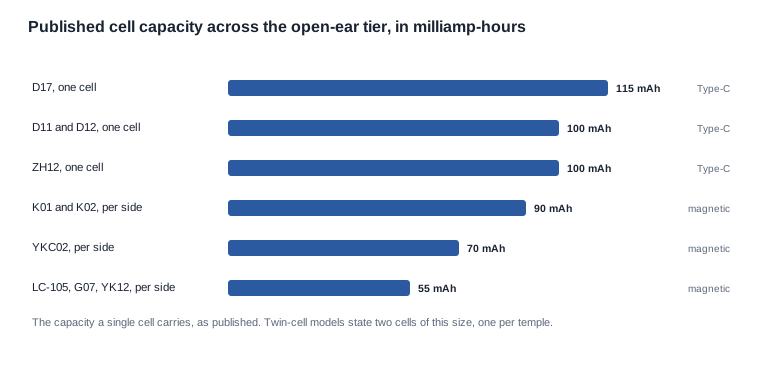
Cells and the packaging they force. The cell configuration is the second structural cost, and it is the one that shows up most visibly on a quotation as a capacity figure. A twin-cell unit places one cell in each temple; a single-cell unit concentrates the same kind of volume in one side. The consequence is not the cell itself, it is everything the cell forces: a wider temple cavity, a second charging contact set, a second protection circuit, a different board shape, and a different assembly line balance. The published chart above shows the capacity a single cell carries across the tier, and the four groups that carry two cells each are the four groups with the twin-cell architecture.
The charging interface and the accessory line it creates. Magnetic charging and Type-C are both cheap per unit. What they cost is downstream. A magnetic model obliges the channel to stock a magnetic cable or a magnetic dock; a Type-C model obliges the channel to stock a Type-C cable, which is the easier half of the market because Type-C is already the dominant cable in most categories. This is a cost line that appears in the accessory budget rather than in the product budget, and a buyer who compares two quotations on unit price alone will discover it in the accessory order.
Temple architecture, and the second mould hiding inside a model. The G07 publishes ultra-slim detachable temples and the YK12 publishes a slim temple. A detachable temple is a separate mould, a separate assembly step, a separate set of tolerance controls and a separate failure mode, and it usually appears as a different model designation rather than as an option on the same one. It is also the one structural cost in the list that genuinely amortises: the mould is cut once and spread across the programme, so the second mould costs more at a small volume than at a large one.
Packaging, inserts and the case line. Packaging is the line item most often treated as a rounding error and most often wrong. A frame with a battery in both temples needs protection in both temples, and that requirement pushes the box size, the insert tooling and the drop performance target in a direction that a generic glasses box cannot absorb. If a case is part of the offer, it becomes a separate line with its own cell, its own transport documentation and its own certification scope. Our catalogue publishes charging case capacities for the camera tier only, at 1400 mAh on the CY03 and the L1 Pro, and the CY05, 900 and 1400 mAh on the L2 Utral, and a 1200 mAh foldable case on the MT6; the audio tier publishes no case capacity at all, which tells a buyer where to ask.
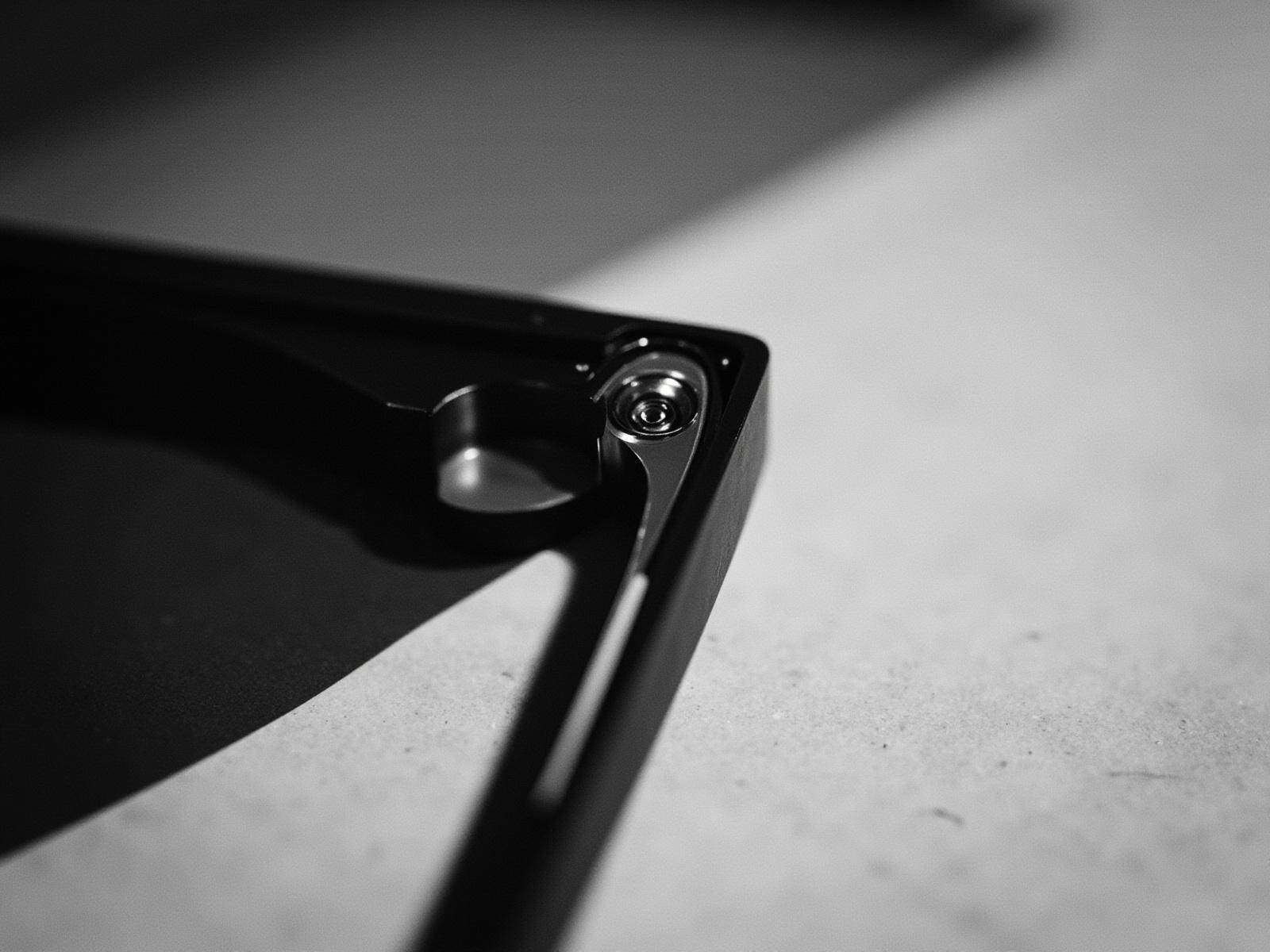
The four components that separate two quotations that look identical
Two quotations that present the same unit price, the same cell configuration, the same radio version and the same charge window can still be different products. The table below sets out the six cost drivers, how each one appears in a quotation, the question that tests it, and where the volume effect lands.
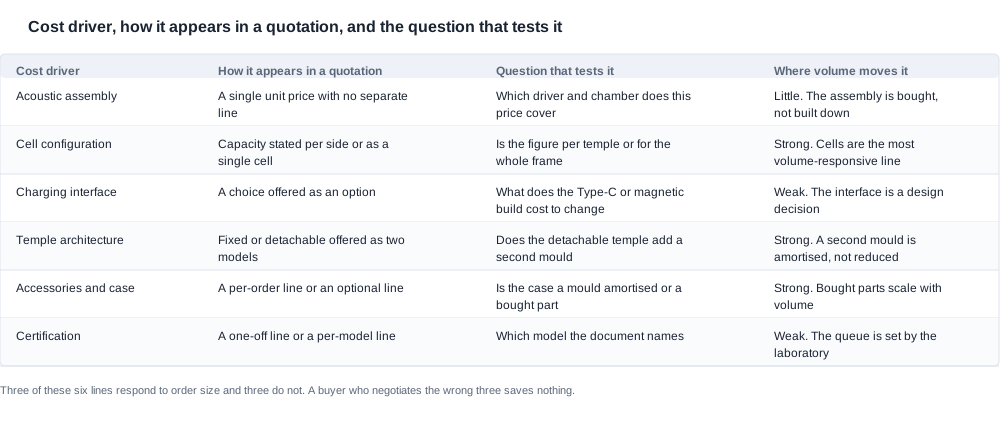
Three of those six lines respond to order size and three do not. That split is the most useful thing on the page, because a buyer who negotiates the three that do not respond has spent the negotiating window on nothing.
What order size changes, and what it never changes. Order size moves the price of bought components, the price of assembly labour, the amortisation of tooling and the price of packaging material. It does not move the cost of a certification exercise, which is quoted per configuration and occupies a laboratory queue rather than a production slot. It does not move the design of a chamber that has already been decided, because the acoustic decision was made before the order and is not revisited for volume. It does not move the elapsed time of a test to obtain a certificate, because the queue is set by the laboratory. And it does not move tooling once the tooling is cut, except in the sense that a larger programme spreads the same one-off charge over more units.
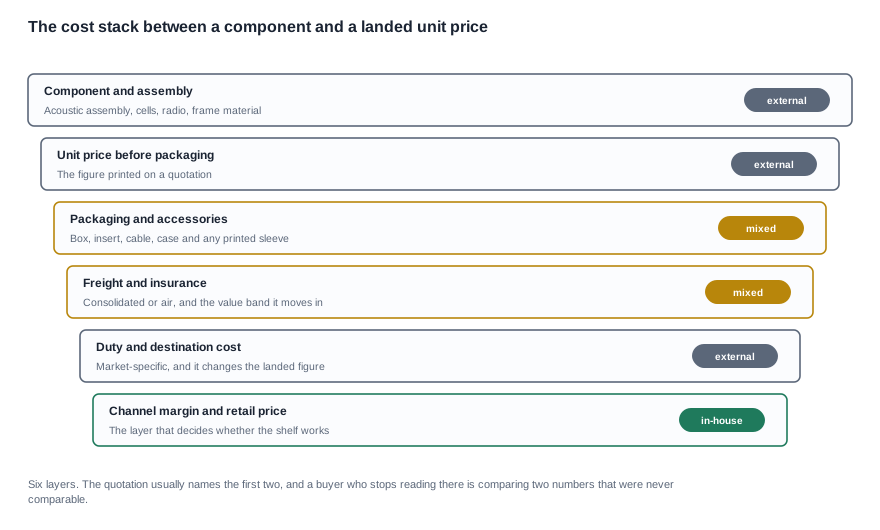
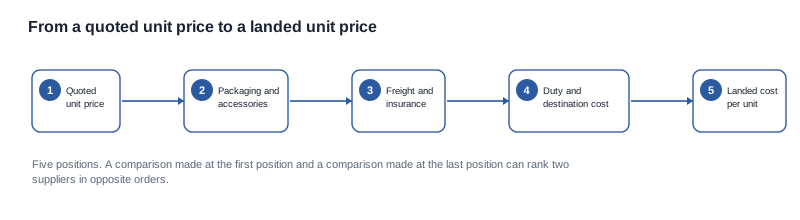
The three additions between a quoted price and a landed cost. A quoted unit price is the first position, not the last. Packaging, accessories and any supplied cable are the second position, and they are frequently excluded from the comparison because they are quoted separately or bundled at a discount. Freight, insurance and the incoterms are the third position, and they are where a low unit price from one factory and a higher unit price from another frequently reverse their order. Destination cost, duty and the channel's own margin are the fourth. A buyer who ranks two suppliers on the first position is ranking them on the position that moves least.
What a price tier is actually made of. Suppliers quote tiers because the cost structure has steps rather than a curve, and the steps come from three places: the volume at which cells and packaging material are bought at a different price, the volume at which assembly labour is scheduled as a full run rather than a part run, and the volume at which a second mould stops being a per-unit burden. A tier boundary is therefore a statement about the supplier's cost structure, and a buyer who asks where the boundaries are and why they sit there learns more than a buyer who asks for the price at a given volume. The step in the middle of a range is often the point at which a second colourway becomes economical to schedule at all.
The five questions that turn a quotation into a comparison. Ask which acoustic assembly and which chamber the price covers. Ask whether the capacity figure is per temple or for the whole frame. Ask what is included in the box. Ask which cost basis the price assumes and what freight terms it assumes. And ask what changes in the price when the second colourway is added, since that answer reveals the mould amortisation plan. Five questions, one email, and the comparison becomes meaningful.

Reading a quotation line by line before you compare it
The practical skill in this category is reading a quotation as a description of a product rather than as a number.
The six lines that must be present before a comparison is valid. The exact model designation behind the price, including which variant of a pair such as the LC-105-1 and the LC-105-2 is quoted. The cell configuration, stated per side or as a single cell. The radio version and the charging method. What is included in the box. The price basis, including the volume it assumes and its validity period. And the cost of anything the price excludes. If any of the six is missing, two quotations cannot be ranked, and the correct response is to ask rather than to choose the lower number.
The red flags in a cost breakdown. A price that is materially below the others without a stated structural reason is usually an acoustic assembly that is not the one you assumed, or a cell configuration that differs, or a single-cell unit presented against twin-cell competitors. A price that includes tooling and a competitor's that does not is a comparison error rather than a competitive advantage. A price quoted with a short validity period on a rising cell market is a price that will move. And a price that cannot be broken down at all is not a price that can be defended at a review.
The commercial scope that is genuinely open. The number of configurations committed at launch is the largest lever a buyer holds, because it multiplies the certification workload, the packaging variants and the per-model minimums. The artwork round count is negotiable and the cost of a late artwork change is real, because it delays the label and the packaging approval. The delivery structure — a single shipment against two — is negotiable and it changes the working capital a buyer carries. The price tier boundaries and their break points are worth a conversation, because the supplier's cost steps are visible and a buyer who knows where they are can position the order to land on a step. And the retention held against the documentation package protects the buyer against the failure that costs most, which is a shipment whose certification scope does not cover the shipped configuration.
The commercial scope that does not move. The cost and the elapsed time of a certification exercise are a fixed cost per configuration and a queue at the laboratory; the elapsed time is set by the laboratory rather than by the order size, and pressing on either of them does not make the goods arrive faster. Tooling is a one-off charge normally amortised across the first order, so the useful questions are over what volume it is amortised and what happens to the tooling if the programme is discontinued. And the acoustic design itself is not a commercial variable: a supplier who will not change the chamber geometry or the driver is telling you the acoustic performance of that model is fixed, and the programme should be built around that fact rather than against it.
A worked quotation review, from two prices to one comparison
The following is a hypothetical case rather than a client project, and it is included to show the comparison sequence rather than to report an outcome.
Assume a brand-side sourcing manager is comparing two quotations for a private-label open-ear audio programme in a European channel, with a target of 20,000 units and a single model in two colourways. Quotation A comes back at a unit price that is about nine per cent below quotation B, with the same published radio version, the same cell configuration and the same charge window. Both quotations exclude packaging, both quote freight on the same incoterm, and neither states a validity period.
The five-question sequence applied to two quotations. The first question — the acoustic assembly — produces the answer that reorders the comparison. Quotation A's line note says the price covers a single driver with an open grille and no published chamber figure. Quotation B's note describes a sealed chamber with a published driver size and states that the acoustic configuration is fixed for the programme. Neither line states a leakage figure, but the two lines no longer describe the same product, and a nine per cent unit price difference is now a question about whether the acoustic configuration is worth the difference rather than a saving.
The second question — the cell configuration — confirms that both are quoting the same twin-cell architecture, so the cost structure is comparable at that level. The third question — what is in the box — removes a difference the buyer did not know existed: quotation A excludes the cable and the moulded insert, and quotation B includes both, and the insert is the part that protects two cells in two temples. The fourth question — the price basis — establishes that A assumes 25,000 units and B assumes 20,000, so part of the gap is a volume assumption rather than a cost difference. The fifth question — the second colourway — reveals that B amortises one mould across both colourways while A quotes a second mould, which at this volume is a larger absolute number than the unit price gap.
The thresholds that decide which quotation wins. Three thresholds decide the comparison, and all three are set before the prices are read. The first is the acoustic configuration: if a programme's listing depends on a specific sound character, then a quotation that does not identify the assembly is not comparable at any price, and the lower price is irrelevant. The second is the landed figure: the comparison is only valid at the same position on the cost stack, so packaging, insert, cable, freight and destination cost all have to be added to both sides before ranking. The third is the configuration count: two colourways in one production run and two colourways in two runs are different programmes, and the second is the one whose certification workload and minimums are higher.
Run in that order, the comparison produces a defensible decision rather than a ranking of two numbers. It also produces the two documents a procurement file needs: a written acoustic configuration note attached to the purchase order, and a landed cost sheet showing what each position contributes. A buyer who has both can defend the selection at a review six months later, when the supplier's catalogue has moved on and the original quotation is no longer available.
Four criteria to apply before you order. How to choose between two structurally different quotations comes down to four criteria applied in this order:
- The acoustic configuration. If a programme's listing depends on a specific sound character, a quotation that does not identify the assembly cannot be compared at any price.
- The cell configuration. Twin-cell and single-cell units are different architectures and their quotations are not comparable on the same axis.
- The landed position. The comparison is valid only when both prices sit at the same point on the cost stack, with packaging, insert, cable, freight and destination cost added to both.
- The configuration count. Two colourways in one production run and two colourways in two runs are different programmes, with different certification workloads and different minimums.
Red flags in this category are not usually dramatic. They are a missing model designation, an unstated price basis, a packaging line that excludes the insert, and a second mould quoted as if it were free. Each of them is a question; each of them is answered in one email; and the total cost of asking is trivial next to the total cost of ordering on the wrong one.
What our catalogue publishes about cost, and what it does not
We publish the rows that help a buyer structure a comparison, and we are explicit about the rows that would be needed to close it.
The rows we publish. Every open-ear model in the range publishes a radio version, a cell configuration, a charge window, an operating window and a charging method, and those five rows are enough to separate two quotations structurally before anyone prices them. The feature rows name surround sound on the YKC02 and the D11, and the D17 and the YK12, stereo surround on the ZH12, remote control photography on the D17 and the ZH12, a slim temple on the YK12 and ultra-slim detachable temples on the G07, which tells a buyer which structural options exist. The camera tier publishes pixel configurations and charging case capacities at AI camera glasses, and the range itself is at bluetooth audio glasses.
The rows we do not publish, and why that matters commercially. We publish no acoustic figures for any model: no driver size, no chamber dimension, no leakage, no frequency response, no pickup distance, no third-party measurement. We publish no unit weight for any audio-tier model, and no bare frame weight anywhere in the catalogue; the only published unit weight in the range is 158 g for the MT6 glasses unit, which includes its battery and camera and excludes the 1200 mAh foldable charging case. We publish no certificate numbers: the catalogue's export-certification page carries ten patent certificates, eight appearance-design patents and two utility-model patents, and names no CE, FCC or RoHS marking, and the model-specific conformity documents have to be requested — and each of those documents carries a laboratory cost and a lead time that a catalogue page does not settle. We publish no cost data of our own, because a published price list in a category with this much acoustic variation would be misleading. The material and frame background is at materials and ergonomics and the radio background is at bluetooth connectivity.
What we will say plainly. We will not quote a unit price without a stated configuration, a stated volume and a stated validity period, and we would rather give a buyer a price that can be compared than a price that wins a quotation. We will not present an acoustic method name as though it were an acoustic measurement, and we will not tell a buyer that a published operating window is an acceptance value. The comparison method for the audio tier is at how to compare open-ear audio glasses, and the list of mistakes that recur when a buyer reads a cost breakdown quickly is at the buying mistakes guide.
The three actions to take this week. Take the highest quoted price of the set and ask for it as a complete landed figure, including packaging, cable, freight and destination cost. Take the lowest quoted price and ask the five questions listed above. Then ask both suppliers the same question about the second colourway, and compare the answers, because that single answer tells you more about each factory's cost structure than the two unit prices do.


