

Open ear audio glasses: a second source, or a second colourway
Two open-ear audio models with the same Bluetooth version, the same charge time and an hour's difference in published runtime are very probably the same product in a different configuration, and the way to find out is the cell configuration row rather than the feature list. In this tier our catalogue publishes Bluetooth 5.3 or 5.4, cell configurations of 55 mAh × 2, 90 mAh × 2 or a single 100 mAh cell, charging in two hours or less, runtime of roughly six to eight hours, magnetic or Type-C charging, and features such as surround sound or a detachable slim temple, and it publishes no touch row for any model. On acoustic performance itself, the published position is that no third-party measurement supports it.
So a comparison has to be built on configuration and power, and the audio claim has to be qualified on a sample. But the decision that actually sits behind that comparison is a sourcing one, and it is usually made later than it should be: are these two models two products you will stock, or one product you will stock twice? That answer determines the order quantity, the artwork count, the inspection plan, whether you have a genuine second source, and whether your range is a range.
The buying task behind this article. The reader is a channel buyer, an e-commerce product owner or a brand buyer who has two supplier quotations in front of them and needs to know whether they are competing products or the same product with different paperwork. The failure this method is designed to catch is a buyer who concludes that two models are differentiated because their feature lists differ, when the difference is a colour or a temple and the electrical platform is identical.
The buyer with two open-ear quotations and one range plan
The answer in three sentences, and the range decision behind it
Open ear audio glasses smart glasses how to compare is a configuration comparison with an acoustic qualification, and its output is not a winner but a range plan. Build the configuration sheet for both models first, because the cell row and the interface row will tell you in minutes whether you are holding two products or one product twice. Then price the range decision — stock, artwork, inspection, certificates — before you sign anything. And qualify every acoustic statement on a sample, because the published position in this tier is that no third-party measurement supports it.
What the published configuration rows say, and what they do not
Bluetooth version: 5.3 on the K01 and the K02, 5.4 on the LC-105-1 and the YK12, the D11 and the G07, and the D12 and the LC-105-2. The three sport models sit outside this tier and publish their own version rows, and the camera models publish none. Charge time: two hours or less across the tier. Runtime: roughly six to eight hours. Charging: magnetic or Type-C. Features: surround sound, a detachable slim temple, an indicator and button control. No touch row is published for any model in the tier, so the temple control has to be confirmed with the supplier.
What is not published for this tier: any acoustic measurement from a third party, any leakage figure, any frequency response, any runtime test condition, any mass, any temple length and any lens dimension.
Why the same platform can be quoted at two prices
An open-ear audio product is an electrical platform, a frame, and a set of features, and the platform is what carries the cost. When a supplier quotes two models that share the platform, the price difference is not a specification difference; it is a packaging, artwork, certification and minimum-order difference, and those are the negotiable parts. Treating it as a specification difference is what leads a buyer to pick the cheaper unit and then discover that the more expensive one carries the case, the interface or the feature the channel needs.
There is a second, less comfortable reason the platform row is decisive. A second source is only a second source if the two products do not share a supply chain dependency. Two models from the same factory on the same platform, with the same cell and the same chipset, will fail together. A brand that lists two such models as a range has not diversified anything, and the second listing is a merchandising asset rather than a supply-chain asset. That is worth knowing before the range plan is written, and it is worth writing down, because the temptation to present two configurations as a range grows with every season.
The rows that separate two platforms, and the rows that only separate two casings
The cell configuration as the most informative published row
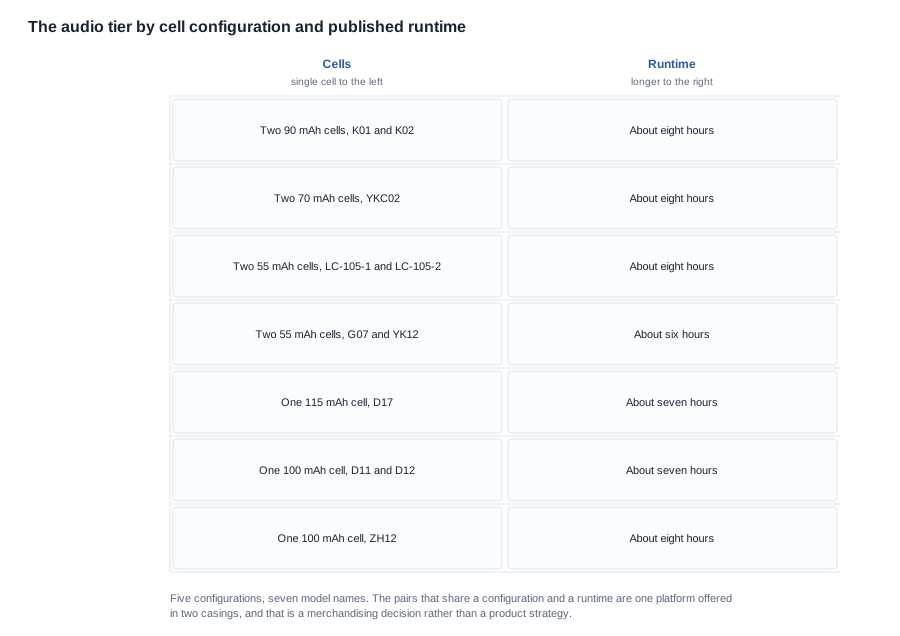
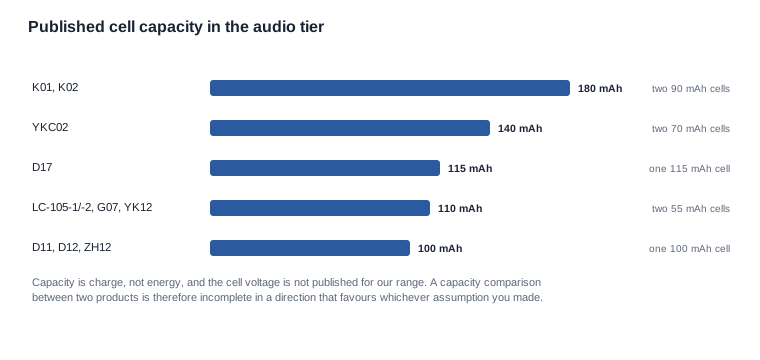
The cell configuration is the most informative published row in this tier, and it is not about audio. Within the audio tier, dual-cell models run 55 mAh × 2 and 90 mAh × 2 — the K01 and the K02 on 90 mAh × 2 with roughly eight hours, the LC-105 pair on 55 mAh × 2 with roughly eight hours, and the G07 and the YK12 on 55 mAh × 2 with roughly six hours — and single-cell configurations appear in the D11 and the D12 at 100 mAh with roughly seven hours. Outside the tier, the YKC02 runs 70 mAh × 2 with roughly eight hours, the ZH12 a single 100 mAh cell with roughly eight hours, and the D17 a single 115 mAh cell with roughly seven hours.
The runtime spread maps closely to the cell configuration, which tells you the audio stage is the dominant load in these products — and that any feature claimed to be passive is passive only in the sense that it is not drawing power. The published capacity rows sit on the Bluetooth audio glasses range and the technical background is at open-ear audio technology.
Two practical rules follow. First, a runtime figure is only comparable within a configuration family, because a twin-cell product and a single-cell product have different power characteristics and their hour figures are not one hour apart, they are two different architectures. Second, the cell row is the cheapest available test of platform identity: if the cell configuration, the interface, the charge time and the runtime all match, you are almost certainly holding two names for one assembly, and the remaining differences are physical.
The acoustic evidence row and the designation row
These are the two rows that most often expose a false comparison, and they do different jobs.
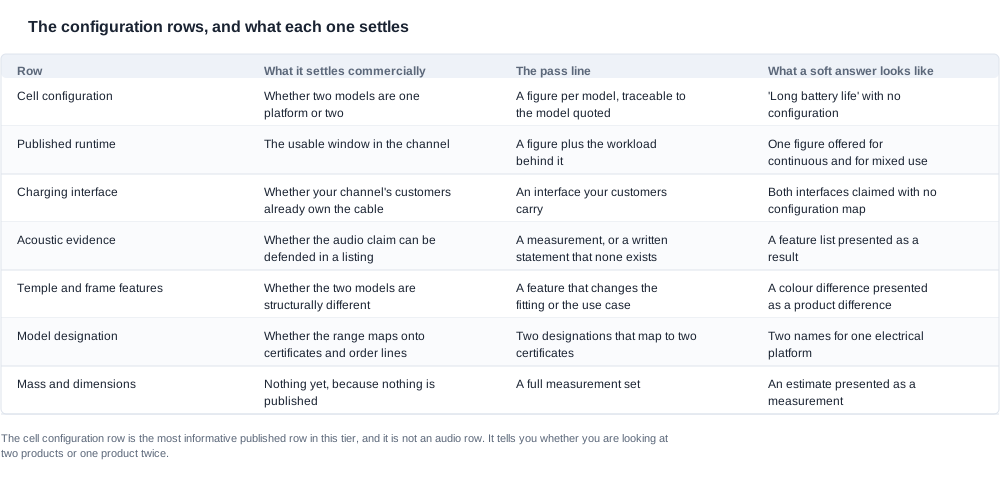
The acoustic evidence row tells you whether a supplier's audio claim can be defended in a listing. The pass line is a measurement, or an explicit written statement that none exists. A feature list with surround sound presented as a performance result is a soft answer, and it is the standard answer in this tier, because the published position across our own range is that no third-party acoustic measurement supports the claims. Asking the question is still worth doing: the point is to establish whether the supplier holds a measurement that we do not.
The model designation row tells you whether you are actually holding two products or one product in two casings, and the answer determines whether your range is a range. The pass line is two designations that map to two certificates and two purchase order lines. A single model that presents under two names is a traceability risk at the point where customs and certification ask the same question.

Establishing platform identity before the range is committed
- Build the configuration sheet. Bluetooth version, cell configuration, charge time, charging interface and runtime, side by side for both models, with the model designation against each row. If the rows are identical, the models are one platform and the price difference is being decided on something other than specification.
- Ask each supplier for the runtime test condition separately. Two suppliers quoting seven hours have almost certainly measured different things, and the condition is the only way to tell.
- Ask for the acoustic test method, not the feature name. A frequency response with a stated method can be compared across suppliers. Surround sound cannot.
- Look up every certificate number in the issuing body's public register. Check that the model on the certificate matches the model you are ordering, that it covers the configuration you are shipping, and that the validity date has not passed. The register is at certification checklist.
- Ask for the model designation for each model, and confirm it is the designation that appears on the label, the packaging and the Bluetooth identity.
- Confirm the sample units are representative of the production configuration, using the procedure at samples.
- Run a call test on both samples in the environment you are buying for. The published rows say nothing about the microphone in a noisy environment, and the call quality is what the customer of the product is actually purchasing. The use case is set out at audio glasses for calls.
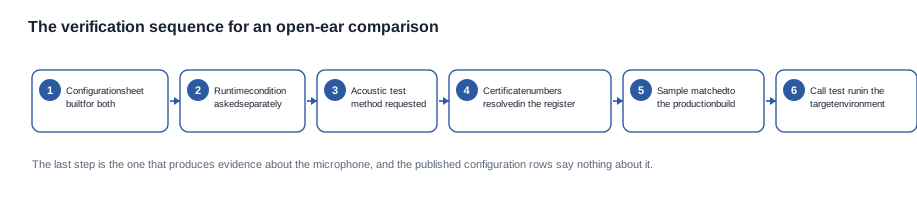
The published configuration rows for this tier are collected at open-ear audio key specifications, and it is worth noting what that page is: a set of platform rows, not a performance table. A buyer looking for a performance comparison in this category will not find one, and that absence is the finding.

The breakdowns that make an open-ear range a mirage
Five breakdowns and the range plan they produce
Two models with identical rows are treated as a range. The D11 and the D12 publish the same Bluetooth version, the same 100 mAh cell, the same runtime and the same charging interface. That is one platform offered for differentiated appearance across markets, and a channel buyer who lists both is running a merchandising decision, not a product strategy. Prevention: decide deliberately which one carries the listing, and know that the second is a colourway.
A feature list is read as a performance ranking. Surround sound and a detachable slim temple are configuration rows. None of them is a measurement, and none can support a claim in a listing that a competitor's listing can be measured against; a capacitive touch row the catalogue does not publish is not a row at all, but a question for the supplier.
Runtime is compared across different workloads. A twin-cell model at roughly eight hours and a single-cell model at roughly seven hours are not one hour apart; they are two different architectures with two different power characteristics. Prevention: put the comparison on the cell configuration row, where the numbers are directly comparable.
The version number is treated as the compatibility answer. Bluetooth 5.4 is a version, not a compatibility result, and it says nothing about the codec, the profile, the antenna design or the range in a real environment. The version is the least informative measurement available on a Bluetooth device, and a buyer who stops there has not checked the thing that decides whether the product connects reliably in a customer's hand.
A weight comparison is attempted with no weights published. Apart from the single whole-unit figure elsewhere in the range, this tier publishes no weights. Any comparison table carrying a weight column for these models is carrying an estimate, and an estimate in a comparison table is a commitment nobody made.
There is a sixth pattern that is commercial rather than technical, and it is the one that costs the most when it goes wrong. The comparison stops before the range plan. A two-model comparison that does not end in minimum order quantity, artwork, delivery split and payment schedule is a technical comparison, and the technical comparison is the one that is easy to win and the commercial one that decides the project.
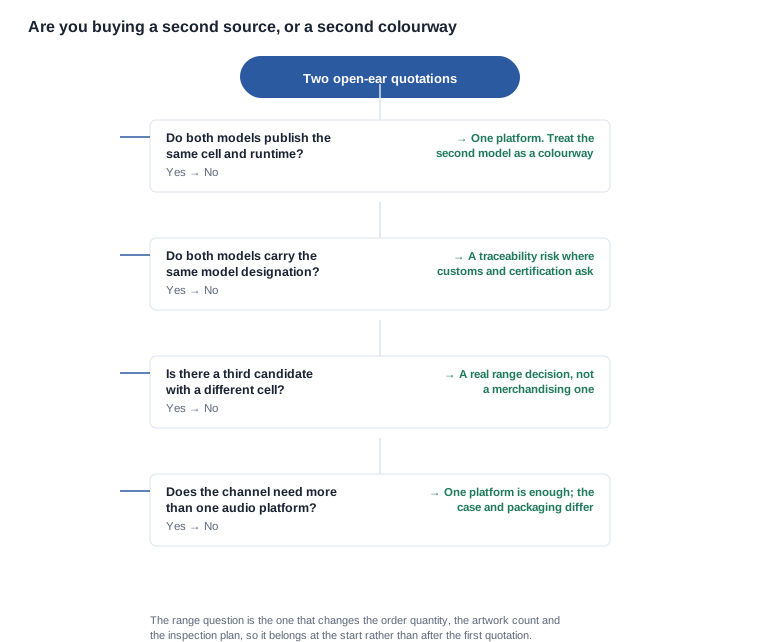
The cost of platform identity, and the file behind it
What remains open for discussion, what is settled, and the open-ear file
The electrical platform of a given model, and therefore its runtime ceiling, does not move, and neither does the Bluetooth qualification for the shipped configuration. Certification cost and lead time follow the testing body rather than your order size. Tooling is normally amortised across the first order and quoted as a separate line rather than folded into the unit price.
In an open-ear range the commercial negotiation is usually about range shape rather than about a single unit price, because the cost of a channel is in how many platforms and colourways it commits to. The terms worth negotiating time on:
- Minimum order quantity tiers, and whether two models can share a purchase order — for a channel buyer this is often worth more than a unit price reduction, because it lets the range be covered in one shipment and one inspection.
- Colour and temple configuration.
- Logo, lens tint and retail packaging.
- Splitting a first run into two deliveries against a staged payment.
- The pilot tranche of the order, kept separate from the run quantity.
- Which of two near-identical models is the one you promote, and whether the other is worth carrying at all.
- The range scope itself: how many platforms you are committing to, and how many colourways each platform carries.
The file that should be on the table before a deposit in an open-ear range is: the model designation table for both models, the certificate register with numbers and validity dates, the battery specification sheet with the runtime test condition, the packaging artwork proof for each, the agreed incoming inspection criteria, and the battery transport documentation required for air movement of lithium cells, set out at battery transport. The clause language is at contract terms, and the commercial structure of a first order is at pricing.
A worked example: a channel buyer planning a three-model range
An illustrative case follows. It is written to put the decision order on the page, and it does not stand for a completed programme.
Assume a channel buyer planning three audio models for a marketplace channel, with a target landed cost, two suppliers quoting, and a plan to differentiate the range by appearance.
Step one, the configuration sheet. The buyer builds the sheet before reading any feature description. The first two candidates publish the same Bluetooth version, the same 55 mAh × 2 configuration, the same charge time and the same runtime. The third publishes a different version, a different cell configuration and a different interface. The buyer now knows that the first two are one platform and the third is a second one.
Step two, the range decision. The original plan was three differentiated models. The configuration sheet shows two platforms. The buyer decides to take one colourway of the first platform, the second colourway of the same platform, and the third platform as the specification-led listing — which is a different merchandising plan from the one that was drafted, and a better one, because it means the range carries a genuine choice rather than three appearances of the same thing.
Step three, the second-source question. The two platforms come from the same supplier, which means the range is not diversified. The buyer asks whether the supplier can quote the second platform from a different production line, and learns that it cannot. The buyer keeps the range as planned but records the concentration as a known risk, which is a decision rather than a surprise.
Step four, the acoustic qualification. The buyer asks both suppliers for the acoustic test method. One has a frequency response with a method and a date. The other has a feature list. The buyer qualifies the second product's audio in the listing and takes the first product's method into its own product file.
Step five, the verification. Every certificate number is resolved in the issuing body's register, and one of them names a model designation that differs from the quoted model by a single character. That model is held rather than bought, and the supplier is asked to correct the document before the order. The samples are checked against the production configuration, and the call test is run in the environment the product will be sold into.
Step six, the commercial structure. Because the range now has two platforms rather than three, the buyer asks whether the two same-platform models can share a purchase order and a single inspection, and whether the artwork can be reduced from three sets to two. The supplier agrees to a combined minimum order, which is worth more to the buyer than a unit price concession because it reduces the working capital tied up in the range and the number of stock-keeping units to manage.
The result is a range that is honestly differentiated, a concentration risk that was identified before it was discovered, and a saving that came from the configuration sheet rather than from the negotiation. Nothing about the outcome depended on a feature name.
What our catalogue publishes for open-ear audio, and what it does not
Here, we publish the cell configuration, the Bluetooth version, the charging interface, the rated runtime, the charge time and the structural feature rows exactly as the catalogue states them, and we publish the absence of third-party acoustic measurement with the same prominence.
What we publish for this tier: the K01 and the K02 at Bluetooth 5.3 with two 90 mAh cells and about eight hours; the LC-105-1 and the LC-105-2 with two 55 mAh cells and about eight hours; the G07 with two 55 mAh cells, about six hours, and an ultra-slim detachable temple; the YK12 with two 55 mAh cells, about six hours, a slim temple and a surround sound configuration; and the D11 and the D12 with a single 100 mAh cell, about seven hours and Type-C charging. Outside this tier we publish the YKC02 with two 70 mAh cells and about eight hours, the ZH12 with a single 100 mAh cell, about eight hours, about an hour of charging and a stereo surround configuration, and the D17 with a single 115 mAh cell, about seven hours, about an hour of charging and a remote control photo function.
What we do not publish: any acoustic measurement from a third party, any leakage figure, any frequency response, any runtime test condition, any mass, any temple length, any lens dimension, and no module part number for any radio entry.
We will not rank two of our own models on an acoustic characteristic that nobody has measured, and we will not present a feature name as if it were a performance result. We will also tell you when two models are the same platform, because that is more useful than presenting them as a range.
The request that opens an open-ear comparison
Send us the two or three models you are comparing, the target market, the channel and the volumes you have in mind, and we will return a configuration-level comparison, flag which of the differences are structural and which are cosmetic, and state plainly which of the questions above we can answer from our documentation and which need a written confirmation from the factory before a purchase order is signed.


