

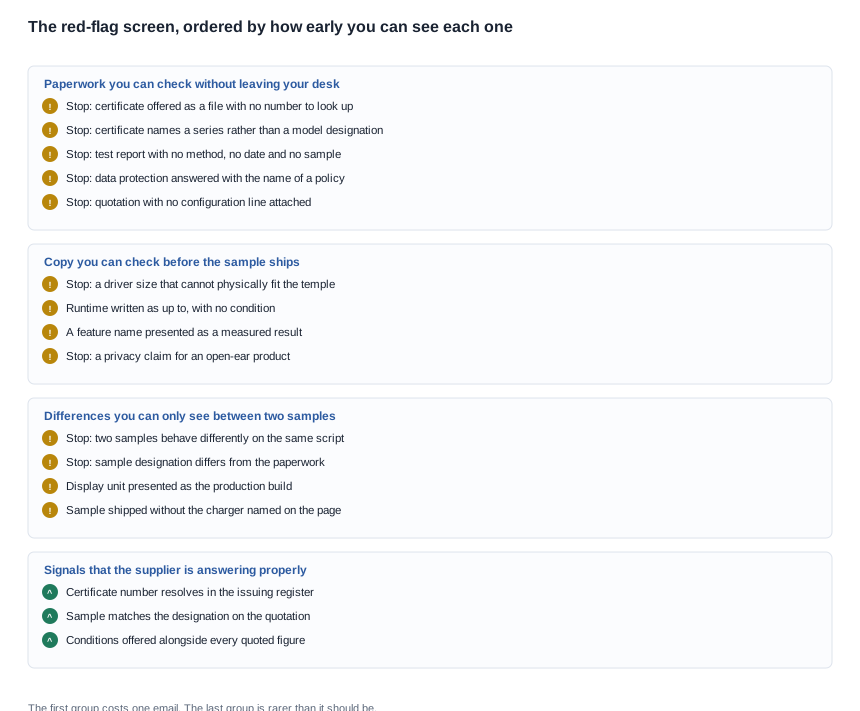
A red flag in this category is not a lie. It is a claim that reads as checkable and is not, or a document that is offered in a form you cannot verify, or two units of the same product that do not behave the same way. Open ear audio glasses smart glasses red flags is the screen for those, arranged by how early you can see each one, because the ordering is the point: the cheapest signals are visible in the copy before a sample is even ordered, and the most expensive ones only appear when two units arrive.
What makes this category unusual is that a red flag cannot be resolved by a lookup. There is no published acoustic figure for any model in our audio tier — no driver size, no frequency response, no leakage distance, no microphone pickup figure, no codec list — so there is no reference value against which a supplier's number can be compared. The only reference points that exist are the document registers, and those cover the radio, the general product safety file and the cell, not the acoustics. Everything else has to be resolved by asking, and asking takes a day rather than a minute.
Open ear audio glasses: red flags without baselines
Why a red flag cannot be resolved by a lookup
Two different failure modes sit inside the word, and a buyer who treats them the same wastes effort on the wrong one.
The first is the unverifiable claim: a number or a phrase that cannot be checked against anything. In a category with published figures this is a minor problem — you compare the figure with a reference and either it holds or it does not. Here there is nothing to compare against, so the only route is to ask what was measured and then test it yourself. That route is slow, which is why it is worth catching the cheaper signals first.
The second is the contradiction: two things the supplier has said do not agree with each other. A page that calls the product waterproof while the specification sheet has no ingress rating for it. A quotation naming a 100 mAh cell while the sample carries two 55 mAh cells. A catalogue row quoting a driver too large to sit inside the temple. Contradictions are the most valuable signals in the whole screen, because they require no permission from anyone — you can find them yourself, from documents the supplier has already sent.
A third category, the mismatch between samples, is the one that costs most to detect and is worth the most when detected. It is dealt with separately below.
The screen, in the order it should be run
The screen above is ordered by how early the signal becomes visible. The first group costs one email. The second costs one afternoon of reading. The third costs two units and a written script. The last group is not a red flag at all — it is the set of signals that tell you the supplier is running a real operation, and in our experience a supplier who volunteers the conditions of its quoted figures is a supplier whose paperwork will hold up when a carrier or a marketplace asks.
Two practical notes on running it. First, apply the screen to the product page before the sample arrives, because every signal in the first two groups is cheaper to raise as a question at the quotation stage than as a rejection afterwards. Second, keep the screen's findings as a list rather than a verdict, because the disposition of most signals is a condition rather than an exit.
Paperwork signals you can check from your desk
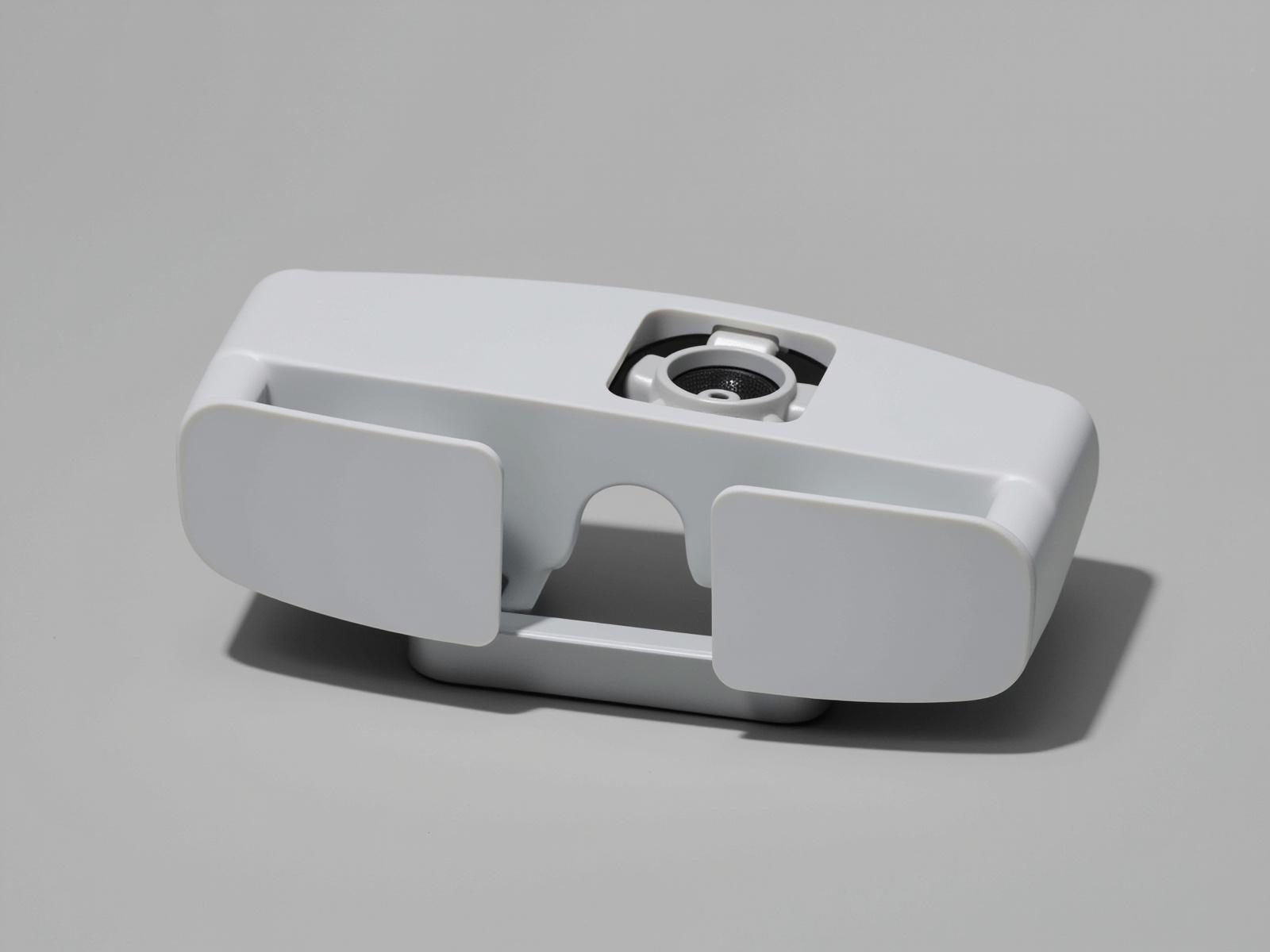
The document set a buyer should be able to name
For a product in this category the documentation pack has seven or eight distinguishable pieces, and each one answers a different question. A buyer who cannot name them cannot tell which one is missing.
- The radio approval reference, with the issuing body, the model designation and the validity date.
- The declaration of conformity for the model designation being shipped.
- The general product safety file: the technical documentation, the responsible economic operator and the information supplied with the product.
- The battery transport test summary for the specific cell fitted.
- The model designation table, showing which document covers which configuration.
- The packaging artwork proof, at the revision that will actually ship.
- The documentation pack in the market language, including the quick start guide and the safety information.
- The known-issue list by firmware build, if the supplier maintains one.
A supplier who sends all eight without being asked has a documentation operation. A supplier who sends a single combined PDF with no numbers in it has a folder.
What each missing piece actually costs
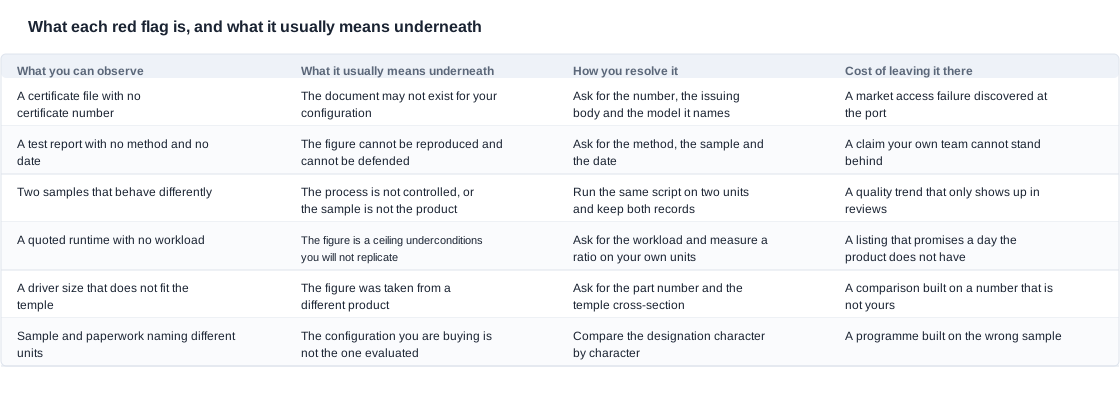
The costs in that table are not hypothetical, and they are lumpy. A missing certificate number is a cheap thing to fix at the quotation stage and an expensive thing to fix at a port of entry. A missing model designation table is a two-hour job for the supplier and a two-week job for your compliance function, because every configuration has to be checked back against the documents one at a time.
The row worth dwelling on is the sample that does not match the paperwork. In this category that mismatch is easy to produce and hard to catch, because the audio tier contains eleven models that share a radio generation, four cell configurations and two charge times. A supplier who builds the wrong configuration is not doing anything unusual — they are filling an order from stock that happens to be close. The unit will power on, connect and sound like something, and the discrepancy only appears when the paperwork is compared against the model designation printed on the unit.
Two document checks that catch substitutions
The first is character-by-character comparison of the model designation across four documents: the quotation, the radio approval, the declaration of conformity and the unit itself. Look for the substitutions that happen in practice — a suffix from an adjacent variant, a family name where a model designation is required, a hyphen written as a space, a model from a related series. Each of these passes a casual read.
The second is the cell check. Ask for the cell configuration in cells and in milliamp-hours, per model designation, and check it against the sample. Our own tier illustrates why this matters: four of the eleven models are single-cell at 100 mAh or 115 mAh, seven are two-cell at 55 mAh × 2, 70 mAh × 2 or 90 mAh × 2, and the D17 and the ZH12 charge in half the time of the rest. A substituted cell changes the runtime tier, the charging interface, the charge time and possibly the certificate coverage, and it changes none of them visibly.
Copy signals that are visible before the sample ships
Four copy signals that can be checked on the page
A driver size too large for the temple. This is the strongest single check available, because it is arithmetic rather than judgement. A driver large enough to deliver the bass an open-ear page implies cannot sit inside a temple that also has to carry a cell or two, a radio and the electronics around them. The check is to ask for the driver part number and the temple cross-section, and to see whether the two are compatible. A figure that cannot physically sit there was not taken from this product. The microphone side of the same reasoning is set out in noise control.
An ingress rating on a page. No model in our audio tier carries a published ingress rating. The IP54 marking in our catalogue belongs to two camera models, which are not this tier and are not a stand-in for it. So a page carrying an ingress rating for an audio-tier model is making a claim the catalogue does not support, whether or not the number itself is real for some other product.
A weight figure where none is published. No model in our audio tier publishes a unit weight. A page stating one is either quoting a different model, quoting a frame without the electronics, or inventing it. Ask for the model it was taken from and the weight it refers to; the answer distinguishes the three.
"Up to N hours" with no condition. This is the softest of the four, because the number itself is published and defensible. The signal is the framing rather than the figure. "Up to eight hours" and "about eight hours" are different statements, and the first one is a ceiling that a customer will not reach under the conditions they will actually create.
A claim of privacy for an open-ear product
This one belongs on its own rather than inside the four, because it is the signal most likely to be tested deliberately by a customer or a reviewer, and because it is the one a supplier can answer in a way that closes the argument.
An open-ear product is audible to a person nearby by construction. That is the trade that makes the format work, and a page claiming otherwise is making a claim about physics. The remedy is not to reject the supplier; it is to require the claim to be withdrawn from the copy before the artwork is approved. A supplier who withdraws it immediately is telling you they will not sign their name to something false, which is a useful thing to know before you sign a purchase order.
The document-versus-copy contradiction, and why it is the most useful finding
The cheapest high-value signal is a contradiction between two documents the supplier has already sent you. A quotation that names a magnetic charging interface while the specification page for the same model shows Type-C. A catalogue row that quotes eight hours while the runtime table in the same file shows six. A model designation that appears in the radio approval but not in the declaration of conformity.
Each of these is answerable in one email, each of them points at a real cause — usually two configurations being described in one file, or a document inherited from a previous programme — and each of them tells you that some part of the supplier's own file is not synchronised. That last point is the one that matters commercially: a file that is not synchronised is a file that will be wrong in a way you did not find.

The two-sample check, and why one sample proves nothing
Why one sample cannot answer the question

A single unit settles nothing about consistency, and the reason is structural rather than a matter of luck. The properties most likely to vary between units in this format are the ones a single unit cannot expose: whether the two drivers in a frame match each other closely, whether the driver is seated correctly in the temple, whether the temple geometry gives the same seal on different heads, and whether the charge contacts mate reliably.
Order two units from the same lot, not two units from different lots, because a lot difference introduces a variable you have not controlled. Run the same written script on both, on the same day, in the same place, with the same connection state and the same volume setting. Record the results side by side. A difference between the two is a finding about the process, not about the sample.
What to compare, and what the comparison tells you
Level and balance. If the two units differ audibly on a fixed playback at a fixed volume, the process is not controlling the transducer seating. This is the check that catches the most common field failure in this category, and it is the reason a fixture with a fixed head position exists.
The seal. Put both units on the same head in turn and check whether the level the listener receives is the same. A difference here is not a defect at all — it is the head, and it is the reason a single-head evaluation is misleading.
The microphone path. Run the same intelligibility script with both units in the same environment. A difference between two units of the same lot in the same room is harder to attribute to the product than it first appears, and it is worth a note to the supplier either way.
The charge path. Test the interface on both units, and test the contacts before wiping them. A unit that will not charge on the bench and will not charge in a pocket is the same defect; a unit that charges on the bench and not in a pocket is a contact problem, and the two are separated by one cloth.
What to do with a difference between two samples
The finding is not a rejection on its own. It is a decision about the inspection regime: it tells you whether the supplier is running fixture-based checks and whether their tolerances are set, which is the subject of factory quality control rather than supplier verification. Two units that match give no evidence either way, because a good process and a process that was not challenged both produce two matching units.
So the two-sample check is most valuable as a positive signal. A supplier who sends two units from the same lot without being asked, and who can say what their fixture is and what their balance tolerance is, has answered the consistency question before you had to ask it.

Deciding what a red flag does to the award
A screen that does not end in a decision is a list. The section below turns each signal into one of three outcomes — stop, condition, note — and then into a contract clause, because the fastest way to close a signal is to make closure a contractual obligation with a named owner rather than a request.
Turning each signal into a consequence
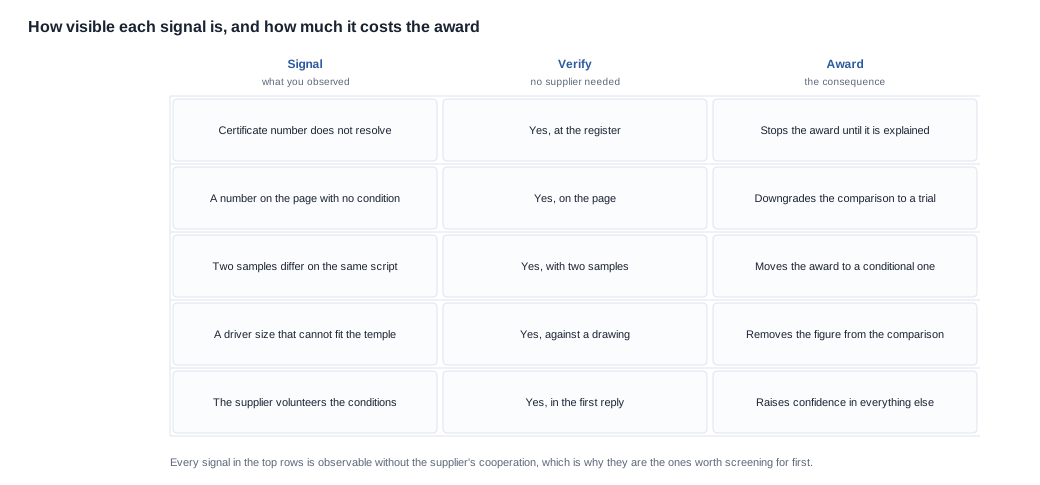
The useful discipline is to attach a consequence to each signal in advance, rather than deciding after the fact when you are emotionally invested in the programme. There are only three consequences in practice, and using more than three is how a screen turns into an obstacle.
Stop — the signal indicates that something fundamental is not what it appeared to be. A certificate number that does not resolve in the issuing body's own register is the clearest example. There is no version of this that is resolved by asking nicely later, because the whole point of a register is that it is the independent check.
Condition — the signal is real but can be closed by a specific document or a specific test. A missing test method becomes conditional on the method being supplied. A runtime with no workload becomes conditional on the workload being stated and measured on a sample. A discrepancy between a page and the specification sheet becomes conditional on the copy being corrected before the artwork is approved.
Note — the signal is worth recording and does not affect the award. A supplier whose page uses a phrase you would not use is a note about the copy, not about the operation.
The two-sample and the supplier-volunteers-the-conditions signals work in reverse. They do not cost the award; they increase confidence in it.
The criteria that decide whether a signal is actually closed
A conditional award is only worth something if the condition is written in a form somebody can close. These are the criteria we use to evaluate a supplier's response to a signal, and they are deliberately mechanical.
- The response names the artefact. A method, a document, a register entry or a measurement. "We will improve it" is not a response to any of them.
- The response carries its conditions. Volume, distance, environment, workload, sample size and date. A figure without them cannot be compared with a figure without them.
- The response is tied to a model designation. Not a series, not a family, not "our audio products".
- The response is something you can re-check. If you cannot look it up or repeat it, it is a statement rather than evidence.
How to evaluate a supplier's response is therefore a short exercise: match it against those four criteria, and note which ones it misses. A response that misses one criterion is often a good supplier with an incomplete document. A response that misses three is telling you something about the operation, and it is worth asking a follow-up question before you conclude.
The trade-offs here are worth naming, because they are the trade-offs most suppliers raise when you ask for conditions. Attaching a condition to a figure narrows the claim, and a narrowed claim is a weaker claim in a listing. That is correct, and the buyer who widens it back is the one taking the risk. A second trade-off runs the other way: a supplier who finds your conditions arbitrary or unreasonable will usually say so, and that objection is worth taking seriously — it may point at a measurement you were not going to be able to repeat.
Whether you should hold the award on a signal depends on what the signal is. A signal that implies the unit you evaluated is not the unit you would receive should hold the award. A signal about copy wording should not, because the copy is fixable at no cost. The pitfalls in this area are almost all about treating the second kind as if it were the first, which is how a programme gets stopped over a sentence.
Writing the findings into the evaluation file
The screen is only worth running if the output is reusable, so the deliverable is a one-page findings sheet rather than a set of mental notes. One row per signal: what was observed, where it was observed, which document or unit it came from, the consequence, the owner, the date raised and the date closed.
Two reasons. First, when the programme reaches the artwork stage, the person approving the copy needs to see which claims were conditional and on what, and a memory is not a record. Second, the findings sheet is what you hand to the next buyer, because the most common failure in this category is not a bad supplier but a supplier that was already flagged once and the flag was not carried forward.
Our own documentation, and the signals we cannot hide behind
The signals we would raise on our own pages
Applying the screen to ourselves is uncomfortable and worth doing. Our audio tier publishes no driver size, no frequency response, no leakage figure, no microphone pickup distance, no codec list and no latency, and no unit weight, for any of its eleven models. A page that stated any of those would be raising a red flag against us.
Concretely, we publish the rows we hold — the cell configuration, the charging interface, the radio generation, the rated runtime, the charge time, the control method and the feature rows including surround sound on five models, remote control photography on two models, and the slim or detachable temple on two models — and we publish the empty measurement rows beside them with the same prominence rather than filling them with typical values.
We will also say plainly that the absence of an acoustic standard is not a gap that will close on its own, and that a buyer waiting for a standard to compare against is a buyer who will compare marketing instead. The protocol is the standard, and in this category it is yours to write.
The one thing we will not do is publish a number we have not established. A catalogue that publishes no acoustic figure is a catalogue whose buyer has to test, and a buyer who tests ends up with a number that can go in the purchase order. A catalogue that publishes a typical value gives the buyer a number nobody measured, and that number is the one that ends up on the product page.
The question list for a supplier
- Give the radio approval reference, the issuing body, the model designation it names and the validity date. A number, not an attachment.
- Give the declaration of conformity for the same model designation, signed and dated.
- Give the battery transport test summary for the cell fitted in that model, not for the cell range.
- Give the model designation table showing which document covers which configuration.
- Give the cell configuration in cells and in milliamp-hours for the model you are quoting.
- Give the firmware build that ships with this order, and the known-issue list for it.
- Give the driver part number and the temple cross-section it has to fit.
- Give the runtime with the workload, the volume and the codec it was measured on.
- Give the acoustic method behind any figure on your page, including the sample it was taken on.
- Say which of your claims are measured and which are design statements.
The technology background is under open-ear audio, the vocabulary behind these pages is in the open ear audio glossary, and the range is at Bluetooth audio glasses.
Related reading
- The vocabulary — open ear audio glossary
- The microphone side — noise control
- Bluetooth audio glasses range
Send us a supplier's product page and we will tell you which signals it raises and which of them have to be closed before the deposit.


