

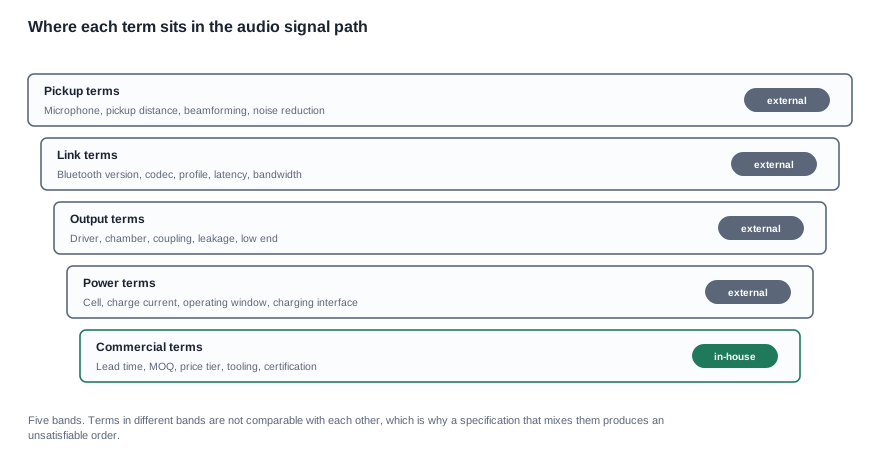
The acoustic vocabulary in this category is borrowed from two unrelated industries — the hi-fi one and the telecoms one — and the words that sound most precise are often the ones carrying the least information. A method name can be mistaken for a measurement; an adjective can be mistaken for a specification; and a row on a catalogue can be mistaken for an acceptance value. Open ear audio glasses smart glasses glossary exists for one purpose: to mark each term as a method, a measurement or an adjective, so that a buyer can tell which entries can be compared and which have to be asked for. Each entry below gives the plain meaning, what our catalogue publishes against it, and the question a buyer puts to a supplier. Where the published position is a method rather than a figure, the entry says so rather than inventing one.
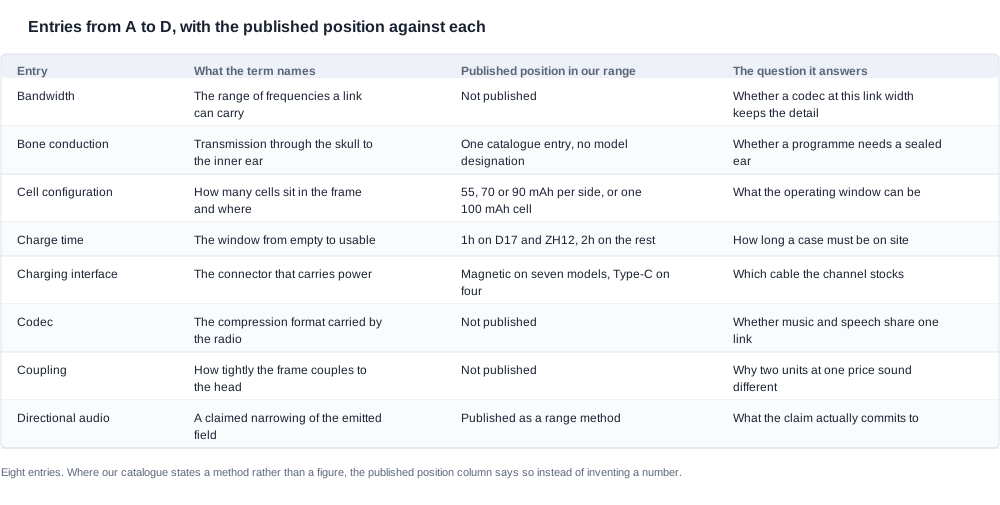
Open ear audio glasses: entries a first specification trips over
The first block covers the terms that appear in almost every first conversation about this category, and three of them are routinely used to mean something the term does not actually name.
-
Ambient noise floor. The level of the environment already present, measured at the position where the sound is to be received. It is the reference against which any intelligibility requirement has to be stated, and without it a requirement such as "clear at the ear" has no meaning. Our published position: not published for any model. Ask the supplier: what floor was assumed, and at what position was it measured.
-
Attenuation. The reduction of a signal between two points, and in this category it refers to how much of the output leaves the frame and reaches the space around it. It is the term that separates "the person hears it" from "the room hears it", and it is the reason an open-ear unit cannot serve a confidential use. Our published position: not published. Ask: at what distance, at what level, and in what room.
-
Bandwidth. The range of frequencies a link can carry. A radio link that is narrow enough cannot carry a high-quality codec, so bandwidth is the hidden constraint behind the radio version row. Our published position: not published; we publish the radio version instead, V5.3 on the K01 and the K02 and V5.4 on the other nine open-ear models. Ask: what codec is actually negotiated with the target phone.
-
Beamforming. The use of more than one microphone, with their signals combined so that a direction is favoured and the others are reduced. It is a method, not a measurement, and a beamformed system still has a floor below which nothing helps. Our published position: the range publishes intelligent noise reduction as a technique. Ask: how many microphones, and what the residual noise level is in a stated floor.
-
Bluetooth profile. The set of rules that defines how a particular kind of Bluetooth function behaves. A version number and a profile number are different statements, and the second one is what tells a buyer whether a function will behave the way the listing assumes. Our published position: not published. Ask: which profile the unit uses for audio output and which for calls.
-
Bone conduction. Transmission through the skull to the inner ear, leaving the ear canal clear by a different route from an open-ear speaker. It is a different category with a different certification scope, not a variant of the same product. Our published position: one catalogue entry with no model designation, publishing a 35 dB amplification gain, a 200 mAh cell, a two hour charge window, an approximately seven hour operating window and Type-C charging. Ask: which regulatory framework the description on the listing falls under.
-
Cell configuration. How many cells the unit carries and where they sit. It is a structural description, not a capacity figure, and it decides the assembly line as much as the bill of materials. Our published position: 55 mAh times two, 70 mAh times two and 90 mAh times two on the twin-cell models; a single 100 mAh cell on the D11, the D12 and the ZH12; a single 115 mAh cell on the D17. Ask: whether a quoted capacity is per temple or for the whole frame.
-
Charge acceptance. The maximum rate at which a cell will take charge without damage, and the property that makes a one hour charge window possible. It is a cell characteristic, not a product characteristic, and it is worth separating from the charge time row. Our published position: the charge window is published; the acceptance rate and the charge current are not. Ask: what charge current the circuit delivers and what the cell's rated acceptance is.
-
Charge time. The window from an empty cell to a usable one. It appears on published sheets as one or two hours and it is the one time row a buyer can compare directly, provided the start condition is stated. Our published position: one hour on the D17 and the ZH12, two hours on every other open-ear model. Ask: from empty, and at what charge current.
-
Codec. The compression format carried across the radio link. It decides how much of the original signal survives, and it is the term behind any claim about audio quality that is not accompanied by a measurement. Our published position: not published. Ask: which codec is negotiated, and whether a different codec is used for calls than for media.
-
Coupling. How tightly the frame couples to the head, and therefore how much of the output is delivered to the ear rather than radiated into the room. It is the single variable that most explains why two units at the same published configuration do not sound alike. Our published position: not published. Ask: what the coupling is expected to be, and how it is held across the size range.
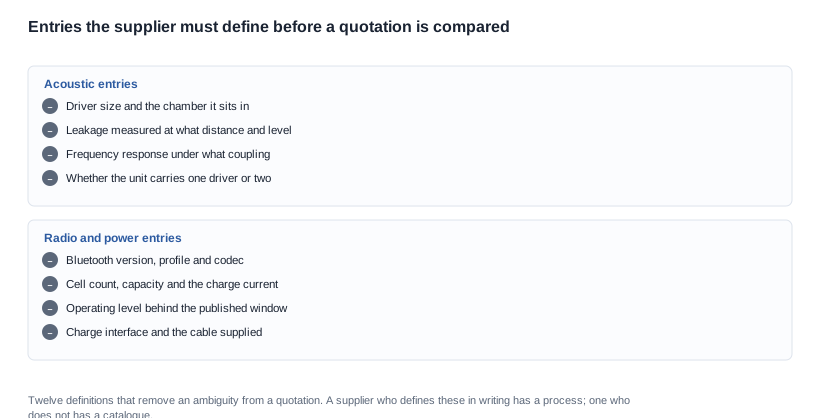

Entries from E to M, the acoustic and radio vocabulary
-
Directional audio. A claim that the emitted field is narrowed rather than radiated evenly. It is a method claim in our catalogue and it commits the supplier to a design intent, not to an outcome. Our published position: published as a range method. Ask: what the measurement of the field is and at what distance.
-
Driver. The transducer that converts the electrical signal into a pressure wave. Its size and type set the achievable low end, and no model in our range publishes either. Our published position: not published. Ask: driver size, and whether the unit carries one driver per side or one in total.
-
Enclosure. The sealed volume in which the driver operates. It shapes the output and it occupies temple space that the cell also needs, which is why power and acoustics compete for the same cavity. Our published position: not published. Ask: what the chamber volume is, and what happens to it if the cell configuration changes.
-
Equalisation. The deliberate shaping of the frequency response to compensate for the acoustic path. It is a design method, and a buyer who sees a row describing equalisation should still ask what the response is after it has been applied. Our published position: not published. Ask: for a frequency response with the measurement conditions stated.
-
Far field. The region in which the source behaves as a point, and the region in which the sound from the frame is normally measured. The opposite term is near field, which matters at very short distances. Our published position: not published. Ask: at what distance the quoted figures were taken, since a figure taken too close is not comparable with one taken across a room.
-
Gain. The amplification applied to a signal. In this category the published 35 dB on the bone conduction entry is a gain figure, and a gain figure is not an output level — it says how much a signal was multiplied, not how much sound leaves the unit. Our published position: the bone conduction entry publishes 35 dB. Ask: what input level the gain applies to, and what the resulting output is.
-
Impedance. The electrical opposition the driver presents to the amplifier, and one of the reasons two units with the same driver and different chambers draw different currents. It is a component property and it is not a published row. Our published position: not published. Ask: the amplifier's operating point and the driver impedance it is matched to.
-
Latency. The delay between an input and the corresponding output. It is what separates a unit used for calls from a unit used for media, and a latency that is comfortable for voice is uncomfortable for anything else. Our published position: not published. Ask: the end-to-end latency with a stated codec and a stated pairing.
-
Leakage. The share of the emitted sound that reaches the room rather than the ear. It is the term that decides whether a confidential use is possible, and it is the measurement that a privacy-based buyer should require. Our published position: not published for any model. Ask: measured at what distance, at what level, and in what acoustic environment.
-
Microphone pickup. Where the microphone sits and what it hears. A microphone placed near the mouth of the temple hears the voice strongly and the room weakly; one placed further away does the opposite, and the choice decides how the noise reduction has to work. Our published position: not published. Ask: the microphone position and the distance assumed for the tuning.
-
Mode. A named operating state of the unit. In a product with a published operating window, the mode is what determines the draw and therefore the window. Our published position: not published. Ask: which mode the published window was measured in, and what the alternatives do to the draw.

Entries from N to Z, the power, channel and compliance terms
-
Near field. The region close to a source, where the sound from the frame is still partly directional and partly shaped by the frame itself. It is relevant whenever a measurement is taken with the source very close to the reference point. Our published position: not published. Ask: for measurements with a stated distance rather than a near-field photograph.
-
Open-ear acoustic structure. The published description of how the unit radiates, with the ear canal left unobstructed. It is our own phrase for the architecture and it commits the design, but it does not describe a measured result. Our published position: published as the range's structural description. Ask: the chamber and driver arrangement behind the phrase.
-
Operating window. The published period a unit runs on a charge. It is a useful screen and a poor acceptance value, because it hides the output level, the duty cycle and the ambient temperature behind it. Our published position: approximately eight hours on the YKC02 and the K01, the LC-105-2 and the ZH12, and the K02 and the LC-105-1; approximately seven hours on the D11, the D12 and the D17; approximately six hours on the G07 and the YK12. Ask: what the figure was measured at, or accept it as a screen only.
-
Pairing. The process by which a unit remembers a device. The behaviour that matters commercially is the reset procedure, because it is what a support line needs when a unit arrives at a customer who has already paired something else. Our published position: not published. Ask: the reset procedure, and whether it clears all devices or one.
-
Pickup distance. The distance at which the microphone is assumed to hear a voice. It is the assumption underneath every noise reduction claim. Our published position: not published. Ask: the distance assumed when the noise reduction was tuned, and how it degrades beyond it.
-
Radiation. The spreading of the emitted sound into the room. It is the counterpart to coupling, and the two together decide how much of the output is private and how much is public. Our published position: not published. Ask: a radiation pattern or a leakage measurement, at a stated distance.
-
Sensitivity. The output produced for a given input. It is the term that connects an electrical description to an acoustic one, and it is what makes a gain figure interpretable. Our published position: not published. Ask: the sensitivity of the output stage, or a frequency response with conditions attached.
-
Signal-to-noise ratio. The separation between the wanted signal and the noise floor. It is the single most informative acoustic figure a buyer can be given, and it is the one that is missing across this range. Our published position: not published for any model. Ask: measured in a stated environment, or with a stated method.
-
Splash resistance. A limited water exposure claim, distinct from immersion and distinct from a full ingress marking. Our audio tier publishes no ingress marking on any model, and only two models in the whole catalogue carry one: the V06 and the S7, both on the camera and sport pages, both marked IP54. Our published position: not published for the audio tier. Ask: which document covers the configuration being quoted.
-
Transducer. The general term for a device that converts one form of energy into another. In this category it is the driver, and it is sometimes used loosely to cover a microphone as well. Our published position: not published. Ask: the transducer on the output side and the transducer on the input side separately.
-
Touch control. A capacitive input surface on the temple. It is a small cost and a specific failure mode, because a surface that misreads a contact produces a unit that changes state without being asked to. Our published position: not published — no model in the range carries a touch row, so the touch behaviour of the temple is a question for the supplier rather than a catalogue fact. Ask: which gestures are supported, what the control surface is, and how a false trigger is avoided.
-
Volume ceiling. The maximum output the amplifier and driver can deliver, and the point at which the sound becomes unacceptable to bystanders. It is a product and channel decision at once, because a unit sold into a retail floor needs a lower ceiling than one sold into a warehouse. Our published position: not published. Ask: what the ceiling is and whether it is adjustable.
-
Wireless output. The selection of which audio device the unit plays from when several are connected. It is a behaviour that a customer notices immediately and that a published sheet never mentions. Our published position: not published. Ask: the selection behaviour and the default after a reconnection.
Six glossary entries that decide a shortlist before the price does
A glossary is only worth carrying into a procurement meeting if it can be used to rank. These six entries do that, because each of them can be settled with a shortlist of three models and a single round of questions, and each of them eliminates candidates that a price comparison would have kept.
- Cell configuration. Settle it first, because it is a structural distinction rather than a capacity figure and it decides whether two models are comparable at all. Twin-cell and single-cell units should not be ranked against each other on any row other than the operating window.
- Charging interface. The interface is a channel commitment as much as an engineering one, and matching the accessory line the channel already stocks removes an accessory cost that no unit price difference shows.
- Operating window. Compare it against the session length in hours, and treat it as a screen rather than as an acceptance value. A candidate whose window does not cover the session needs a case, and the case is a budget line the comparison has to carry.
- Leakage. This is the entry that decides whether a scenario is servable at all. A buyer who needs a confidential channel cannot proceed past the entry, whatever the other rows say.
- Coupling. Between two models at the same published configuration, this is the entry most likely to explain an acoustic difference that no published row accounts for. It is the question to ask when two quotations describe the same product and sound different.
- Volume ceiling. Where the product is sold into a space where other people are present, the ceiling decides whether the listing claim is defensible. It should be written into the acceptance condition rather than left to the firmware default.
The three questions to ask a supplier before you order. Ask which of these six entries the supplier has a figure for, and which they answer with a method. Ask which entries they will commit to in writing for the configuration being quoted. And ask which entries they can only settle on samples, so that the sample protocol is written before the samples arrive. The total cost of asking is one email, and it converts a shortlist of three models into a shortlist of three models with a documented reason for each exclusion.
How to use these entries in a supplier conversation
The point of a glossary in a procurement file is not to be read once. It is to be used as a sorting tool on the answers a supplier gives, and on the rows a supplier publishes.
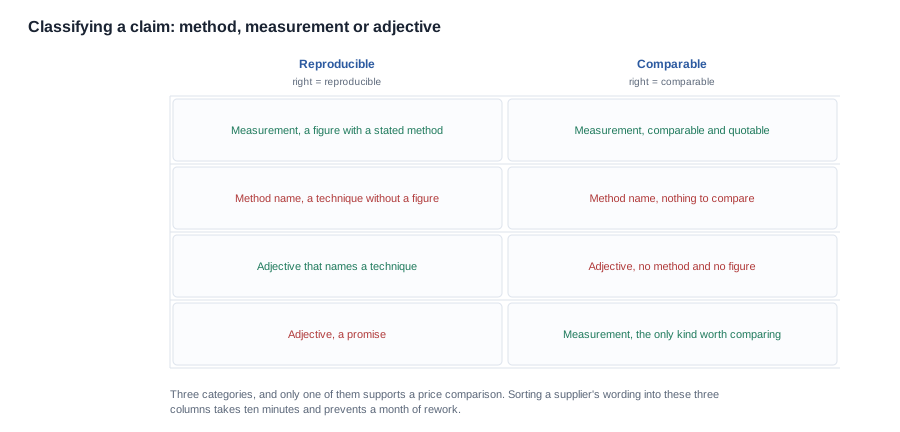
Entries that name a method rather than a measurement. Directional audio, intelligent noise reduction, open-ear acoustic structure, beamforming and equalisation are all methods in our catalogue. A method tells a buyer that a design decision has been made. It does not tell the buyer what the decision produced, and two suppliers can both claim the same method with results that are not comparable. The move from a method to a measurement is the point at which a quotation becomes comparable, and it costs the supplier a test rather than a sentence.
Entries that sound qualitative and are still testable. Leakage, pickup distance, signal-to-noise ratio, latency and the volume ceiling all sound like preferences, and all five can be written as acceptance conditions with a value, a protocol and a position. A leakage condition with a defined measurement position is testable. A leakage claim without one is not, and the difference between those two sentences is the difference between a condition and a wish.
The three uses this glossary has in a procurement file. The first is the request list: each entry with a published position of "not published" becomes a line in the document request, phrased as a question rather than as a demand. The second is the quotation review: each supplier answer is classified as a method, a measurement or an adjective, and two quotations cannot be compared until both are in the same class. The third is the acceptance condition: entries that are testable become the clauses, and entries that are not become the exclusions.
The terms that do not belong in an open-ear specification. A specification written for this architecture should not contain a sealed-audio expectation, an isolation figure, a channel-balance figure, or a statement about sound pressure at the ear canal, because the ear canal is not where this product delivers its output. A buyer who asks a supplier for a sealed isolation figure has asked for a different product, and the answer will be either a number that does not apply or a refusal. The same applies to any claim about hearing assistance: our catalogue publishes an amplification gain on the bone conduction entry as a technical figure, and that figure must not be turned into a description of what the product does for a person's hearing, because that description moves the product into a framework the audio range is not built for.
Where the rest of the detail sits. The mechanism behind these terms is set out at how open-ear audio works, the selection consequences are at choosing a model by use case, the selection procedure is at how to choose open-ear audio glasses, the questions to send a supplier are collected at what to ask a supplier about open-ear audio glasses, the range is at bluetooth audio glasses, and the technical background is at open-ear audio technology.
What we will not do with a glossary. We will not fill an empty measurement row with a typical value from another product, and we will not define a term in a way that makes a published method sound like a published figure. A glossary that flatters the catalogue is a document a buyer cannot use, and this one is written to be used against us as much as for us.


