

There is a set of considerations in the light-responsive lens category that only become visible after a product has been designed, and they are worth naming separately because most of them are invisible in any specification and several of them cannot be fixed later at all. The familiar questions — how fast does it darken, how uniform is the tint, what is the ultraviolet transmission — matter, and this article assumes they have been asked. Photochromic smart glasses advanced considerations is about the layer above them: the decisions that get frozen at design freeze, the ways the lens reaches into the platform around it, and the programme-level consequences that no per-unit lens comparison will ever surface.
The published position in our range is minimal, which is itself the starting point. The dedicated entry publishes Bluetooth 5.4, a 100 mAh cell, charging in two hours or less, roughly seven hours of rated runtime, magnetic charging, and electrochromic lenses. There is no model designation, no switching time, no transmission range, no temperature behaviour, no uniformity figure, no cycle durability and no coating detail. There is no second light-responsive platform with published lens data to compare it against: the camera platform that lists a photochromic lens configuration, the V03 Pro, publishes no lens figure either.
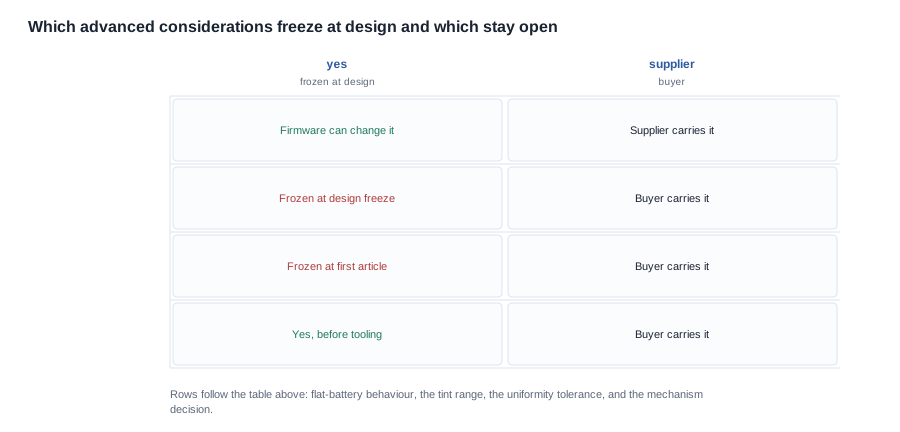
Photochromic: four decisions that tooling fixes
Some decisions in a lens programme are reversible until the design is frozen and then are not reversible at all. A buyer who discovers them after tooling has been cut is discovering them too late, and the cost of discovering them then is a new tool rather than an answer.
The tint ceiling and the claim it can support
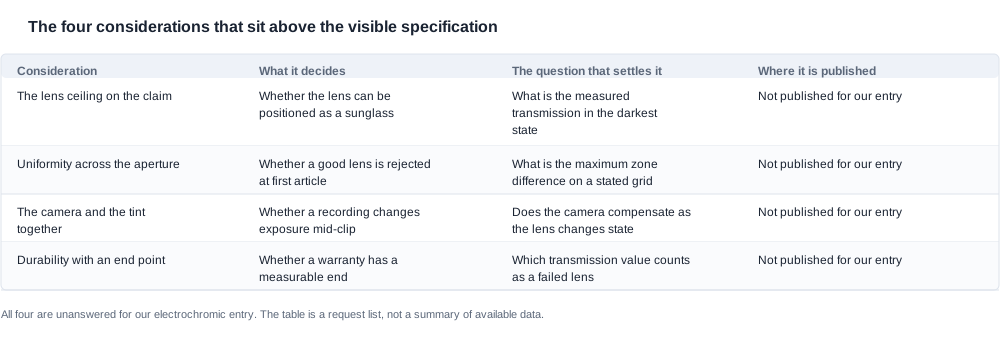
How dark the lens goes is not one number. It is a ceiling, and the ceiling is what determines whether a sunglass proposition was ever available. The pair of figures that matters is the transmission in the clear state and the transmission in the darkest state, because it is the gap between them that a customer experiences and that a claim has to describe.
The advanced point is not the missing measurement — that is obvious — but what the ceiling does to the commercial positioning even when no measurement exists. A lens that moves from a high clear-state transmission to a modest dark-state transmission supports a claim of the form "adapts to light conditions", and nothing stronger. A lens that reaches a low dark-state transmission may support a sunglass claim, and only that product may. Because we publish neither figure for our entry, the honest position is that the narrower claim is the only one available, and that this is a product decision rather than a marketing constraint.
There is a second-order consequence worth naming: the ceiling also sets the customer expectation that the returns rate will be measured against. A product positioned on adaptation and delivered as adaptation has a support script. A product positioned on sunglass depth and delivered as adaptation has a returns problem, and the returns problem is invisible to a buyer who never asked for the ceiling.
Why a uniformity tolerance has to predate the first article
Uniformity is the consideration most often handled in the wrong order. A centre reading is easy and nearly useless, because a user notices edge-to-centre variation before they notice an average. The tolerance therefore has to be a maximum difference between defined zones, measured on a stated grid, with the grid defined before the first article is produced rather than after it has been inspected.
The advanced point is about who writes the tolerance. The buyer does, not the supplier, and the reason is that the supplier's tolerance is derived from what their process currently achieves while the buyer's tolerance is derived from what the channel will accept. Those two numbers are frequently different, and the first article is where the difference becomes visible.
A tolerance agreed after a rejection is a tolerance that has already been missed, and the cost of that is not the lens — it is the schedule, because the first article is on the critical path and a rejected one consumes a production slot. Budgeting one more first article into the plan is cheaper than discovering the tolerance was never written.

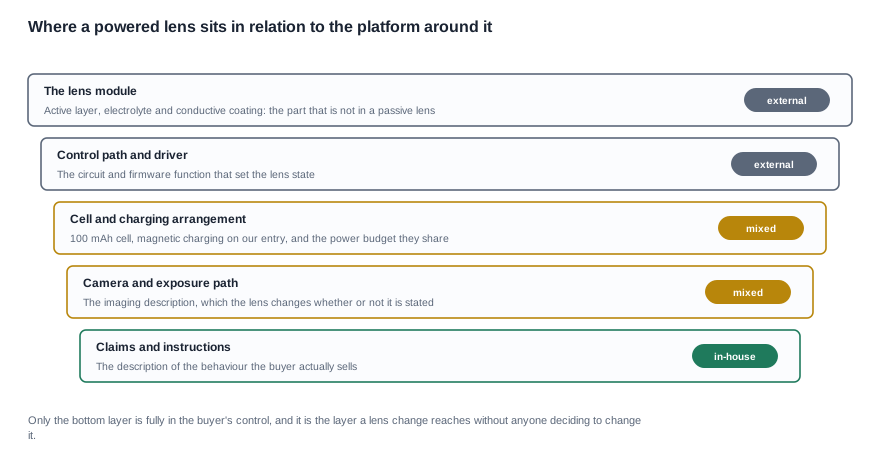
The second layer: how the lens interacts with the platform around it
A lens is a component, and a component changes the behaviour of the system it sits in. The considerations in this section are the ones that describe the product rather than the lens, which is why they are invisible on a lens datasheet and are the reason a lens programme is not a lens purchase.
The camera, the exposure path and the middle of a recording
A tinted or light-responsive lens changes the light the camera receives, and the change is not constant. A lens that darkens over a number of seconds changes the exposure during a recording, and what the camera does about it — whether it re-exposes, whether it locks, whether it applies a fixed compensation curve — determines whether the footage has a visible brightness ramp through it.
Three questions close this. Does the camera re-expose as the lens changes state? Is the behaviour documented anywhere, or is it an emergent property of the firmware? And what happens at the transition in the opposite direction, when the lens clears and the scene is suddenly brighter? A camera module and a lens module designed by different people is the normal case rather than the exception, and the interface between them is exactly the kind of thing that is never written down.
For a buyer whose channel sells the camera function, this is the difference between a product with one known weakness and a product with an unknown one. The weakness can be documented in the listing, the instructions and the support script. The unknown surfaces as a complaint.
The microphone, the acoustic path and a switched element
The same logic applies to the microphone, in a direction that is easier to overlook. A lens sits in front of the microphone path on many frames, and a lens with an active element adds a small mechanical noise source to the assembly — a driver circuit, a switching element, a control path that draws current at a low duty cycle. None of that is a problem in principle. It becomes a problem when a call-quality complaint arrives and nobody has a baseline to compare it against.
The advanced consideration is procedural rather than technical: establish a baseline before the lens is fitted, not after. A microphone capture with the standard lens in the same frame, in the same environment, on the same script, is a reference that makes the powered configuration legible later. Without it, the only available comparison is between the powered product and a competitor, which is the comparison that settles nothing.
The temperature range, and the parked car
Electrochromic behaviour is temperature-dependent, in the same direction that photochromic behaviour is: the chemical or electrochemical process that produces the tint runs at a different speed and to a different depth when the assembly is cold or hot. A lens that performs at room temperature behaves differently in a vehicle left in the sun, and differently again in a winter morning, and the difference is large enough to change what a customer sees in the first thirty seconds of using the product.
This is a consideration rather than a specification because the relevant question is not what the temperature range is. It is how slow the lens is at the cold end, and how long the product takes to reach a usable state when it comes out of a cold car. That question is the difference between a product that a driver puts on and a product a driver waits for. It also determines whether the first five minutes of a review in a cold climate are representative, which is a content problem as much as a product one.
Programme-level considerations a per-unit lens comparison never reaches
The considerations above are about the product. This section is about the programme, and it is where the majority of the money in a lens programme is actually spent.
The lens module is usually not made by the factory that assembles the frame. That means the material documentation for the active layer, the electrolyte and the conductive coating belongs to a second company and has to be obtained, passed through and re-obtained when the module supplier changes. A lens supplier change does not just change a component; it changes the material position of the product and therefore the file behind it.
A configuration change is a product change. Whether the lens is a fixed option on one model or a choice across four colourways, each combination is a configuration, and each configuration is a candidate for its own model list, its own labelling, its own sample and its own artwork. Buyers consistently underestimate this by treating a lens option as one additional stock keeping unit rather than as a multiplier on the configuration count.
The claim scope has to be decided before the artwork. The wording that describes the behaviour, the demonstration that supports it and the tolerance that defines it are one decision taken three times. A programme that writes the copy after the artwork has been approved has written copy that the evidence cannot carry, and the correction afterwards is a withdrawal rather than an edit.
Warranty arithmetic when the failure criterion is yours to define
A cycle count on its own is a quantity, and a warranty written against a cycle count has no measurable end. What gives a warranty an end is a failure criterion: a transmission value, or a behavioural threshold, at which the lens is considered failed. And in a category where no cycle figure and no transmission range are published for our entry, that criterion has to be written by the buyer.
This is an advanced consideration rather than a basic one because the criterion has consequences in both directions that are easy to miss. A criterion that is too tight rejects lenses that would have served the customer perfectly and turns a durable product into a warranty cost. A criterion that is too loose lets a genuinely degraded lens ship for years and produces a slow, invisible quality decline across the installed base. And the criterion interacts with the uniformity tolerance, because a lens that fails on uniformity at the first article and a lens that fails on transmission after two seasons of use are two different failure modes requiring two different criteria.
The practical step is small and it is worth doing at the design stage: write the failure criterion down, put a number against it, and agree with the supplier which measurement method produces that number. A criterion without a method is a preference.
The criteria that separate a lens programme from a lens purchase
Advanced considerations are difficult to act on because they are qualitative by nature, and a buyer who cannot reduce them to criteria will negotiate on instinct. The table below reduces the ones in this article to a form a supplier can answer and a purchase order can hold.
| Consideration | The criterion a buyer writes | How to evaluate it | What a soft answer sounds like |
|---|---|---|---|
| The tint ceiling | A transmission range with a method, or a stated claim limit | A measurement on the buyer's own units at a stated light level | It darkens well in the sun |
| The uniformity tolerance | A maximum zone difference on a stated grid | A grid measurement across at least three zones | It is even across the lens |
| The camera interaction | A written exposure behaviour during a state change | A recording made while the lens transitions | The camera compensates automatically |
| The acoustic baseline | A capture with the standard lens, on the same script | A before-and-after capture in the same environment | The microphone is unchanged |
| The cold-end behaviour | A time to a usable state from a stated low temperature | A cold-soak run with the transition timed | It works normally in winter |
| The failure criterion | A transmission value that counts as a failed lens | A stated method producing that value | It lasts a long time |
Three features of this table are worth pointing out. Every criterion is answerable. None of them requires a laboratory, and every one of them can be closed by a supplier document, by a buyer measurement, or by a protocol the buyer writes. Every criterion has a soft answer that sounds identical to a hard one, which is why the middle column has to be written before the request goes out rather than negotiated afterwards. And every criterion is a writing task before it is a testing task, because a criterion that is not written cannot be applied to a rejected first article.
The trade-offs between them are real and a buyer should expect to prioritise. A programme shipping into cold climates should weight the cold-end behaviour above the uniformity tolerance, because the uniformity is visible and the cold behaviour is the complaint that generates returns. A programme with a camera should weight the exposure interaction above everything except the tint ceiling, because the camera is the differentiated feature and the lens is the thing that changes it.

Moving these questions out of the sample stage and into the design review
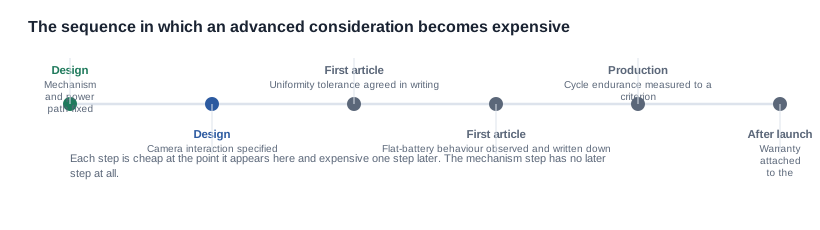
The most useful thing a buyer can do with this list is change when it is asked. Every consideration in this article is cheap at the design review and expensive at the first article, and two of them — the mechanism and the uniformity tolerance — become effectively permanent once the design is frozen.
The four questions that should be asked at the design review
Is the lens powered, and what is the state of the lens when the cell is flat? A powered lens is an active component with a power path, a control connection and a defined state. Its behaviour with no power is a product behaviour that belongs in the instructions, the support script and the file, and it is designed rather than discovered.
What is the mechanism, stated as ultraviolet-reactive or electrically driven, and what follows from it? The mechanism determines the material file, the power budget, the behaviour behind glass, the temperature behaviour and the test protocol. A programme's whole measurement plan depends on which one it is.
What is the tint ceiling, and what claim does it support? The answer determines the listing copy, the demonstration, the return expectations and the price position.
What does the lens do to the camera and to the microphone? The exposure behaviour during a transition, and the acoustic baseline before the active element is fitted.
The red flags worth naming before the design review
Five signals show up repeatedly in lens programmes that end up being re-scoped, and all five are visible at the design review rather than at the first article.
A mechanism that is never stated in writing. A programme where the word on the listing is the only reference to how the lens works is a programme whose test plan, material file and claim scope are all provisional.
A uniformity tolerance that appears only in the supplier's own quality file. It describes what their process achieves rather than what the channel will accept, and the two are usually not the same number.
A lens module supplier named only as "the lens supplier". Without the module identified, the material documentation has no owner and a substitution has no control point.
A camera specified without anyone asked how it behaves when the lens changes state. This is the omission that becomes a mid-recording brightness ramp, and it is invisible until a customer films a video.
A warranty written against a cycle count rather than a failure criterion. It looks precise on the listing and cannot be adjudicated when a claim arrives.
The pitfalls that sit alongside them are equally common. Asking the advanced questions at the sample stage and treating a slow answer as a non-answer. Accepting a figure because it is the only one on the table, without checking what condition it was taken under. And building the claim around a behaviour the channel has never seen demonstrated — the questions to ask, and the criteria to write, are cheap at the design review and expensive at the launch.
The rows we leave open, and why that is the honest answer
We publish the electrochromic entry's rows accurately — Bluetooth 5.4, a 100 mAh cell, two hours or less to charge, roughly seven hours of runtime, magnetic charging and electrochromic lenses — and we will not supply a switching time, a transmission range, a uniformity tolerance, a temperature range, a cycle count or a coating description, because none is published to us. On weight, the catalogue's published position is one figure and it belongs to a different model: the MT6 glasses body at 158 g, including its fitted battery and camera and excluding the folding charging case, which holds 1200 mAh and whose own weight is not published. No bare frame weight is published for any model, and none is published for our electrochromic entry.
We will also tell you plainly that the absence of published lens data is a structural condition of this category rather than an oversight by any one supplier, and that a buyer-run measurement on a fixed protocol is worth considerably more than a figure with no stated conditions.
What a buyer can establish without us is most of the list above. The mechanism question is answered by any supplier who has specified the product. The flat-battery behaviour is observable on a sample in a minute. The camera interaction is observable on a sample with a recording. The tint ceiling, the uniformity tolerance and the temperature behaviour need a protocol and a grid, and the method is published in how to measure photochromic smart glasses. The mechanism background is under photochromic lens technology and in how the lens actually works, and the range itself is at photochromic smart glasses.
Send us the environment, the use case and the channel, and we will say which of these considerations are decisive for your programme and which can be left open.
Related reading
- Photochromic lens technology
- How the lens actually works
- Measuring photochromic performance
- Photochromic smart glasses range
Tell us the environment and the use case and we will say which of these considerations are decisive.


