

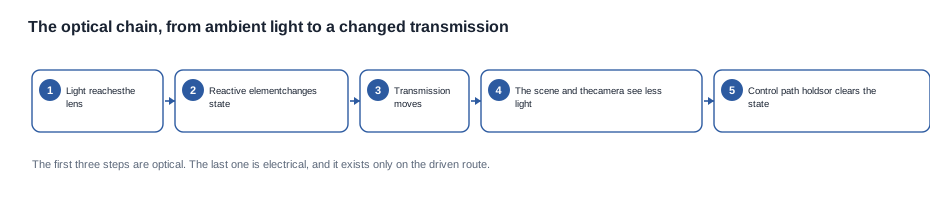
A colour-change lens is a chain with four links, and only the first three are optical. Light reaches the lens, the reactive element changes state, the transmission moves, and then — on one of the two routes in this category — a control path holds or clears that state. Understanding where the chain stops being optical is the single most useful thing a buyer can take from the mechanism, because it decides whether the product has a cell, a driver, a firmware function, a charging accessory and a battery transport file, or whether it has none of them. It also decides why two products sold under the same retail name behave differently behind a windscreen, differently in cold weather and differently when the battery is flat. This article walks the chain link by link, states what the catalogue publishes and what it does not, and connects each link to the commercial consequence a procurement team has to price.
Photochromic: two mechanisms, one lens seat
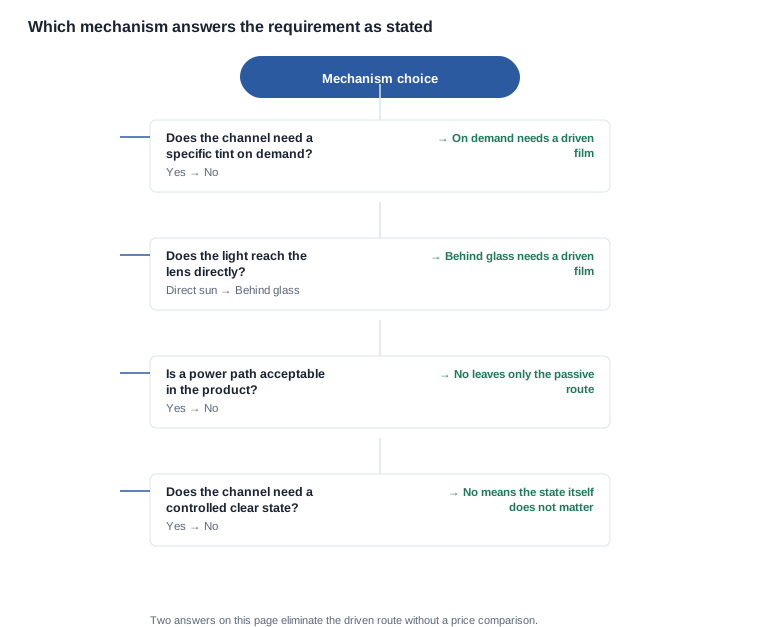
The passive route and the driven route
The first link of the chain is the trigger, and there are two of them.
On the passive route, the trigger is ultraviolet already present in the incoming light. The element reacts to it directly, the reaction is a consequence of the environment rather than a command, and the product contains no electronics dedicated to the lens. Nothing controls the tint; the light does. This is why the behaviour behind glass differs from the behaviour in open air, why the response rate falls in cold conditions, and why a passive lens needs no specification for the state at a flat battery — there is no state and no battery.
On the driven route, the trigger is an applied voltage. The element can be set to a chosen transmission, it can hold that state independently of the ambient light, and it can be commanded back to clear. That control is what a channel buys when it chooses the driven route, and it is paid for with a driver circuit, a control path, a firmware function, a charging interface and a cell.
The two routes are not versions of one product. They are different products with different bills of materials, different failure modes and different documentation obligations, and they are both sold under the retail word photochromic.
What the catalogue names
Our catalogue publishes two relevant entries. The camera platform carries the lens as a configuration alongside published rows: an 8 MP sensor, a 220 mAh cell, a rated runtime of 5–8 hours, Type-C charging, charging in two hours or less, flexible temples, three published colour options, and the colour-change lens itself. The dedicated colour-change entry publishes its own set of rows: the lens technology described as electrochromic, Bluetooth V5.4, a 100 mAh cell, charging in two hours or less, a rated runtime of about seven hours, and magnetic charging.
What is published for the lens itself is a single word in each case — a configuration on one, an electrochromic technology on the other. What is not published anywhere in the range is any performance figure: no switching time, no transmission range, no uniformity tolerance, no temperature range, no cycle life figure, no coating specification and no lens model designation. The mechanism therefore has to be understood as a chain whose links are specified by the buyer, not as a product whose specifications can be read off.
From ambient light to a changed transmission
Step one: the light that reaches the lens
The chain starts with the light that actually arrives at the lens, which is not the same as the light that arrives at the product. Three filters sit between the environment and the element, and each one changes the behaviour.
The first is the atmosphere and the surroundings, which determine how much ultraviolet is present at all. The second is any glazing between the environment and the lens — a windscreen, a window, a canopy — which removes a large part of the ultraviolet that a passive reaction depends on. The third is the lens's own coating stack, which reflects and absorbs a part of the spectrum before the light reaches the reactive chemistry.
The commercial consequence is that the specification has to name the light condition, not the environment. "Works outdoors" is not a condition, because behind a windscreen is outdoors. A condition is a statement about the light reaching the element, which is what the measurement has to be made against.
Step two: the element changes state
The second link is the chemistry. The reactive element is either a doped substrate that darkens as it absorbs ultraviolet, or a film between layers whose state is set by an applied charge. In both cases the change is a rearrangement of the material, and in both cases the rate at which it happens depends on temperature.
This is the link that explains the behaviour that generates field reports. A reactive element works faster when it is warm and slower when it is cold, and the effect is large enough at the cold end to be reported as a fault. It also explains why a figure without a temperature attached cannot be compared with another figure without a temperature attached: two numbers on the same row may be two different measurements.
For a buyer, the useful question is not what the chemistry is — the supplier will have a proprietary answer — but what form the supplier's evidence for it takes, and whether that evidence is a measurement on the finished product or a datasheet for the element before it is assembled.
Step three: transmission moves
The third link is the optical consequence: as the element's state changes, the proportion of light passing through the lens moves. This is the transmission range, and it is the characteristic that decides whether the product can be described as adapting to light at all.
Two products can both be described as changing with the light and cover completely different ranges. The range is bounded at the clear end by how much light the lens passes when the element is in its clear state, and at the dark end by how much it passes at full reaction. The clear end is the one that determines whether the product is usable indoors and in low light, and it is the one most often omitted from a published range, because the dark end is the number that presents better in a demonstration.
Step four: what the camera and the scene see
The fourth link is where a product that carries a camera departs from the simple case. The camera sits behind the same lens as the eye does, so a change in transmission in front of the camera is a change in the exposure the camera has to cope with.
The interaction has four parts, and all four are measurable. Whether the automatic exposure re-adjusts as the transmission changes, and how quickly. Whether the image is acceptable at both ends of the range. Whether the coating stack introduces flare or veiling reflections into the imaging path, which a coating is exactly where a supplier would add one. And whether a frame or a temple intrudes into the field of view in a way that becomes visible once the transmission moves.
None of these is published for any model in our range, and all of them belong in the acceptance criteria of any product that combines a camera with a colour-change lens. The combination is not two independent features; it is a coupling, and the coupling is where the field problems live.

The lens stack and what surrounds the element
The substrate and the reactive chemistry
The element is carried on a substrate, either a mineral glass or a polymer, and the choice determines how the lens is worked and how it is coated. Mineral glass is cut and polished; polymer is cast and finished. The implications for a buyer are threefold: the tooling and change cost when the lens shape changes, the machining tolerance available on the seating face, and the coating systems that can be applied.
The reactive chemistry itself sits on or in the substrate, and the supplier's position on it — whether it is proprietary, whether it is bought from a third party, and whether the element is the supplier's own or another's — determines who owns the performance evidence. That matters because the performance evidence is what the warranty claim and the listing claim both rest on.
The coating stack around it
The coating stack sits on top of the reactive chemistry, and it is the part of the lens that a customer sees. Its layers carry functions that are individually specifiable: anti-reflective performance for clarity and for camera output, scratch resistance for durability, and in some designs the tint itself.
For a procurement team this is where the specification earns its keep, because the coating is what determines the visible quality of the product and what determines whether the coating degrades. The commercial point is that a coating grade is a specification and a cost line at the same time, so it can be written into the request for quotation and held at sample stage. The two quotations that appear identical on unit price are frequently not identical on coating grade, and the difference shows up as a quality difference in the field rather than as a difference in the price.
The seat: geometry, seal and tolerance
The last part of the optical stack is the seat — the frame feature that locates the element, seals it and defines the geometry around it. The seat is part of the product rather than part of the lens, and it is assembled by whoever assembles the product, which means the frame geometry and the lens tolerance have to be compatible by design rather than by luck.
Two commercial consequences follow. A change to the frame is a change to the seat, and therefore a change to the optical position of the element and to the compatibility of whatever specification was written against it. And the assembly tolerance has a cost attached to it, because a lens that is dimensionally correct but outside the supplier's handling assumptions behaves differently in a frame than it did on a bench.

Power, driver and state on the driven route
The driver, the current and the state
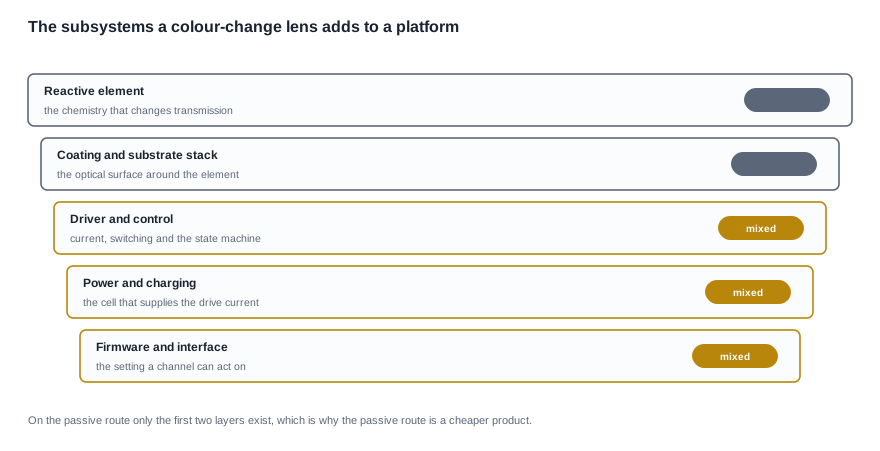
On the driven route the chain gains an electrical section, and it is worth being precise about what that section contains. A driver circuit applies the voltage that moves the element between states. A control path carries the instruction. A firmware function decides when the change happens and how the state behaves over time. A cell supplies the current. And a charging interface, magnetic on the dedicated entry in our catalogue, keeps that cell charged.
The dedicated entry publishes the numbers that describe the electrical section: Bluetooth V5.4, a 100 mAh cell, charging in two hours or less and a rated runtime of about seven hours. It publishes none of the numbers that describe the lens behaviour on that route — no state tolerance, no time to reach a commanded state, no cycle life, no temperature range. Those are the rows a buyer writes and a supplier confirms.
The control path
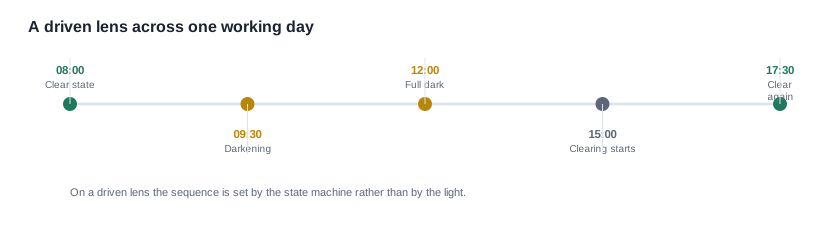
The control path is the link that determines whether the feature is a product or a setting. A lens whose state changes only on a fixed schedule has a control path that nobody uses, and a channel cannot build a claim or a workflow on it. A lens whose state can be set on demand from a connected device is a product feature, and that feature brings a protocol, an interface, a firmware behaviour and a support script.
For the driven route this is where the camera interaction becomes a real question rather than a theoretical one. If the state can be changed while the camera is running, the exposure has to cope with a change the user initiated, and if the state is on a timer, the exposure has to cope with a change the user did not initiate. The two cases have different specifications, and the buyer has to know which one is being bought before the acceptance criteria are written.
The cell, and what happens when it is empty
The last electrical link is the one that produces the most expensive field reports in this category, because it is the one nobody writes down. On the driven route the lens has a state, and a state survives a power cycle unless something is specified to change it. If the unit is flat when it is picked up, the lens is in whatever state it was last in, which may be a dark tint.
That single unspecified behaviour generates a cluster of returns that read as defects and are not. The specification row that prevents it is short: the behaviour of the lens at a flat battery, written down, applied to every unit in the lot, and consistent with the support script and the instructions. On the passive route the row does not exist, because there is no battery and no state — and that absence is one of the clearest commercial reasons to prefer the passive route when the requirement allows it.
The interfaces that decide how the chain behaves
The four interfaces that decide the behaviour
Read as a whole, the chain contains four interfaces that decide what the product actually does, and each of them is a place where a specification has to be written rather than assumed.
The light interface decides whether the trigger is present at all: how much ultraviolet reaches the element, and how much of it has been removed by glazing, by surroundings or by the coating.
The thermal interface decides the rate at which the chain responds, and it is the reason two figures on the same row may not be comparable.
The optical interface decides the range the lens covers and how evenly that range is distributed across the element, which is where the coating, the substrate and the seat all participate.
The electrical interface decides whether there is a state at all, and on the driven route it decides what happens when the power is gone.
Every figure a supplier publishes belongs to one of these four interfaces, and every figure without its interface attached is incomplete. That is the practical test to apply to any specification you receive: for each number, name the interface it belongs to and the condition it was taken under. If you cannot, the number cannot be used as an acceptance criterion, and it should be recorded as unpublished rather than carried into the comparison table.
How to verify each link of the chain
The chain is useful for verification because each link has a different kind of evidence, and a supplier who has measured the chemistry has not necessarily measured the assembly. Four steps close the chain in the order it runs:
- The trigger. Confirm the mechanism in writing and confirm the power path, if there is one. A supplier who names a brand rather than a mechanism has not answered this step, and nothing downstream can be verified until they do.
- The rate. Ask for two switching figures, one per direction, each with a light level and a temperature attached, and treat a figure without those conditions as absent rather than as incomplete.
- The range. Ask for the transmission at both ends of the range with the measurement method stated. If the supplier offers only the darkened end, ask again for the clear end — it is the end that decides whether the product is usable in the environments your channel actually occupies.
- The state, where there is one. On the driven route, ask what states are reachable, what tolerance applies to each, how a state is commanded, what happens at a flat battery and whether a state survives a power cycle. On the passive route, record that these rows do not exist rather than leaving them blank.
Then take the four steps onto the sample. The trigger is confirmed by observing a change under a stated light and recording the time in each direction. The rate is confirmed at a stated temperature. The range is confirmed by measurement on the finished unit rather than on a datasheet. The state is confirmed by commanding it and by taking the power away. Whatever the supplier has not measured, the sample protocol in how to measure photochromic smart glasses will close, and the results become your acceptance criteria rather than the supplier's claims.
Where the chain breaks and what it costs
The chain has four predictable break points, and each of them has a commercial cost that is visible before the order if somebody goes looking for it.
A trigger that is not there. Behind glass or under a filter, a passive chain never starts, and the product appears inert. The cost is a cluster of field reports from a channel the product was never suited to.
A rate that changes with temperature. A chain that works in the afternoon and stalls at the cold end produces reports that are geographically and seasonally clustered, which is exactly the pattern that gets misread as a defect in one batch.
A range that does not reach. An element that never reaches the state the specification assumed produces a product that is correct in a demonstration and wrong in a field condition, and the demonstration is the case that gets photographed.
A state with no defined end. On the driven route, an undefined behaviour at a flat battery produces a return stream that cannot be diagnosed, because the evidence required to diagnose it was never specified.
The countermeasure in all four cases is the same and it is not technical: put the condition inside the criterion. A criterion without a condition is a description of intent, and the four break points are where intent meets a working day.
The red flags for a buyer are recognisable: a switching time quoted without a temperature, a transmission range quoted without its clear end, a driven lens with no flat-battery row, and a camera path described without an exposure behaviour. Before you order, each of those is a line to be resolved rather than a number to be accepted, and the way to choose between two suppliers whose evidence is equally thin is to ask which of the four links they can measure on a sample rather than which of them has more rows.
The category background sits under photochromic lens technology, the protocol that closes the open rows is in how to measure photochromic smart glasses, and the broader product family is covered in photochromic smart glasses. The document side of a configuration change is in photochromic smart glasses certification.
If you are working through this chain for a specific configuration, send us the model designation, the route you are considering and the environments the product will be used in, and we will tell you which links of the chain the published rows already close and which ones your acceptance criteria have to close.


