
Photochromic smart glasses clarity in low light is a question with no published answer, and the reason is not that the answer is complicated. It is that the catalogue does not contain the parameter at all. There is no transmittance figure, no tint depth, no state description, no drive mechanism, no lens substrate and no illumination specification anywhere in the record for this entry. The only published fields are a Bluetooth version 5.4 radio, a 100 mAh cell, a magnetic charging method, a charge ceiling of two hours, and an endurance of around seven hours.
That absence is the answer, and it is a procurement-grade answer rather than a dead end. "The parameter does not exist in our documentation" tells you exactly what to ask, in what form, and against what acceptance criteria — which is considerably more useful than a number nobody can reproduce.
This article treats the absence seriously. It decomposes "clarity in low light" into the separate measurable questions hiding inside the phrase, explains why a qualitative description of clarity cannot be re-ordered against, sets out what the electrical rows can and cannot contribute to a dim-environment argument, and builds a test protocol that a buyer can put in front of suppliers and use to compare their answers. The aim is a defensible number by the time the first quotation is opened, not a figure to quote before one exists.
Photochromic smart glasses: the low-light parameter that is not in the catalogue
Buyers arrive at this question from one of two directions. Some are asked by customers whether the lenses are usable at night, and need a defensible answer for a retail listing. Others are trying to decide whether a product positioned for evening and interior use is being sold on a claim the supplier cannot support. Both need the same thing, which is a clear account of what is documented and what is not.
The first step is to name the confusion precisely. "Clarity in low light" is not a property of a lens. It is a property of a lens, at a stated ambient light level, in a stated state, at a stated angle, observed by a stated method, judged against a stated criterion. Remove any one of those and the phrase becomes unmeasurable, which is why it appears in listing copy far more often than it appears in a specification.
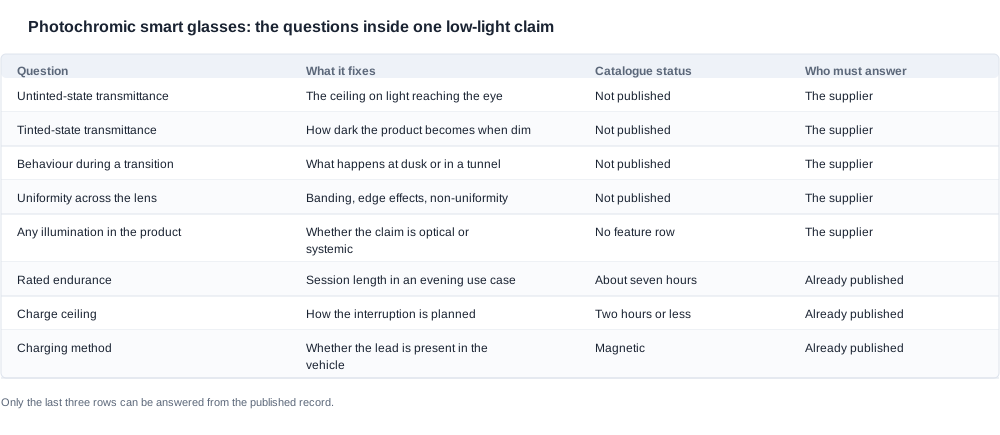
Breaking it down, a low-light claim is built from at least five separable questions, and the catalogue answers none of them individually:
- How much light passes through the lens in its untinted state. This is the transmittance of the clear state, and it is the single most important number in the whole question, because it sets the ceiling on what anyone can see through the lens in a dim environment.
- How much light passes through the lens in its tinted state. This determines how dark the product becomes in a dim environment, which is where a product can be unusable rather than merely less tolerable.
- What the lens does while it is changing state. A transition in progress is a third condition, and it is the one that matters most in the environments buyers actually worry about, because dusk and tunnels are exactly where a transition happens.
- How even the optical result is across the surface. Non-uniformity, banding and edge effects are low-contrast phenomena, and a dim environment is where the human eye is most likely to notice them.
- What else in the product affects the result. Whether the product carries its own illumination, whether the lens is bonded or framed, and whether the frame blocks peripheral light are all part of the answer, and none of them are published.
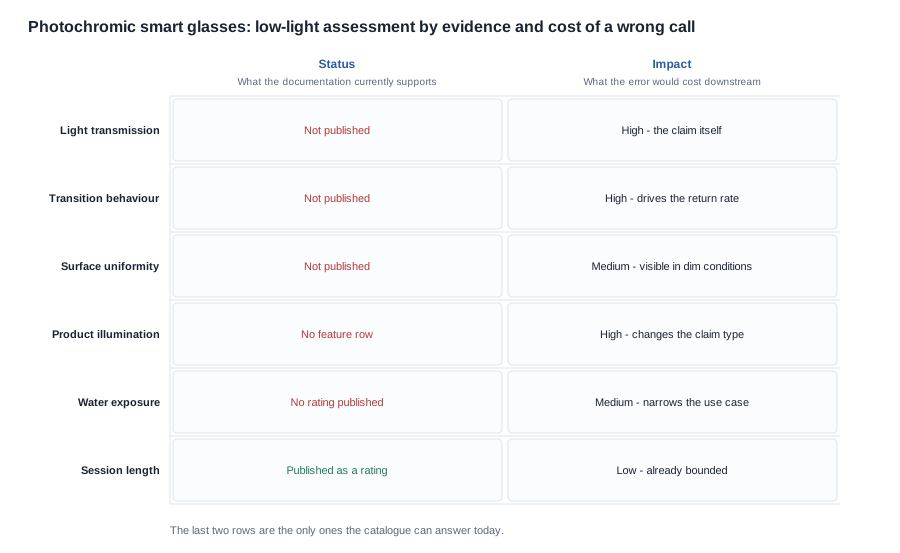
The fifth point deserves emphasis because it is where the category's data is thinnest and where the risk of an overstated claim is highest. If the product carries no light source at all, then a low-light claim is purely an optical claim about the lens, and it is a claim the buyer is making about someone else's component. If the product does carry illumination, the low-light performance is a system property that no lens datasheet can substantiate alone. The catalogue publishes no feature row for this entry beyond the electrical fields, which is consistent with a product without an illumination feature, but "not published" is not the same as "not present", and a buyer who assumes either way is guessing.
Why a qualitative description of clarity cannot be re-ordered against
Most supplier conversations about low light do not fail because the supplier is withholding something. They fail because both sides are using the same words to mean different things, and because a word cannot be put on a purchase order.
Consider the usual set of descriptors: crystal clear, good visibility, no darkening at night, pleasant in low light. Each of them is a claim about an experience rather than a measurement, and each of them fails in a different way when the buyer tries to use it.
A claim about an experience has no method attached, so two units in the same production run can both be described that way by the same person. That makes the claim useless for incoming quality control, because the acceptance test cannot be written from it. It also makes it useless for a re-order, because the buyer has no way of knowing whether the next batch meets the same description. And it is useless as a marketing line in a jurisdiction where descriptive claims about a product's performance have to be capable of being substantiated on request, which is a different problem from the ones described here but arrives on the same desk.
The discipline that fixes all of this is to require the descriptor to be replaced by a method and a threshold. Not a better adjective — a measurement. A buyer who asks a supplier to state the transmittance of the untinted state at a stated light level, with a stated measurement method, gets an answer that can be checked on a sample and repeated on a re-order. A buyer who asks how clear the lens is gets a marketing sentence.
There is a second-order reason for insisting on numbers, and it concerns the switching behaviour. A driven lens that is in the middle of a transition has an optical state that is neither of its two settled states. In bright daylight that intermediate condition is easy to overlook, because ambient light is high enough to mask a small optical difference. In a dim environment the same intermediate condition can dominate the experience, because there is no surplus light to compensate for it. The result is that low-light performance is disproportionately a question about transition behaviour and about uniformity, and neither of those is a number that appears in a catalogue.
The practical consequence for procurement is a rule worth writing into the purchase specification: no low-light claim, in any document, on any label or in any listing, without a method and a threshold. That rule is easy to state, easy to audit, and it is the difference between a product that can be re-ordered and one that can only be re-experienced.
What the electrical rows do and do not say about a dim environment
It is tempting to treat the absence of lens data as total, and to conclude that nothing in the published record is relevant. That would be wrong, and the reason it is wrong is that three of the published fields do bear on the low-light question even though none of them measures the lens.
The rated endurance of roughly seven hours is relevant because a low-light use case is a long-use case. A product that is expected to be used in evening conditions is expected to be used for a long session, and the charge ceiling of two hours or less becomes a constraint on the interruption plan. Any low-light positioning that is not paired with an endurance plan is a positioning claim without an operating model behind it.
The magnetic charging method is relevant because a low-light product is very likely to be used in a vehicle, and a vehicle is the environment where the charging lead is most likely to be absent and where the charge interruption is most disruptive. The proprietary lead becomes a logistics line rather than a detail.
The Bluetooth version 5.4 radio is relevant in a narrower and more useful way. A radio connection is how a driven lens is commanded in many designs, and a radio that is busy, out of range or trying to reconnect will change the behaviour of the lens state precisely while the wearer is passing between two lighting conditions. A product whose lens state depends on a radio link behaves differently in a tunnel than in a car park, and that difference is a low-light property even though it is not an optical one.
What none of the published fields can do is establish anything about the optical result. The catalogue does not state how the lens behaves in a dim environment, whether the state is driven automatically or on command, what happens during a transition, or whether any illumination is provided. A buyer who builds a low-light argument on the electrical rows alone is building it on the wrong foundation, and the argument will not survive a customer who measures it.
There is one more published fact worth holding on to, and it is a boundary rather than a capability. An ingress rating appears against two products elsewhere in our range - the V06 and the S7 - while this entry carries none, so no water, sweat or rain claim may be attached to it. For a category whose natural low-light territory includes outdoor evening use, that constraint is commercially significant: it removes the option of positioning the product for conditions where the lens may be exposed, and it means the low-light story has to be told for dry indoor and in-vehicle environments only. The market-access note covers the documentation side of the same entry, and the same discipline applies there: nothing may be claimed that the supplier has not put in writing.
Turning an absent parameter into a written test protocol
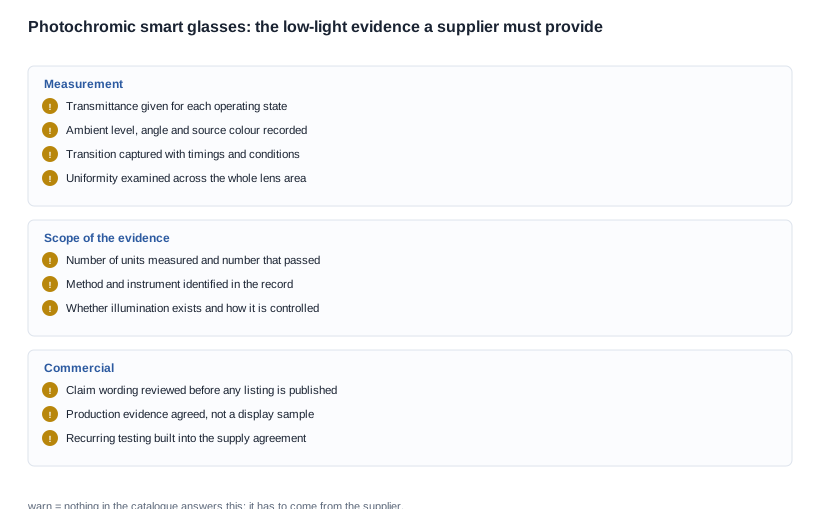
The single most useful move a buyer can make in this category is to define the acceptance criteria before the quotations arrive, and then let suppliers quote against a criterion they did not write themselves. A supplier who is asked to meet a clear acceptance protocol has to produce a measurement; a supplier who is asked how clear the lens is produces a description. The protocol has five stages, and each stage answers a different question.
- Set the ambient condition and record it. The illuminance at the lens plane, the angle of the source, and the colour of the source are all recorded with a meter, and the recording is attached to the result. A dim room lit by a single warm lamp and a dim room lit by a cool overhead panel are different tests, and a result is meaningless without the setting.
- Record the settled states. The untinted state and the tinted state are measured separately, each with the ambient condition stated. If the product has more than one operating state, each is measured. The result is a set of numbers rather than a single impression.
- Record the transition in the same environment. The lens state is captured at fixed intervals while the ambient condition changes, with the timing of the change recorded. This is the stage that exposes most of the practical problems, and it is the stage a supplier is least likely to have run.
- Record the uniformity of the result. The optical result is examined across the full area of the lens rather than at one point, and any visible non-uniformity, banding or edge effect is documented photographically under fixed exposure settings.
- Record the method itself. The instrument, the geometry, the number of units tested and the number of units that passed are all part of the record. A protocol that does not state how many units were measured is not a protocol.
A sixth element sits outside the measurement and belongs in the contract: the number of units in a production run that must meet the criterion, and the evidence the supplier will hold that they did. Without it, the protocol is a sample test rather than a quality control, and the total cost of a mismatch lands on the importer at the point where the goods are already in the channel.

The questions to ask a supplier, in order, are therefore short and mechanical. What is the transmittance of the lens in each operating state, measured how and at what ambient level. What is the state during a transition, and how long does each transition take under that ambient level. What uniformity evidence exists for the lens surface. Whether any illumination is provided, and if so, how it is controlled. And whether the supplier is able to run the protocol above on a production unit and issue the record, because a supplier who can only produce the numbers for a display sample has not answered the question a buyer needs answered.
There is a third option when the supplier cannot measure, and it is worth understanding before the negotiation gets stuck. The measurement can be commissioned independently, on a sample the buyer has bought, and the result can be attached to the buyer's own specification. This has three consequences worth weighing. It costs money that the supplier has declined to spend, and a supplier who will not spend it is telling you something about how much confidence they have in the result. It produces a record the buyer controls, which is worth more than a summary the supplier controls. And it removes the measurement from the commercial negotiation entirely, so the remaining negotiation is about price and lead time rather than about evidence.
The trade-offs are real. An independent measurement characterises the product as it is today, from one sample, and it does not bind the supplier to anything in the future. It also costs calendar time, and in a launch schedule that time competes with everything else. What it does buy is certainty about the one product attribute on which the whole low-light proposition depends, which for a product that has to be listed, shipped and defended in a dozen markets is usually worth more than the schedule it delays. The decision about when to choose it is a normal one for a buyer to make, and the criteria above — whether the supplier will measure, and what the number changes about the claim — are the right ones to make it on.
Writing the claim once the numbers finally arrive
Suppose the protocol has been run and the numbers exist. The last stage of the work is turning them into a claim, and this is where a great deal of avoidable exposure is created.
A claim about low light is a derived claim: it is the result of a method applied to a sample under stated conditions, and its meaning depends entirely on those conditions being reproduced in the wording. The three rules below are enough to keep it defensible.
- Say what was measured, not what it felt like. The wording should carry the state, the ambient level and the method, so that a reader — including a market surveillance authority — can tell what the number refers to. A number without its condition is a claim with a hole in it.
- Say which units it applies to. If the measurement covers a sample rather than a production run, the claim should reflect that. A production claim needs a production evidence base, and the buyer should establish what that base is before the claim is written, not after.
- Do not extend the claim to environments the test did not cover. A result obtained in a dim interior does not support a claim about a dim exterior at a different ambient colour temperature, and the temptation to generalise is exactly where the legal risk sits.
The commercial side of the same discipline is straightforward. A supplier who can produce a low-light characterisation has a real advantage in a category where almost nobody can, and that advantage is worth paying for — it is the difference between a product that can be listed with a performance statement and one that can only be listed with a general description. The trade-off the buyer is making is between the cost of the measurement and the cost of an unsubstantiated claim, and for a line extension sold in volume the second cost is very much larger. Buyers should ask what to ask in a way that makes the supplier's own qualification the deciding factor rather than a claim made in a sales conversation, and should weigh a supplier's willingness to be measured against the price difference before ordering.
Our own position on the evidence is the same as it is everywhere else in this category. For this entry our catalogue records five fields and nothing beyond them — a Bluetooth version 5.4 radio, a 100 mAh cell, a magnetic charging method, a charge ceiling of two hours, and an endurance of around seven hours — and nothing at all about the lens. We do not hold a low-light transmittance figure, a uniformity measurement or a transition record for this entry, and we will not substitute a figure from another product or a general industry range. What we can do is set out the protocol above, and the selection note covers the rest of the sequence from the first question to the sample order. If you are assessing this product for evening or interior use, tell us the environment and the claim you intend to make, and we will tell you which part of the photochromic smart glasses clarity in low light question the published record can support and which part has to be measured before you write anything down.


